
Valery Basanets
1941— Brody, Lviv region (Ukraine). Lives and works in Odesa (Ukraine)
One of the leading representatives of the Odesan unofficial art scene from the 1960s to the 1980s, Valery Basanets is a painter, graphic artist, sculptor, theorist, member of the Union of Artists of the USSR, and Honored Artist of Ukraine (2009). His artistic style was influenced by postimpressionism, abstraction, and surrealism, while his artworks are characterized by a contemplative approach; a tendency toward metaphysical imagery; warm, whitewashed colors; and broadly geometric forms.
Basanets was born on January 11, 1941, in Brody to a military family. In 1963 he graduated from the Odesa Art School, where his teachers were the painters Yevhen Zheltiakov and Volodymyr Puteiko.
In the late 1960s, Basanets met his future wife, art critic Tetiana Basanets, who shared his worldview and become his close associate. Later, she became a well-known researcher of Odesa’s unofficial art scene. In 1971 the couple had a son, Luka, who also became an artist.
By the mid-1960s, Basanets, along with his friends from the Odesa Art School Volodymyr Strelnikov (b. 1939), Oleksandr Anufriiev (1940–2024), and Viktor Maryniuk (1939–2025), formed the core of the informal community of unofficial artists in Odesa. The group would come together as a whole in the apartment of the married couple Oleksandr Anufriiev and Marharyta Zharkova, where the young artists began to organize exhibitions. In the 1970s, apartment exhibitions became a regular occurrence and took place in the homes of not only artists but also scholars, musicians, and collectors.
Connected to the powerful local tradition of early twentieth-century modernism, these artists obtained information from the foreign literature departments of Odesan libraries, in addition to the pages of magazines that came to the city via sailors on foreign ships. Basanets was especially influenced by the texts of the existentialists Jean-Paul Sartre and Albert Camus that were published in the USSR; by films of Antonioni, Fellini, Bergman, and Buñuel; and by a 1961 exhibition of works of the Italian artist Renato Guttuso in Moscow. Other influences on the artist’s development included Vincent van Gogh, Paul Cézanne, Maurice de Vlaminck, Georges Seurat, and Odilon Redon, as well as examples of Byzantine and Old Russian iconography, and paintings by Rembrandt, Zurbarán, El Greco, and Uccello. Among his older contemporaries, an important role was played by Odesan artists Oleh Sokolov (1919–1990) and Yurii Yegorov (1926–2008), and also by the Moscow-based nonconformist artist Vladimir Yakovlev (1934–1998).
Basanets placed his own spin on abstract art, refracting the latest European trends through a classical lens. His early figurative compositions already stood out for their subtle melancholy and emotional content. When working mainly in the genres of landscape and portraiture, Basanets created his own version of surrealist painting, balancing on the edge of dream and reality and the real and the ephemeral, which, in its own way, accurately conveyed the reality of the late “stagnation era” of the Soviet Union. [1] In his work Листопад [November] (1966), he achieves the ghostly effect of uncertainty and slippage by placing an image from a Renaissance portrait (possibly by Pinturicchio) in the very real environment of a Soviet city with its recognizable features: a bright Продукти [Groceries] sign, the windows of five-story buildings, and a passerby holding a child with a violin. In the landscape Архітектонічний мотив [Architectonic Motif] (1971, ZAM 2013.006.006) from the Zimmerli collection, an urban motif is transformed into the fragment of a dream or delusion created through the artist’s use of color and the gloomy, frozen desolation of the geometric forms.
Basanets’s individual style took shape in the 1970s. His work from this time consists mainly of silhouetted images that combine the figurative and the abstract, solved in a subtly nuanced, often ocher palette. A person dissolves into the landscape, becoming almost ethereal; the air both pierces and unites objects and space. The artist brings this artistic energy into works with socialist realist themes. For example, the painting Будівельники [Builders] (1974) depicts working people constructing a new future. However, the landscape lends the image a sense of uncertainty and unrealism owing to its metaphysical nature (arches disconnected from their base, the too-brightly colored uniforms of the workers, and a lonely figure in the distance).
Due to the complexity of his painting technique and its subtle nuances in tone, the content of his works does not reveal itself immediately; Basanets helps us understand it through specific hints: the gestures of the people depicted, their mysterious expressions, and the state of the landscape. The artist combines similar compositional techniques, in which human figures always either move toward the viewer or remain in close proximity to one another, thus both inviting the viewer into their company and at the same time alienating them in the way the figures concentrate on themselves. This type of semantic underpinning encourages viewers to independently reflect upon and understand their own impressions of the artworks. The monochromatic painting surface, silhouettes, iridescent tones, openness, and detachment of the characters reflect a reality based on the principles of theater. In Basanets’s art, the characters and their surroundings can be understood through the lens of performance; rather than representing the gradual unfolding of a story, instead they operate as a prologue that reveals to the viewer the whole story. The titles of the artist’s works from the 1970s and 1980s sometimes reveal their hidden plots—for example, in Ті, що йдуть назустріч [Those Who Walk Toward], Слухаючи [Listening], and Розмовляючи [Talking].
Among the works created by Basanets in the 1970s, a special place is held by Портрет художників Олександра Ануфрієва, Володимира Стрельникова, Віктора Маринюка [Portrait of the Artists Oleksandr Anufriiev, Volodymyr Strelnikov, and Viktor Maryniuk] (1975, collection of Anatolii Dymchuk, Odesa). Painted in oil on wood, the painting references Renaissance portraits in its technique, while it immortalizes the images of the author’s friends and associates, two of whom would move abroad a few years later. In maintaining a certain figuration and conveying recognizable features, the artist deprives the image of weight and density by composing the forms of dots and brushstrokes that glow like grains of sand in the sunlight. This mirage is balanced by a central pyramidal composition that underscores the unity of the artist friends.
Valery Basanets took part in several international projects that were milestones in the recognition of Odesa’s informal art scene, including the famous exhibition Сучасне мистецтво з України [Contemporary art from Ukraine], held in 1979 in Munich, London, Paris, and New York, and the exhibition Три покоління українського мистецтва 1960-х–1980-х [Three generations of Ukrainian art of the 1960s–1980s] (1990, Kyiv-Odense). The artist’s first solo exhibition took place in 1980 in Odesa at the Museum of Western and Eastern Art, where he exhibited about forty works.
Recognition of Valery Basanets and the artists of the informal Odesan art scene began in the post-perestroika period. He began to take active part in exhibitions and to receive awards. In particular, Basanets was the winner of the Grand Prix of the international biennale Impression-89 in Ivano-Frankivsk and the laureate of the biennale of Ukrainian fine arts Lviv-91: Revival (1991). During this time, artworks by Basanets were dominated by female images, metaphorical or otherwise, although they were compositionally related to the portraiture tradition; examples are Untitled (1990) and Модель [Model] (1992).
In independent Ukraine, representatives of the unofficial Soviet art scene from different cities began to unite and form collectives. Basanets became one of the founders of the Човен [Choven Group, Boat from Ukrainian] (1993) and the Мамай [Mamai] Creative Association (1998) [2].
In the 2000s and 2010s, Valery Basanets increasingly turned to pure abstraction, his images dissolving into a haze. He worked a lot in sculpture, developing his distinctive geometrized forms of the human figure.
In 2023 the Odesan sculptor Mykola Khudolii made an enlarged copy out of artificial marble of a sculpture made by Basanets in the collection of the Odesa National Art Museum (ONAM): Комфорт [Comfort] (2001, plaster). This copy was used for the grave of Oleksandr Roitburd (1961–2021), artist and director of the ONAM.
Oksana Barshynova
Translated from Ukrainian by Nathan Jeffers
Notes:
1. Used to describe the Brezhnev period, i.e., the mid-1960s to the early 1980s.
2. Cossack Mamai is a famous Ukrainian folklore character often featured in folk paintings and songs.
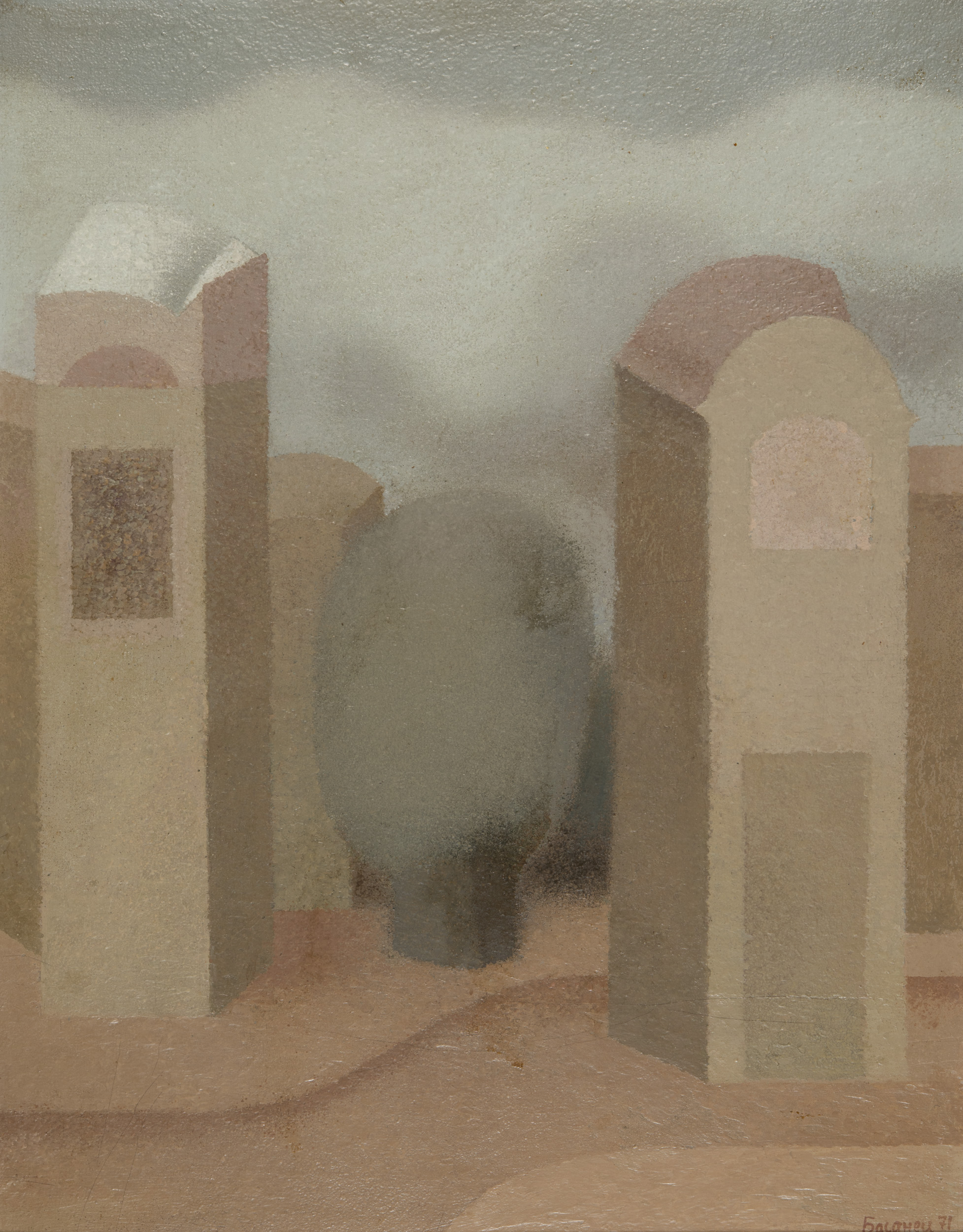
Architectonic Motif, 1971. Oil on fiberboard, 56 x 43.7 cm (22 1/16 x 17 3/16 in.). Norton and Nancy Dodge Collection of Nonconformist Art from the Soviet Union. 2013.006.006

The Walkers, 1984. Ink on paper, 29.8 × 20.9 cm (11 3/4 × 8 1/4 in.). Norton and Nancy Dodge Collection of Nonconformist Art from the Soviet Union. D15720