
Valda Batraks
(a.k.a. Valda Mikāne, Valda Mikane-Batraks)
1953 — Malta, near Rēzekne Municipality, Latvia. Lived and worked in Riga (Latvia), currently works in Riyadh (Saudi Arabia)
Valda Batraks’s father, Broņislavs Pavlovskis, taught drawing and technical drawing, and her mother, Valentīna Pavlovska, taught mathematics and physics. The artist remembers that her family’s home was located near the Malta church. In Latgale, the influence of the Catholic church has always been strong. Although it was dangerous during the years of Soviet rule, much of her father’s painting was for the needs of the church and, on the advice of the local pastor, other churches also sought his assistance, both to restore old paintings and to create new works. Valda helped him with these tasks. When her father painted a work for Malta’s church, he entrusted her with painting lilies for the composition. His guidance and encouragement sparked a love of drawing that Batraks feels to this day. [1]
While Valda was still a little girl, her father took her to the State Hermitage Museum in Leningrad (now Saint Petersburg), where together they became acquainted with the works of the old masters. He showed Valda’s drawings to Vladimirs Kozins (1922–2023), a professor at the Art Academy of Latvia, who one summer included Valda, still a teenager, with a group of academy students for summer practice near Rēzekne. After graduating from Malta Secondary School in 1971, Batraks moved to Riga to study at the Latvian SSR State Academy of Art. However, as her basic knowledge of art was insufficient, she attended the academy’s preparatory courses, where in the evenings she studied drawing, painting, and composition under painters Edvards Grūbe (1935–2022) and Inese Ziemele (b. 1943), and by day she worked as a typist in the academy’s office.
In 1973 Batraks entered the Department of Industrial Arts of the Academy (now the Functional Design Section of the Design Department), graduating in 1978 with a diploma in Subtitles for Latvian Television, under the supervision of the graphic artist Aleksandrs Dembo (1931–1999). After graduating, she more consciously decided to be a graphic artist, working in lithography and etching techniques, while also working as an artist-designer.
In the early 1980s she designed invitations, diplomas, gift wrap, greeting cards, and posters as Valda Mikāne. Her contribution was important for developing the corporate styling and some of the packaging for the confectionery factory Uzvara for both domestic and export markets. Most of the sweets produced in Latvia during the years of Soviet rule were exported to other republics of the USSR, where their high quality and artistic design made them very popular.
After the restoration of Latvia’s independence, for more than 15 years Batraks collaborated with Latvijas Pasts, Latvia’s postal company, whose artistic postage stamps sought to represent the image of Latvia around the world. She created a postage stamp and envelope design for the series Christmas (2001), while for the series Europe she designed the stamps Circus (2002), Riga Towers (2003), Holidays (2004), Gastronomy (2005), Museum of the History of Riga and Navigation (2006), 800 Years since the First Riga Penny (2011), and Jānis Misiņš (2012).
Batraks has participated in exhibitions with her graphic works since 1979. These included etchings and lithography, all of which were created in the Experimental Workshop of the Art Foundation of the Latvian SSR. [2] There was a creative atmosphere there, which was important for a newcomer with a design background. She received support from experienced colleagues Vladislavs Grišins (1937–2023), Baņuta Ancāne (1941–2024), and Artūrs Ņikitins (1936–2022), and advice from the master printer Laimonis Lejnieks (1916–1989). She developed creative friendships with Lilija Dinere (b. 1955) and her mother, poet Cecīlija Dinere (1919–1996), poet Māris Čaklais (1940–2003), and composer Vineta Līce (b. 1955). In her early prints such as And Dance (1984, ZAM, D02415), From a Fairy Tale (1981, ZAM, D02416), Mountains (1981, ZAM, D03658), and Evening Games (1982, ZAM, D03659), the artist addressed the theme of the mother and child, in associative and emotionally saturated fixations of intimate moments of reflection, aware of the fragility of relations between people. Batraks was able to create a visionary atmosphere. Changes in emotional states helped the artist discover the image of a bird or groups of generalized female figures in some unspecified environment. The strength of her prints is in their fine, flowing, twisting lines, which create sometimes grotesque, sometimes gently resigned associations.
Batraks has always been interested in drawing, a technique that gives the opportunity to work with both a single line and dense, velvety areas in charcoal, which she employed in the early 1980s. In the 1990s she surprised everyone with several cycles of large-format drawings about the Latvian state and people at important moments in history. Many of her colleagues, including graphic artists Juris Petraškēvičs (b. 1953), Ināra Garklāva (b. 1957), and Malda Muižule (1937–2022), had also turned to a symbolic depiction of past events, each creating their unique interpretations. Batraks, however, stood out for her technique. She was one of the first Latvian artists to rediscover color drawing, and its selection was fully justified. With exquisite color transitions and balance, she achieved tonal saturation and pictorial effect. Metaphorically, these illustrated the flow of time and the connection between the present and the past. Batraks’s more recent work picks up on these expansive ideas, mixed with introspection: “My art engages deeply with archetypes and the principles of uncertainty. Through abstract forms, imaginative thinking, and metaphor logic, I reflect on the complexities of the psyche and invite viewers to explore connections between their inner and outer worlds.”
Batraks has received numerous accolades, including for her postage-stamp design: honorable mention, World Heritage Series Postage Stamp Design Contest (Tokyo, Japan, 2003); Parchemin d’Honneur for contributions to the development of Contemporary Art, 4th Triennale Mondiale d’Estampes Petit Format (Chamalières, France, 1997). She has been a member of the Artists’ Union of Latvia since 1984. In 2023, Batraks created the brand ValdaFortunata, offering T-shirts, fine-art prints, tapestries, mounted aluminum prints, and mounted acrylic prints, as well as accessories.
Batraks’s works are in the collections of the Latvian Artists’ Union Museum; the Latvian National Museum of Art; the Boris and Inara Teterev Foundation, Riga, Latvia; Karlskoga Municipality, Sweden; Caves Art Center, Taipei, Taiwan; and Chan Liu Art Museum, Taipei, Taiwan; as well as in private collections in Latvia and abroad.
Irēna Bužinska
Translated from Latvian by Philip Birzulis
Photo: 2006, from Valda Batraks’s personal archive
Notes
1. ARTisSpectrum: Chelsea Perspective 18 (2007): 34.
2. Established in 1957, the Experimental Workshop existed until the end of 1994, when the public organization Graphics Camera was created, which took over the management of the workshop with the aim of preserving the opportunity for artists to work in classic drawing techniques and continue the Latvian graphic art traditions.
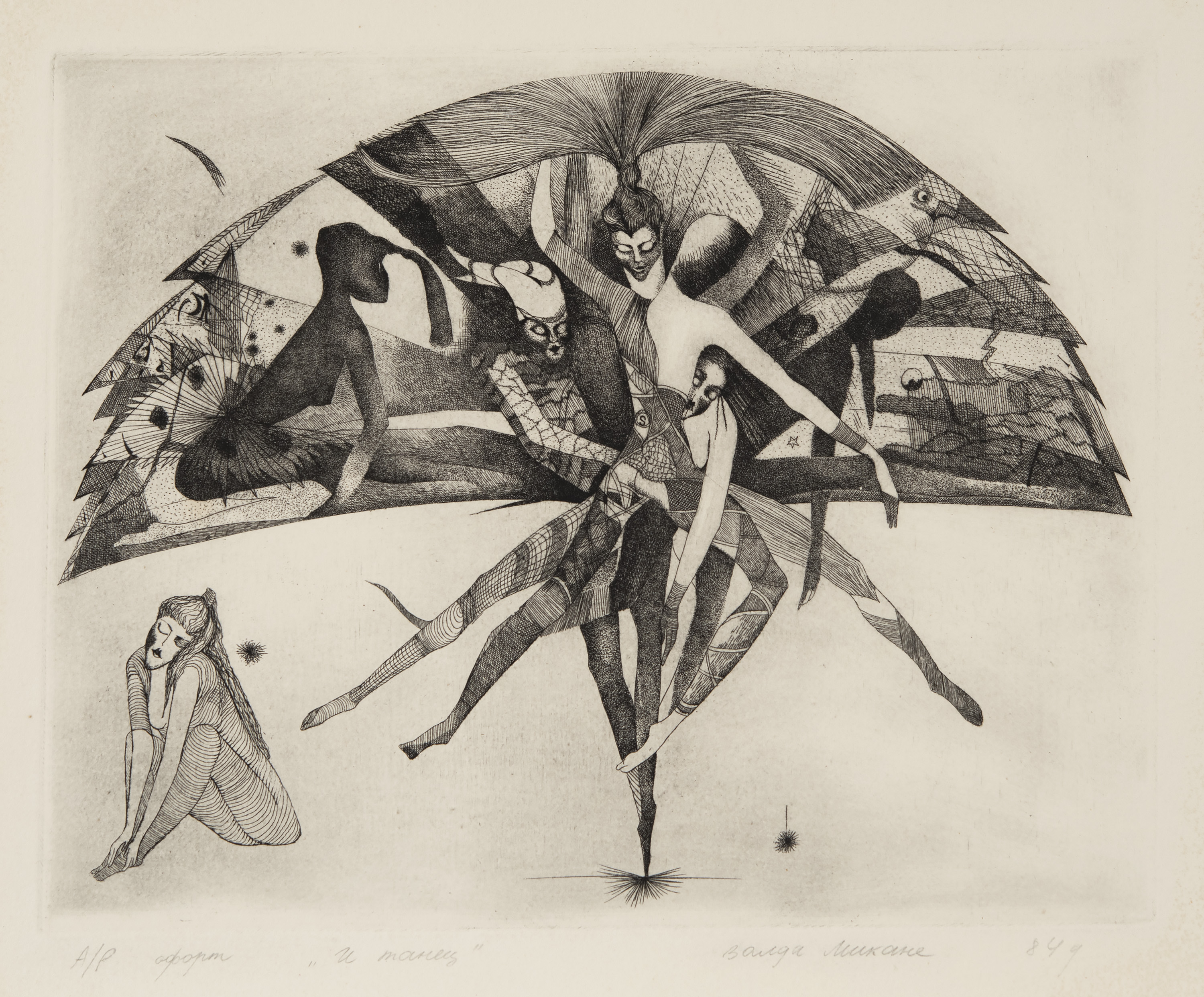
And Dance, 1984. Etching on paper, 23.9 x 29.8 cm (9 7/16 x 11 3/4 in.). Norton and Nancy Dodge Collection of Nonconformist Art from the Soviet Union. D02415
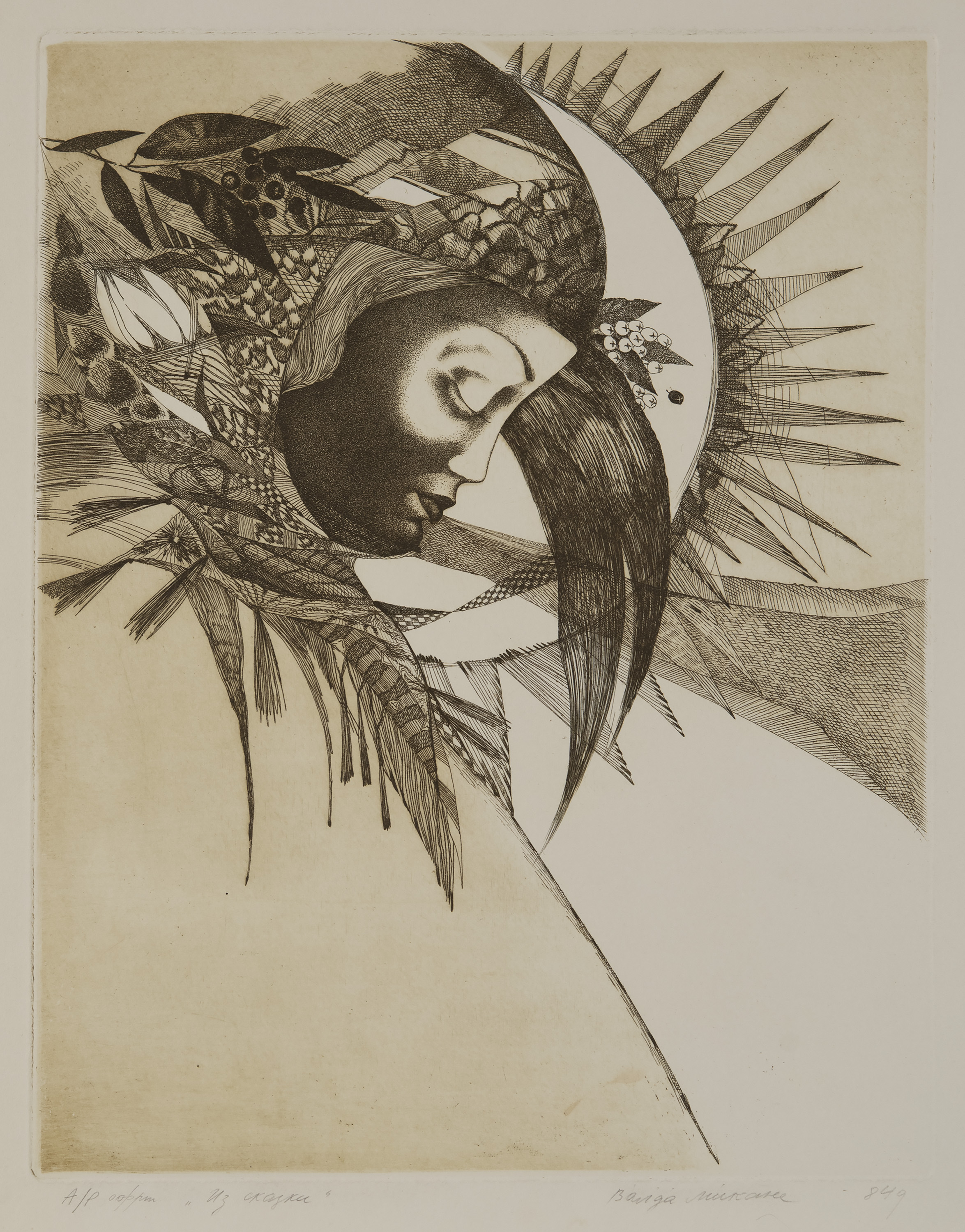
From a Fairy Tale, 1984. Etching on paper, 38.6 × 30.8 cm (15 3/16 × 12 1/8 in.). Norton and Nancy Dodge Collection of Nonconformist Art from the Soviet Union. D02416
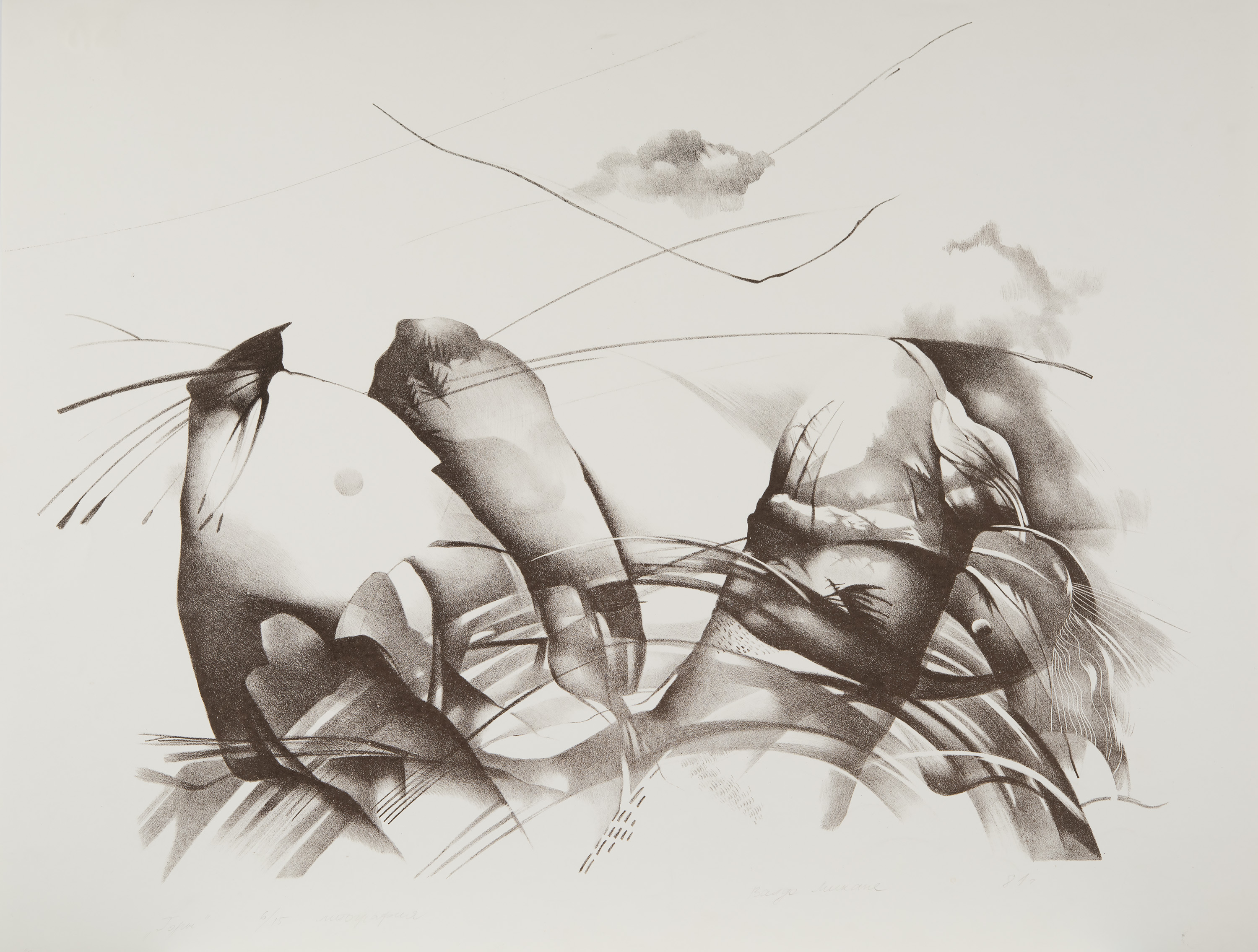
Mountains, 1981. Lithograph on paper, 56.9 × 72.2 cm (22 3/8 × 28 7/16 in.). Norton and Nancy Dodge Collection of Nonconformist Art from the Soviet Union. D03658
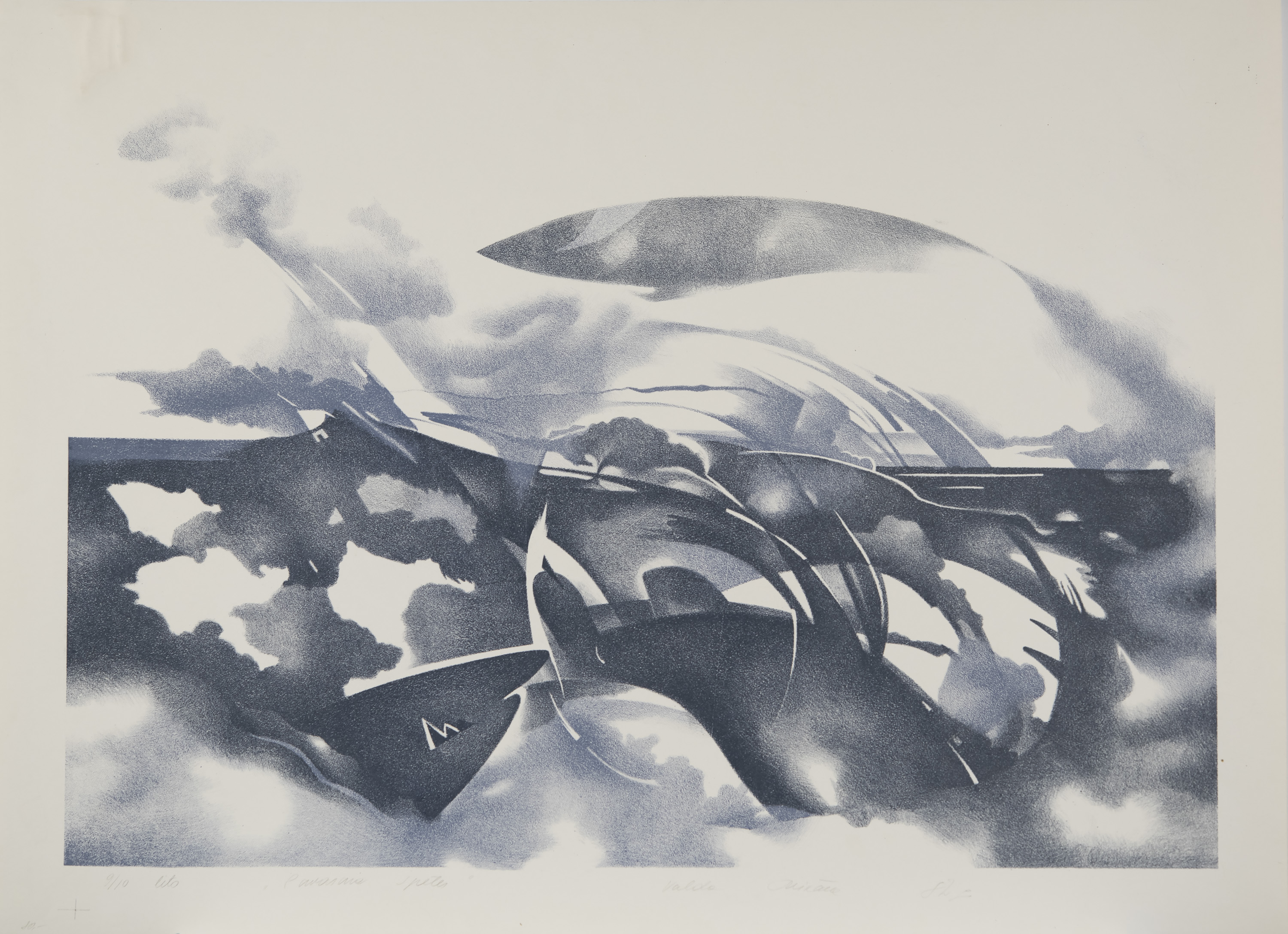
Evening Games, 1982. Lithograph on paper, 45.9 × 65 cm (18 1/16 × 25 9/16 in.). Norton and Nancy Dodge Collection of Nonconformist Art from the Soviet Union. D03659