
Tymofiy Liashchuk
1930 [1] — Obolon, Poltava region (Ukraine) | 2015 — Kyiv (Ukraine). Lived and worked in Kyiv (Ukraine)
Tymofiy Liashchuk was a Ukrainian graphic artist, painter, and illustrator, widely known in Soviet times as a leading master of political and social posters in the socialist realist style. Throughout the second half of the twentieth century, he created film and theater posters, as well as oil, watercolor, and gouache paintings and drawings in a poetic realist style. In the late twentieth to the early twenty-first century, he continued to demonstrate his mastery of watercolors and oils in landscape, portrait, and historical painting. from 1958 on he was a member of the Soviet Ukrainian Union of Artists (Now National Union of Artists of Ukraine), and he was named an Honored Artist of Ukraine in 1969.
In 1946 Liashchuk entered Kyiv Art Secondary School (now the Taras Shevchenko State Art School), where he studied with the renowned teachers Olena Yablonska and Yevhen Volobuiev. Immediately after graduating in 1951, he passed the entrance exams to the graphic department of the Kyiv State Art Institute in Kyiv (now the National Academy of Fine Arts and Architecture), where he completed his studies in 1957 in the poster art workshop, which was headed by the leading Ukrainian graphic artist, Vasyl Kasyan (1896–1976).
Liashchuk was just a young man when, in 1948, the Central Committee of the Soviet Union Communist Party issued a resolution “which directed poster artists and workers of publishing houses and printing houses to further raise the ideological and artistic level of poster production.” [2] This resolution by direct order of Stalin raised the prestige of the profession of poster artist considerably. Within the context of the Cold War that had begun between the USSR and the West, the Communist Party tried to make poster art a powerful ideological weapon in the struggle for communism. Thus, the generation of poster artists who graduated from art universities in the second half of the 1950s was given this task. It is not surprising that after his sixth year at the Art Institute, Liashchuk defended his diploma with five political posters created under the theme “Glory to the Young Communist League (five medals of the Komsomol [Communist youth movement]!)”
Liashchuk’s chosen topic for his diploma played a decisive role in his immediate admission to the Union of Artists of the Ukrainian SSR in 1958, bypassing the two-year candidate status required by the union’s charter. From then on, he participated in all annual republican and all-union exhibitions of the Union of Artists of the Ukrainian SSR and the USSR with his posters, watercolors, and drawings.
While still a student, Liashchuk began working as a freelance artist at the State Publishing House of Fine Arts and Musical Literature in Kyiv (now Mystetstvo State Publishing House), where his political posters were periodically published from 1954. The Dodge Collection includes two such posters—Механізатори! Виконаємо рішення партії! [Mechanizers! Fulfill the Party Decisions!] and Затримаємо! [We Will Hold It Back!] (both 1955, ZAM, D10493, D10492)—which heroize the resilience and preparedness of collective farm workers who embrace excessive workloads and harsh weather conditions as their patriotic duty. Liashchuk was already one of the leading masters of Ukrainian Soviet poster art by 1959, when he was appointed head of the editorial board of the newly created Агітплакат (Agitation Poster) art workshop of the Union of Artists of the Ukrainian SSR. He served in that post until 1972. Under his direction, the workshop produced purely political posters as well as posters of high artistic quality.
Liashchuk’s teaching career began in 1964 when Vasyl Kasyan, head of the department of graphics at the Art Institute, asked him to head its poster art workshop. Liashchuk received the title of associate professor in 1966 and became a full professor in 1979.
At the same time, he was actively involved in his civic duties as a member of the board of the Union of Artists of the Ukrainian SSR and its Kyiv branch, as a member of the Art Council of Mystetstvo Publishing House, and as chairman of the Art Council of the Ukrreklamfilm factory. He was awarded the Certificate of the Presidium of the Supreme Soviet of the Ukrainian SSR in 1967 and named Honored Artist of Ukraine in 1969.
From the 1950s to ’80s, the artist created about three hundred political, social, and agricultural posters in a socialist realist style, which were regularly awarded prizes and diplomas at republican and all-union art competitions. The vast majority of them embodied Soviet propaganda narratives, using oft-repeated phrases to extol the achievements of “the Soviet people in the construction of socialism” and “in the struggle for peace throughout the world.” The posters affirmed the ideas and decisions of the Party and the government, and called, in one form or another, for “the bright future of mankind—communism.” These posters were printed in millions of copies and were known both in Ukraine and throughout the USSR.
Liashchuk’s highly professional posters are characterized by a concise pictorial language with moderate decoration, a dynamism and sharpness in their composition, and a monumental simplification of form set against a graphically interpreted flat background. He invariably depicted his heroes as young, active, courageous, “full of joyful, triumphant optimism,” [3] and often illuminated by the sun against great expanses of land under a vast sky, as in Молодь борись за великий хліб України! [Youth, Fight for the Great Bread of Ukraine!] (1961); Слався свято врожаю! [Glory to the Harvest Holiday!], (1965); and Радянська славна Україно, будь преславна з роду в рід! [Glorious Soviet Ukraine, Be Glorious from Generation to Generation!] (1967).
In the 1960s and ’70s, Liashchuk also created theater posters (e.g., Othello and Cassandra [both 1971]) and numerous film posters for cult Soviet feature films from that period. V. Tseltner notes: “[Liashchuk], when watching the works of cinema to which his posters are dedicated, first of all sees the history of human characters, the embodiment of dramatic destinies. . . . For him, the meaning of the film is associated with the image of the protagonist and is embodied by him.” [4] The artist’s posters successfully reveal the dramaturgy and stylistic language of the films in question: “It is in cinema and theatrical posters that Liashchuk expresses his love for history, for literature. He ‘feels’ very precisely—because he knows the era to which the performance or film belongs, he knows how to convey this feeling.” [5] Liashchuk’s film posters include Hamlet (1964); A Wedding in Malinovka and The Brothers Karamazov (both 1965); Evening on the Ivan Kupala (1968); The White Bird with a Black Mark and Zakhar Berkut (both 1971); King Lear and Taras Bulba (both 1972); Lost Letter (1973); Red Rose (1974); and Romeo and Juliet (1975).
The artist’s drawings of the 1950s–70s demonstrate a loyalty to the classical traditions of academic drawing and painting, maintaining a traditional naturalism but elevating everyday motifs to poetic images. Examples include Shevchenko Street in Kanev after the Rain (1952); Cossack (1953); Cherkasy (1955); Oksana (1974); Chestnut Alley and Sedniev. In the Courtyard of the House of Creativity (both 1975); and Sedniev Trees and Tamara (1977).
Liashchuk’s watercolors from the second half of the twentieth century are executed with a clarity, plasticity of form, and subtlety of mood. He began painting watercolors in his school years, when they were repeatedly exhibited at republican and all-union exhibitions. With its inherent transparent quality and purity of tone, watercolor shows another side of the artist’s work. In his poster art Liashchuk adhered to the socialist realist style with its strict rules, but in watercolor painting he was able to express his creative individuality through the style of poetic realism, as in View of Podil from the Art Institute (1951); Old Intellectual (1952); Liuba from Tahancha (1953); Evening on the Sula (1962); From My Window (1964); Lesia and Oksana with a Flower (both 1974); Old Linden, Horses in the Meadow. Mokoshin Village, On Vacation, and Portrait of a Ballerina (all 1975); and Portrait of a Mother (1999). These works reveal the immediacy of his feelings and his reflections on life. It is these watercolors, whether landscape or portrait, that demonstrate his mastery as an artist.
Liashchuk left his teaching post at the Art Institute in 1994 and devoted himself primarily to oil painting. His work from these years is distinguished by genre diversity and a wide thematic range, including historical paintings such as На Кафу здобувати славу [To Gain Glory in Kaffa] (2006); self-portraits and portraits of relatives like Ой, не ріж косу [Oh, Don’t Cut Your Braid] (1997) and Self-Portrait (2005); and urban and rural landscapes such as Прощавайте чорнобильські озера [Farewell, Chornobyl Lakes] (1992) and Зима на Курганівській [Winter on Kurhanivska] (1999), where the artist seeks a harmonious fusion of his inner world with the surrounding reality, as well as Самотність [Loneliness] (2003) and Помаранчеві дні [Orange Days] (2004).
The artist conveys the moods of nature in works including Реве та стогне... [Roars and Groans…] (1997) and creates portrait images of historical figures who are spiritually close to him in paintings such as 110-й Великдень Петра Калнишевського [The 110th Easter of Petro Kalnyshevskyi] (1997) and Козацька слава на вістрі шаблі. Іван Богун [Cossack Glory at the Tip of the Saber: Ivan Bohun] (2006). His paintings from the 1990s to the mid-2010s—including П’ятдесят троянд плюс одна [Fifty-Three Roses Plus One] and Допоки не виспіла ніч [Until the Night Has Ripened] (both 2007), which was based on the poetry of Valentyna Davydenko, are marked by increased decorativeness and expressiveness. In some of Liashchuk’s works, however, there is also a tendency toward a distinctive painterliness achieved through tonal convergence—almost to monochrome—as in Кафа палає [Kaffa Is Burning] (2006).
In 2000 Liashchuk was awarded “The Gratitude of the President of Ukraine.”
Zoya Chegusova
Translated from Ukrainian by Nathan Jeffers
Notes:
1. Liashchuk was born in 1930 according to his passport, but in 1929 according to the church baptismal register.
2. Vasyl’ Kasyan, foreword to Timofii Liashchuk: Katalog personal’noi vystavky [Tymoffi Liashchuk: Personal exhibition catalogue] (Kyiv, 1977), 3.
3. V. Tsel’tner, “Tvorchist’ Tymofiia Liashchuka” [The art of Tymofii Liashchuk], Obrazotvorche mystetstvo, no. 6 (1977): 19.
4. V. Tsel’tner, preface to Tymofii Liashchuk.
5. Tsel’tner, preface to Tymofii Liashchuk.
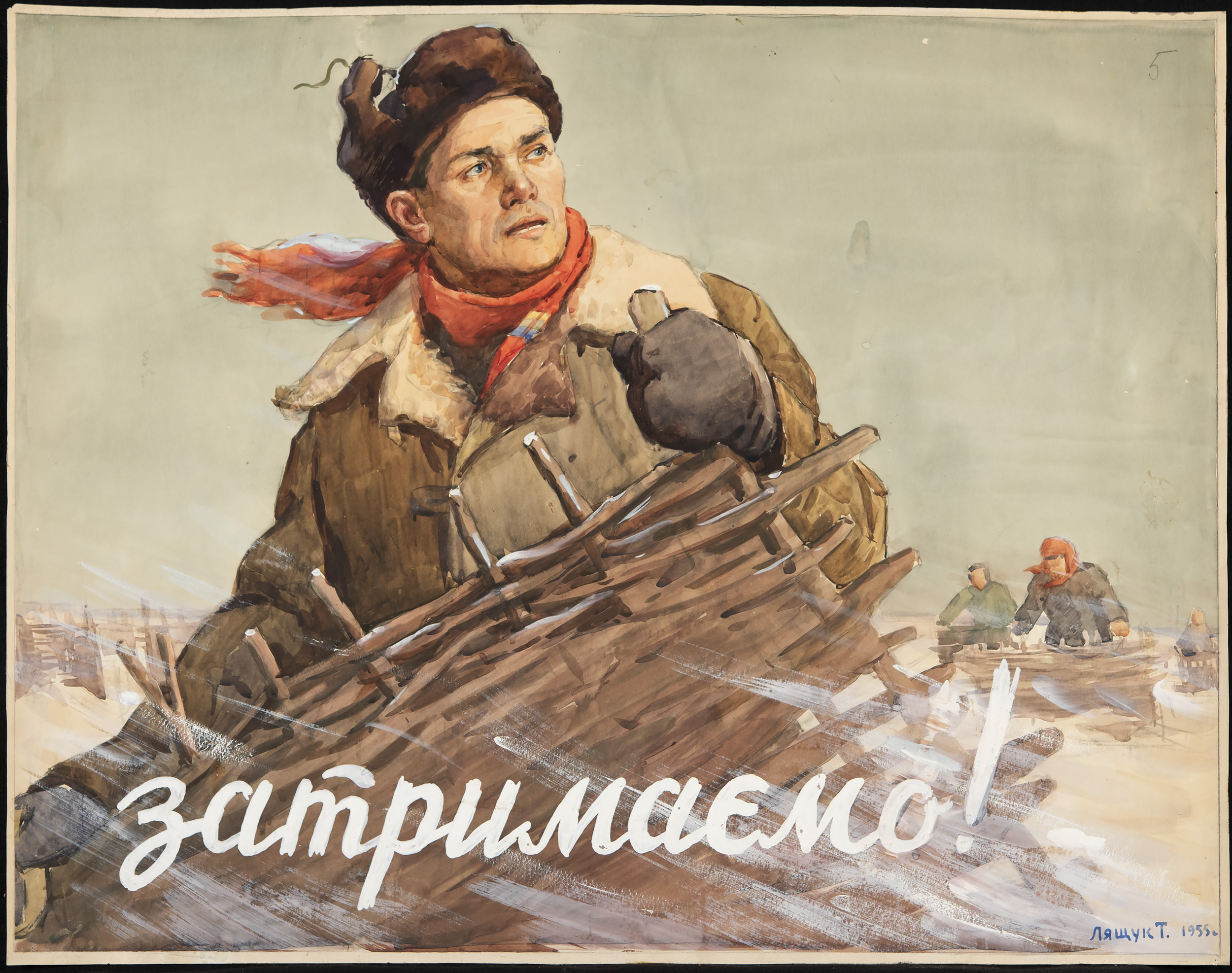
Zatrimaemo, 1955. Watercolor on paper, 64.2 × 83.4 cm (25 1/4 × 32 13/16 in.). Norton and Nancy Dodge Collection of Nonconformist Art from the Soviet Union. D10492
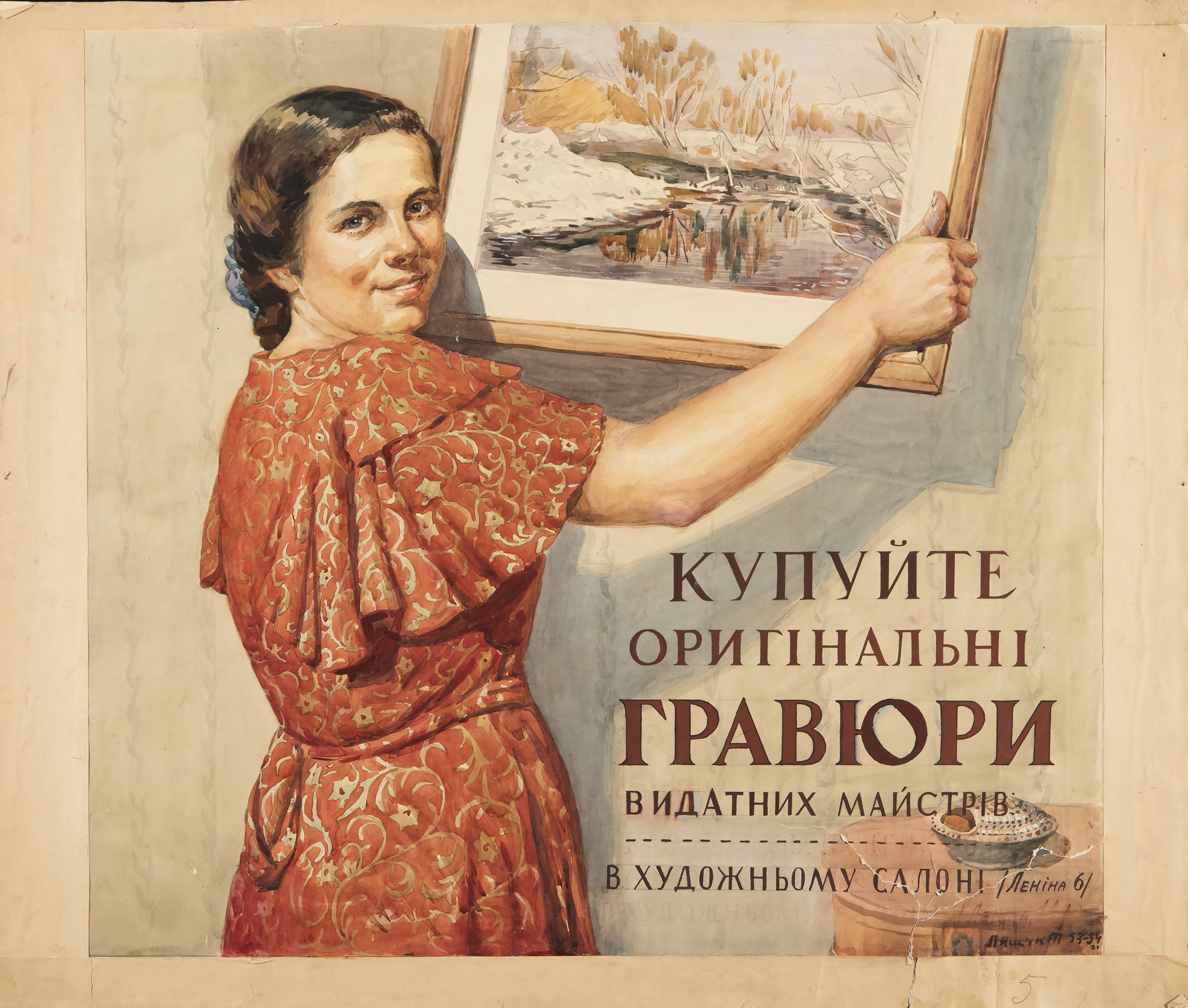
Buy Original Etchings of Famous Masters in the Art Salon, 1953–54. Watercolor on paper, 64.3 × 70.4 cm (25 5/16 × 27 11/16 in.). Norton and Nancy Dodge Collection of Nonconformist Art from the Soviet Union. D10491