
Tiit Pääsuke
1941— Põltsamaa (Estonia). Works in Tallinn (Estonia)
Tiit Pääsuke was born in Põltsamaa to a schoolteacher father and a factory worker mother. After the end of World War II, his family moved to Tallinn. In 1962 Pääsuke graduated from the art school and was admitted to the State Art Institute of the Estonian Soviet Socialist Republic (now the Estonian Academy of Arts) in Tallinn to study painting. He had just started his second year when he was sent to Russia to serve three years in the army. He subsequently returned to the State Art Institute and graduated in 1971. During his studies in Tallinn, Pääsuke was much influenced by his professor Lepo Mikko. After graduating, he remained at the school to teach painting. In 1992 he was appointed professor and in 2006 professor emeritus. From 1992 to 1994, he also taught at Rovaniemi Art School and the University of Lapland, both in Finland.
Pääsuke’s work was extremely popular in the 1970s and ’80s. He was not a clear representative of any one style, integrating the latest artistic trends with a more traditional mode of art. In the 1970s his paintings were especially influenced by pop art and hyperrealism. He was among the first Estonian artists to engage with the then-fashionable hyperrealist style, incorporating hyperrealistic elements into sections of his works while combining them with more painterly techniques.
Tiit Pääsuke is often admired for his masterful use of color. He remembers that in 1960 or 1961, just before he was taken to the hospital with acute appendicitis, he had an intense vision of color: “I saw that instead of my stomach I had a white, thick piece of drawing paper that was bisecting me. When I finally got back to my box of paints, I unscrewed the top of my tube of zinc white (or maybe it was lead white) and looked at the white paint. The disappointment was immense: the color seemed gray and muddy. I knew I would never witness such a beautiful white as I had seen then. Such white can only be born out of light and pain. ” [1]
Pääsuke’s paintings include realistic forms such as people, animals, furniture, machines, and clothing, yet they have an effect of mystery, tension, and multilayered, open-ended meaning. He combines a realistic rendering of material objects with painterly techniques that emphasize surface and texture. While his approach to depicting physical forms is grounded in realism, his use of color is imaginative and often diverges from naturalistic representation. He often creates complicated pictorial spaces and structures, sometimes including paintings-within-paintings. His treatment of purely painterly problems goes hand in hand with symbolic references to current political and ecological issues.
A theme running through Pääsuke’s painting is the conflict between contemporary urbanized humans and natural landscapes and wildlife. “Nature is my church and my cinema,” the painter has remarked. [2] In Estonian, pääsuke means “swallow,” and he probably had this in mind in making birds (both alive and stuffed) a recurring motif in his works. Such conceptual little games are quite characteristic of Pääsuke, but his work is anything but shallow entertainment.
Although in the 1970s Pääsuke rendered space as a whole, in the following decade his emphasis was on the combination and transformations of objects, as in Landscape Spread Before the Eye (1982, ZAM, D06298). The subjects of his paintings included concrete objects such as mannequins and stuffed animals or birds, as well as emblems of art—musical instruments, easels, and depictions of artists’ self-portraits, sometimes shown as paintings-within-paintings. His compositions often contained two stylistically distinctive parts: realistically fleshed-out portraits, on the one hand, and abstract handling of colors and brushwork on the other.
Pääsuke never gave up painting people, and women were a favorite subject. Particularly in the 1970s and ’80s, he painted a number of virtuoso portraits, using contemporary women artists as models. Throughout his career these female subjects were portrayed as beautiful women of stylized beauty who were snobbish or unworldly (e.g. The Game II [1979, ZAM, D05263], Kolm keraamikut [Three Ceramicists] [1985, Art Museum of Estonia]). Pääsuke has said that painting is essentially feminine: “Painting is intuitive and the intuition of women is definitely more correct than that of men.” [3]
In the mid-1980s, Pääsuke moved further toward abstraction, often combining purely abstract imagery with figurative fragments and revisiting motifs from his earlier works. At times, his compositions bring together seemingly unrelated objects, evoking a free flow of thought or imagination—suggestive of associative visual thinking or sudden flashes of intuition. In the 1990s he continued with semiabstract fragmented compositions. In the new millennium, Pääsuke has often returned to his recognizable images, sometimes creating painterly footnotes and commentaries on his earlier works.
The artist dedicated thirty-five years to teaching painting at the Estonian Academy of Arts. He himself has commented: “If you want to know what a completely academic career of the past centuries looked like, I might have been the last of the Mohicans.” Pääsuke is not nostalgic for such careers, saying that he hopes they never return. [1] In Estonian painting Pääsuke has been called a keeper and developer of traditions. “I’m not cross-eyed, but I try to look back with one eye and forward with the other. So I try to mix the classic painting style with different techniques and see what comes out of it,” he has said. [4]
Pääsuke has remained active and involved in contemporary painting. His colorist, painterly, intellectual, sensitive, and highly aesthetic work is considered a high point of Estonian late Soviet period painting.
Tiit Pääsuke was married to the book and package designer Vaike Pääsuke (1941–2018), with whom he had a son and a daughter.
Tõnis Tatar
Photo portrait: Tiit Pääsuke, 1988. Photo by Kalju Suur. Art Museum of Estonia. EKM j 60361 FK 3669
Notes
1. Joanna Hoffmann, ed., Tiit Pääsuke: Nostalgiata = Tiit Pääsuke: Nostalgialess, exhibition catalogue (Tartu: Tartu Art Museum, 2020), 155.
2. The quote is attributed to Tiit Pääsuke by the author, but the original source could not be located.
3. Hoffmann, Tiit Pääsuke: Nostalgiata, 90.
4. Jaanus Kulli, “Tiit Pääsuke: ‘Ma ei karda välja öelda, et tunnen ennast väga üksikuna,’” Õhtuleht, February 26, 2021.
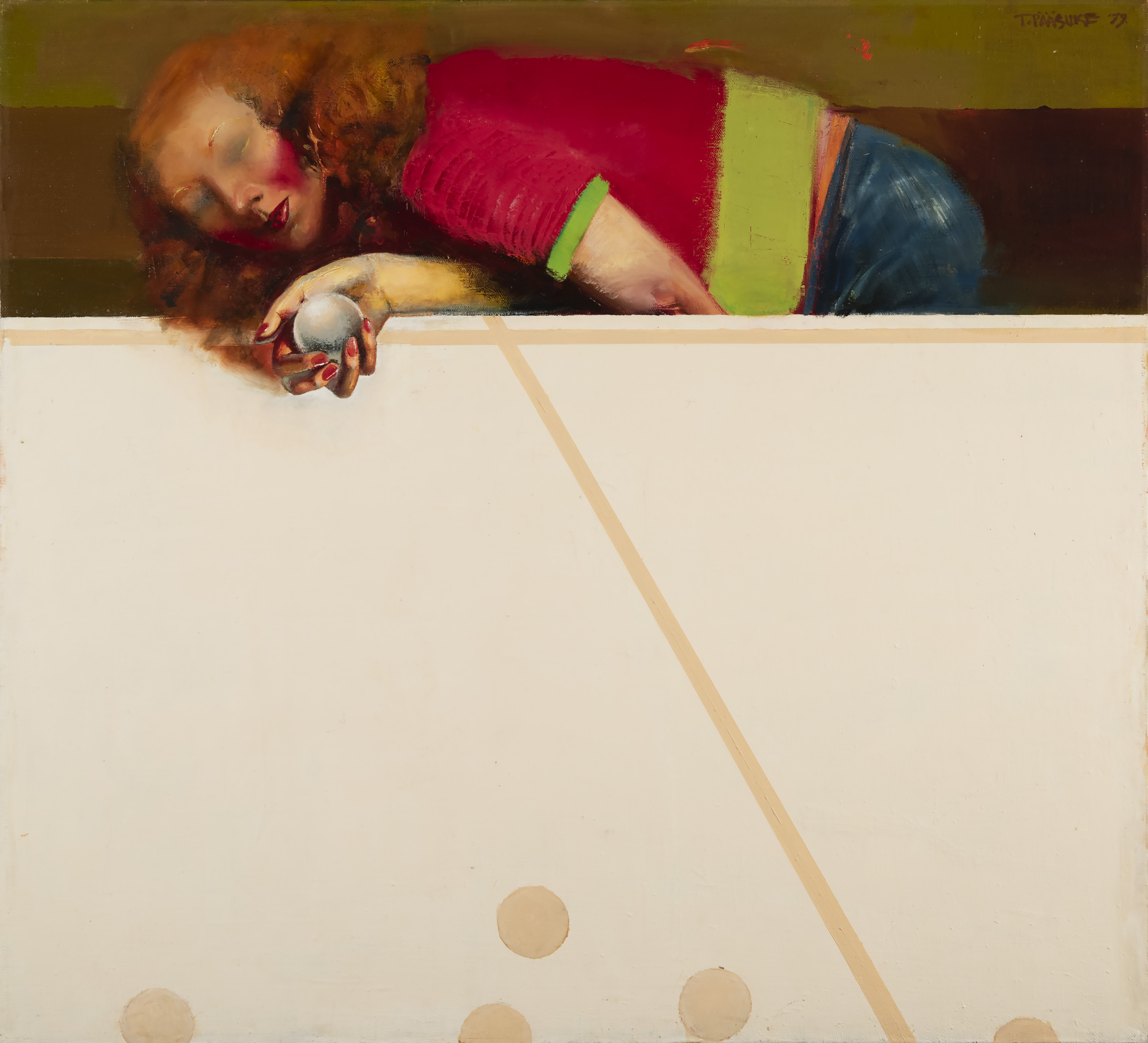
The Game II, 1979. Oil on canvas, 90 × 100 cm (35 7/16 × 39 3/8 in.). Norton and Nancy Dodge Collection of Nonconformist Art from the Soviet Union. D05263

Landscape Spread Before the Eye, 1982. Oil on canvas, 110 x 140 cm (43 5/16 x 55 1/8 in.). Norton and Nancy Dodge Collection of Nonconformist Art from the Soviet Union. D06298