
Stanislav Sychov
1937 — Odesa (Ukraine) | 2003 — Odesa (Ukraine)
Stanislav Sychov was a Ukrainian artist who worked with painting, drawing, watercolor, illustration, and monumental painting. He also wrote poetry and was a member of the Odesa nonconformist movement. In 1967 he and the artist Valentyn Khrushch (1943–2005) organized the so-called fence exhibition by hanging their paintings on the fence around the Odesa Opera Theater. The exhibition was dismantled by order of the police after no more than three hours. However, the event symbolically marked the first public appearance of Odesa nonconformism.
Sychov came from a working-class family that lived on the outskirts of Odesa in a private house, where eventually the artist established his studio. From 1955 to 1959, he attended the Odesa Art School, studying under the artist Dina Frumina (1914–2005). Among her teachers were the organizer and leader of the Odesa Society of Independent Artists Teofil Fraerman (1883–1957) and Fedir Krychevsky (1879–1947), the first rector of the Ukrainian Academy of Arts—figures whose influence preserved a fragile thread of continuity with Ukraine’s suppressed modernist legacy, which the Sixtiers generation accessed through pedagogical lineage. Already during Sychov’s student days, senior artists and students spoke with admiration of his talent. At that time, he was influenced by the Viennese Secession, and later became interested in impressionism and the severe style. [1] Upon graduation, inspired by Frumina’s stories about Samarkand, where she evacuated during WWII, Sychov moved to Uzbekistan and lived there till 1963. Later, the artist would remember the years spent in Central Asia as some of the happiest in his life. [2] There, his deep knowledge of the modernist tradition and the ease with which he controlled color and light on canvas were enhanced by Eastern motifs that would often reappear in later years. While in Samarkand, in addition to creating many drawings and paintings with colorful genre scenes, he produced a monumental mural painting illustrating Ferdowsi’s poem Shahnameh (Book of Kings) (c. 977–1010). Many of Sychov’s paintings from this period now reside in Uzbekistan museums. In Cambridge, England, in 1991, some of Sychov’s works from this period were shown at the exhibition Soviet Art in Cambridge. [3]
After his return to Odesa, Sychov quickly joined the nonconformists circle and participated in informal apartment exhibitions in Odesa, Moscow, and Leningrad. Being a loner by nature, he kept himself a little aloof. This standing manifests in his paintings, where a lonely figure of a man (Біля Вікна, Near the Window [1967, Dymchuk Collection]) or a dog (Дощ, Rain [1967, Dymchuk Collection]) represents existential solitude, contrast between a man and a society, and dramatic awareness of being abandoned in the world. Sychov’s palette is dominated by ocher, multiple shades of yellow and brown, bright splashes of red, black, and as many as sixty shades of gray. [2] One of his techniques is to inscribe his lonely figures into already existing compositions of architectural portals, such as a window or door. He often painted female nudes and female portraits. As for this subject matter, it started to prevail toward the end of his life, although the colors became thinner and more translucent. According to his contemporaries, there were often young women in his studio not only posing but also cooking or helping with the work around the house. [2] Throughout his career Sychov also experimented with large paintings (which he later destroyed), watercolors, miniature engravings (2 by 3 centimeters), monumental mural paintings (in Samarkand, Odesa, and Kamianets-Podilskyi), and lithography. Naro, a book of his paintings and poetry, was published in 2013.
In 1967 Sychov and Khrushch held an impromptu exhibition of their works on the fence surrounding the Odesa Opera Theater while it was undergoing reconstruction. This soon became known as the “fence exhibition.” The two were opposites: Sychov was tall, thoughtful, and thorough; Khrushch a small, fast-moving extrovert. Although the artists were often compared by their colleagues, they were not known to be close friends. Apparently, on a day when their works had just been rejected by the Union of Artists, while carrying them back to their studios they stopped and leaned the paintings on the fence. This caught the eye of passersby, and the artists decided to turn it into an improvised exhibition, hanging the paintings and writing on the fence with white paint Sychik + Khrushchik. The exhibition was quickly dismantled by the authorities, and the artists thereafter suffered even more persecution, effectively losing the opportunity to take part in official exhibitions until the collapse of the Soviet Union.
Despite his almost legendary reputation, Sychov’s works were little known then; he only occasionally exhibited at apartment exhibitions and was completely excluded from official cultural life. He was a regular at the bar in the Krasnaya Hotel in Odesa and loved to party; there are stories that he would purposefully surrender to the police so that they would take him to the sobering-up center located next to his house, thus getting a way home. [2] The Odesa-based journalist Evgeny Golubovsky recalled a relatively big exhibition in the late 1960s at the Writers’ Union, on Pushkinskaya Street. [4] In 1971 the Union of Artists hosted an exhibition of four artists: Sychov, Aleksey Lopatnikov (b. 1948), Lucien Dulfan (b. 1942), and Volodymyr Strelnikov (b. 1939); three days later it was closed. Sychov’s first solo exhibition took place at the Odesa Museum of Western and Eastern Art in 1989, which became possible thanks to museum employees Oleg Sokolov and Veniamin Mlynchik, who mounted the show in the director’s absence. It was installed in two days, and according to eyewitnesses Sychov brought a truck full of his works. [4]
During the years of Ukrainian independence, Sychov exhibited at the Mist Gallery and the Maritime Gallery in Odesa, and had additional exhibitions at the Museum of Western and Eastern Art. The artist died in 2003, at the age of sixty-six. Allegedly, he was one of the first Soviet artists of his generation whose work was sold at Sotheby’s. [3]
Kateryna Filyuk
Notes:
1. “Severe style” describes a style of realistic Soviet painting from the 1950s and ’60s. The term was introduced by the art critic Alexander Kamensky in 1962. Artists working in the severe style reflected the real, everyday difficulties of life for workers and peasants. These artists used mostly muted colors from a dark palette and clearly drew the linear contours of the figures, which led to the works resembling posters. They were influenced by Soviet avant-garde art and Italian neorealism.
2. Irina Timokhova, “Pamiati Stanislava Sychova” [In memory of Stanislav Sychov], Almanac Deribasovskaya–Richelievskaya 23 (2005), 201–8.
3. Vladimir Kozhukhar, “Biography,” Okna Sotsrealizma.
4. Evgeny Golubovsky, Sychov, Stanislav. Oni ostavili sled v istorii Odessy. Sobranie biographicheskikh ocherkov i statei [They left a mark on the history of Odesa: Collection of biographical sketches and articles], Odessa Memory.
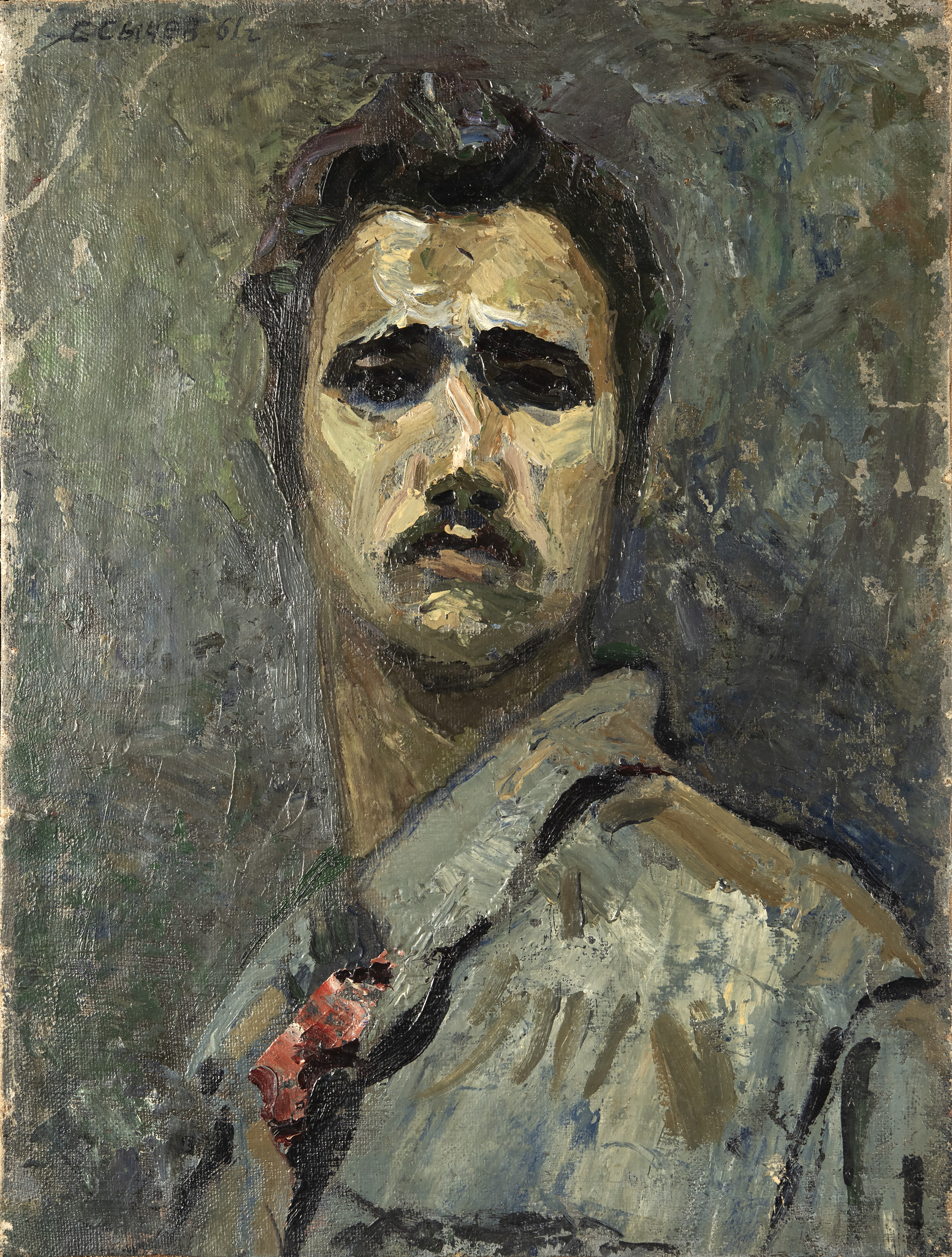
Self-Portrait, 1961. Oil on coarse weave canvas, 60.7 x 45.6 cm (23 7/8 x 17 15/16 in.). Norton and Nancy Dodge Collection of Nonconformist Art from the Soviet Union. 2013.006.031
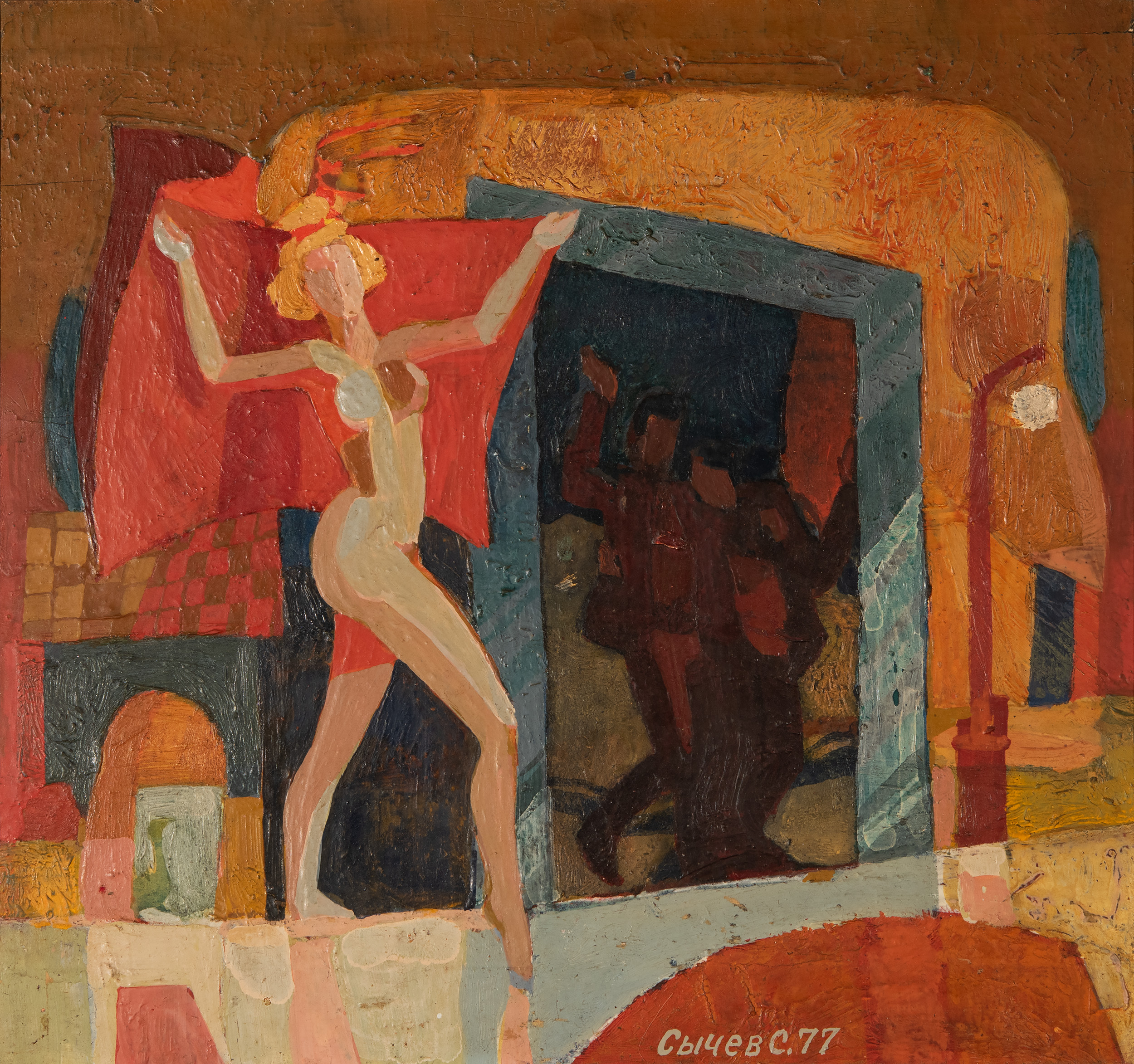
Dance, 1977. Oil on illustration board, 33.4 × 36.6 cm (13 1/8 × 14 7/16 in.). Norton and Nancy Dodge Collection of Nonconformist Art from the Soviet Union. D04664
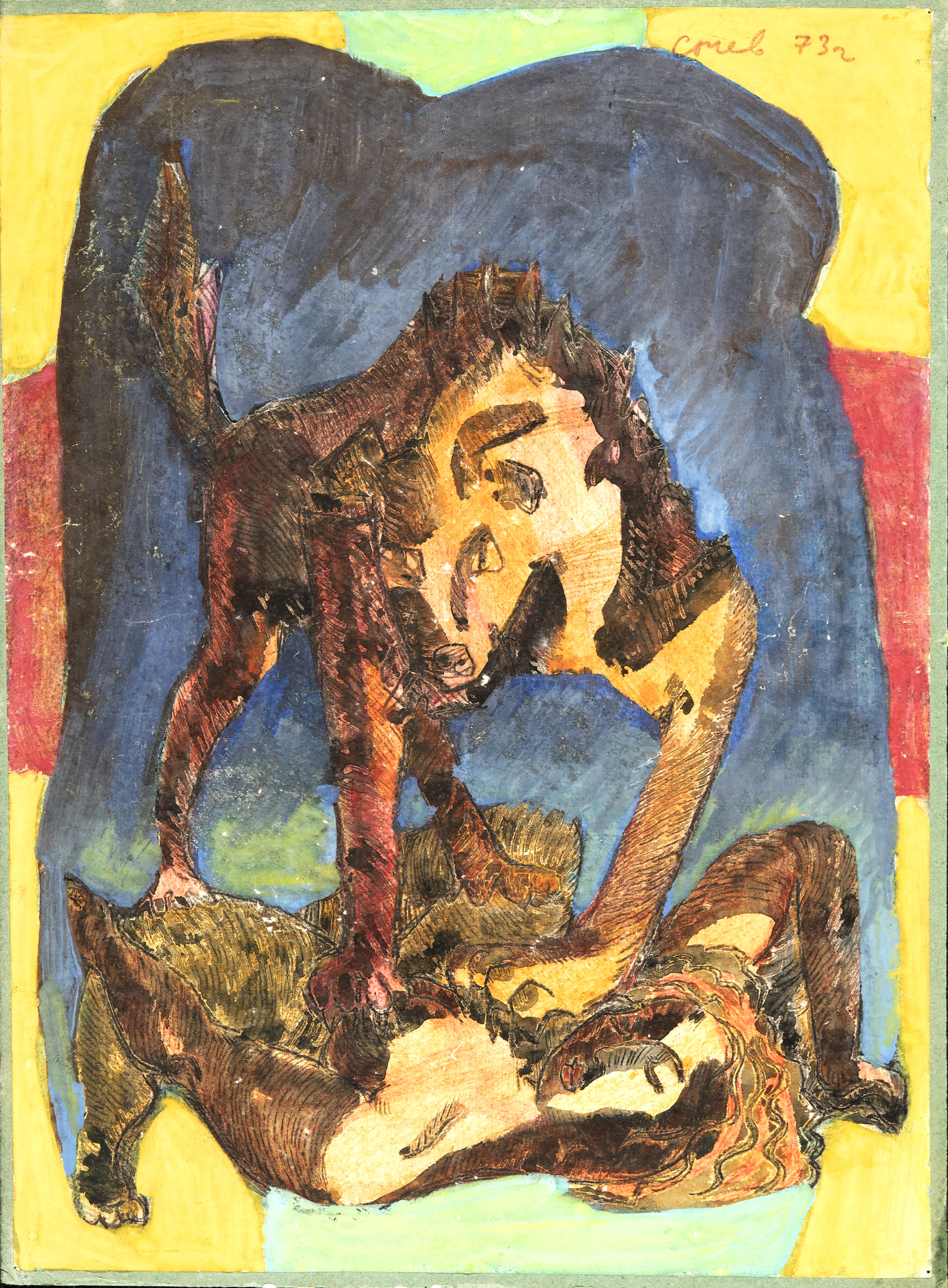
Untitled, 1973. Gouache, watercolor, and crayon on illustration board, 42.5 × 32.5 cm (16 3/4 × 12 13/16 in.). Norton and Nancy Dodge Collection of Nonconformist Art from the Soviet Union. D06989