
Silvi Liiva
1942 — Tupina (Estonia, now Russia) | 2023 — Tallinn (Estonia). Lived and worked in Tallinn (Estonia)
Silvi Liiva was a graphic artist and lecturer born in the countryside, in a small village called Tupina (now part of Russia). She studied at the Tartu Art School from 1958 to 1963 and at the Estonian State Art Institute (now the Estonian Academy of Arts) from 1963 to 1969. After graduating, she worked as an art editor at the publishing house Eesti Raamat (1969–74) and taught at the Department of Drawing of the State Art Institute (1978–87). For her graduation work, she created surrealist illustrations for One Has to Hear, a collection of poetry by Paul Éluard, and she later designed and illustrated several books, including Pildi sisse minek [Entering a picture], by Viivi Luik, in 1973 and the Estonian translation of Die neue Melusine by Johann Wolfgang von Goethe, in 1982). She participated in numerous exhibitions in Estonia and abroad and was awarded the Annual Graphic Art Prize of the Soviet Estonian Union of Artists (now the Estonian Artists’ Association) on several occasions. In 2003 she was awarded the Kristjan Raud Prize.
Liiva worked mainly in etching. Her earliest works grew out of her graduation-work illustrations for Éluard’s collection of poetry. Similar figures and style of depiction can be seen in her works of the first half of the 1970s. In Tants [Dance] (1970), strange, surrealistic, ecstatic figures perform a ritual. As in all of Liiva’s oeuvre, the narrative of the work is mysterious and ambiguous. The artist has stated that she sought, first and foremost, to evoke different emotions and provoke thought in the viewer. [1]
Liiva’s psychologically compelling scenes often feature women as central characters in works that are allegorical, mythical, epic, humorous, and suggestive. These existential images—sometimes surreal and absurdist, sometimes serious—reflect on the experience of being human, and especially on the many facets of being a woman. Omaette [By Themselves] (1971, ZAM, D09783) shows several characters busy with their own activities and unbothered by those around them. The work seems to capture a women’s world imbued with a sense of freedom, lightness, and possibility, where everyone has a place and space to be both together and alone.
Over the 1970s and ’80s, Liiva’s graphics traced the arc of women’s lives. Reflecting her own aging, emotions, and experiences, the artist’s figures changed from young girls to elderly women. Those from the earlier 1970s, such as Suur suvi [Great Summer] (1970, Art Museum of Estonia), Ateljee [Studio] (1973, ZAM, D03527), and Naine [Woman] (1976, ZAM, D05607), were more fragile and ethereal, and then they became stronger and more concrete, as in Optimist [Optimist] (1978, Art Museum of Estonia), inspired by Liiva’s friend Marju Mutsu. Gradually, her female figures became almost abstract, as, for example, in Kaks naist [Two Women] (1985) and Lahutamatud [Inseparable] (1988) (both Art Museum of Estonia). Women were also very often depicted together in a large crowd.
One of the artist’s central themes of the 1970s was consecrations and rituals—whether a harvest festival or a birthday—where women of different generations gather, as in Tüdrukud [Girls] (1978, ZAM, D08361]; Sünnipäev [Birthday] (1975, Art Museum of Estonia), dedicated to Liiva’s mother; Sügis [Autumn] (1975, Art Museum of Estonia); and Lõikuspidu [Harvest Festival] (1976, Art Museum of Estonia). Such works reflect life in its diversity, joy, and celebration, alternating hope and humor with melancholy and gloom.
Liiva was born and raised in the countryside, and one of the main threads pervading her art is a connection with both nature and a traditional way of life. She considered Reekviem [Requiem] (1971, ZAM, D03530] an ode to nature and has said that she depicted soul birds, carriers of souls between the living and the dead in Estonian folklore, in the picture. [2] Several of her works depict the relationship between humans, usually women, and nature (Naine. Sarjast meri [Woman, from the series Sea]) (1972, ZAM, D05554), as well as conflicts between natural elements and humans. Tormiöö [Stormy Night] (1986, Art Museum of Estonia), for example, suggests the difficulties of motherhood or family life.
Some of the artist’s works featuring motifs from nature are metaphorical and surrealistic, such as Kala [Fish] (1973, Art Museum of Estonia) and Kodulind [Poultry] (1975, Art Museum of Estonia). She has said that Haldjas [Fairy] (1977, ZAM, D08358) is a symbol of goodness [3], yet the woman-fairy is presented as a multilayered and ambiguous character who assertively scatters assorted wild animals from a bag. Perhaps she is setting them free.
Liiva was not interested in the material world or objects as subject matter; instead, she took as her main focus more general concepts in human relations such as goodness; love; pain, as in Kurbus [Sorrow] (1980, private collection) and Äng [Anguish] (1989, Art Museum of Estonia); and loneliness, as in Pühendus Vaikusele [Dedication to Silence] (1981, Art Museum of Estonia). Liiva was a master of creating emotional compositions, but because the depiction of negative feelings was not favored in the Soviet period, she had to change the titles of some of her works. One example is Sügisitk [Autumn Cry] (1982, ZAM, D08359), which depicts her own forlorn response to autumn as the landscape is changing and the birds are migrating.
By the 1990s Liiva’s imagery had been distilled to near-abstraction and her works had become more monumental. Several of the series of that time—such as Mägi [Mountain] (1994) and Valgus öös [Light in the Night] (1997) (both Art Museum of Estonia)—combine large abstract areas with a hint of darkness. Despite their concrete titles, the works do not depict specific objects, spaces, or landscapes, but instead create abstract planes that evoke a feeling about a phenomenon; Täppide vägi II [The Force of Dots] (1996, Art Museum of Estonia) and Mereäärne [Seaside] (1997, private collection) are examples. Occasionally, the artist added some color—usually variations of blue—that rhythmizes and enlivens the surface, as in Väljal [In the Field] (2015, private collection). What is common to all of Silvi Liiva’s works is a certain tension: Never settled or calm, they always contain some movement, disruption, or emotion.
Eda Tuulberg
Photo portrait: Silvi Liiva, 1986. Photographer unknown. Art Museum of Estonia. EKMj61685FK4803
Notes:
1. Silvi Liiva, conversation with the author, September 13, 2022.
2. Liiva, conversation with the author.
3. Liiva, conversation with the author.
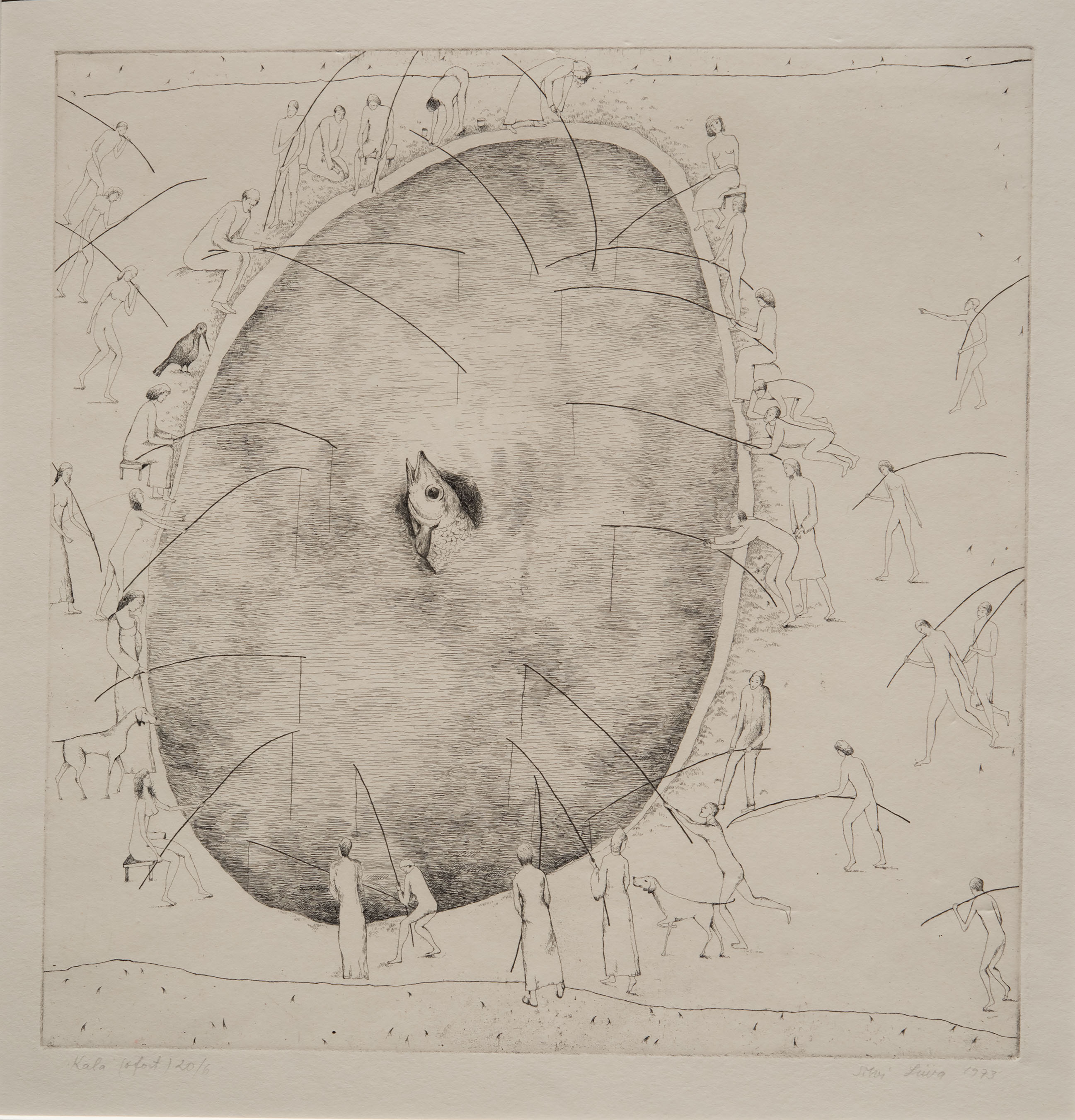
Kala, 1973. Etching on paper, 39 × 38.5 cm (15 3/8 × 15 3/16 in.) / 52.7 × 50.8 cm (20 3/4 × 20 in.). Norton and Nancy Dodge Collection of Nonconformist Art from the Soviet Union. D03480
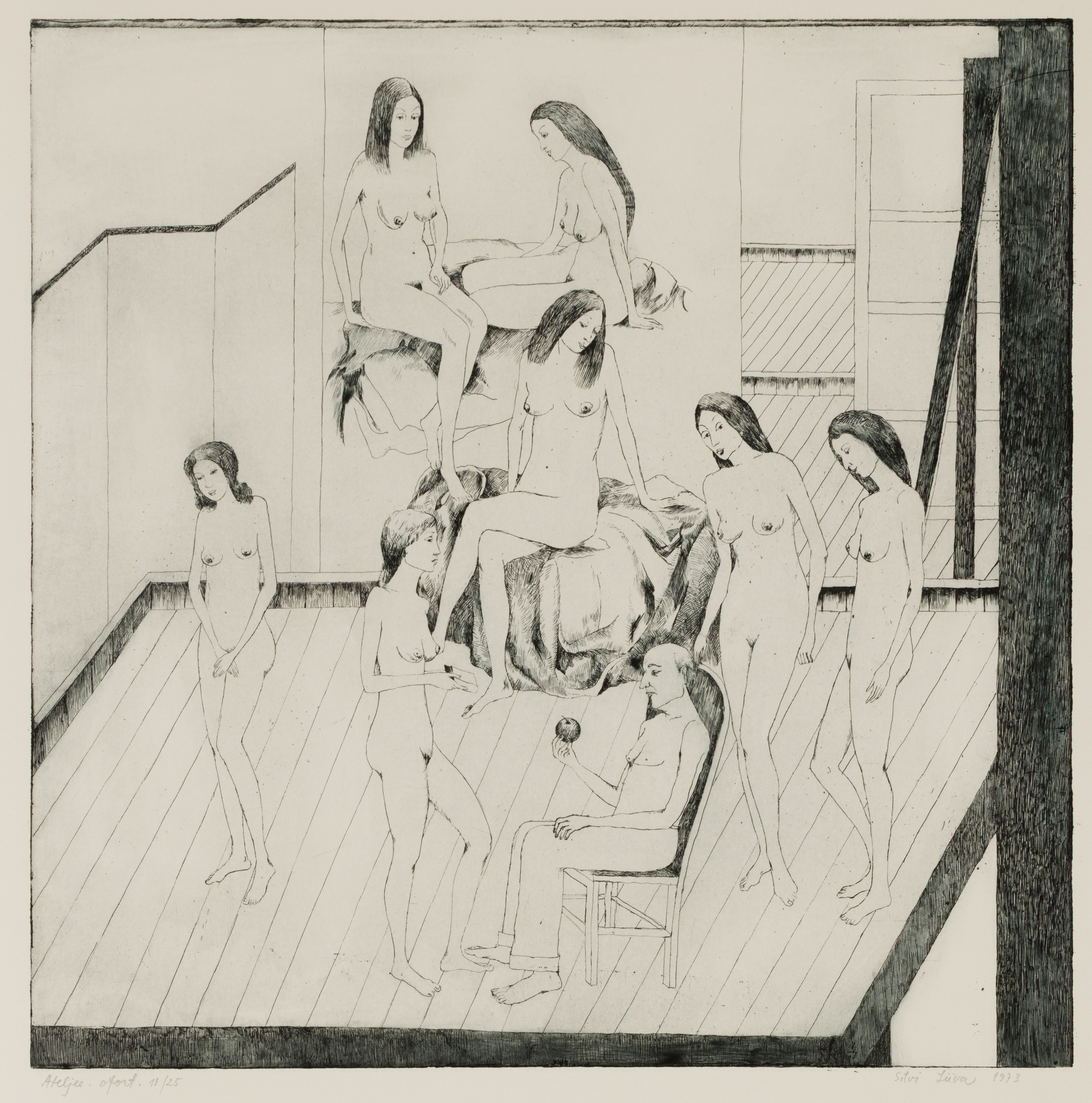
Studio, 1973. Etching on paper, 34.3 × 34.1 cm (13 1/2 × 13 7/16 in.) / 51.4 × 46.2 cm (20 1/4 × 18 3/16 in.). Norton and Nancy Dodge Collection of Nonconformist Art from the Soviet Union. D03527
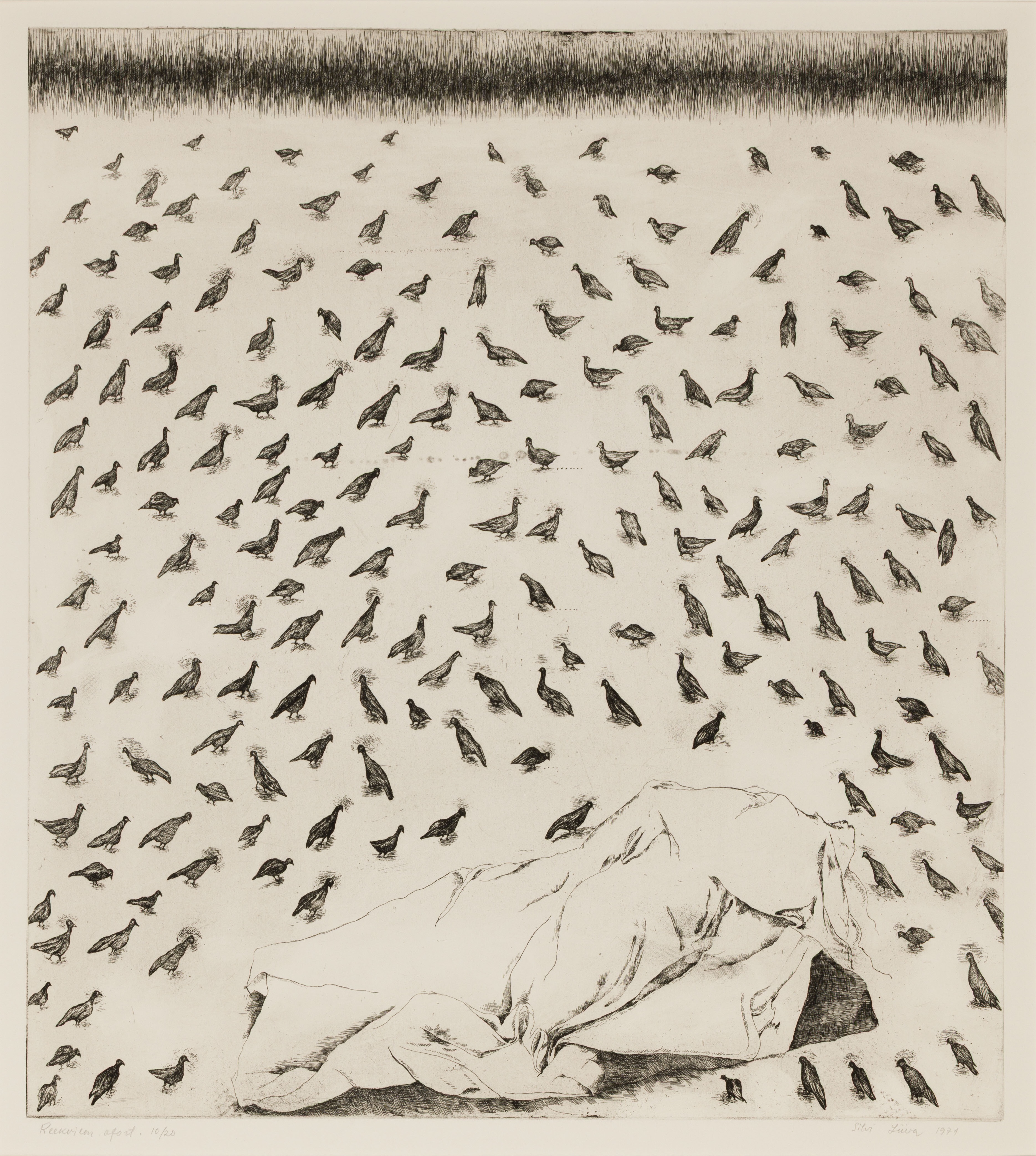
Requiem, 1971. Etching on paper, 43.7 × 39.2 cm (17 3/16 × 15 7/16 in.) / 57 × 49.9 cm (22 7/16 × 19 5/8 in.). Norton and Nancy Dodge Collection of Nonconformist Art from the Soviet Union. D03530

Woman from the series Ocean, 1972. Lithograph on paper, 43.2 × 38 cm (17 × 14 15/16 in.) / 58.5 × 51.3 cm (23 1/16 × 20 3/16 in.). Norton and Nancy Dodge Collection of Nonconformist Art from the Soviet Union. D05554
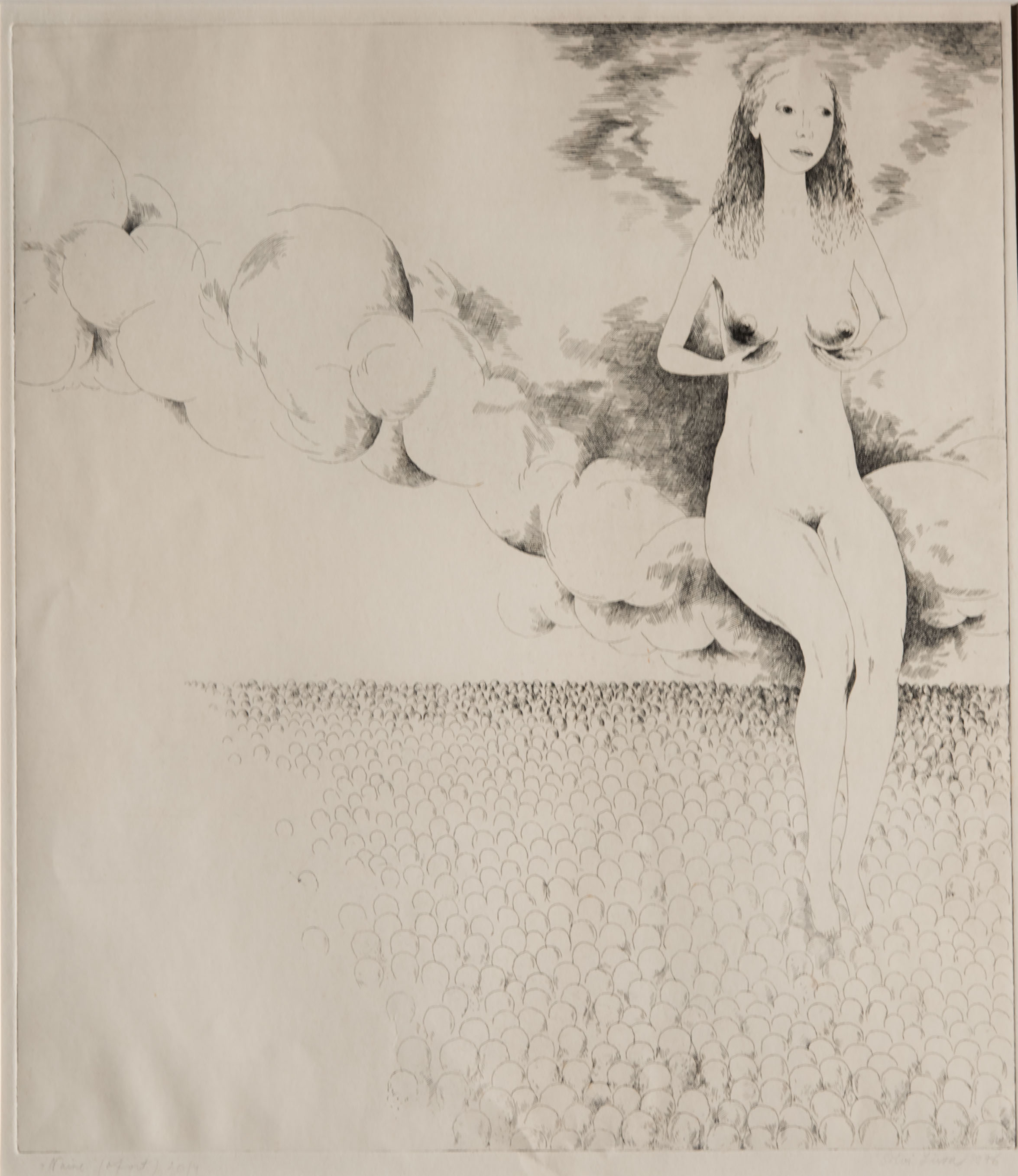
Woman or Meeting, 1976. Etching on paper, 49.5 × 43.2 cm (19 1/2 × 17 in.) / 56.4 × 50.3 cm (22 3/16 × 19 13/16 in.). Norton and Nancy Dodge Collection of Nonconformist Art from the Soviet Union. D05607
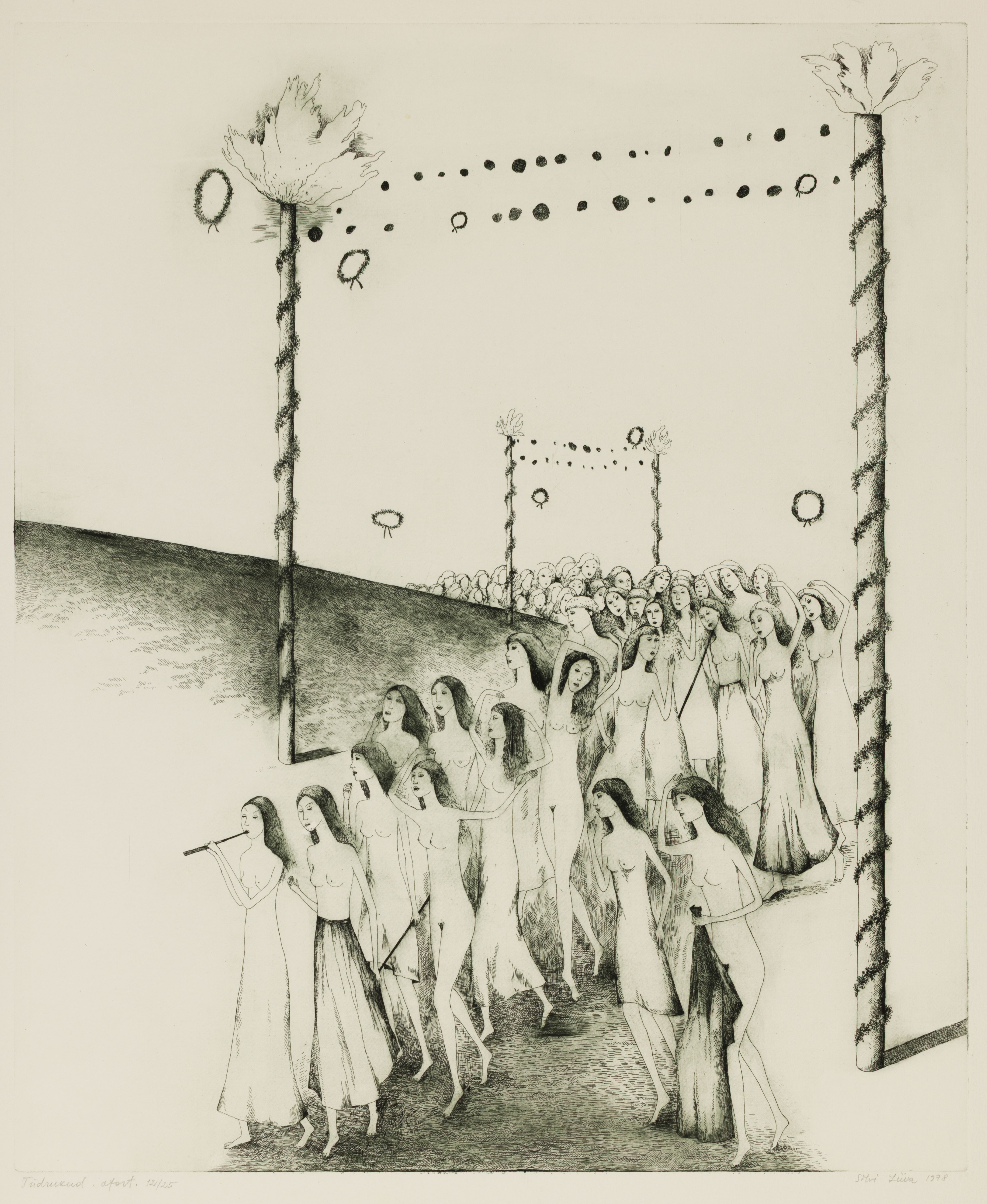
Girls, 1978. Etching on paper, 49.5 × 41 cm (19 1/2 × 16 1/8 in.) / 61.3 × 50.5 cm (24 1/8 × 19 7/8 in.). Norton and Nancy Dodge Collection of Nonconformist Art from the Soviet Union. D08361