

Sergei Kovalsky
1948 — Leningrad (USSR) | 2019 — Saint Petersburg (Russia). Worked in Leningrad (USSR) / Saint Petersburg (Russia)
Sergei Kovalsky was an artist, a public figure, and a key individual in Leningrad’s unofficial art scene. Through his work, he played an important role in supporting independent artists, developing cultural initiatives, and popularizing alternative directions in art. A versatile artist and thinker, he worked in the fields of painting, collage, photography, poetry, and performance, participating in numerous exhibitions and actively promoting unofficial art.
He was born on August 1, 1948, in Leningrad, USSR. He graduated from Leningrad Topographic College (now Saint Petersburg College of Geodesy and Cartography), working on expeditions between 1966 and 1977. In the late 1960s, he began delving into painting and literature, and by 1969, he had started to develop his own unique direction in visual art, which he called “Metaelementalism.”
In 1973, Kovalsky, along with Boris Mitavsky and Viktor Bogorad, founded the art group Inaki (The Others), which quickly became a central meeting point for many artists in Leningrad. During the 1970s, Kovalsky was actively involved in organizing apartment exhibitions, offering artists a platform to present their works outside the constraints of state censorship. In 1977, he opened a permanent exhibition in his apartment on Piskaryovka (Piskaryovsky Prospect, 48), where members of the Inaki group and other artists showcased their works. At the same time, he continued his literary pursuits, publishing poetry in the samizdat almanac Golos (1978, issue no. 7), under the pseudonym S. Kanin.
An important moment in Kovalsky’s life came with his involvement in organizing the legendary exhibition On Bronnitskaya Street in 1981, which brought together a large number of nonconformist artists and became the final major apartment exhibition. That same year, Kovalsky cofounded TEII, Fellowship for Experimental Fine Art. Years later, TEII would celebrate a landmark achievement with its first international touring exhibition, from 1987 to 1989, which Kovalsky co-organized with American artist Barbara Hazard. This exhibition marked a significant breakthrough, introducing Soviet unofficial art to the world stage.
In 1981, Kovalsky forged connections with Leningrad underground writers Boris Ivanov, Igor Adamatsky, and Boris Ostanin, contributing articles to the samizdat magazines Chasy, Obvodnyi Canal, and Mitin Zhurnal. That year, he also began developing a new artistic direction—social folk art.
In 1983, together with Evgeny Orlov, he cofounded the group 5/4, which included Yuly Rybakov, Anatoly Dmitriev, Eugene Tykotsky, Vadim Voinov, Viktor Andreev, Igor Ivanov, Vladimir Brylin, Igor Orlov, and Kovalsky himself. The group’s work focused on innovation and experimentation in the visual arts.
One of Kovalsky’s key achievements was the founding of the cultural center Ковчег XXI век (The Ark XXI Century) in 1989 (later renamed Pushkinskaya-10 art center), which became the leading venue for independent art in Leningrad. Kovalsky played a significant role in the activities of the Pushkinskaya-10 art center, transforming it into an internationally recognized cultural hub. In 1994, during the radio broadcast Sevooborot on the BBC, Kovalsky symbolically proclaimed the sovereignty of the Pushkinskaya-10 art center, declaring it an independent republic of art.
In 1990, together with Yuly Rybakov, Kovalsky established the Свободная культура (Free Culture) foundation—Leningrad’s first official organization supporting independent artists. Later, the fund evolved into the Товарищество «Свободная культура» (Free Culture Society), where Kovalsky remained president and an important figure for many years. The culmination of his long-term efforts was the founding of the Museum of Nonconformist Art (MoNA) in 1998, alongside Evgeny Orlov—a unique institution created to preserve and promote independent art. Kovalsky donated his extensive collection of works by nonconformist artists to the museum and served as its chief consultant.
Museum work played an important role in his activities. He organized numerous exhibitions of nonconformist artists, independent art festivals (From Fall to Flight, marking the thirtieth anniversary of Leningrad’s “unofficial” artists’ exhibition at the Ivan Gaza House of Culture in 2004; and Sea Level, celebrating the twentieth anniversary of the Pushkinskaya-10 art center in 2009 at the Manege in Saint Petersburg), while also continuing his research into the history of unofficial art in Leningrad.
Despite the immense organizational work, Kovalsky consistently and intensively focused on developing his own creative output. Over many years, he developed his own original artistic-philosophical concepts.
The artist himself divided his work into two areas: metaelementalism in 1969 (the transformation of sound into color using the technique of so-called counter-collage), and social folk art in 1981 (works dedicated to social themes).
Metaelementalism is one of the most fascinating directions in which Kovalsky worked. For him, sound was the primary element underlying human perception of the world. As he asserted, “In the beginning was sound, man heard the beating of his own heart, the rush of blood flowing through his veins. The word came later. Therefore, sound remains the foundation of perception.” [1]
The translation of music into color was explored by many scientists and artists. Isaac Newton proposed the first theories based on the analogy of “spectrum—octave,” influenced by the cosmology of Pythagoras and Johannes Kepler. Color-music harmonies (Farblichtmusik) were studied in 1920–21 at the Moscow Institute of Artistic Culture (Institut Khudozhestvennoy Kultury, INKhUK), and in 1922–23, this subject was developed by Vasily Kandinsky at the Bauhaus in Germany. From 1923 to 1926, the interaction of color and sound was studied by a group led by Mikhail Matyushin at the Institute of Artistic Culture (GINKhUK) in Petrograd.
Kovalsky’s creative method is not simply the translation of sound into color, but a synesthetic approach that creates what is known as a “visual chord” [2] in each of his works. This chord is formed from carefully thought-out elements: composition, color, and texture. Kovalsky’s paintings can be listened to. They are like graphic musical scores. In them, each detail—a note, chord, or melody—creates the sensation of a resonating canvas. The artist himself believed that his works were open to improvisational interpretation by musicians. Kovalsky loved music and knew it intimately. He referred to himself as a professional listener with many years of experience. In creating his works dedicated to music, the artist boldly entered into a dialogue with the most renowned musicians and composers of the twentieth and early twenty-first centuries: from Duke Ellington, Miles Davis, the Beatles, and Pink Floyd to Sergei Rachmaninoff, Karlheinz Stockhausen, Sofia Gubaidulina, and Krzysztof Penderecki.
Kovalsky divided his works dedicated to music into the following categories: classical music, sacred music, new classical music, rock music, jazz, and improvisational music.
Reflecting on these musical directions, he created works dedicated to sacred music (the diptych Communion, 1988–2004, set to Rachmaninoff’s “All-Night Vigil”), new classical music (the diptych Larghetto sensibile,1999, set to Gubaidulina’s In the Mirror), and improvisational music (the diptych Sacred Hymns, 1986–98, inspired by Keith Jarrett), and united them into a single cycle titled Temple of Music.
A vivid example of his work set to improvisational music is the triptych Concerto Grosso (1982) (ZAM, D12013.01–03), based on the improvisation of the trio “G.T.Ch.” (V. Ganelin, V. Tarasov, and V. Chekasin). In this work, Kovalsky, through painting, performs his own improvisation, becoming a co-participant in the creative process. The resulting triptych is a unique musical score created by the artist in color and form.
In the musical vein, Kovalsky also created a series of portraits of outstanding musicians and performers: Sarah Vaughan, My Sweet Valentine (1979); John Coltrane, Twilight of John Coltrane (1980); and Miles Davis, Walk (2017), as well as works dedicated to specific musical compositions, albums, and songs. Inspired by an album by Erroll Garner, he created the eponymous composition Body and Soul (1986); dedicated the composition The Dark Side of the Moon (1997–2003) to the legendary Pink Floyd album; and created the work Ticket to Ride (1977, ZAM, D01602) dedicated to the Beatles’ album Revolver.
Being fascinated by the pioneering art of the 1920s, Kovalsky, influenced by the jazz compositions of Duke Ellington and Louis Armstrong, also created works dedicated to Alexander Rodchenko (Homage to A. Rodchenko, 1983) and El Lissitzky (Homage to El Lissitzky, 1983, ZAM, D14036). Like in Lissitzky’s Prouns, the artist constructed dynamic forms in his works that float in space, free from the usual references to top and bottom. Sometimes, the sound concept of a particular musical instrument becomes the main impulse for the artist to create a piece. For example, in Red Line (1999), we clearly observe how the “red line” transforms into the prolonged sound of Chet Baker’s trumpet. Through these works, Kovalsky was devising a new technical method called “counter-collage.” This technique allowed the artist to “free the details of the collage from conventional volume and informative ‘fillers,’ which are set from inside.” [3]
The second significant direction in Kovalsky’s work is social folk art (social folklore). Works in this direction are primarily a response to the problems of Soviet reality. His collages and paintings, such as Karla Marla (portrait of Karl Marx, 1969), Attention, We Can Be Overhead (1984), Inhalation Forbidden (1985, ZAM, D14041), Danger Zone I (1986), and Samasadik (1986, ZAM, D21176), have a social focus and convey the spirit of the Soviet era, using signs and symbols from the time—song lyrics, slogans, everyday objects—through which he encourages the viewer to see familiar symbols from a new angle (Ladushki, 1986–88; Pif-Paf, 1990). He skillfully combined text and image, as in Attention, We Can Be Overhead (1984), in which the text is an important element of the composition.
Kovalsky created the concept of Parallelosphere (2004), which unites his entire creative activity. Parallelosphere became a symbol of the twenty-first century—a self-reproducing and self-developing kinetic object, mathematically mapped as a three-dimensional square inscribed in a sphere, which served as the foundation for Pushkinskaya-10 as a space for parallel existence of nonconformist art in the Soviet and post-Soviet spheres. He considered this project his main creative achievement and created a series of works dedicated to the subject: the series Parallelosphere in the Space of Transraduga (2000), Staircase to Parallelosphere (2009), and Prayer to Parallelosphere (2011).
The pinnacle of the Parallelosphere concept and Kovalsky’s last major project was the exhibition Parallelosphere of Color and Sound (2018, MoNA). The exhibition included new works created to the music of Mikalojus Konstantinas Čiurlionis, Sergei Prokofiev, Igor Stravinsky, Phillip Glass, David Bowie, Brian Eno, Vyacheslav Gaivoronsky, Vladimir Volkov, Alfred Schnittke, Arvo Pärt, Miles Davis, and Archie Shepp.
In all areas of his practice, Kovalsky sought to create his own artistic reality, opposed both to Soviet ideology and the contemporary world order. He called himself a traveler, artist, and poet—words that fully reflected his multifaceted personality. His creative legacy impresses with its scale, diversity, and depth of conceptual understanding. Not only an outstanding artist, but also a brilliant organizer and art researcher, Kovalsky boldly pushed the boundaries of the artistic process, discovering new forms and possibilities. For him, art and organizational activity were inseparable, merging into a single, cohesive statement, where each idea became part of an overarching artistic concept.
Kucher Larysa
Translated from Russian by Ilya Bernstein
Photo portrait: Sergei Kovalsky, 2014. Photo by Dmitry Shubin.
Notes:
1. Demshina, Anna. “Color of Music.” In Parallelosphere of Color and Sound, exh. cat. Saint Petersburg: DEAN, 2018: 9–11.
2. Demshina, Anna. “The World Map of Sergei Kovalsky.” In Inaki: Anniversary exhibition, 1973–2013, exh. cat. Saint Petersburg: DEAN, 2013: 152–62.
3. Kovalsky, Sergei. “Color of Sound.” In Color of Sound 1966–2004, exh. cat. Saint Petersburg: DEAN, 2005: 78–79.
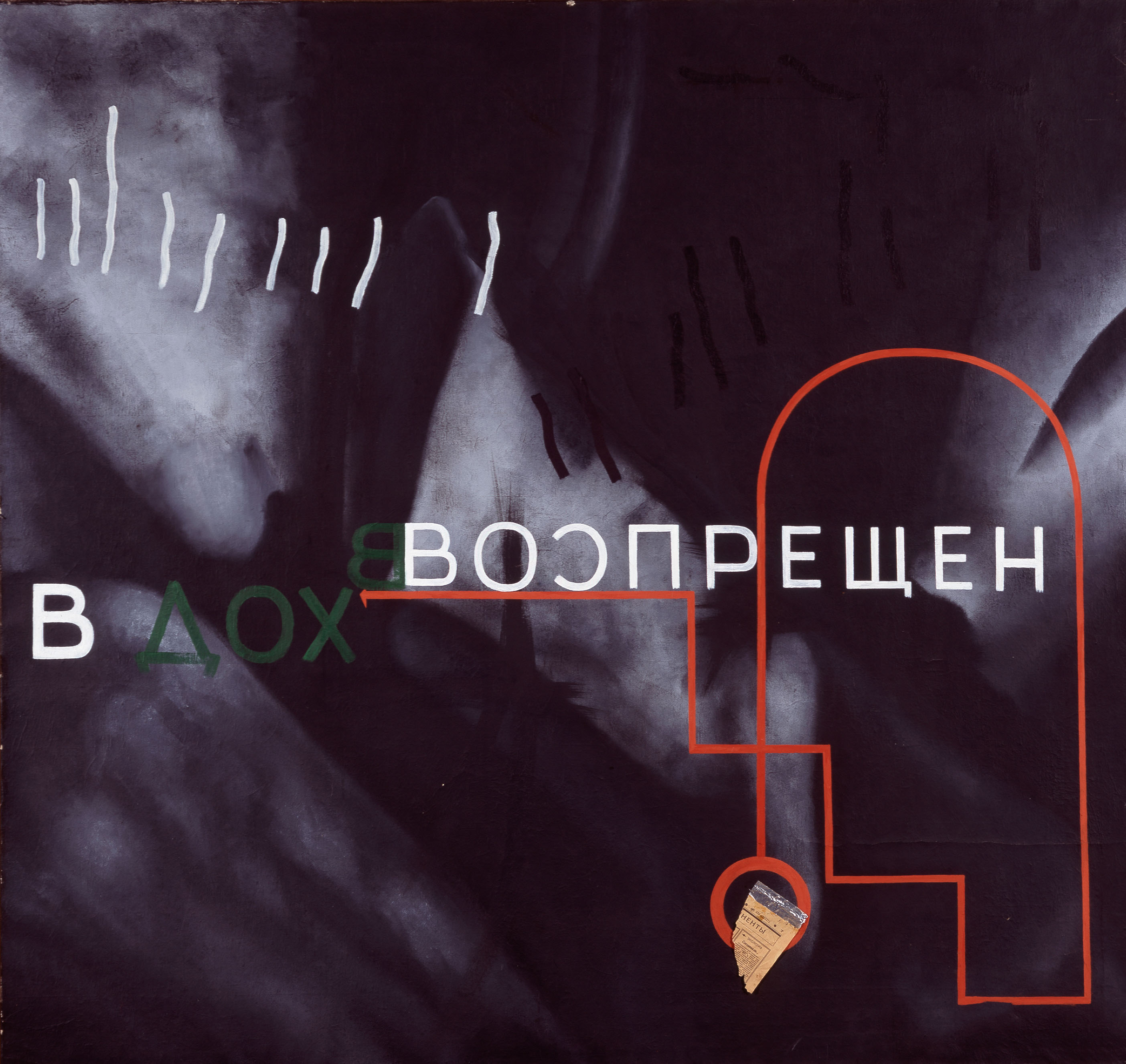
Inhalation Forbidden, 1985. Oil with paper and tape on canvas, 141.5 × 151.2 cm (55 11/16 × 59 1/2 in.). Norton and Nancy Dodge Collection of Nonconformist Art from the Soviet Union. D14041
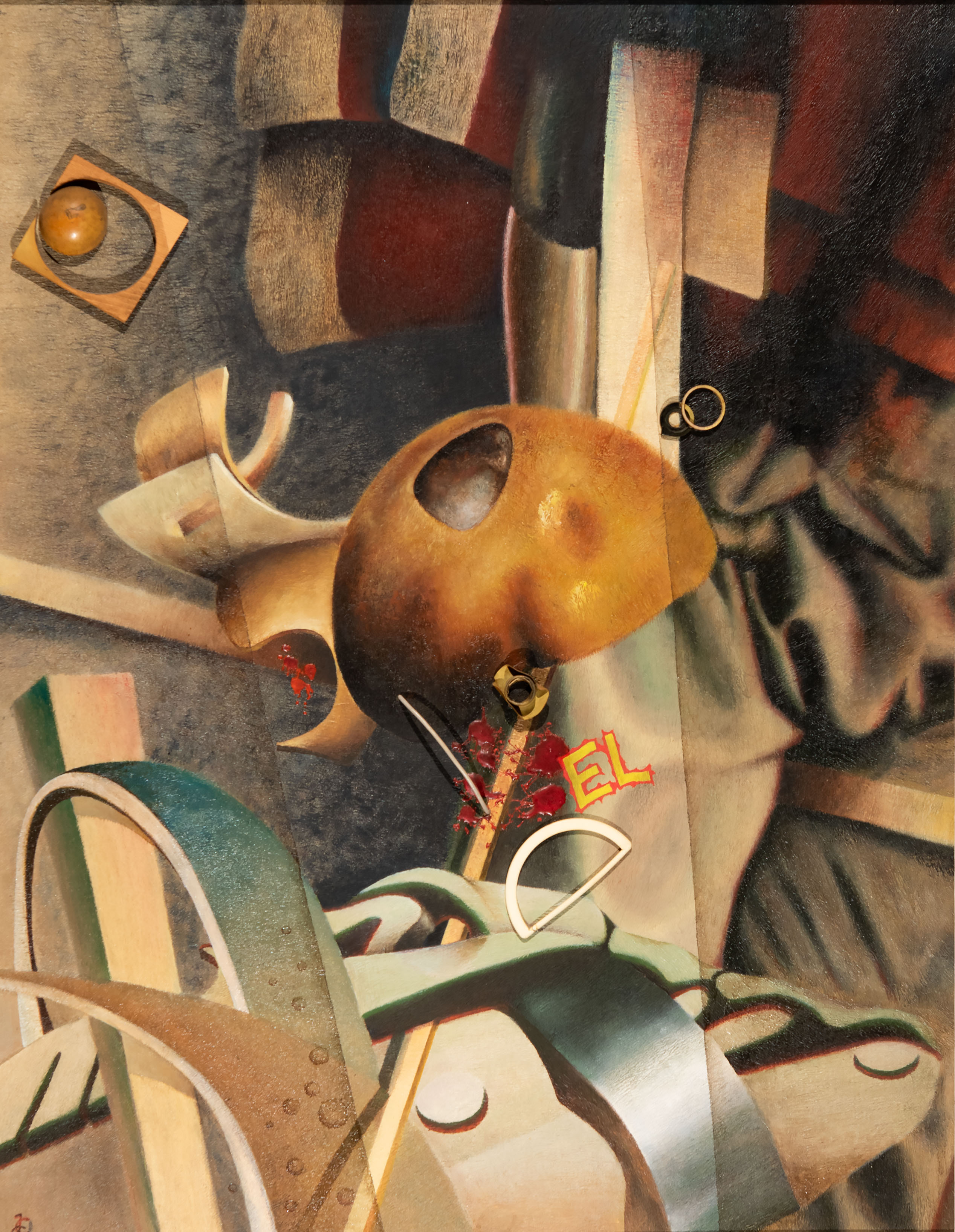
Homage to El Lissitsky, 1983. Composition in the colors of music: Twelfth Street Rag (SP, 3’08”) from the record Louis Armstrong, The Hot Fives & Hot Seven, 1927. Oil, wood, and metal on canvas, 92.8 x 73 x 4 cm (36 9/16 x 28 3/4 x 1 9/16 in.). Norton and Nancy Dodge Collection of Nonconformist Art from the Soviet Union. D14036
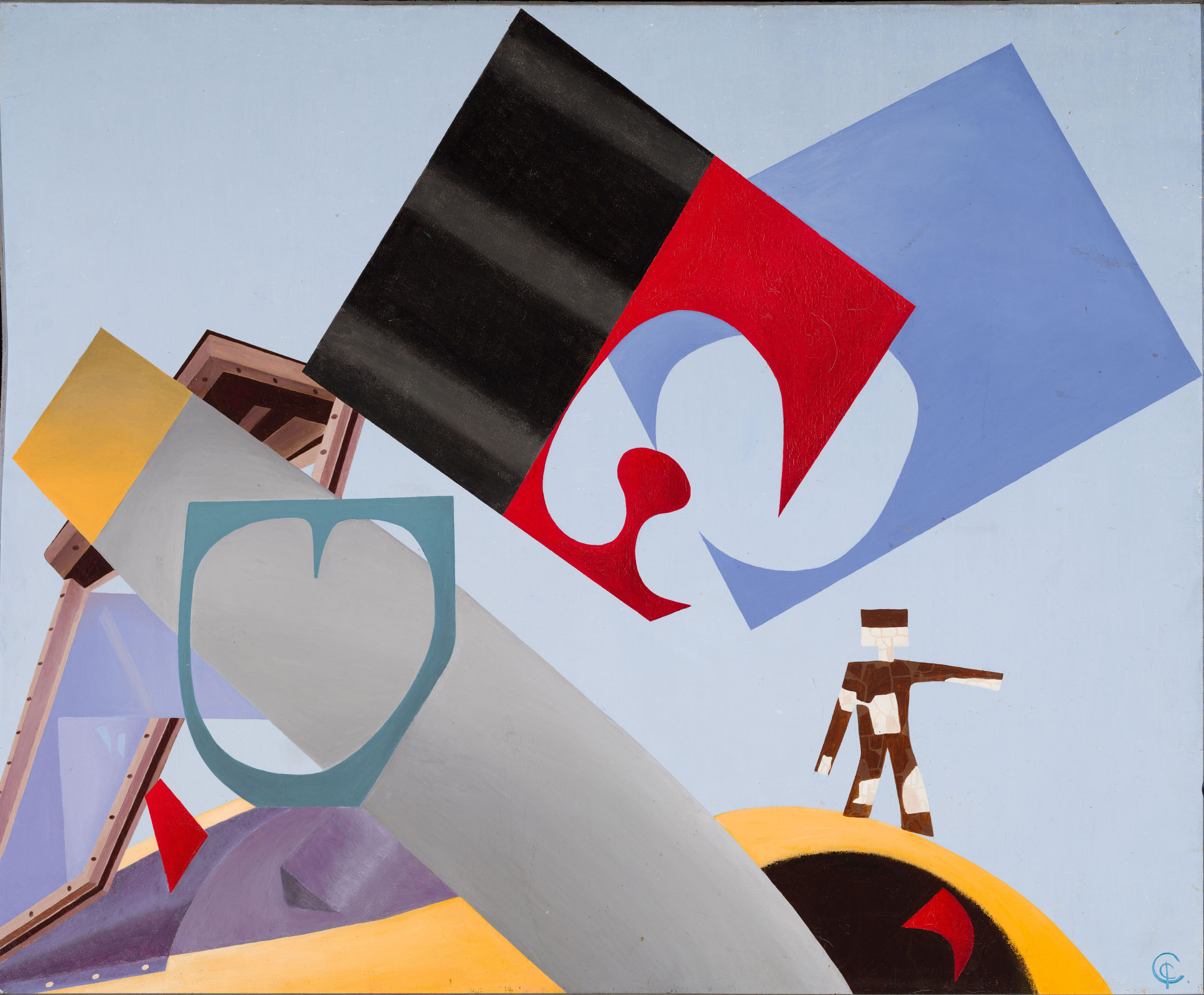
Ticket to Ride. Composition in the colors of music from the record: The Beatles, Revolver, 1966 (LP. 35’04”), 1977. Oil and gouache on canvas, 82.3 × 100.5 cm (32 3/8 × 39 9/16 in.). Norton and Nancy Dodge Collection of Nonconformist Art from the Soviet Union. D01602
Selected Exhibitions
1981 On Bronnitskaya Street, apartment exhibition, Leningrad, USSR
1984–87 TEII exhibitions, Palace of Youth and Kirov House of Culture, Leningrad, USSR
1988–89 The Leningrad Show: Twenty-One Artists from the Fellowship of Experimental Fine Art (TEII), Gallery Rout One, Point Reyes Station, CA; University of California at Davis, Davis, CA; Santa Cruz Museum of Art & History, Santa Cruz, CA; University of Oregon, Eugene, OR; Erikson Center, Cambridge, MA, USA
1990–91 Keepers of the Flame, Fisher Gallery, University of Southern California, Los Angeles, CA; Berman Museum of Art, Ursinus College, Collegeville, PA, USA
2006–08 The Space of Freedom: Apartment Exhibitions in Leningrad, 1964–86, Joel and Lila Harnett Museum of Art, University of Richmond Museums, Richmond, VA; Faulconer Gallery, Grinnell College, Grinnell, IA; Samek Art Gallery, Bucknell University, Lewisburg, PA, USA
2007 I drank the sea. The experience of nostalgia. Part I., Museum of Nonconformist Art, Saint Petersburg, Russia (solo)
2011 Transgeometry of Memory, Museum of the Petersburg Avant-Garde (House of Mikhail Matyushin), Saint Petersburg, Russia (solo)
2013 The Color of Music III, Museum of Nonconformist Art, Saint Petersburg, Russia (solo)
2014 Total Transparency, Museum of Nonconformist Art, Saint Petersburg, Russia (solo)
2016 Superstrings of Kandinsky, Museum of Nonconformist Art, Saint Petersburg, Russia
2018–19 Parallelosphere of Color and Sound, Museum of Nonconformist Art, Saint Petersburg, Russia (solo)
Selected Publications
Demshina, Anna, ed. Параллелошар Сергея Ковальского [The Parallelosphere of Sergei Kovalsky]. Saint Petersburg: DEAN, 2013.
Hazard, Barbara J. Off Nevsky Prospekt: Life Amongst Leningrad’s Unofficial Artists. Berkeley: Open Books, 1992.
Khlobystin, Andrey. «Заполняя форму пустоты» [Filling the form of emptiness]. In Art & Times 1, no. 12 (2004).
Kovalsky, Sergei. Parallelosphere of Color and Sound. Saint Petersburg: DEAN, 2018.
Linnik, Yuri, ed. Параллелошар. Онтология. Семантика. Эстетика [Parallelosphere. Ontology. Semantics. Aesthetics]. Saint Petersburg: DEAN, 2013.
Vertin, Liza. «Под черным флагом» [Under the Black Flag]. In Новый Мир Искусства (НОМИ) [New World of Art] 4, no.15 (2000): 23.
See also