
Sergei Kalmykov
1891 — Samarkand (Uzbekistan) | 1967 — Alma-Ata (Kazakhstan). Worked in Alma-Ata (Kazakhstan)
Those who lived in Alma-Ata in the mid-twentieth century share a clear memory of Sergei Kalmykov, an extravagant man whose appearance in the streets invariably attracted crowds of spectators. He would wear a long robe embroidered with ribbons and bells, a bright beret, and a big canvas bag slung over his shoulder. From this, he would produce a sketchbook—and suddenly, before the eyes of the crowd, a landscape would be born.
When he passed away in 1967, his tiny apartment in the middle of a sleepy neighborhood was found to conceal—besides piles of old newspaper that served as a bed—thousands of artworks, including paintings, drawings, sketches, engravings, and diaries. Everything he created was an act of revelation in its own way, a kind of monologue flung into outer space.
In Kalmykov, the Russian avant-garde found its unexpected continuation far from the capital centers and artistic hubs, under conditions of almost complete cultural isolation. Kalmykov did not only draw, he obsessively filled the world with himself. His diaries are an endless flood of thoughts, prophecies, formulas, manias. He believed he could see the deepest truth in the vibration of a line, in the “pulsing of a point.” [1] He conversed with Leonardo da Vinci and named himself the Great Dresser (for his costume design), the Architectonic (sic) of Time. He dreamed of art as a mission from which one could not turn away, even at the cost of their life.
Rejected by society, expelled from the system, Kalmykov created his own world. Somewhere between madness and genius, he was the last prophet of the avant-garde. The Zimmerli Collection includes works from Kalmykov’s late period, created shortly before his death. Among them is a self-portrait in the form of a jack of spades playing card, depicting a young man in full figure against the backdrop of a Leningrad landscape—an inscription identifies the painting as an illustration for the artist’s memoirs. The examples of monumental art are executed in the artist’s characteristic manner of combining different materials, merging images and symbols from various eras and civilizations, filling the picture plane with intersecting vertical and horizontal lines resembling a chessboard, and consistently incorporating text into the composition. The collection also features examples of text heading designs, which constitute independent artistic statements.
Kalmykov spent his childhood in Orenburg, Russia, near the Kazakhstan border. He studied painting in private studios of the Russian impressionist Konstantin Yuon in Moscow and, in 1910, in Saint Petersburg with Kuzma Petrov-Vodkin; the Lithuanian-Russian painter, illustrator, and theatrical designer Mstislav Dobuzhinsky; and the progressive modernist Elizaveta Zvantseva. When the Great War began in 1914, he returned to Orenburg and did his military service in Kazakhstan. After 1917, he participated in Orenburg’s exhibitions and in the significant undertakings of Orenburg artists of the 1920s, created unique avant-garde projects, delivered public talks, and taught. Starting in the mid-’20s, he worked as a designer and decorator at circuses and theaters, and followed a traveling opera through the cities of the Volga and Ural regions. At the end of the 1930s, he settled permanently in Alma-Ata, where he had been invited by composer Evgenii Brusilovskii to join the musical comedy theater that had opened in 1935 (renamed the Abay Kazakh National Opera, and Ballet Theater) as an artist-decorator. Kalmykov remained in Alma-Ata for the rest of his life, and created the vast majority of his work there.
The struggle with formalism in Soviet art and the attitude toward the artist as a local eccentric or madman could hardly have contributed to the appraisal of his works as worthy of museum collections. Immediately after Kalmykov’s death, the director of the T. Shevchenko Kazakh State Art Gallery (part of the future Abylkhan Kasteev National Museum of the Arts of the Republic of Kazakhstan), Lubov Georgievna Plakhotnaya, had the bulk of his work transferred, with over a thousand of the best pieces going to the gallery and handwritten diaries and other documents going to the State Archive of the Republic of Kazakhstan.
As an expansion of notions about time and space, Einstein’s theory of relativity, developed from 1905 to 1915, clearly inspired the artist. The concepts of cosmism defined the essence of his work, which was clearly ahead of its time. His artistic universe is populated with visitors from interplanetary civilizations, organically dovetailing with landscapes and mythological scenes flooded with the light of astral worlds. Kalmykov dreamed that one day he would be fortunate enough to see heavenly cities descending to the earth, reconfiguring the world.
Like many avant-gardists, he created his own theory of art, based on geometrical harmonies. Terming himself an “architectologist,” he created compositions that strove for exact, proportionate forms—a steady square, an equilateral triangle (the sides representing beginning, middle, end). And finally, he held that the basis of everything in existence is a point, “the zero state of an infinite number of circles,” and a point in motion is a line, “an infinite number of rows can intersect in one point, and this is the infinitude of the infinite.” [2]
Admiring da Vinci’s genius, Kalmykov conducted imaginary conversations and correspondences with him, at times identifying with him. The sheer scale of his thinking and the universality of his technical and artistic skills made this possible.
One important element in the poetics of his work is the theme of the cup, embodied in the series Звёздная чаша [Star Cup, 1930–40]. The vessel appears as a certain center of the spirit, a repository of the highest substance of heaven, a symbol of the universe, organically combining real-body pieces and astral objects. The forces of cosmic energies are transmitted through phantasmagorical images, exaggerated color, vibrating brushstrokes, and pulsing lines. He had a special attitude toward the line—nervous, mobile, rattling, emotional. It moves ceaselessly from one object to another, simultaneously designing their presence and dematerializing them.
As art critic Yelizaveta Kim put it: “The peculiarity of S. I. Kalmykov’s art is its dualism, which can be traced in his work in any form. If we look at theater, then on the one hand these are sketches for particular productions, and on the other they are also fantasy drawings from the life of ancient civilizations. If he creates portraits, then this genre organically combines expressive images of contemporary people and marquises, poets from the cycle Majestic Portraits, and also representatives of the future, of the thirtieth century. His landscapes are true, quiet corners of Orenburg or Almaty, and are fantastical, in the ‘MONSTER’ style, landscapes in which space is used in a manner that recalls George Lucas’s Star Wars. Kalmykov wrote, ‘And I became the herald of the MONSTER style, a style of approaching squalls and cataclysms.’ The artist’s ‘maidens’ are particular ballerinas from the theater and daughters of the Great Dresser, Leda, Graces, caryatids. Still lifes in the artist’s work are images of a few objects from his modest everyday life and ‘nuclear bomb reflectors.’” [3]
Kalmykov’s genius remains a paradox in the history of twentieth-century Kazakh and Russian art. In his life, he was marginal, ignored by institutions, and dismissed by society. Today, he is a nearly mythic figure, arousing the interest of museum curators, researchers in post-humanism, and new media artists. His strategy of the complete subjectivization of creativity, of total diary-keeping, of ceaseless self-construction, is gaining special relevance today in not only regional but even international contexts.
The artist wrote in his diary: “Thousands of eyes are upon the Earth from far off in the cosmos. And what do they see? A dull, monochromatic, gray mass crawls and crawls across the earth, until … suddenly, like a shot, one spot brightens—it’s me hitting the street!” The title of Igor Gonopolskii’s 1991 documentary about Kalmykov’s life and work was taken from this passage: Это я вышел на улицу! [It is I who went out to the street!]. [4]
Master of color geometry (as he described himself in his personal writings), grandmaster of the great lines, great dresser—these are not by a long shot all the epithets the great artist gave himself. Kalmykov was an obsessive artist, a graphomaniac hermit, who left indecipherable messages to the future. Although his life was marked by poverty, ridicule, and isolation, after his death he achieved recognition, and his work was sought by museum collections.
Katerina Reznikova
Translated from Russian by Ian Dreiblatt
Notes:
1. Sergei Kalmykov, diaries.
2. Levina, N., and E. Liubov, eds. Три портрета: Жизнь и судьба творца в психиатрическом интерьере [Three portraits: Life and destiny of a creator in psychiatric context]. Moscow: New Choices, 2010: 39.
3. Kim, Yelizaveta. Sergey Kalmykov: Painting, graphic art from the collection of the A Kasteev State Museum of Fine Arts of the Republic of Kazakhstan. Almaty, 2017: 27.
4. Igor Gonopolskii, Это я вышел на улицу! [It is I who went out to the street!], 1991, three-part documentary, 10.3-minute excerpt on YouTube.
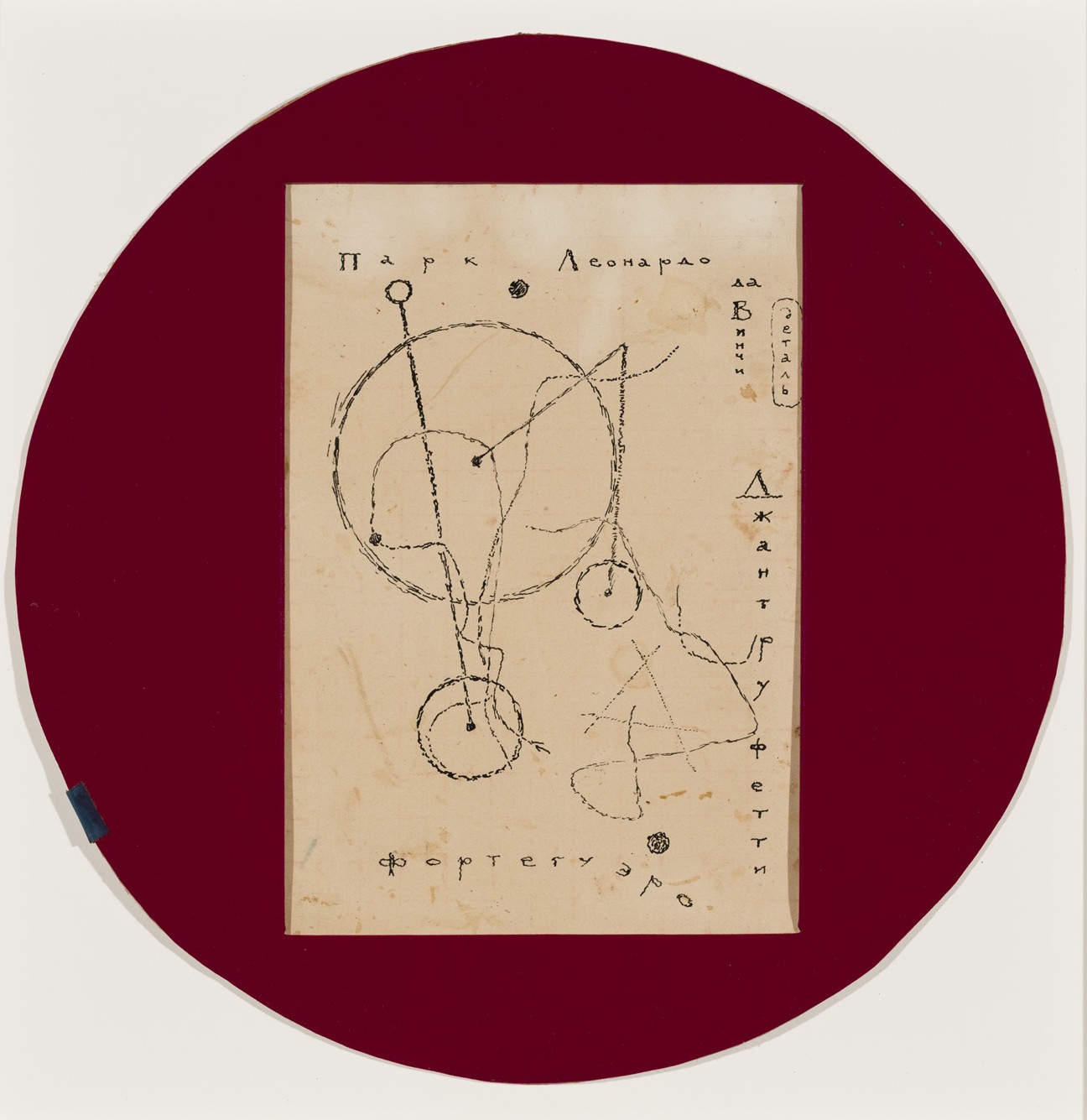
Park Leonardo da Vinci (detail) [by] Dzhantrufetti Fortequero, undated. Ink on paper, 19.7 × 13.8 cm (7 3/4 × 5 7/16 in.). Purchased with funds donated by Norton Dodge and Nancy Dodge. 2000.0062
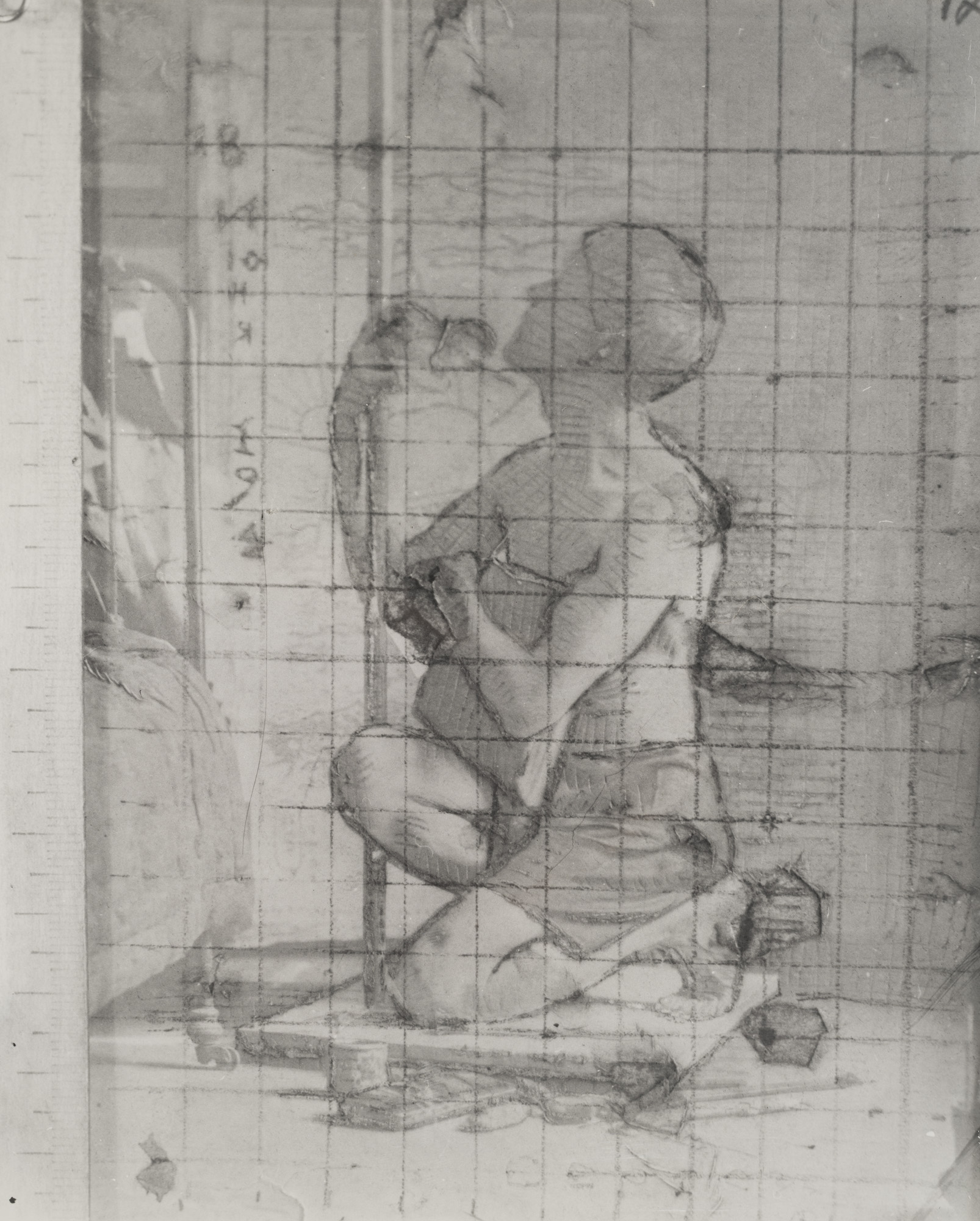
Self-Portrait with Shaft, 1997. Photographic print (made from archival negative) on paper, 80 × 65 cm (31 1/2 × 25 9/16 in.). Purchased with funds donated by Norton Dodge and Nancy Dodge. 2000.0045
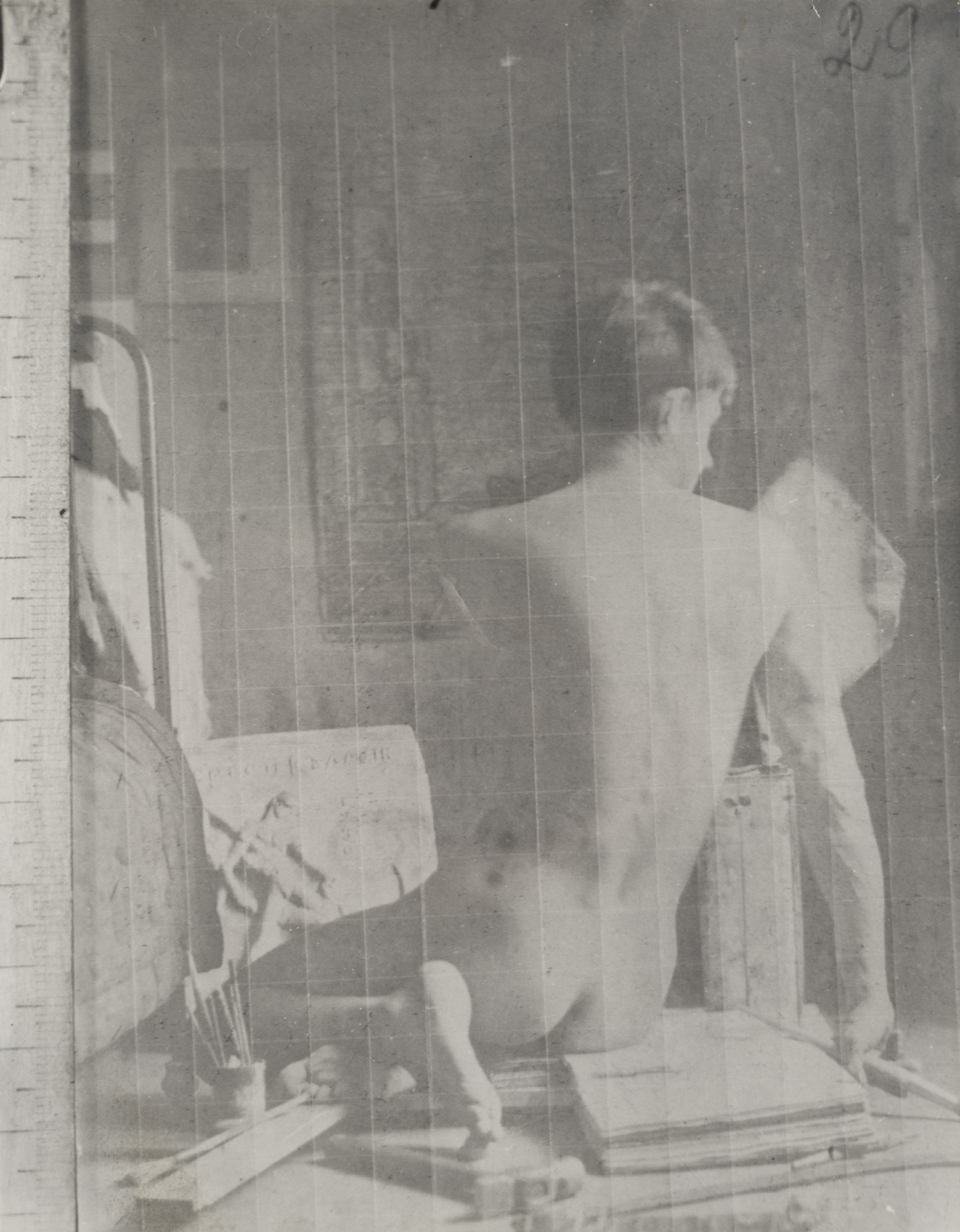
Self-Portrait (Nude), 1997. Photographic print (made from archival negative) on paper, 79.8 × 62 cm (31 7/16 × 24 7/16 in.). Purchased with funds donated by Norton Dodge and Nancy Dodge. 2000.0046
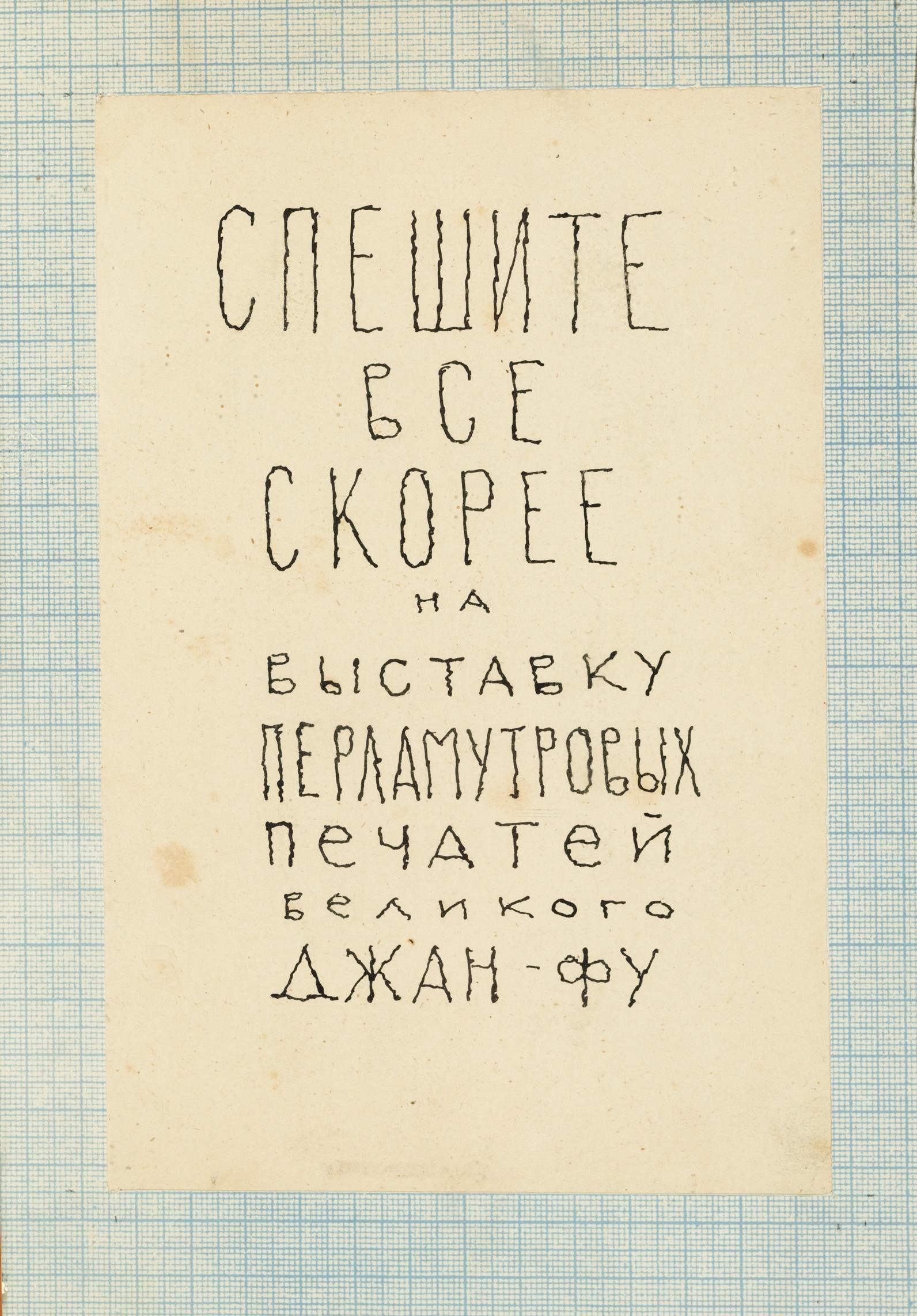
Hurry even faster to the exhibition of opalescent prints by the great Dzhan-Fu, undated. Ink on paper, 19.7 × 13 cm (7 3/4 × 5 1/8 in.). Purchased with funds donated by Norton Dodge and Nancy Dodge. 2000.0066

Example of a Witticism, 1966. Graphite and colored pencil on paper, 22.3 × 29.6 cm (8 3/4 × 11 5/8 in.). Purchased with funds donated by Norton Dodge and Nancy Dodge. 2000.0064
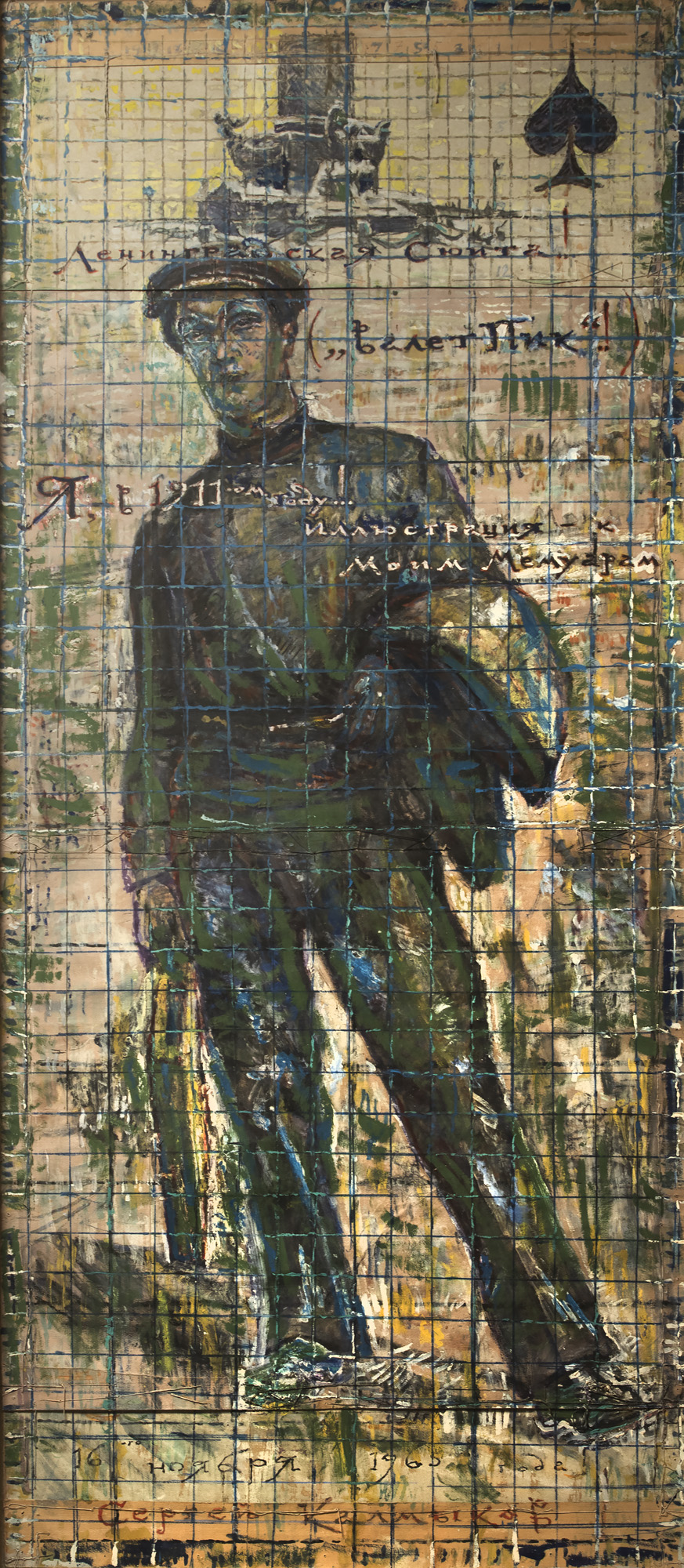
Self-Portrait, 1965. Gouache and string on paperboard, 180.5 x 79.9 cm (71 1/16 x 31 7/16 in.). Purchased with funds donated by Norton Dodge and Nancy Dodge. 2000.0036
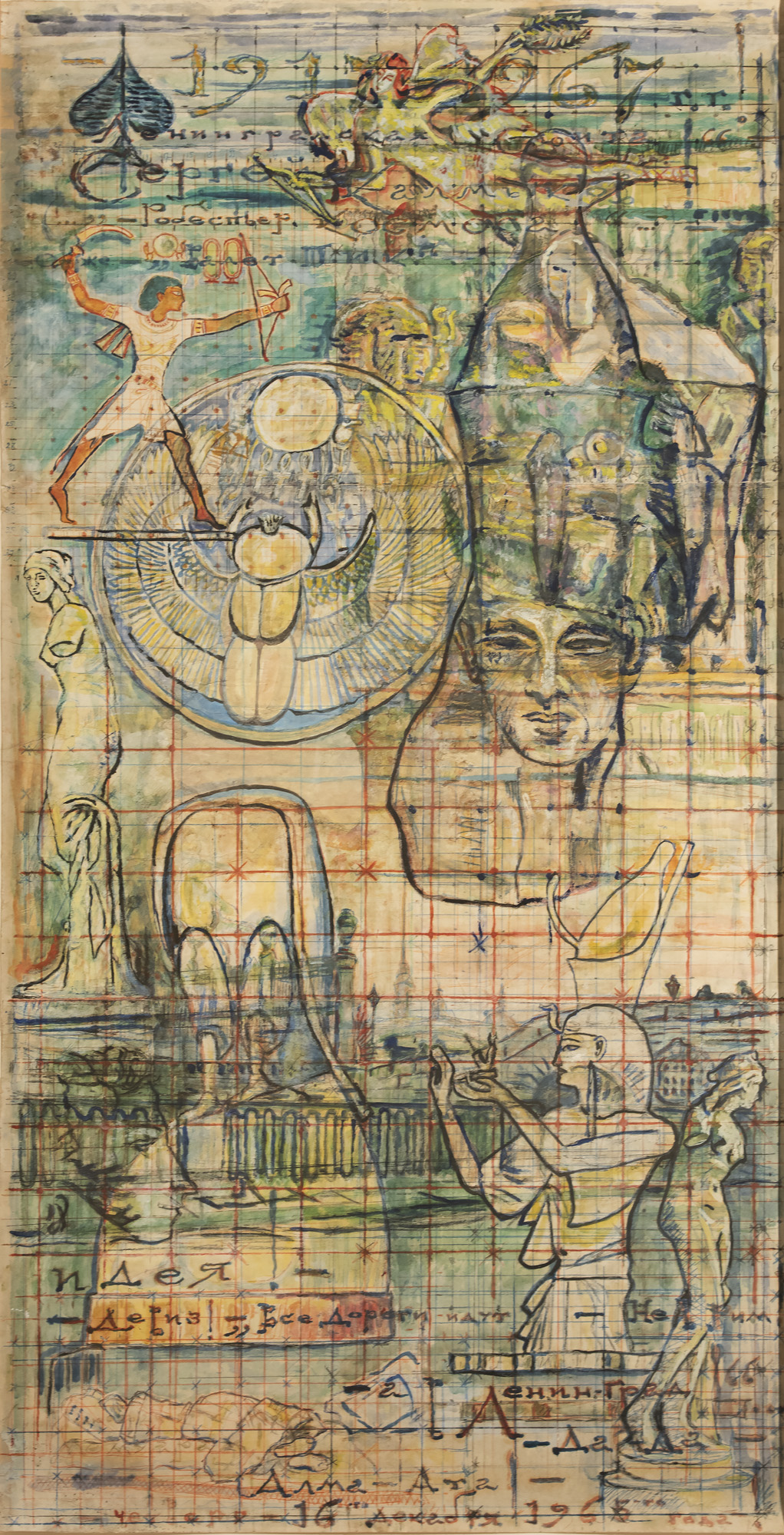
Untitled (Self-Portrait), 1965. Watercolor, gouache, graphite, colored pencil and ink on paper mounted on linen, 167 x 84 cm (65 3/4 x 33 1/16 in.). Purchased with funds donated by Norton Dodge and Nancy Dodge. 2000.0069
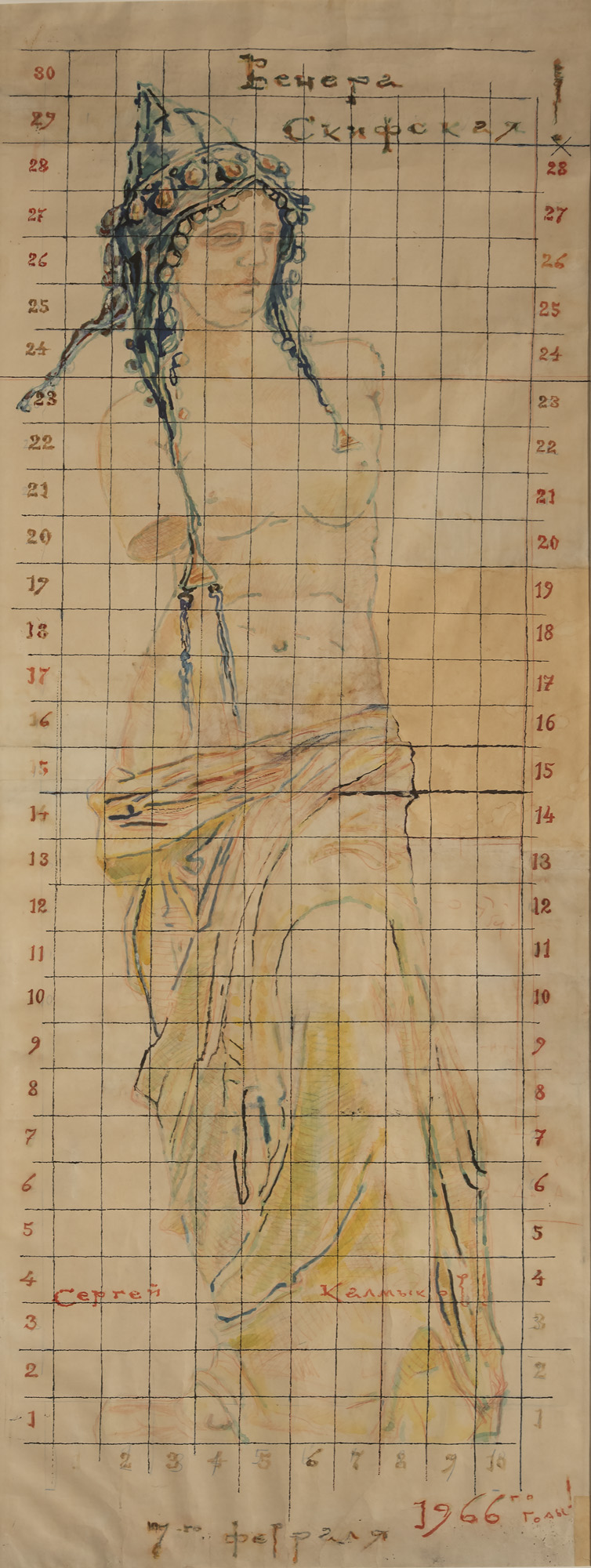
Scythian Venus, 1966. Tempera on paper, 162 x 59 cm (63 3/4 x 23 1/4 in.). Purchased with funds donated by Norton Dodge and Nancy Dodge. 2001.0130