
Sergei Balenok
1954 — Boiarka (Ukraine). Lives and works in Minsk (Belarus)
Sergei Balenok was born on May 31, 1954, in the village of Boiarka, in the Kyiv region of present-day Ukraine. After serving in the army (1972–74), he enrolled at the Ivan Fyodorov Polygraphic Institute in Lviv (now Ukrainian Academy of Printing), Ukraine in 1975, studying under Yury Charyshnikov (b. 1947). Upon completing his studies in 1980, he moved to Minsk and later entered the Creative Academic Workshops of the Belarusian State Theater and Art Institute (now the Belarusian State Academy of Arts), graduating in 1987. His first solo exhibition took place that year. In 1988 he became a member of the BSSR Artists’ Union (later renamed the Belarusian Artists’ Union).
From 1980 to 1995 the artist collaborated extensively with publishing houses, creating book illustrations that earned him wide recognition and provided an opportunity to shape his distinctive style. The only illustrations he created for a specific publication were images for a volume by Jules Verne, while his other illustrations were originally created as stand-alone graphic works and later adapted for publication in various literary editions. Among the most notable books illustrated by Balenok are Kurt Vonnegut's Cat’s Cradle; the anthology Wings of the Night; selected works of Mikhail Bulgakov; the science fiction collection Planet for Sale; several poetry collections of Joseph Brodsky; and books by Isaac Asimov, Ray Bradbury, and Robert Sheckley, among many others. He worked as an art editor in various Minsk publishing houses: From 1980 to 1989, he served as an art editor at the publishing house University (Універсітэцкае, Unіversіtetskaye, affiliated with Belarusian State University); from 1986 to 1992, he was the chief art editor at the publishing house Eridan; in 1993, he became the chief art editor at the publishing house Belarus; and finally, from 1993 to 1995, he served as the director of his own private publishing house, Balenok & Co. He has been working as a freelance artist since the end of his publishing career in 1995.
Balenok’s work has a strong affinity with science fiction, and his pieces are particularly well suited to illustrating this genre. His work is characterized by metaphysics and mysticism, aligning with the literary genre of magic realism. Magic realism in his art is accentuated in the recognizable silhouettes of landscapes and buildings, where something mysterious and extraordinary takes place that transcends the conventional understanding of reality. This effect is achieved through the conventional presentation of images, a certain disorderliness, and even a deliberate profanity in the stylization of forms. His works also share with science fiction a premonition of global disaster. Balenok leaves ample empty space in his compositions, avoiding filling the sheet entirely with hatchings, thus steering clear of artificiality, intricacy, and decorative elements, creating a supernatural spatiality in his works, where deserted and eerie landscapes become the main settings for unfolding plots—as in his 2013 etching Shallow Waters . . . or One Can Just Be Staring at the Bottom of the Glass, in which a series of zoomorphic and anthropomorphic figures appear to float within an abstract, eerily deserted space.
At the center of all his plots are the inhabitants of these wastelands: anthropomorphic and zoomorphic figures, depicted at times in an abbreviated and concise manner, and at times with elaborate detail and intricate hatchings. His works often evoke puppet theaters and eerie nightmares, with their dreamlike logic. The characters in his works, like ghosts in metaphysical spaces, perform their mundane ceremonies, hovering above the ground, their interactions with each other tinged with a sense of alienation. The artist has referred to his shadowlike characters as “lost souls with an extra shard of intellect in the brain.” [1] The body parts of numerous figures extend beyond the frame, rupturing the space of the image and revealing the logic of the frame, while also enhancing the effect of a dream or an animation. Balenok also often uses images of spheres, either floating in space or appearing as empty eye sockets of characters, imbuing them with a dull and eerie gaze. This category of horror characterizes the plots of his works: not just the fear of encountering the unknown, but rather a state of horror—as in Freud—of something familiar to us, but rendered strange, unfamiliar, and therefore frightening. The artist often works with his subconscious: “There is nothing concrete, everything is from the realm of sensations, emotions. Everything is present in my paintings. People, houses, a flying fish. Why is it flying? These are its problems. As Proust said, art is a visual means of understanding oneself. I have a picture called ‘Sometimes a six-legged memory rushed in.’ Who knows what it means.” [2]
The influence of literature can be found not only in the peculiar lyricism of Balenok’s works but also in the long, poetic titles he meticulously crafts during the preparation of his etchings. Sometimes, the work itself starts with the title. The artist often puts titles in lowercase letters and uses ellipses, creating the effect of a quote taken from a book. Here are examples of the titles of his etchings: “perhaps you can leave or wait some more . . .” (2007), “dark lamp, dark windows, dark wine . . . and twilight inside . . .” (2022), “. . . brick walls, brick doors . . . and blind windows . . .” (2023). These titles and the images themselves seem to form a single narrative—an endless story where strange creatures find refuge along empty streets, wandering alone through a sleeping, damp, and inhospitable city.
Balenok's favorite techniques include etching, aquatint, mezzotint, and drypoint. He uses various tools such as etching needles, other needles, and nails to create a variety of lines. The empty space in his works vibrates due to scratches, debris, textures, and other seemingly random interferences, making his works appear aged and even more ethereal. The needle scratches the metal of the etching as if trying to reveal this fantastic world of special emotions—the subtle shades of magical sadness. The artist succeeds in capturing complex human emotions, feelings, and sensations, yet almost always with a touch of irony, as the parallel world of his bleak postapocalyptic universe takes shape before our eyes.
Among the most important collectors of Balenok’s work is the Belarusian art collector Alexander Ivanov, who has assembled a complete collection of the artist’s prints. In 2004 the artist left the Belarus Artists’ Union. Since 2011 he has held the position of senior researcher at the exhibition department of the National Center for Contemporary Arts of the Republic of Belarus. Between 2014 and 2017 he created a series of bright and cheerful landscapes and still lifes, made with oil paint applied on the surface of canvas with thick, square brushstrokes. His recent art thus manages to reconcile wandering, troubled heroes set against the backdrop of deserted landscapes with sunny, life-affirming painting.
Sergey Shabohin
Photo portrait by Andrey Yankovsky, 2015
Notes
1. Kamila Yanushkevich, “Blyuz zhaleznaga dakhu” [Iron-Roof Blues], Mastactva 9, no. 378 (2014), p.9.
2. Sasha Romanova, “Sergey Balenok: I zavtra tozhe ” [Sergey Balenok: And Tomorrow Too . . . (interview)], Mixtura, February 20, 2006.

Untitled, 1982. Linoleum block print on paper, 26.4 × 27.5 cm (10 3/8 × 10 13/16 in.). Norton and Nancy Dodge Collection of Nonconformist Art from the Soviet Union. D15572
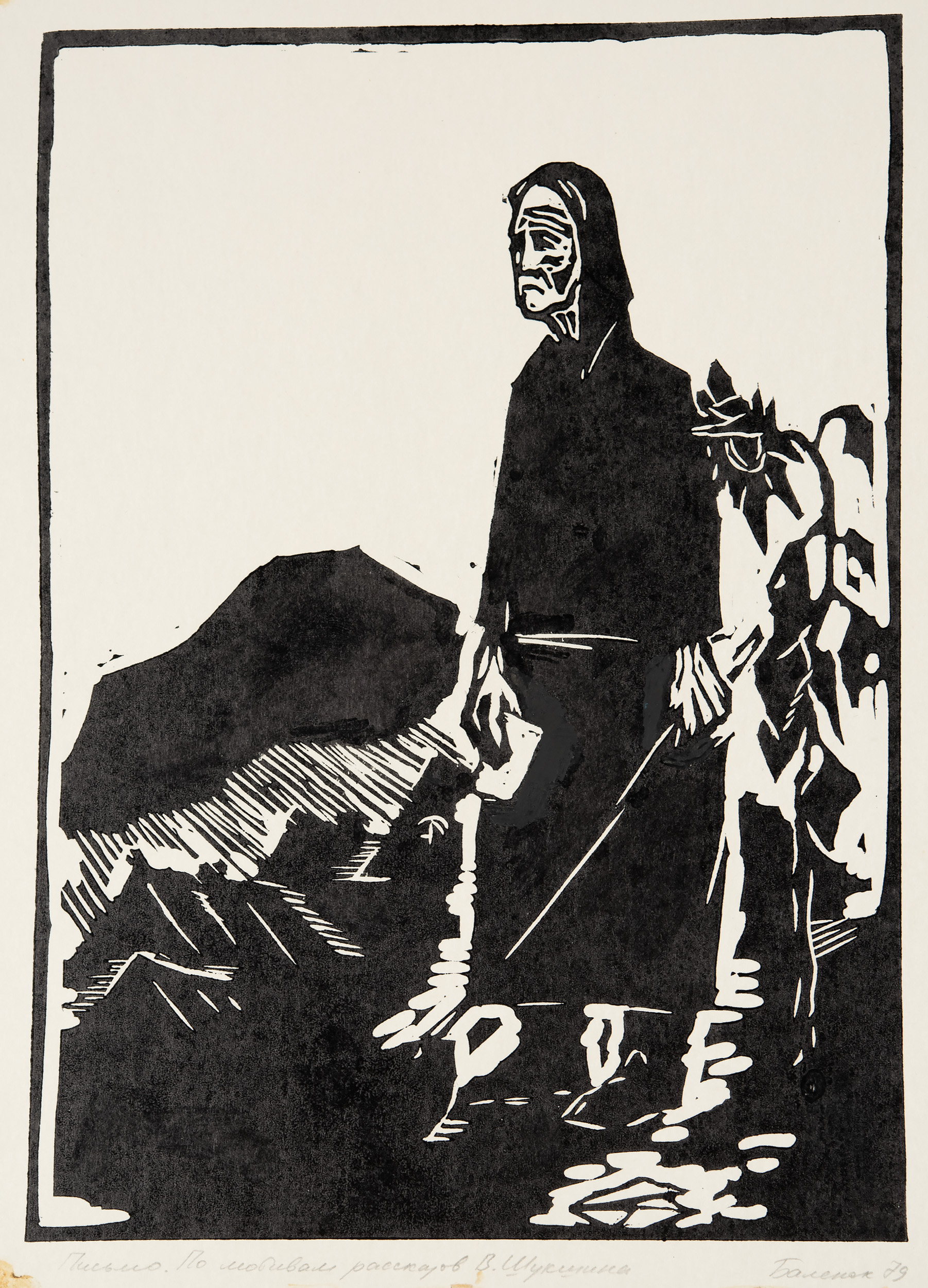
The Letter. Based on V. Shukshin stories, 1979. Linoleum block print on paper, 29.9 × 21.6 cm (11 3/4 × 8 1/2 in.). Norton and Nancy Dodge Collection of Nonconformist Art from the Soviet Union. D15571
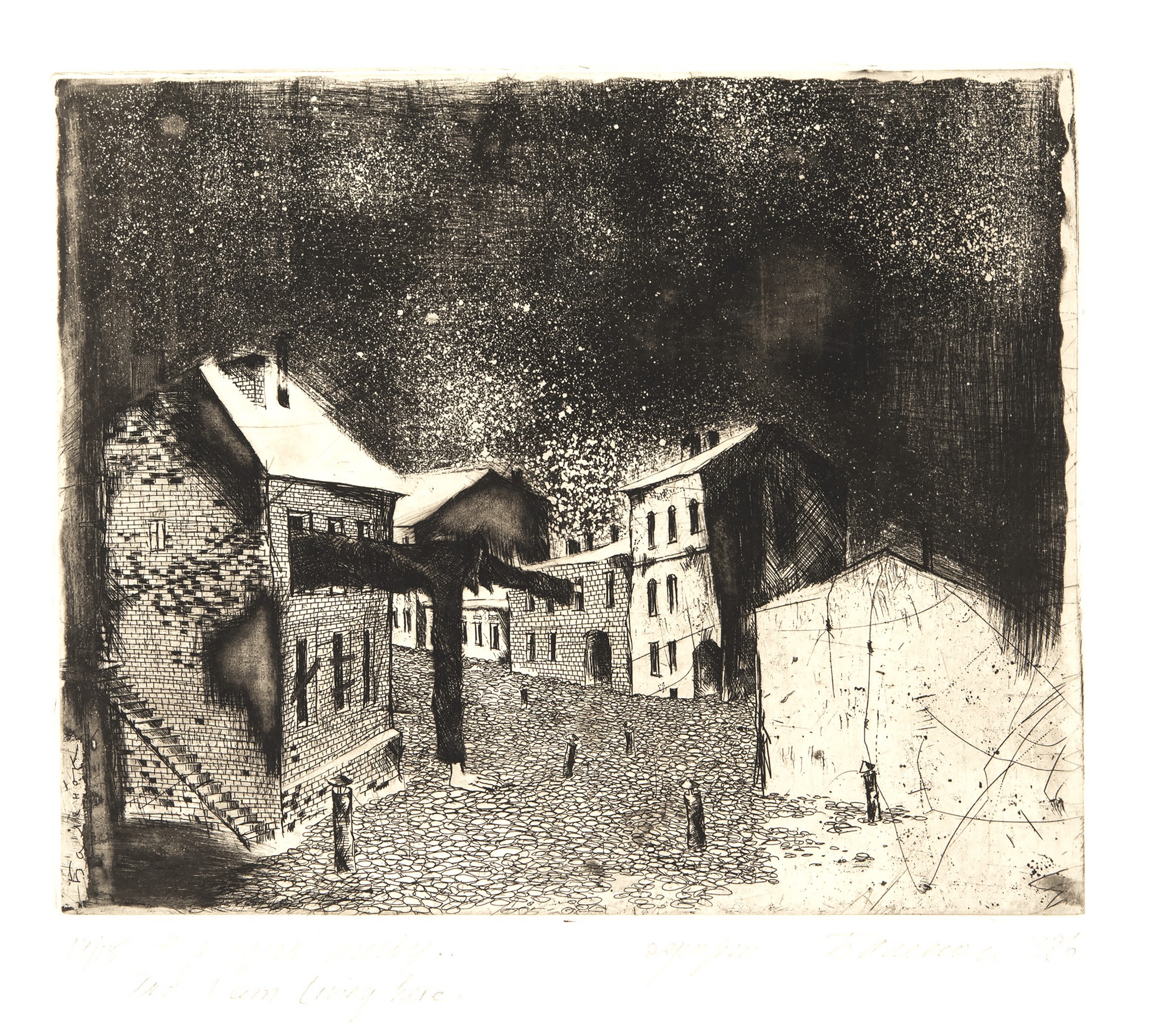
And I am Living Here, 1986. Etching on paper, 28.1 × 33.5 cm (11 1/16 × 13 3/16 in.). Norton and Nancy Dodge Collection of Nonconformist Art from the Soviet Union. D15230
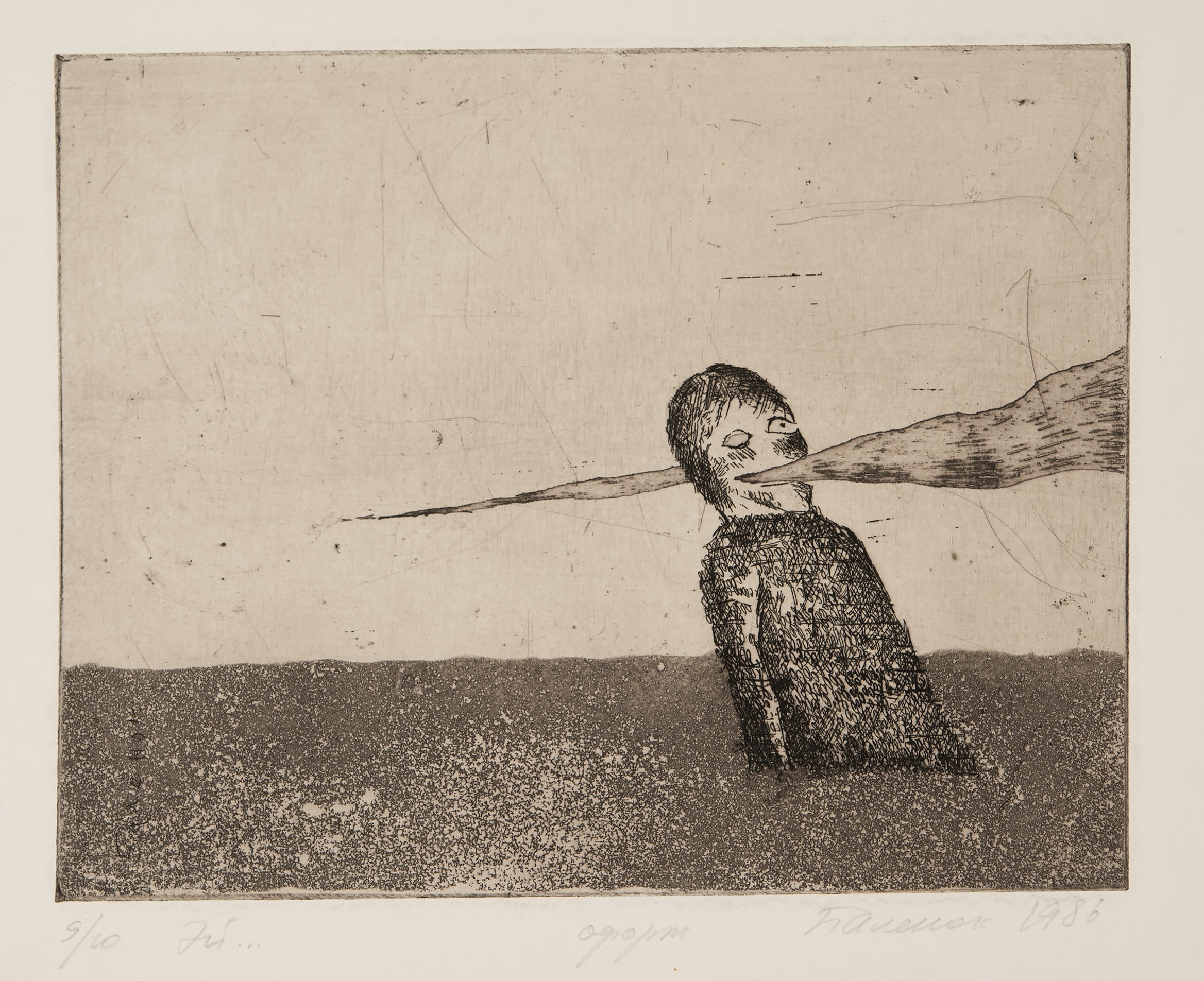
Untitled, 1986. Etching on paper, 18.6 × 23.1 cm (7 5/16 × 9 1/8 in.). Norton and Nancy Dodge Collection of Nonconformist Art from the Soviet Union. D15568
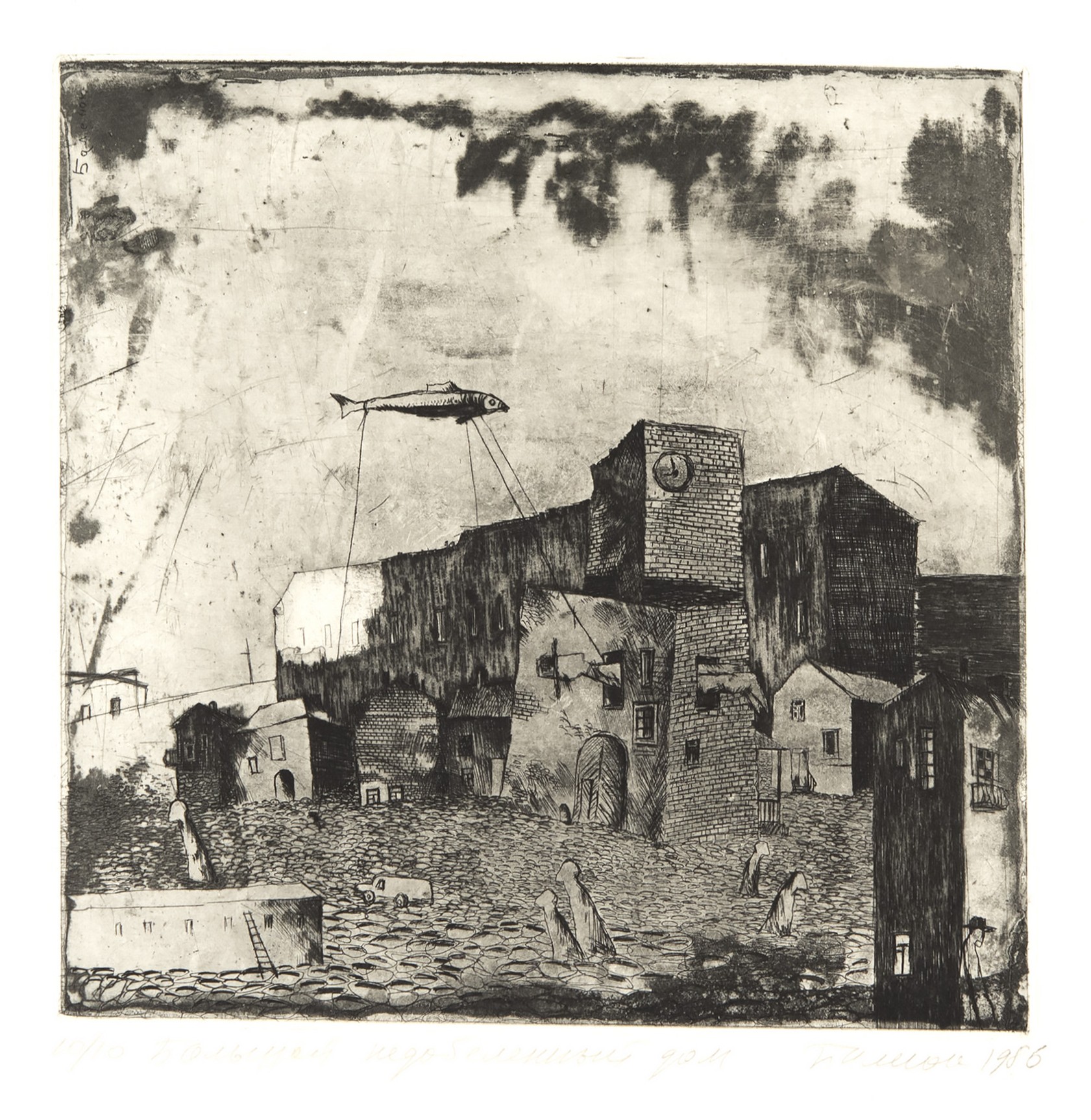
A Big House Not Made White Enough, 1986. Etching on paper, 27.7 × 27 cm (10 7/8 × 10 5/8 in.). Norton and Nancy Dodge Collection of Nonconformist Art from the Soviet Union. D18563