

Semyon Faibisovich
1949 — Moscow (Russia). Worked in Moscow (Russia); works in Tel Aviv (Israel)
Semyon Faibisovich was born in Moscow on February 10, 1949. From 1959 to 1964, he studied at the Krasnopresnenskaya Art School. Like many artists of the Soviet underground, he never received formal higher education in the arts. Instead, in 1966, he enrolled in the Moscow Institute of Architecture, graduating in 1972. He then worked in various architectural bureaus and participated in the design of the press center for the 1980 Moscow Olympics. From 1979 to 1988, he served as an architect and designer at the Monumental Art Department of the USSR Art Fund.
Frustrated by the ideological constraints of Soviet architecture, Faibisovich began exploring alternative forms of expression. Alongside his architectural work, he turned to graphic art and eventually painting. His training in architecture provided him with a strong sense of composition, spatial logic, and visual perspective—qualities that would profoundly shape his artistic language.
In the early 1970s, after graduating from the Architectural Institute, Faibisovich began developing his distinctive artistic method. He worked exclusively in graphic media, and his earliest works focused on scenes from his domestic environment: bottles on windowsills, jars of flowers, bathroom and kitchen interiors, self-portraits, and portraits of his family—all fragments of everyday life. During this period, his distinctive artistic style began to emerge. Though frequently compared to American photorealism, Faibisovich consistently rejected the label, asserting that his approach developed independently. In 1976, he began exhibiting his works at Gorkom grafikov [City Committee of Graphic Artists] on Malaya Gruzinskaya Street.
His first encounter with American photorealism likely occurred during the 1977 exhibition American Painting from the Second Half of the 19th and 20th Centuries, at the Pushkin Museum in Moscow, which featured artists such as Richard Estes (b. 1932), Ralph Goings (1928–2016), and Chuck Close (1940–2021). The exhibition came as a profound shock to the artist. Encountering the works of American photorealists, Faibisovich experienced a temporary creative crisis, as he had believed he had already developed a unique artistic method of his own. He later overcame this crisis and continued his experiments in painting and photography.
The defining moment in Faibisovich’s turn toward art came from a deeply personal experience during his daily commute. In the 1970s, he lived with his family on the outskirts of Moscow, where there was no metro service. Amid his daily routines—waiting for the bus and taking a long bus ride to and from work each day—he began noticing the fleeting beauty of shifting light, warped reflections, and unusual spatial distortions inside public transport. Initially attempting to capture these impressions with a Zenith V camera, he found black-and-white film inadequate and began retouching the photographs. This process evolved into fully realized paintings, forming the basis of his first significant series.
Faibisovich’s works from the early 1980s focused on the unvarnished realities of Soviet life, standing in stark contrast to the idealized depictions of labor and progress promoted by socialist realism. His scenes—overcrowded buses, weary commuters, aging pensioners, and crumbling communal buildings—offered a quiet, melancholic counternarrative to the official aesthetic. Critics and the artist himself have since drawn parallels between his work and the Russian realist tradition of the nineteenth century. His paintings blend optical distortion and painterly trompe l’oeil with genre scenes rich in social commentary, constructing a portrait of late Soviet everyday life.
From the mid-1970s onward, Faibisovich began participating in exhibitions associated with the Moscow unofficial art scene, though he never formally aligned with any group. His breakthrough came in the mid-1980s, amid Mikhail Gorbachev’s reforms. The era of glasnost and perestroika opened the Soviet Union to the West, sparking international interest in underground Soviet artists. In 1985, a delegation of New York art dealers, including renowned gallerist Phyllis Kind, visited Moscow. After seeing his work at a group show on Malaya Gruzinskaya Street, Kind signed Faibisovich and facilitated his move to the United States. His international career began in 1987, with exhibitions across the US, Europe, and beyond. However, the collapse of the Soviet Union also led to a decline in Western interest in Soviet topics. This shift deeply affected Faibisovich’s work. The late Soviet world had been the central theme of his art, and the political changes marked both the end of an era and the loss of his primary subject matter.
Despite this, his core artistic method—close observation and the study of visual perception—remained. This marked a shift in focus from what was depicted to how it was perceived.
In the early 1990s, he launched the project Evidence, investigating visual distortions caused by physiological processes—residual vision, blind spots, and the effects of light, motion, and external stimuli on the human eye. These investigations inspired a new body of work exploring how perception alters reality. Despite its conceptual sophistication, the Evidence series failed to gain traction in the American art world. Faibisovich returned to Moscow, where he completed The Last Demonstration, a monumental installation that served as both a requiem for the Soviet era and a bridge to his evolving visual language. Based on overlaid colour slides, the series portrays ghostlike figures caught in a liminal, timeless space—inhabitants of a lost civilization.
In Moscow, Faibisovich began working with Regina Gallery (later Ovcharenko), which exhibited The Last Demonstration in 1992. In 1993, he showed his Evidence series, followed by Together with Spielberg (Experiment in Deconstruction) in 1995, a cycle marking the fiftieth anniversary of WWII and one of the first Russian artistic statements on the Holocaust.
Nevertheless, his traditional media and realist style clashed with the prevailing currents of Russian contemporary art. Oil painting, particularly, with its fidelity to the visible world, was often dismissed as outmoded or politically suspect. After the 1995 Farewell Anniversary exhibition at Regina Gallery, Faibisovich abandoned painting altogether. This decision was compounded by a personal crisis and a serious health diagnosis (his wife left him and he was diagnosed with diabetes)—experiences he later recounted in his autobiographical novel Case History.
Having stepped away from painting for a time—thus marking the end of the first period of his artistic career—Faibisovich turned his attention to literary work. In the late 1980s, his prose began appearing in leading literary magazines, including Ogonyok, Oktyabr, Znamya, Novy Mir, and Literaturnoye Obozrenie. He began writing essays in 1993, and in 1997 he received the Znamya Prize for his novella Uncle Adik. Both Case History and his essay collection New and Not-So-New Russians were later shortlisted for the Andrei Bely Prize.
In the late 1990s and early 2000s, Faibisovich began experimenting with video and photography. His first video work, A Bundle Under the Pine-Trees: Double Screening, appeared in 2001. He went on to win the Silver Camera Prize in 2002 (architecture) and 2004 (portrait). In 2005, he participated in the Mobilography project, which invited artists to create photographs using mobile phones. Inspired by the digital age, Faibisovich returned to painting in 2007, making work that, while still rooted in photorealism, incorporated digital glitches and visual distortions and abstraction.
The 2008 Comeback exhibition marked the beginning of a new creative period. Over the next several years, he produced series such as Trolleybus (2007–08), Razgulyai (2009), Back in the Metro (2010), My Courtyard (2012–13), A Dog’s Life (2011), and Kazansky V (2013–14). These works focused on Moscow and its inhabitants—courtyard neighbors, the homeless, stray dogs, migrant laborers from Central Asia, and commuters. Compared to his earlier, more detached works, these paintings carried a deeper sense of empathy and lyricism. In 2013, Faibisovich began Nighttime Razgulyai, his final Moscow cycle—a concluding chapter in the Comeback series and a farewell to the city and country itself.
In 2015, he emigrated to Israel, where he abandoned painting and resumed working exclusively with digital media. This new phase in his artistic journey debuted in 2020 at the New World exhibition at the GUM-Red-Line Gallery in Moscow.
Works by Faibisovich are in the collections of Time Magazine (New York, USA), Ludwig Museum (Aachen, Germany), Ludwig Múzeum of Contemporary Art Budapest (Budapest, Hungary), Zimmerli Art Museum (New Jersey, USA), Birmingham Museum and Art Gallery (Birmingham, UK), Kunsthalle Emden (Emden, Germany), Muzeum Sztuki (Łódź, Poland), ART4.ru Museum of Actual Art (Moscow, Russia), AZ Museum (Moscow, Russia), Moscow Museum of Modern Art (Moscow, Russia), State Tretyakov Gallery (Moscow, Russia), State Literature Museum (Moscow, Russia), Multimedia Art Museum, Moskau (MAMM) (Moscow, Russia), Museum of Moscow (Moscow, Russia), Jewish Museum and Tolerance Center (Moscow, Russia), Zuzeum (Riga, Latvia).
Sergey Fofanov
Photo portrait by Tatiana Liberman, courtesy of the artist
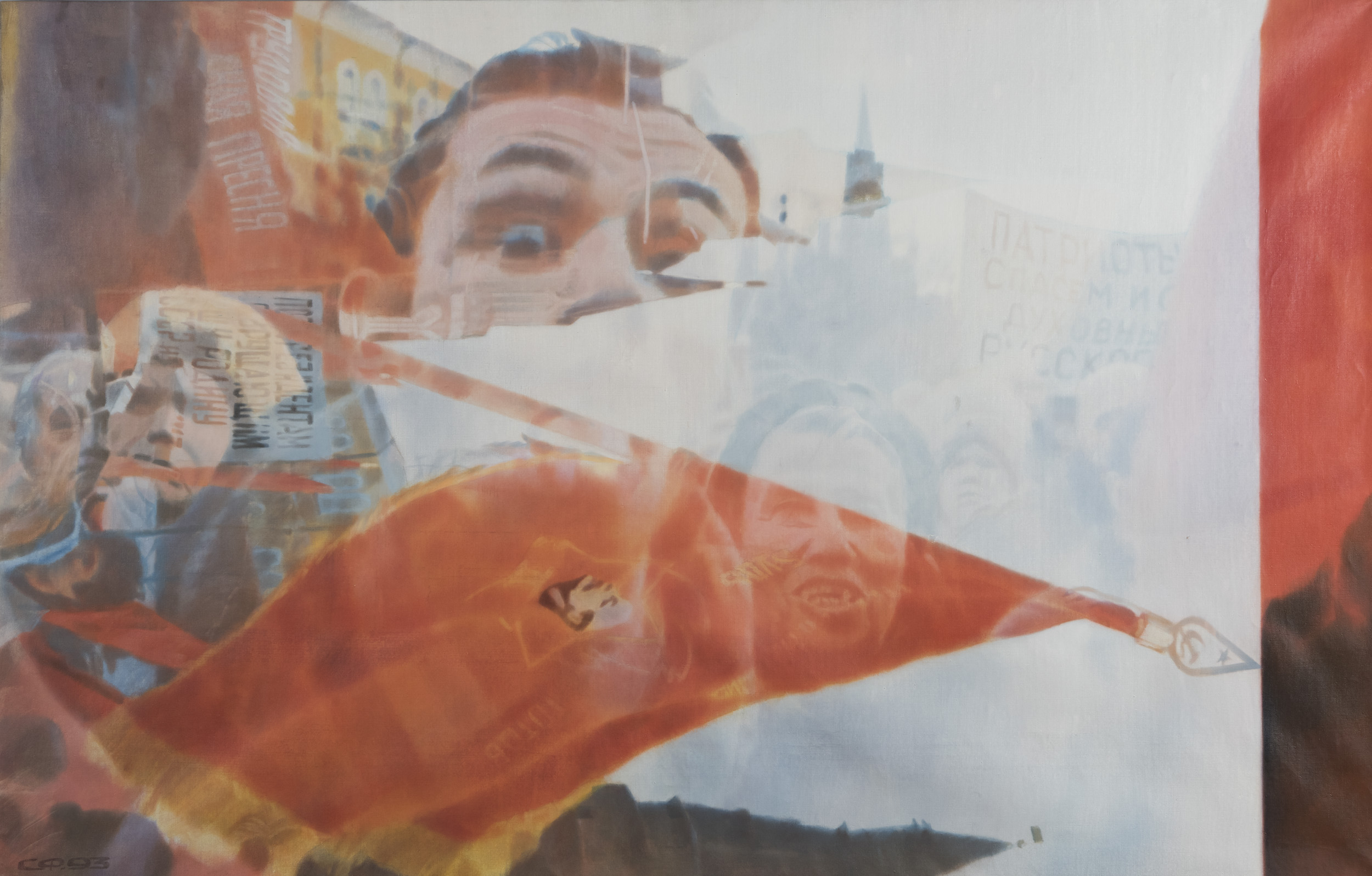
Saviors of Russia, 1993. Oil and acrylic on canvas, 124.5 × 196.9 cm (49 × 77 1/2 in.). The Claude and Nina Gruen Collection of Contemporary Russian Art. 2021.006.011

Double Portrait of the Artist at Work, 1987. Oil on canvas, 150.4 x 75.6 cm (59 3/16 x 29 3/4 in.). Norton and Nancy Dodge Collection of Nonconformist Art from the Soviet Union. 2018.010.002
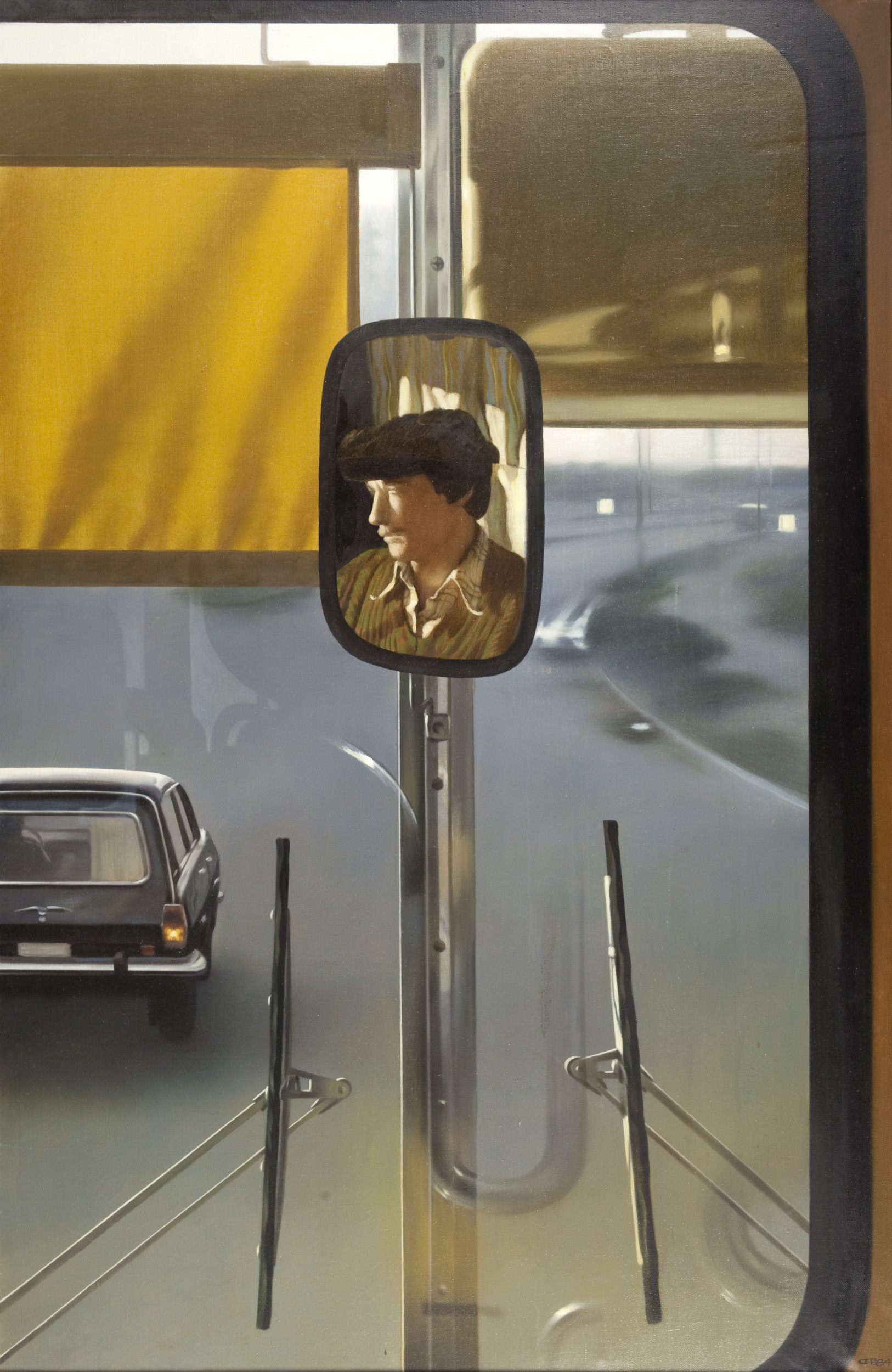
Driver of Ikarus, 1984. Oil on canvas, 175 × 118 cm (68 7/8 × 46 7/16 in.). Norton and Nancy Dodge Collection of Nonconformist Art from the Soviet Union. 2018.010.005
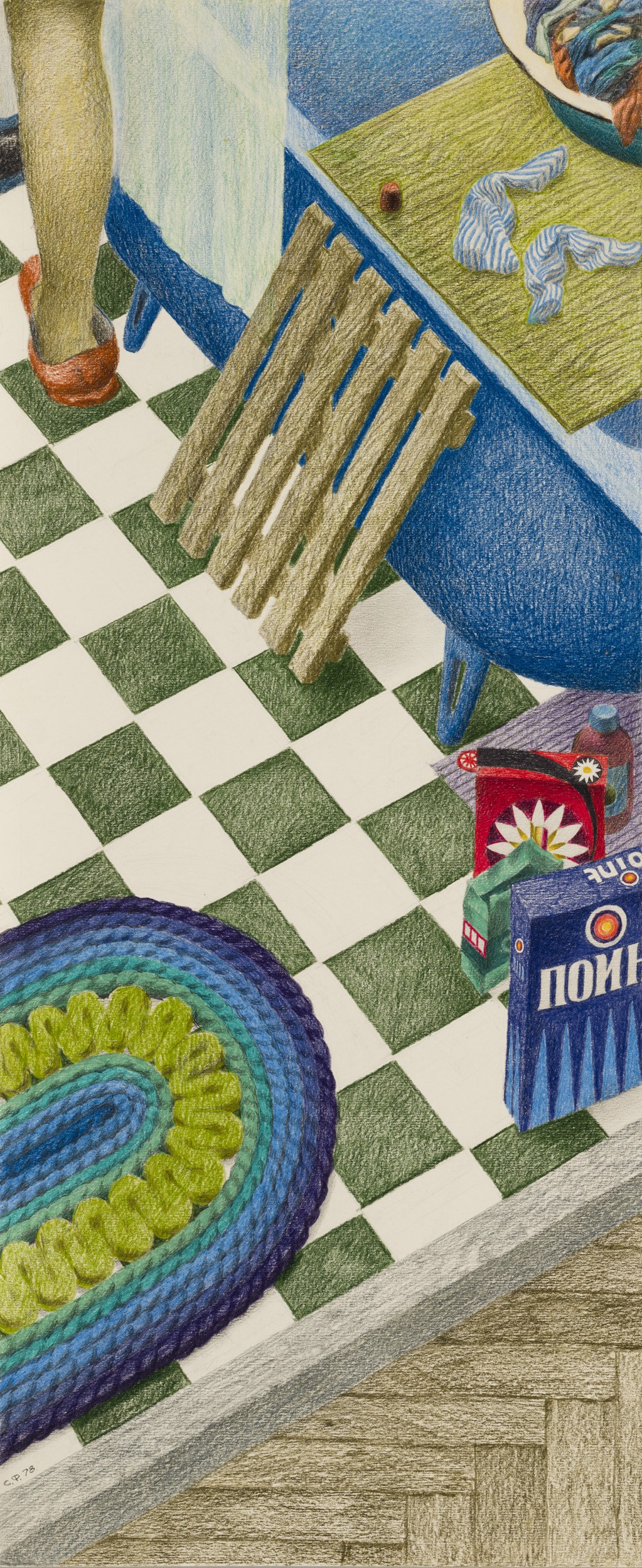
Untitled, 1978. Crayon and graphite on paper, 71.9 × 29.5 cm (28 5/16 × 11 5/8 in.). Norton and Nancy Dodge Collection of Nonconformist Art from the Soviet Union. D02577
Selected Exhibitions
1976–88 Exhibitions of the City Committee of Graphic Artists on Malaya Gruzinskaya Street, Moscow, Russia
1985 16th Youth Exhibition, Moscow, Russia
1987 International Art Fair, Chicago, IL, USA
1988 Painting, Phyllis Kind Gallery, New York, NY, USA
1989 Photo in Painting, First Gallery, Moscow, Russia
1991 Painting, Galerie Inge Baecker, Cologne, Germany
1992 The Last Demonstration, Regina Gallery, Moscow, Russia
1994 The Chronicle of Current Events, Yakut Gallery, Moscow, Russia
1997 Cold Running Down Your Spine, L Gallery, Moscow, Russia
1999 Our Fluff, Zverev Contemporary Art Center, Moscow, Russia
2000 The Living and the Dead (Memories of the Summer), Marat Guelman Gallery, Moscow, Russia
2001 All in Due Time, All in Due Place…, Andrey Sakharov Museum and Community Center, Moscow, Russia
2001 My Windows, Moscow House of Photography, Moscow, Russia
2001 The Restored Values, Regina Gallery, Moscow, Russia
2003 Lviv Eyed by the Muscovite, Moscow, Russia; Kiev, Lviv, Ukraine
2004 The Early Painting and Graphics, Krokin Gallery (project: Archiving Contemporaneity), Moscow, Russia
2010 Evidence, Moscow Museum of Modern Art, Moscow, Russia
2010 Les Miserables, Regina Gallery, London, UK
2013 It’s a Dog Life, collaborative exhibition with Alexander Brodsky and Olga Chernysheva, Red October Gallery, Moscow, Russia
2017 Moscow Mine, Museum of Moscow, Moscow, Russia
2019 Semyon Faibisovich: Retrospective, State Tretyakov Gallery, Moscow, Russia
2022 Razgulyai. Farewell, Jewish Museum and Tolerance Center, Moscow, Russia
Selected Publications
Adaptation and Negation of Socialist Realism: Contemporary Soviet Art [exh. cat.]. Ridgefield: Aldrich Museum of Contemporary Art, 1990.
Agunovich, Konstantin. "Restored Values." Afisha, vol. 24, 2001.
Aizenberg, Mikhail. "Opening Day against the Background of Celebration." Regina Gallery Chronicle, September 1990–June 1992. Moscow: Regina Gallery, 1993.
Alekseyev, Nikita. “Restitution of the Important.” Inostranets, December 11, 2001.
Balakhovskaya, Faina. “The View from My Window.” Vremya.ru, September 2001.
Bown, Matthew Cullerne. Contemporary Russian Art. Oxford: Phaidon, 1989.
Bredikhina, Lyudmila. "The Last Rally." Regina Gallery Chronicle, September 1990–June 1992. Moscow: Regina Gallery, 1993
Chachko, Asya. “Simon Faibisovich: Natspredatel.” Colta.ru, 2016.
Decter, Joshua. “Simon Faibisovich.” ART Magazine, April 1990.
Dyogot, Ekaterina. “Semyon Faibisovich Painting – Total Deceit, not Truth.” Kommersant, December 1993.
Dyogot, Ekaterina. “The Man with a Cellphone” in Comeback [exh. сat.]. Moscow: Regina Gallery, 2008.
Fedotova, Elena. “Semyon Faybisovich: 'All the most interesting things in life happen right under your nose'.” The Art Newspaper Russia, no. 72. March 29, 2019.
Freeburg, Andrew. “Semyon Faibisovich is a misfit and he's proud of it.” Art Focus Now, March 27, 2019.
Grebelnikov, Igor. “The Camera Looks at the Canvas: Semyon Faibisovich at the Tretyakov Gallery.” Kommersant, no. 54, March 11, 2019.
Guskov, Sergey. “Simon Faibisovich: Peripheral Epic.” aroundart.ru, July 2011.
Heartney, Eleanor. “Simon Faibisovich at Phyllis Kind.” Art in America, June 1988.
Kibirov, Timur. “To Artist Semyon Faibisovich.” Theater, vol. 6, 1989.
Mak, Irina. “Expressionism, Photorealism and Turning into Birds at the New Tretyakov.” Vedomosti, May 29, 2019.
Medvedev, Aleksey. “Red over Black and White.” Obshchaya Gazeta, vol. 20, 1995.
Nesbit, Lois E. “Simon Faibisovich.” Artforum, April 1990.
Peschler, Eric A. Ateliers De Moscou Dessins Contemporains / Studios of Moscow Contemporary Drawings. Paris: Galerie de France, 1989.
Romer, Fedor. “Cold Running Down Your Spine.” Itogy, vol. 36, September 16, 1997: 80.
Semyon Faibisovich: Painting of the 1980s. Moscow: Regina, 2001.
Smolev, Dmitry. “Semyon Faibisovich Focuses on Moscow.” The Art Newspaper Russia, no. 103, July 27, 2022.
Solntseva, Alyona. “Non-Affiliated Semyon Faibisovich.” Stolitsa, vol. 25, 1992.
Timofeyeva, Olga and Andrey Lipsky. “Call Things by Their Proper Names.” Obshchaya Gazeta, vol. 51, 1994.
Tolstova, Anna. “A Dog’s Life.” Kommersant Weekend, no. 14, April 19, 2013.
Tolstova, Anna.“My perspective is influenced by nothing but my own perspective: an interview with Semyon Faibisovich.” Kommersant, March 22, 2019.
Publications by the Artist
Русские новые и неновые [The New and Not-So-New Russians]. Moscow: Novoe literaturnoe obozrenie, 1999.
Вещи о которых не [Things Not to Be Spoken Of]. Moscow: EKSMO-Press, 2002.
Невинность [Innocence]. Moscow: OGI, 2002.
Рим. Разговор [Rome. A Conversation]. Moscow: Knizhnyi klub 36.6, 2005.
See also