
Samuel (Semen) Kaplan
1928 — Baku (Azerbaijan) | 2021 — New York (USA). Lived and worked in Kyiv (Ukraine) and, after 1991, Los Angeles and New York (USA)
Samuil Kaplan was a renowned Soviet Ukrainian and American graphic artist, painter, and draftsman of Jewish descent. He became a master of painting, drawing, and printmaking (especially urban and architectural landscapes), book illustration, portraiture, and depictions of animals and domestic subjects, working in a variety of artistic media and techniques, including etching, color linocut, lithography, oil, tempera, and gouache. He employed a poetic and romantic realism in his work, often using metaphors and symbols that provide a glimpse into the subjective perceptions of this artist-lyricist, fantasist, and philosopher.
In 1938 Kaplan moved with his family from Baku (Azerbaijan) to Kyiv, Ukraine. He showed a keen interest in drawing from childhood. During World War II the family evacuated to Orenburg from Kyiv. Kaplan’s father died at the front in 1941, and the family returned to Kyiv in 1945, after the end of the war. The gifted young Kaplan was accepted into the Kyiv Art Secondary School (now Taras Shevchenko State Art High School), where he studied under the renowned teachers Volodymyr Denysov and Yevhen Volobuiev. He repeatedly received certificates of merit and won prizes in school competitions. He graduated from the school in 1950 with honors.
In 1951 Kaplan was drafted into the Soviet Army, but he continued to dream of his future in art, making pencil sketches from nature every day in small albums. Upon returning to Kyiv after nearly five years of military service, Kaplan was admitted to the Kyiv State Art Institute (now the National Academy of Fine Arts and Architecture), using his 1,500 life sketches from his time in the army to support his application. At that time there were ten applications for every place in the department of easel graphics. [1] Kaplan’s talent as a draftsman was duly recognized by the professors at the Art Institute, including People’s Artist of the USSR Serhiy Hryhoriev (1910–1988) and Peoples Artist of the USSR Karpo Trokhymenko (1885–1979).
Kaplan’s first creative success came in 1957, when, as a student, he was allowed to hang his best army drawings on the walls of the Art Institute, thus staging his first solo exhibition, Soldiers’ Everyday Life. In 1962, even before completing his studies in the studio of Oleksandr Pashchenko, Kaplan had work regularly accepted for republican and all-union exhibitions in Kyiv, Moscow, and Leningrad. He was admitted to the Union of Artists of the Ukrainian USSR in 1964.
By the late 1950s and early 1960s, Kaplan had transformed himself from a novice artist into a mature master of prints, drawings, and book illustration. His work in the last category included Autumn Came (1957); Fontanka Twilight (1958); The Last Lesson, a children’s book by Alphonse Daudet (1960); Barracks (from the series T. Shevchenko in Exile) and illustrations for Dzhiulio, a children's book by Edmondo De Amicis (1961); End of March (1963); and Mumu, a story by Ivan Turgenev (1964).
From the late 1950s to the 1980s, the artist's favorite subject was urban and architectural landscapes, which he explored with his portraits of Kyiv, a city Kaplan had loved passionately since childhood. Its charming old streets and impressive new buildings of the time are leitmotifs in numerous colored linocuts and paintings by the artist such as Київ, вулиця Стрілецька. Ранок [Kyiv, Striletska Street; Morning] (1957); Київ. Фунікулер. Іній [Kyiv Funicular; Frost] (1962); Київ. Білі, білі будинки [Kyiv: White, White Houses] (1968); Інститут технічної інформації [Institute of Technical Information] (1970); and Перехід біля Володимирської гірки. Весна [Passage near Volodymyrska Hill. Spring] (1982). Kaplan often included self-portraits in these compositions, thereby emphasizing his inseparability from his hometown. In an exhibition catalogue, Mykhailo Munzhiu called the Kyiv works “a thorough study of the urban organism in all its dimensions, a scrupulous, almost research-like work that, through strict selection, has collected the most essential and natural observations, thus allowing the artist to create a picturesque suite of Kyiv over 20 years.” He concludes, “it would be difficult to find anything similar in modern Ukrainian fine art.” [2]
For many, Kaplan was primarily an artist of Kyiv, who created his own unique image of the city. Noting his works’ “happy lovers and countless cats,” Oksana Lamonova observes: “Cats, from triumphant tom cats to Mikhail Bulgakov’s Behemoth, are another recognizable visual signature of the artist. In perhaps Kaplan's most famous painting, Березень–квітень [March–April] (1973), there are 14 of them.” [3]
At numerous republican, all-union, and personal exhibitions in the 1960s to the ’80s, Kaplan also demonstrated his virtuosity as a portraitist. Examples include the linocut Хірург М. Амосов [Surgeon M. Amosov] (1961); a pastel series of male portraits, Наші друзі та гості [Our Friends and Guests] (1964) and Пам’яті батька [In Memory of Father] (1979); and Sleeping People I, II, III, from the series Train Station (1977, ZAM, 1999.1041–1043). In his portraits, the artist masterfully conveys the psychological state of his subjects, whose depictions are organically integrated with the surrounding material environment re-created by the artist—e.g., Брати [Brothers] (1983, pastel), Фестиваль «Київська весна». Портрет піаністки [Festival “Kyiv Spring”: Portrait of the Pianist] (1985, gouache on cardboard); and Автопортрет. Метро в нуль годин тридцять хвилин [Self-Portrait” Metro at Zero Hours Thirty Minutes] (1986, tempera on cardboard).
Kaplan’s inspiration and muse from a young age was his wife, Sofia, who frequently appears in his graphic and painting works, such as Квітка [Flower] (1961, watercolor and pastel), Софія та квіти [Sofia and Flowers] (1962, oil), Чекання [Waiting] (1979, tempera), Софія – моя дружина [Sofia—My Wife] (gouache); and Відпочинок. Портрет дружини [Vacation: Portrait of a Wife] (1980, charcoal, pencil, and sanguine). A total of twenty-seven works were dedicated to Sofia during her lifetime and after her death in 1994.
The architectural landscapes created by Kaplan in the Soviet period, with their everyday episodes of city life, are all imbued with the lyrical mood of the artist-poet and the special atmosphere of the ancient city of Kyiv. Sometimes his pieces contain a light humor or a touch of sadness. Overall, Kaplan’s works are characterized by a close connection with reality, but they are distinguished by a masterful simplification of form outside the strictures of socialist realism.
In 1991 Kaplan immigrated to the United States, beginning a qualitatively different creative stage in his life. Vadim Feldman observes, “Kaplan’s work now goes far beyond the urban context: it is war, and the Gulag, and emigration, and Jewish sentiment. Samuil Kaplan is an artistic chronicler of the life of his generation.” [4] He treated some of these themes in Anne Frank and Family Archive from the 1990s.
In the next thirty years of his life in Los Angeles and then New York, Kaplan began to focus more on painting, and new motifs emerged that were closer to the American mindset. He took on subjects as diverse as Ukrainian Jewish life, depictions of victims of the Holocaust and Stalinist terror, portraits of such famous figures as the musician Nathan Rakhlin, and the terrorist attack on New York on September 11, 2001, while still treating older themes, defined by the artist as “the city with its houses and streets; lovers; cats.” [5]
Kaplan continued to work with a realistic bent, but his use of certain formal techniques became more pronounced over time. His color and composition became more decorative, his spatial construction more expressive, his metaphors and symbols more complex, and his use of imaginary and fantasy motifs more extensive, as seen in Morning in Brooklyn (1999) and Dance on the Boardwalk (2003).
The artist’s atmospheric, architectural landscapes of New York—filled with a certain beauty and spirituality—are decidedly original in the way they embody the scenic modern city with its movement, rhythm, and urban development. Kaplan is especially well known for his series of paintings dedicated to the terrorist attack on the World Trade Center in New York on 9/11. In the painting Requiem (2004), the Twin Towers are transparent against the backdrop of a night sky, surrounded by buildings draped in flags and crowned with candles. In the center, the artist painted himself flying over the city. Kaplan donated this work, which addressed the most tragic American event of the early twenty-first century, to the National September 11 Memorial and Museum. He died just a day after it was exhibited there on May 19, 2021.
Kaplan was a member of the National Union of Artists of Ukraine, the Los Angeles Art Association, and the Board of the Nathan Rakhlin Memorial Fund. His artworks are in the collections of more than twenty art museums across Ukraine, including Kyiv, Odesa, Mykolaiv, Feodosia, Kharkiv, Sumy, Chernihiv, Luhansk, Donetsk, and others. His work has been exhibited in the United States in California, New Jersey, Brooklyn City Hall, and New York public libraries.
Zoya Chegusova
Translated from Ukrainian by Nathan Jeffers
Notes:
1. Easel graphics was the term for independent artworks, as opposed to monumentalist art, which referred to decorative works placed in architecture and public spaces.
2. Mykhailo Munzhiu, Semen Kaplan. Zhyvopis. Hrafika. Kataloh vystavky tvoriv S. Kaplana [Paintings, drawings: Catalogue of the exhibition of art by S. Kaplan] (Kyiv: Kyiv branch of the Union of Artists of Ukraine, 1987), 4.
3. Oksana Lamonova, “Mista, heroi ta spohady khudozhnyka Samuiila Kaplana” [Cities, heroes and memories of the artist Samuil Kaplan], Den’, September 9, 1999.
4. Vadim Feldman, “Samuil Kaplan. Khudozhnik iz Kieva” [Samuil Kaplan: An artist from Kyiv], Evreiskii obozrevatel’ [Jewish Observer], September 9, 2013.
5. Quoted in Feldman, “Samuil Kaplan.”
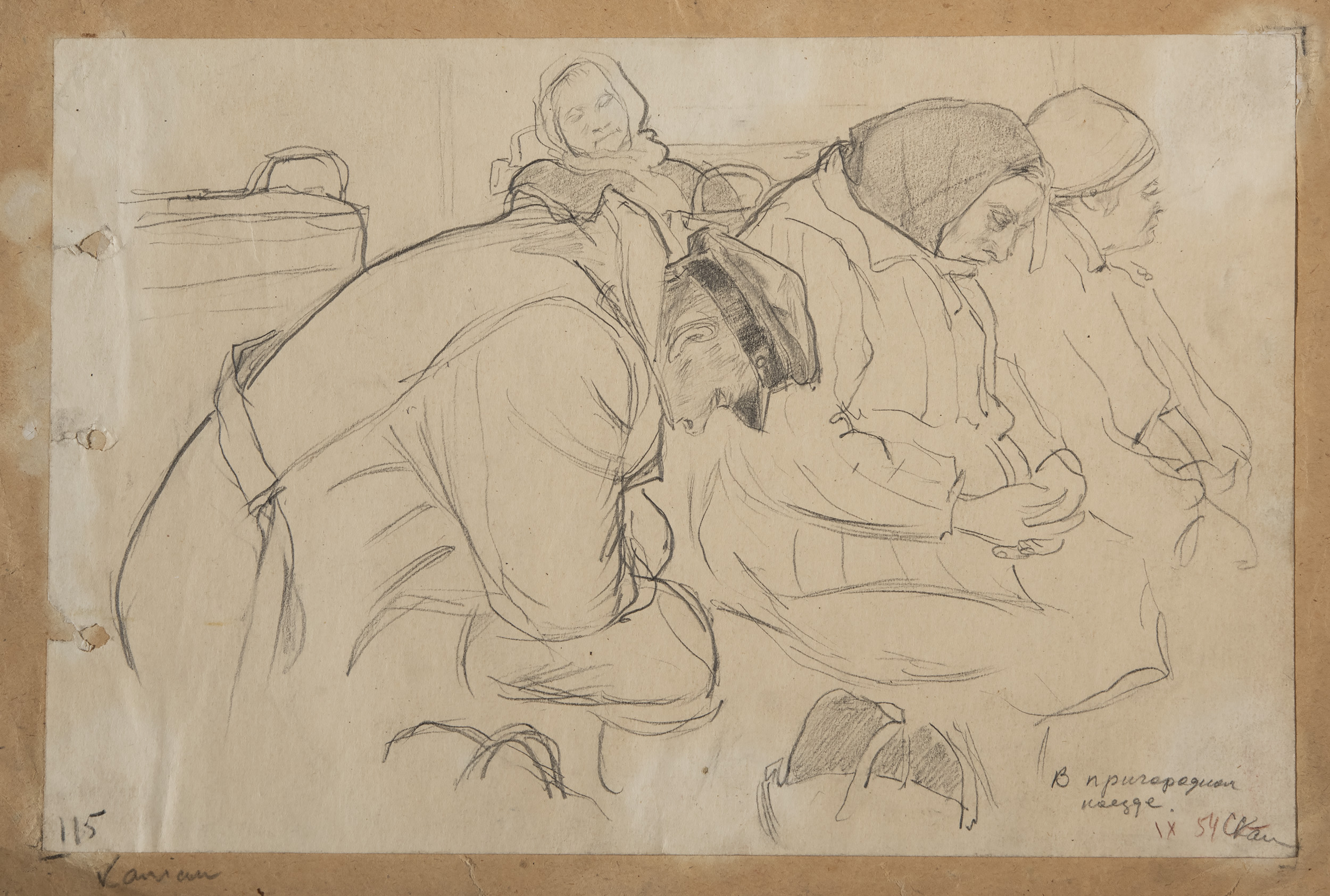
In the Traincar, 1954. Graphite on paper, 20.5 × 30.3 cm (8 1/16 × 11 15/16 in.). Purchased with funds donated by Norton Dodge and Nancy Dodge. 1999.1039
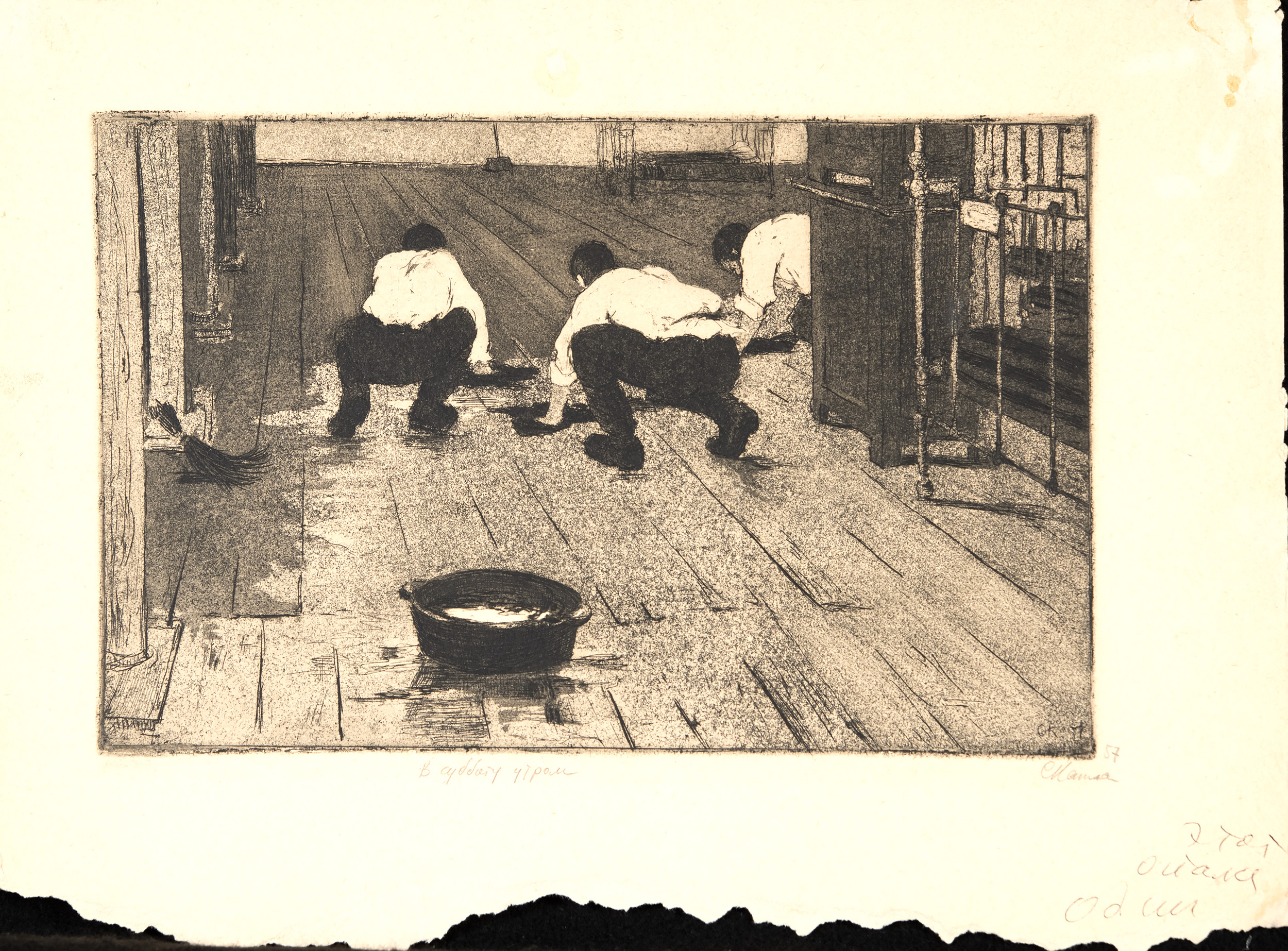
Morning in the Soldier's Dormitory from the series The Soldiers, 1957. Aquatint on paper, 18.5 x 31.5 cm (7 5/16 x 12 3/8 in.) / 28 x 42 cm (11 x 16 9/16 in.). Purchased with funds donated by Norton Dodge and Nancy Dodge. 1999.1040
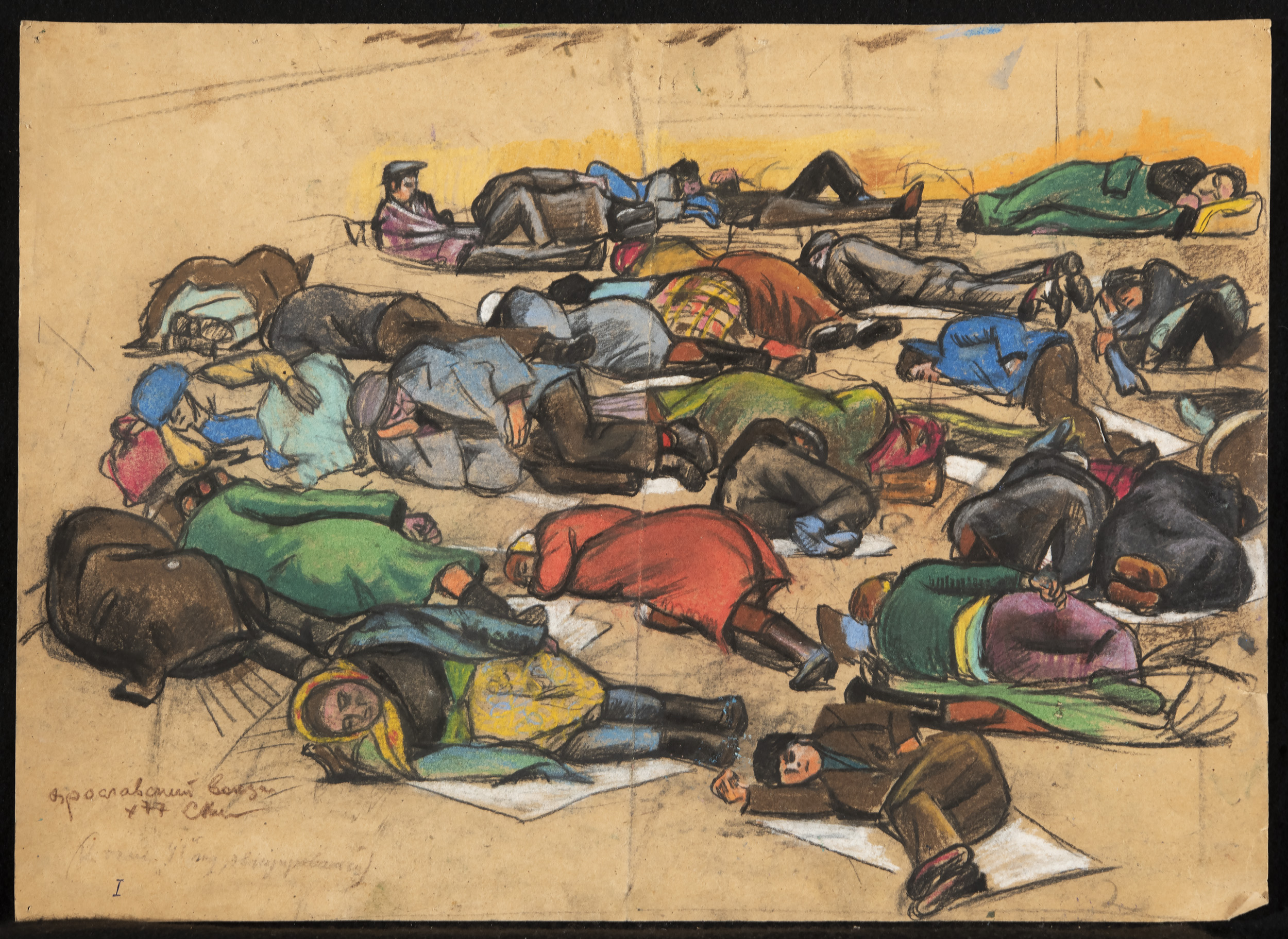
Sleeping People I from the series Train Station, 1977. Pastel on paper, 41.4 × 59.5 cm (16 5/16 × 23 7/16 in.). Purchased with funds donated by Norton Dodge and Nancy Dodge. 1999.1041
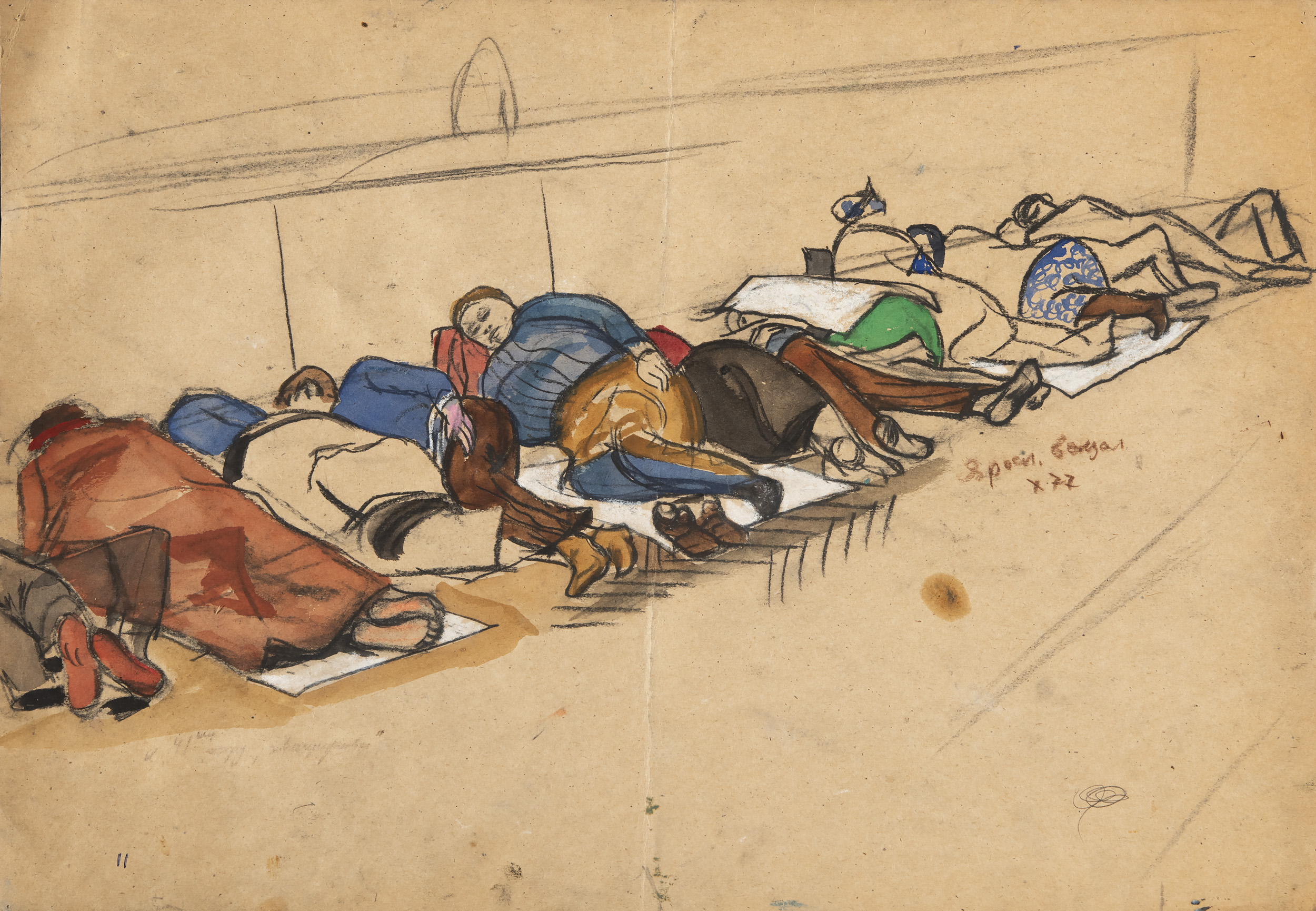
Sleeping People II from the series Train Station, 1977. Gouache, graphite, and pastel on paper, 41.5 × 59.5 cm (16 5/16 × 23 7/16 in.). Purchased with funds donated by Norton Dodge and Nancy Dodge. 1999.1042
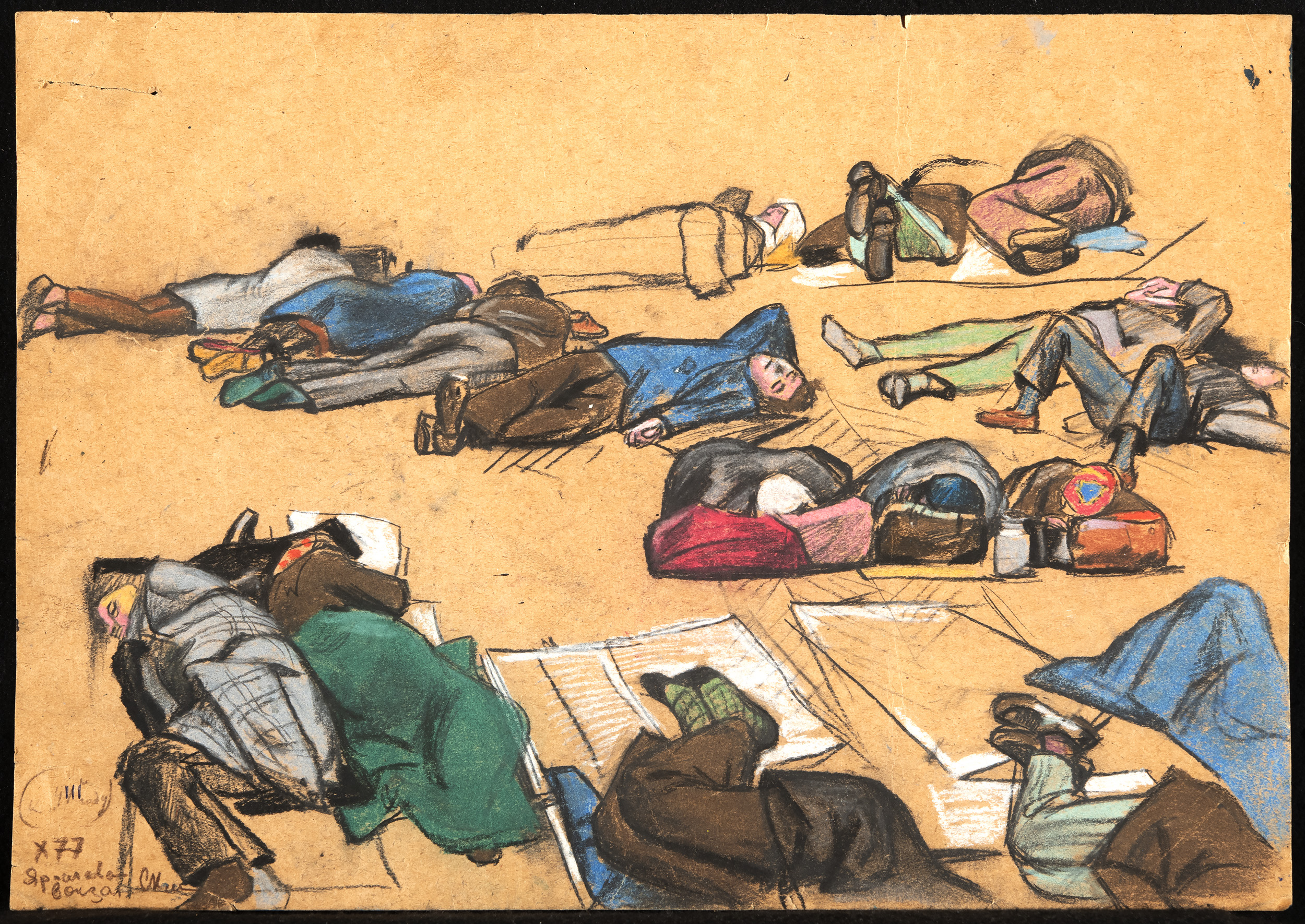
Sleeping People III from the series Train Station, 1977. Pastel on paper, 42.2 × 59.4 cm (16 5/8 × 23 3/8 in.). Purchased with funds donated by Norton Dodge and Nancy Dodge. 1999.1043
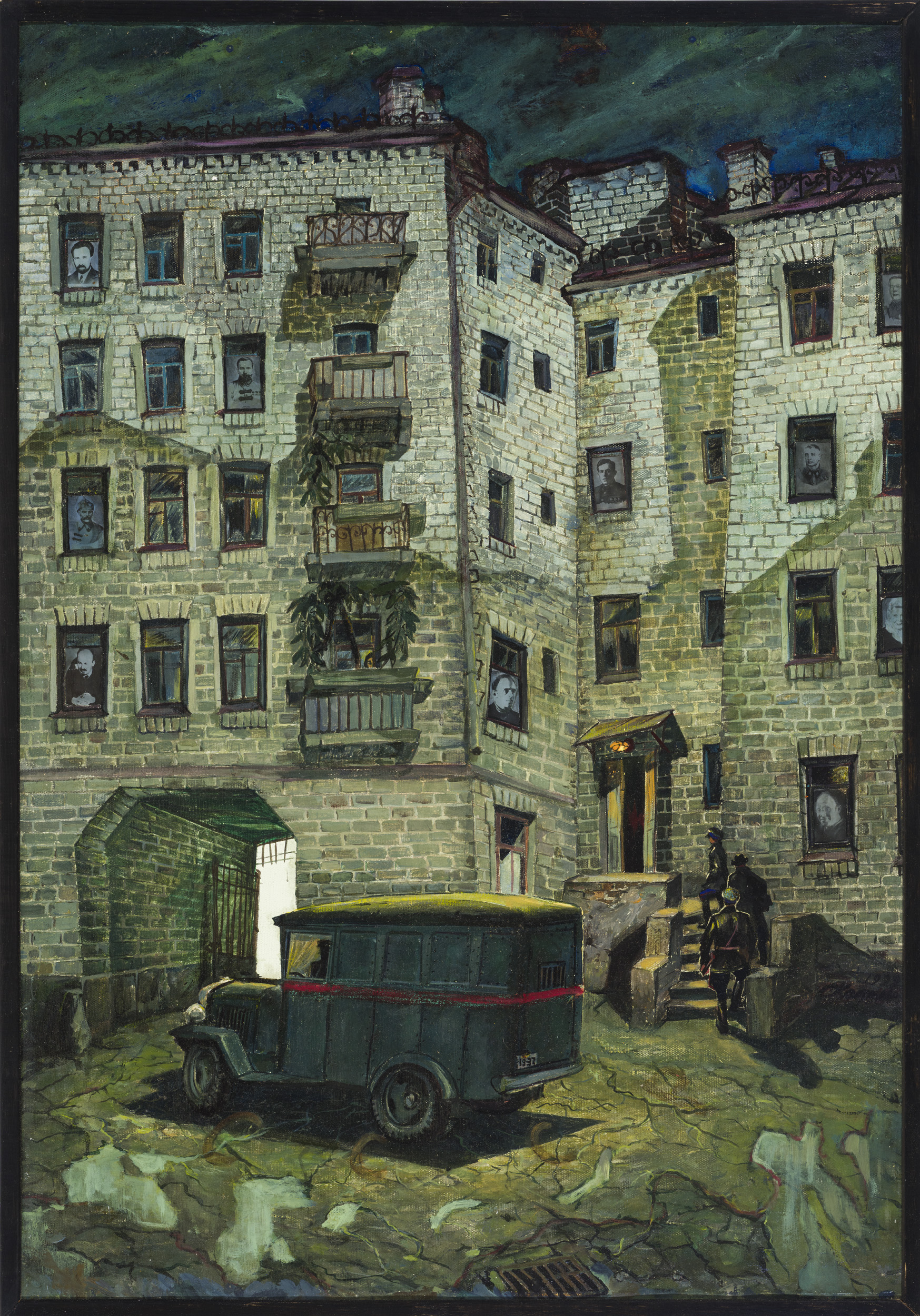
Midnight in the Courtyard in 1937, 1978. Oil, tempera, and collage on canvas, 104 × 72 cm (40 15/16 × 28 3/8 in.). Purchased with funds donated by Norton Dodge and Nancy Dodge. 2000.0008