
Rūdolfs Pinnis
1902 — Jaunlubāna Manor, Madona Municipality (Latvia) | 1992 — Riga (Latvia). Worked in Riga (Latvia), Paris (France), and Constantinople (Turkey)
Rūdolfs Pinnis was a painter and a major personality in Soviet Latvian art. With the assistance of his brother, at the age of fourteen he visited the State Hermitage and the State Russian Museum in Saint Petersburg. There, in front of the painting The Last Day of Pompeii (1830–33) by Karl Bryullov (1799–1852), he decided to become an artist. After experiencing Saint Petersburg, he did not want to return to his family home in Bērzkalni, so he moved from the countryside to Riga. He attended the studio of the Latvian painter Valdemārs Tone (1892–1958), as well as the Art Academy of Latvia;however, in both places he studied for a short time without receiving a systematic formal education or diploma. From 1927 to 1929, Pinnis wandered around Europe, exploring Poland, Austria, Italy, and Egypt, and spending eighteen months of that time in Turkey. Although Pinnis absorbed art in museums, he was charmed by Venice’s Saint Mark’s Square even more than admiring the canvases of Tintoretto (1518–1594) and Titian (1488/90–1576).
These travels ended on May 25, 1929, when Pinnis settled in his dream city of Paris. [1] He spent ten years there, launching his professional career and marrying the Latvian sculptor Elvīra Ādams (1907–1984), who became his lifetime artistic soulmate. In the late 1920s and early 1930s, Pinnis episodically attended the private Parisian art academy La Grande Chaumière and befriended the Estonian graphic artist Eduard Wiiralt (1898–1954). For his livelihood, he painted city scenes for tourists, and while under the influence of Wiiralt he made etchings, few of which have survived. Together with his wife, he made samples of industrially produced fabrics for the silk production plants of Lyon, Paris, and London; was a decorator at the film studio Studios de Billancourt; [2] and in 1937 he helped to design the Latvian pavilion at the International Exposition of Art and Technology in Modern Life. [3] Living in the same house as the French painter Fernand Léger (1881–1951), Pinnis moved in creative circles, and at the bohemian Café le Dome he befriended figures from theater, art, and literature from all over the world. He was also a regular participant in the Paris salon exhibitions, particularly Salon des Echanges (1932, 1933), Salon d’Automne (1934, 1938), and Salon des Tuileries (1939). Pinnis was especially proud of being part of the Salon d’Automne at the Grand Palais on the Champs-Élysées in 1938, where he was the only foreigner alongside French painters such as Albert Marquet (1875–1942).
When World War II broke out, Pinnis was at the zenith of his career. He and his wife returned to Latvia, which had been occupied by the Soviet army. Up until the German invasion in 1941, he held positions of responsibility in Soviet artistic life: he cofounded the Latvian SSR Artists’ Union and became the head of the Fine Arts Department of the Art Affairs Department. With the return of Soviet forces in 1944, the Pinnis family, along with their young daughter Skilla (b. 1943, later a broadcast director), tried unsuccessfully to return to Paris. This led to Pinnis being deported for a short period to Siberia and soured his relationship with the Soviet machine. As a result, from 1950 to 1955 he was denied full status in the Artists’ Union, the body tasked with supervising and funding artists, and had to endure accusations from defenders of socialist realism for allegedly seeking to “embody in painting his vague internal, subjective experiences that go far beyond the framework of the imaginative visible reality,” [4] while his use of bright and pure colors supposedly ridiculed “the tradition of painting cultivated over the centuries.” [5]
During the Khrushchev Thaw, which saw a modernization of Soviet art, Pinnis’s career was also rebooted, and in 1956 he went on a creative trip to Crimea. In 1971 he was awarded an honorary certificate by the Ministry of Culture of the Latvian SSR; in 1976 he was allocated a new studio; in 1981 the Artists’ Union awarded him a diploma and a medal for the most outstanding creative performance of the year; and in 1984 he won the grand prize at the 6th Baltic Republican Painting Triennial in Vilnius. Pinnis spent six months in Paris in 1972; there, while unsuccessfully searching for works from his youth, he befriended the Catalan artist Antoni Clavé (1913–2005). After returning home, the two continued their correspondence, and in 1985, at the invitation of Clavé, Pinnis and his daughter, Skilla, went on a visit to Saint-Tropez, which left a deep impression on the artist’s work.
In 1973 a joint exhibition by Elvīra and Rūdolfs Pinnis, Sculptures and Paintings, was planned at the Latvian National Museum of Art (then the State Art Museum of the LSSR). However, it was banned by the responsible acceptance committee. [6] Despite this disappointment, Pinnis’s solo exhibitions continued to take place in the most important exhibition venues in Riga, as well as in major provincial centers in Latvia.
As a young man, Pinnis had first gained artistic recognition in Moscow, the citadel of Soviet power, when a solo exhibition of his landscapes was held in the Gorky Central Park of Culture and Leisure in 1959; after 1962, his works were regularly included in exhibitions abroad showcasing Soviet Latvian artists. His work was also exhibited in Estonia (1976) and Germany (1991, 1992). Even after his death, exhibitions and publications about him continued; since 2002 a show titled Paris—Riga—Paris. Elvīra and Rūdolfs Pinnis has been regularly shown.
While Pinnis eschewed traditional education, he absorbed impressions from his surroundings. Of his early works, the few that have survived are mostly landscapes and nudes. In Paris, he painted with dry impasto strokes, leaving abrasions of color on the canvas, balanced by monochrome squares (Paris: Les Invalides, 1930–1935, Latvian National Museum of Art [LNMA]). Pinnis was a moderate modernist and represented the multicultural Paris school of painting. In 1936, during a brief visit to Latvia, his landscapes and still lifes acquired dark tones, and, with paint thickly laid with palette knives, echoed the expressive painting of the Belgian school popular in his homeland (Stylized Landscape, 1936, private collection). He may be regarded as a formalist, as Pinnis himself declared: “The secret of painting is color! And we must be like archaeologists, discovering this secret.” [7] He subjected the study of color to dynamic relations with the outside world.
Armed with those spectral colors allowed by Stalinist socialist realism, Pinnis brought vivid landscapes into Soviet grayness. In the 1950s he used impressionistically detached, emphatic brushstrokes (Summer, 1957, LNMA) and worked in plein air. His favorite motifs included rivers and forests (Forest Motifs. Variation, 1968, Madona Local History and Art Museum), as well as flower still lifes. Influenced by the “severe style,” Pinnis switched to a more laconic expression and stylization; the paintings became monumental, with the color areas strictly separated by palette knife streaks highlighting the compositional rhythm (Summer in Iecava, 1967, private collection). In the 1970s, he worked primarily in the studio. Landscapes were replaced by memories of the past, open-window motifs, Elvira’s sculptural masks, or idealized female figures (Composition, 1971, ZAM, D08740). The texture of his paintings took on greater significance, as the contrast between the scratches and embossed paint spots increased. Influenced by Clavé, he began employing illusionistic collage (as in Saint-Sulpice, 1973, LNMA). In the 1980s, only associative elements were retained, entangled in a common rhyme (Peace, Love, 1986, Latvian Artists’ Union, and The Torn Folk Song, 1987, LNMA), until by the end of his life, Pinnis’s painting culminates in pure abstraction (Composition with Yellow, 1992, private collection).
The artist also returned to older motifs, such as the 1973 Composition with a Reclining Person (Gems), and the white-bluish color is repeated in the 1987 painting For You. There is a similarity with motifs in the work of artists one might describe as the “intuitive formalists,” artists who use their own originality and intuition to discover new artistic challenges, rather than a systematic set of directives. The color variations are inexhaustible, and affirmed the position Pinnis expressed: “In every work there must be a new discovery. If that’s not the case, the work is futile.” [8] It should be noted that his apparent openness to experimentation did not extend to photorealism, which he did not consider art. [9]
Pinnis reached his creative maturity in retirement, actively working until his ninetieth birthday. His personality, memories, and legendary deeds have been felt by several generations of cultural figures. Despite a successful artistic career within the Soviet system, he often experienced a lack of appreciation. [10] Pinnis was a lover of life and a heavyweight of painting, whose works were eagerly awaited in the exhibition hall and who influenced the younger generation of artists, including Helēna Heinrihsone (b. 1948).
Sniedze Sofija Kāle
Translated from Latvian by Philip Birzulis
Photo portrait: Rūdolfs Pinnis, 1987. Photo by Valts Kleins. Artist’s family archive.
Notes
1. Pēteris Zirnītis, ed., Rūdolfs Pinnis: Glezniecība [Rūdolfs Pinnis: Painter] (Riga: Liesma, 1990), 15.
2. Zirnītis, Rūdolfs Pinnis, 23.
3. Dace Lamberga, Rūdolfs Pinnis (Riga: Neputns, 2023), 20.
4. Arturs Eglītis, “Par lielas patiesības, lielu ideju mākslu!” [On the Art of Great Truth, Great Ideas!], Padomju Latvijas Komunists, October 1957, 39.
5. Rasma Lāce, “Republikas tēlotājas mākslas izstāde” [Fine Art Exhibition of the Republic], Cīņa, September 28, 1957, 3.
6. Skilla Pinnis-Rikarde, ed., Rūdolfs Pinnis. Gleznotājs [Rūdolfs Pinnis: Painter] (Riga: Puse, 1993), 128.
7. Rūdolfs Pinnis, “Glezniecības noslēpums ir krāsa [The Secret of Painting Is Color],” Literatūra un Māksla, November 19, 1982, 8.
8. Pinnis, “Glezniecības noslēpums,” 8.
9. Pinnis-Rikarde, Rūdolfs Pinnis, 124.
10. “The appearance of my first works in Latvia (after Paris) offended a small citizen, touched his thinking, and so it continued for many years.” Zirnītis, Rūdolfs Pinnis, 17.

Composition, 1971. Oil on canvas, 99.3 × 99.5 cm (39 1/8 × 39 3/16 in.). Norton and Nancy Dodge Collection of Nonconformist Art from the Soviet Union. D08740
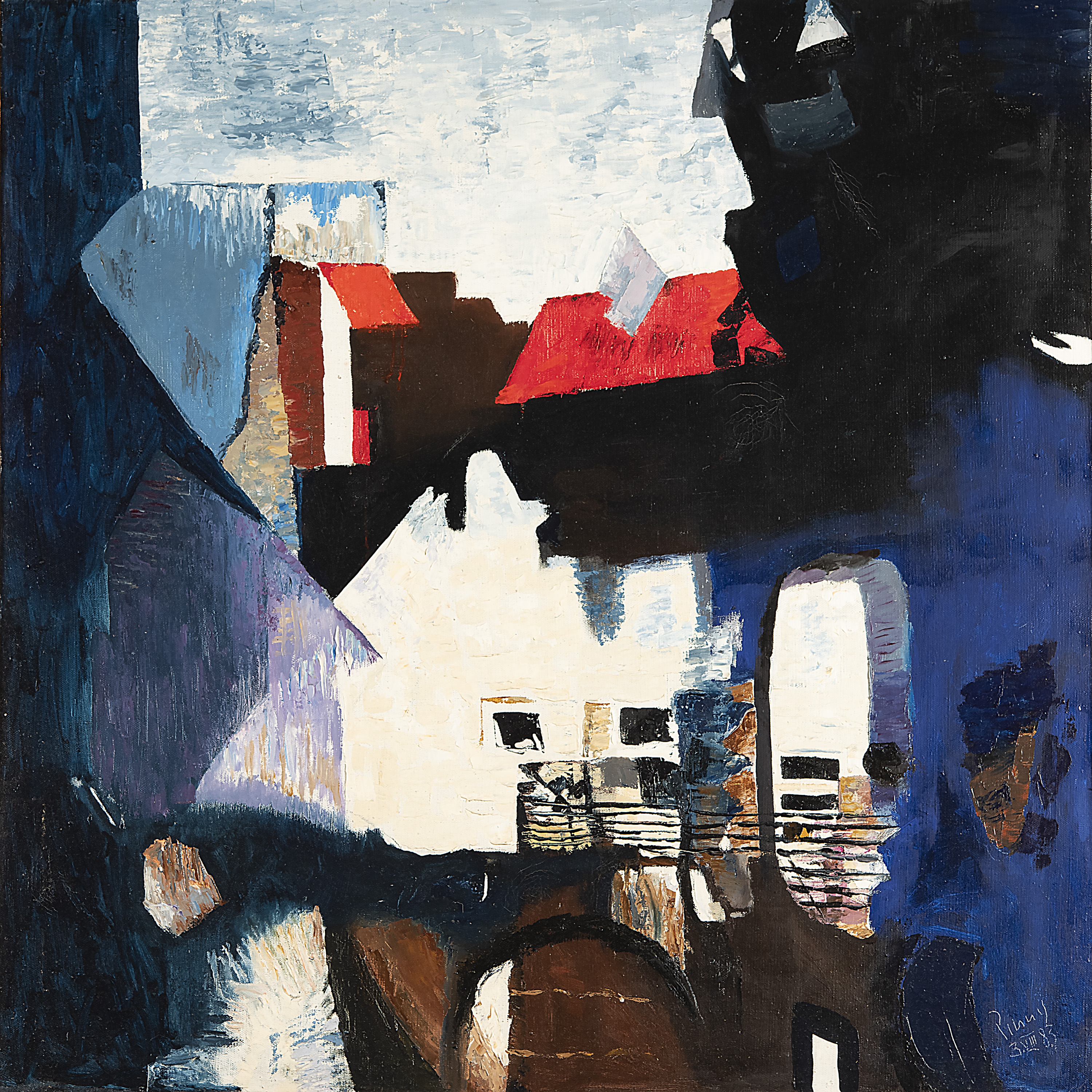
Remembrance of Spain, 1983. Oil on canvas, 100.2 × 100.5 cm (39 7/16 × 39 9/16 in.). Norton and Nancy Dodge Collection of Nonconformist Art from the Soviet Union. 1992.1057
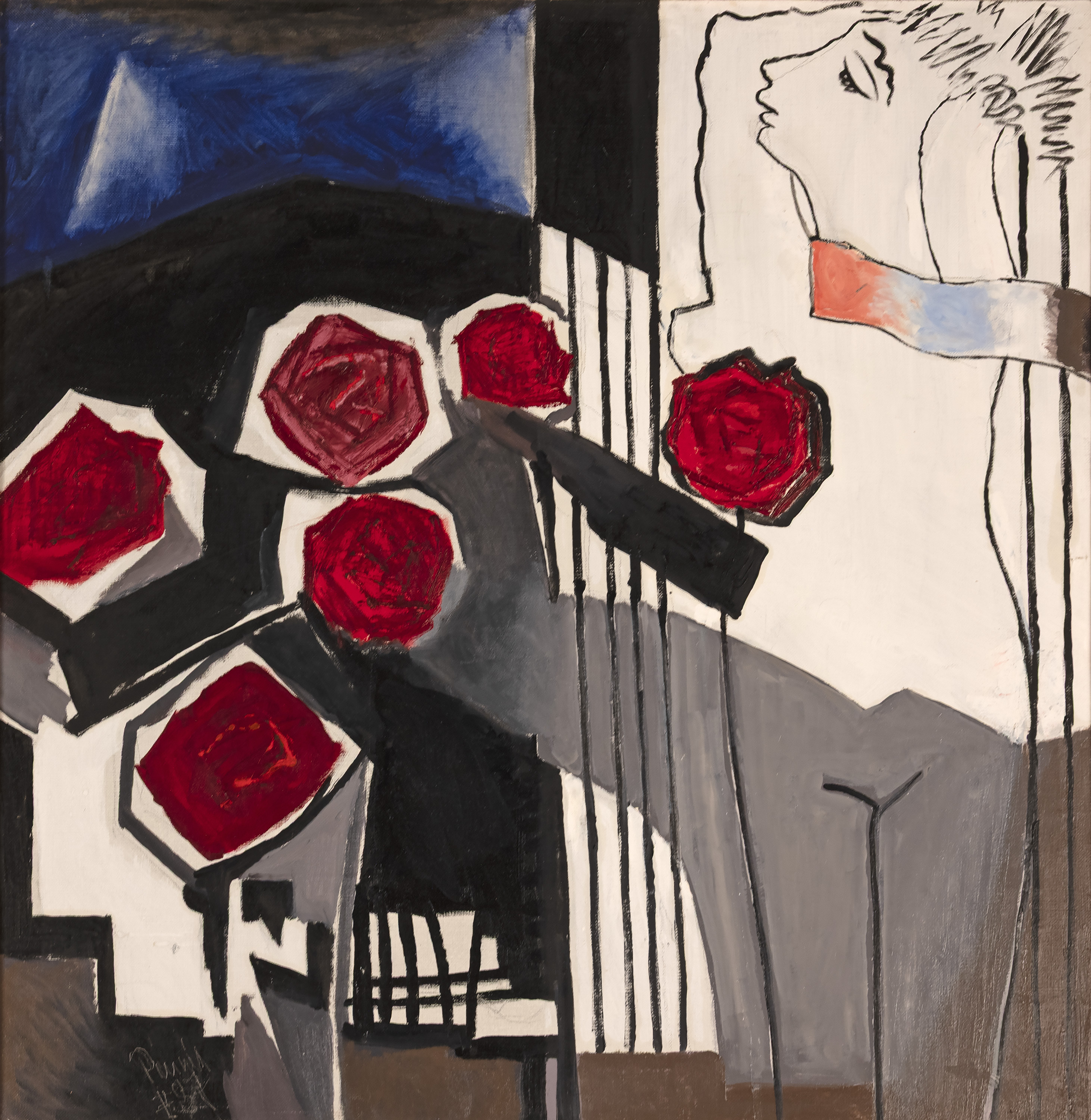
For You, 1987. Oil on canvas, 100.4 × 100 cm (39 1/2 × 39 3/8 in.). Norton and Nancy Dodge Collection of Nonconformist Art from the Soviet Union. D05468