
Pavel Zaltsman
1912 — Kishinev, Bessarabia Gubernia (Russian Empire) | 1985 — Alma-Ata (Kazakhstan). Worked in Leningrad and Alma-Ata (USSR)
Pavel Yakovlevich Zaltsman was a Soviet painter, master draftsman, film production designer, poet, and writer. He was the third, late child of tsarist army officer Yakov Zaltsman (1873–1941) and Maria Samuilovna (baptized Maria Nikolayevna) Ornshteyn (1873–1942). His father, who worked as a bookkeeper after the revolution, had a talent for drawing and a passion for literature. Zaltsman inherited his talents and interests.
Because of his background, Zaltsman had no chance of getting a higher education. At the age of seventeen, he began to work as an illustrator for magazines in Leningrad (Rezets, Perelom, Yunyy proletariy, and others). In 1930, he was hired as a production designer at Lenfilm studios, and over the next ten years he was involved in the production of thirteen films.
Zaltsman had no formal artistic education, but he said that he was educated by the Hermitage Museum, the Russian Museum, and Pavel Filonov (1883–1941), whose work made an enormous impression on Zaltsman when he first saw it at the age of seventeen. Zaltsman joined the Masters of Analytical Art group, became an active participant in the life of this workshop, and called himself Filonov’s student for the rest of his life. What is curious, however, is not so much the similarity between their styles as the difference between them. With the same treatment of the space-time continuum (the past, present, and future in both Filonov’s and Zaltsman’s paintings are merged into one) and the detailed elaboration of every millimeter of the painting’s surface, Zaltsman did not “analyze” visible reality so much as he sought to harmonize his figures with the world around them.
According to his daughter Lotta Zaltsman, “In addition to the powerful influence of Filonov, one must note [Zaltsman’s] interest in the German romantics, the painting of the Italian primitives, and the German Renaissance, as well as the culture of the Mir iskusstva artists, whose work attracted [him] with its irony, use of the grotesque, and retrospectivism, which made it possible to ‘play’ with the entire stock of human culture.” [1] Working in Filonov’s studio, Zaltsman met the painter Tatyana Glebova (1900–1985), who introduced him to Daniil Kharms and the OBERIU poets. Zaltsman assimilated their absurdism and later made brilliant use of it in his literary work, interpreting the tragic experience of war and evacuation.
In 1935, Zaltsman married his former classmate Roza Magid, and in 1942, they had a daughter, Lotta (Elena). The family lived in extreme poverty; the windows of their small room in a communal apartment overlooked a garbage dump, and their living quarters were dark and damp. Despite the fact that Zaltsman worked constantly, there was never enough money. Some compensation for this unsettled existence was provided by painting work and creative field trips: before the war, Zaltsman visited Lake Baikal, the Pamir Mountains, Karelia, and Crimea, and in 1934 and 1938 he spent months traveling around Central Asia.
Fortunately, almost all of his prewar paintings have survived. “[They] contained no plot, no genre story, no Soviet moralizing, no manly patriotism. … The faces on Zaltsman’s canvases were tragic and represented a whole generation, which was methodically being destroyed by the Soviet system. … A number of canvases turned out to be simply prophetic. Especially Leningrad, 1940, all of the figures in which (apart from the central figure, a portrait of my mother) died in the war, from hunger, during bombings, in evacuation, or in the camps,” the artist’s daughter later wrote. [1]
The war caught the family in Leningrad. During the first winter of the siege, Zaltsman’s parents died of hunger, which was a severe blow to him. He described the horror of those months in his diaries, published 70 years later: “We all turned into skeletons. … Many neighbors had already died. Many were preparing to run away, despite the cold. We understood that we could no longer run away, we were too weak. The blanket already felt heavy to me when I went to sleep, but I really wanted to sleep. For a time, when I lay down in bed, I would imagine things to eat, and sometimes describe them out loud to Roza, but then it passed.” [2]
Zaltsman, who had German roots, was ordered to leave the city or face arrest and deportation. On July 27, 1942, the family was evacuated to Kazakhstan. In the city of Alma-Ata, Zaltsman was given the status of deportee: he had to report regularly to the commandant's office, he could not leave the city without permission from the authorities, and any return to Leningrad was out of the question. Exhausted by hunger, lack of housing (at first, the family slept in a theater under a piano), and lack of money, Zaltsman fell ill with typhus. Only the dedication of his wife and the help of first-rate doctors (internal exiles, evacuees, or those who had not yet left) prevented him from dying.
In a desperate situation, Zaltsman began to write prose. “The drafts of most of his texts were written between 1944 and 1954. His reflections on free will and predestination, on death and the reincarnation of souls, found a place in his novels … and short stories, whose plots often came to him in dreams. … The sense of a hopeless lack of freedom was hardest of all. Life … in a tiny room, with nowhere to escape from one another, with no room for an easel, was undoubtedly hard for my father,” wrote Lotta Zaltsman. [1]
Eventually, Zaltsman found an unexpected way out of this hopeless situation: he began teaching art history. Although this required a higher education, he lied and said that he had lost his diploma during the evacuation. At first, he lectured at an art school, then at a pedagogical institute and at the university. He made his own illustration materials, tracked down reproductions of paintings, drafted architectural drawings, made copies of rock carvings and ornaments. He lectured two or three times a day, and everywhere he was met with packed lecture halls. The universal adoration that surrounded Zaltsman in Kazakhstan in the 1970s and ’80s continues to surround his name to this day, and many of his students eventually became key figures in Kazakh culture.
In the 1950s, Zaltsman began working at the Kazakhfilm film studio. Over the next few decades, he participated in the production of twenty-two films. He collaborated with Shaken Aimanov (1914–1970), the most prominent Kazakh director, whose name the studio bears today. Together they made such films as White Rose (1943), Daughter of the Steppes (1954), Poem of Love (1954), and Crossroads (1963).
His work at the studio was not limited to film production, however: for the Kazakhfilm building, Zaltsman developed monumental mosaics based on national ornaments and later oversaw their realization. He also contributed to the creation of the fountain in front of the film studio’s main entrance. Ultimately, he became Kazakhfilm’s chief artist and was awarded the title of honored artist of the Kazakh SSR. In 1957, he was admitted into the Cinematographers’ Union, and in 1967, into the Kazakh Artists’ Union. In 1971, his first solo exhibition took place in Alma-Ata. Decades later, all those who worked with him or studied under him remembered him with admiration. Tall, fit, athletic (he practiced yoga), and elegantly dressed (he loved gray suits, which suited his gray hair, and always wore a tie), he educated others by the very fact of his presence.
In the mid-1950s, a new love and a new family (which, however, broke up in 1972) appeared in Zaltsman’s life, but he always maintained warm relations with his first wife and daughter. He had the opportunity to return to Leningrad, but he preferred to stay in Alma-Ata, where he was known and appreciated. In 1967, Zaltsman finally obtained his own apartment, and thus room to work on his own visual art. During this period, he used mainly ink and watercolors on paper in a 100 x 70 cm format. Most of the works that make up his legacy (including five works from the Zimmerli collection) were created during the last twenty years of his life. It was painstaking work: each composition took several months to complete. He aimed to produce twelve works per year.
No less dramatic than his life was the return of Zaltsman’s name to the history of art. Fortunately, his daughter, Lotta, and granddaughter, Maria, both art historians, became the artist’s executors. For forty years after the artist’s death, the family promoted interest in his work. The first art books about Zaltsman as an artist were published in the mid-1980s. By the early 2010s, his texts had been deciphered, and books began to be published one after another: Signals of the Last Judgment (2011), Puppies. Prose of the 1930s–1950s (2012), Shards of the Shattered to Smithereens. Diaries and Reminiscences. 1925–1955 (2017). The books became a sensation. Zaltsman was called the “Russian Kafka”—a witness to the “anthropological catastrophe” that befell Russia (in the words of critic Ilya Kukui), who “was able [to convey] with the maximum degree of intensity and openness the despair of a man who has lost faith in the rational foundations of existence and lives in a state of incessant absurdity.” [3]
In 2012, Kazakh documentary filmmaker Igor Gonopolsky released the film Ordinamenti. Artist Pavel Zaltsman. Due to the efforts of dozens of people, Zaltsman's name rose through the ranks of Russia’s avant-garde artists. Still, it must be acknowledged that Zaltsman belongs to the history of Kazakh art more than to the history of Russian art: he lived for seventeen years in Leningrad, and for forty-three in Almaty. “The Soviet government took one homeland away from him, but accidentally gave him a second one.” [3]
In 2022, the artist’s 110th anniversary was celebrated in Kazakhstan on a grand scale: the Kasteyev State Museum of Arts mounted a solo exhibition of his art, Faces of Time, which included more than fifty works. It was said during the exhibition’s opening that Zaltsman was a gift of fate for Kazakhstan: “People like him set the bar for high professionalism. They were not Kazakhs by origin, but they departed this life as artists of this country.” [4]
Liudmila Lunina
Translated from Russian by Ilya Bernstein
Author thanks Pavel Zaltsman’s granddaughter, Maria Zusmanovich, for help with preparing this article.
Photo portrait: Pavel Zaltman, Alma-Ata, 1981. Source: pavelzaltsman.org
Notes:
1. Zaltsman, Lotta. “Memories of My Father. Materials for the Biography of P. Ya. Zaltsman.” pavelzaltsman.org
2. Zaltsman, Pavel. “And then the frightening blockade winter began…” Preparation of the text, preface, and publication by A. Zusmanovich, Ilja Kukui. Znamya, no. 5, 2012.
3. Niyazov-Adyljan, Ramil. “‘An Unreliable German and a Jew.’ The Story of Artist Pavel Zaltsman.” Sibreal, January 2, 2024.
4. Kravtsov, Vadim. “Загадочный художник Павел Зальцман” [The Mysterious Artist Pavel Zaltsman]. DKNews, January 24, 2022.

Small Town, 1976. Ink on paper, 46.5 × 66.5 cm (18 5/16 × 26 3/16 in.). Norton and Nancy Dodge Collection of Nonconformist Art from the Soviet Union. D18134

Abandoned City from the series Resistance, 1982. Ink on paper, 52 × 73.3 cm (20 1/2 × 28 7/8 in.). Norton and Nancy Dodge Collection of Nonconformist Art from the Soviet Union. D18135

Fortress by the Bay, 1972. Ink on paper, 51.2 × 73.3 cm (20 3/16 × 28 7/8 in.). Norton and Nancy Dodge Collection of Nonconformist Art from the Soviet Union. D18136

Untitled, 1967. Ink on paper, 43 × 61.1 cm (16 15/16 × 24 1/16 in.). Gift of Charlotte Douglas. 2016.016.001
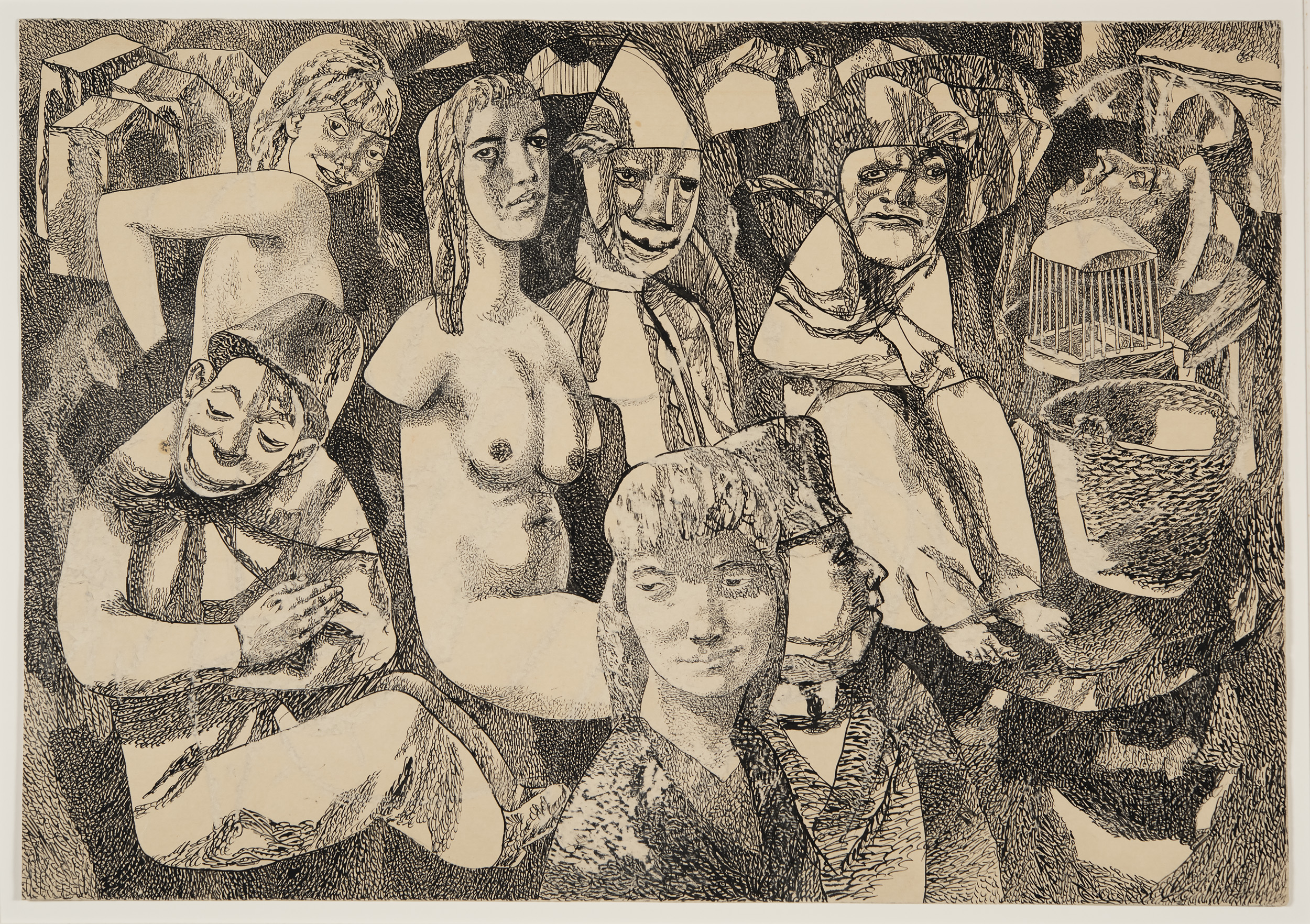
On a Bulgakov Theme, c. 1970. Ink on paper, 43 × 61 cm (16 15/16 × 24 in.). Purchased with funds donated by Norton Dodge and Nancy Dodge. 2000.0063