
Oleksiy Levchenko
1948 — Kakhovka, Kherson region (Ukraine) | 2018 — Kyiv (Ukraine). Worked in Kyiv (Ukraine)
Oleksiy Levchenko was a Ukrainian production designer, director, screenwriter, illustrator and collage artist, and collector. He was a member of the National Union of Cinematographers of Ukraine (from 1982) and the Soviet Union of Artists of Ukraine (from 1989). Levchenko was awarded Ukraine’s prestigious Shevchenko Prize and the Special Prize at the All-Union Festival of TV Films and achieved posthumous recognition as an Honored Artist of Ukraine. Known for his theatrical style rooted in cinema and Ukrainian culture, he created graphic works that are kept in both public and private collections globally.
Born in Kakhovka, Ukraine, on July 18, 1948, Levchenko was the son of a military pilot and an artist. Recalling his childhood, Levchenko wrote that his mother was a true artist by vocation, and despite her lack of schooling, her paintings were extraordinary. Following his mother’s love of art, as a child he met the legendary director Oleksandr Dovzhenko whose films inspired Levchenko throughout his life. In 1972 Levchenko graduated from the Kyiv Art Institute, where he studied graphic art under the tutelage of Viktor Shost. For several years thereafter Levchenko worked as a school art teacher. In 1978, he left his role as an educator to begin work at the Dovzhenko Film Studios in Kyiv. His new role as an art director presented opportunities to work on the film projects of notable Soviet directors, including Roman Balayan, Alexander Dulerayn, Aleksandr Itygilov, Sergey Koryagin, Viacheslav Kryshtofovych, Mykola Maletsky, Anatolii Mateshko, Mykola Mashchenko, Nikita Mikhalkov, Vladimir Popkov, Mykola Rasheiev, and Arkady Yakhnis.
Levchenko’s artworks debuted in cinema before his own exhibitions off-screen. In Mykhailo Bielikov’s film The Hidden Work (1979), one of the characters, a young female artist, paints on a construction site in Mariupol (then Zhdanov). Produced at the director’s behest, the resulting paintings made a stunning impression on her contemporaries in the film and effectively introduced Levchenko’s art to the viewing public. Levchenko created these experimental works utilizing a glassblower on photographic paper. During the filming of this project Levchenko met the composer Valentyn Silvestrov, with whom he would remain in communication for years.
Levchenko’s first film as an art director (My Happiness, 1979) was awarded the Special Prize at the All-Union Festival of TV Films in Baku, Azerbaijan, alongside the film’s director, Vyacheslav Kryshtofovich. Working in art direction with filmmaker Viktor Gres on the children’s fantasy-drama Black Chicken or Underground Dwellers (1980) was a moment of particular success for Levchenko; the film received the Jury Prize at the International Children’s Film Festival in Giffone (Italy) and a prize at the Tour Film Festival (France). Levchenko remained friends with the director until the end of his life.
In 1986, the president of Ukraine awarded the Shevchenko Prize, Ukraine’s highest state prize for works of culture and arts, to Levchenko, together with director Mykhailo Bielikov and cinematographer Vasyl Trushkovskyi, for the films The Night Is Short (1981) and How Young We Were (1986). Levchenko soon after made his debut as a film director, releasing Luna in 1991, for which he also wrote the screenplay. This was followed in 1993 by The Champs Elysées, for which he was both the screenwriter and production designer.
In his work on The Champs Elysées, Levchenko brought creative ideas to life which had been in development for years. The film features extravagant works of art: an interactive unicorn toy, a metal bas-relief mask, a cradle made for adults, a music box, and a candle snuffer, as well as reproductions of paintings. Vintage and antique items regularly appeared in Levchenko’s films. The artist-cum-production designer would create collage within the set interiors: In one film, a carpet was secured to the wall with a photo or painting attached to it. This composition alludes to the traditional motifs of Soviet domestic interiors, wherein intricate carpets were often secured to, and featured as art on, the walls of the home. Suggesting this design history, Levchenko used his film’s interiors as a space to realize his artistic ambitions, often referencing the allure of cinema for its unique capacity to retake shots—a trait unavailable to painting, illustration, and theater.
Levchenko’s paintings and works on paper are intrinsically connected to his work in cinema. His collages utilize clippings from Western newspapers and magazines, as well as fragments of packaging, also functioning as concept development and storyboards for future scenes. To further the medium’s dual purpose, these artworks were often divided into quadrants and draw the viewer’s eye across its collages in storyboard fashion. The images, initially jarring in their contrast of Western references and simplicity, are annotated with the manual additions of typewriter messages and illustrations. For instance, Puzzle No. 5 (undated, ZAM, D22198) invites a close reading of its text; Levchenko depicts a French newspaper entitled “Entre Washington et Pékin: cinq problèmes” [Between Washington and Pékin: five problems], a drawing of a stork on the biblical Noah’s Ark, a calculator machine, and the unfolded packaging of Unitas brand Portuguese sardines. Like the newspaper’s bullet point allusion to the Soviet Union, Levchenko’s own commentary and, at times, playfulness hides across the work: the calculator is labeled Ребус No. 5 [Rebus No. 5], hinting that the collages are also a puzzle wherein the meaning is presented as a series of symbols, letters, or drawings.
When taken together, the artwork presents a decidedly somber tone. The lone stork floats across dark waters of the Flood. The machine draws up numbers to account and headlines announce problems. The typed message on the sardine packaging states, “In this region, there are no fish,” relaying Levchenko’s environmental concerns. The artist grew up along the banks of the Dnipro River, surrounded by a picturesque landscape of rolling fields and placid waters once teeming with fish. The disappearance of the river’s shores following the creation of the artificial sea profoundly affected him and, as a metaphor for the fate of its people, inspired the artist to turn to film as a means of raising awareness and advocating for the preservation of Ukraine’s principal river.
His work in cinema and Ukrainian culture, with its strong Baroque underpinnings, shaped his interest in theatricality, spectacle, and a doubled distance from reality, mediated through both the camera lens and the artist’s eye. In House with 33 Windows (1984, ZAM, D11507), Levchenko’s drawing on paper depicts a theater stage with the curtains pulled open to reveal a hazy scene of mixed architecture, wildlife, chairs, and people. The plated inscription at the base of the stage writes the titular “Dom v 33 okna” [House with 33 windows]. The overlapping scenes of different times and places mimic the effect of double exposure in film. “There is a cinematic feel to literally every painting he created throughout his life,” writes film critic Anton Filatov. “The subject of his paintings are phantasmagoric, the colors muted, as if the image was shot on black and white film, and the composition is clearly staged. For Levchenko, painting and graphics are a kind of continuation of his cinematic reflections.” [1]
The article Movie vs Painting: Dialogue of Arts (2013) shines a light on contemporary Ukrainian artists who work in both cinema and painting. The artists mentioned include Emma Behliarova (b. 1945), Larysa Kadochnykova (b. 1937), Serhii Masloboishchykov (b. 1957), Ihor Podolchak (b. 1962), Oksana Chepelyk (b. 1961), and Serhii Yakutovych (b. 1952). [1]
Levchenko used a variety of artistic mediums throughout his long professional career, even experimenting with sculpting plasticine. At the beginning of the film The Secret Diary of Simon Petliura (2018), you can see the artist beside a model of the Eiffel Tower, the photographic angle creating the illusion he was standing on the streets of Paris. In the last years of his life, Levchenko prepared scripts for documentaries about the Ukrainian artists Ivan Aivazovskyi (1817–1900), Petro Levchenko (1856–1917), Oleksandr Murashko (1875–1919), Taras Shevchenko (1814–1861), and the “father” of Ukrainian poetic cinema, Oleksandr Dovzhenko.
Following Levchenko’s death in 2018, Petro Poroshenko, by Presidential Decree No. 91/2019, posthumously awarded him the title of Honored Artist of Ukraine for his “significant personal contribution to the development of national culture and theater, and his significant creative achievements and professional skill.” [2]
Kateryna Lebedeva
Translated from Ukrainian by Nathan Jeffers
Notes:
1. Anton Filatov, “Movie vs Painting: dialogue of arts,” Ukrainian Culture, no. 1/2 (1009–10) (January 2013): 18–23.
2. President of Ukraine Petro Poroshenko, “Decree of the President of Ukraine No.91/2019: On the celebration of state awards of Ukraine on the occasion of International Theater Day,” March 26, 2019, Office of the President of Ukraine.
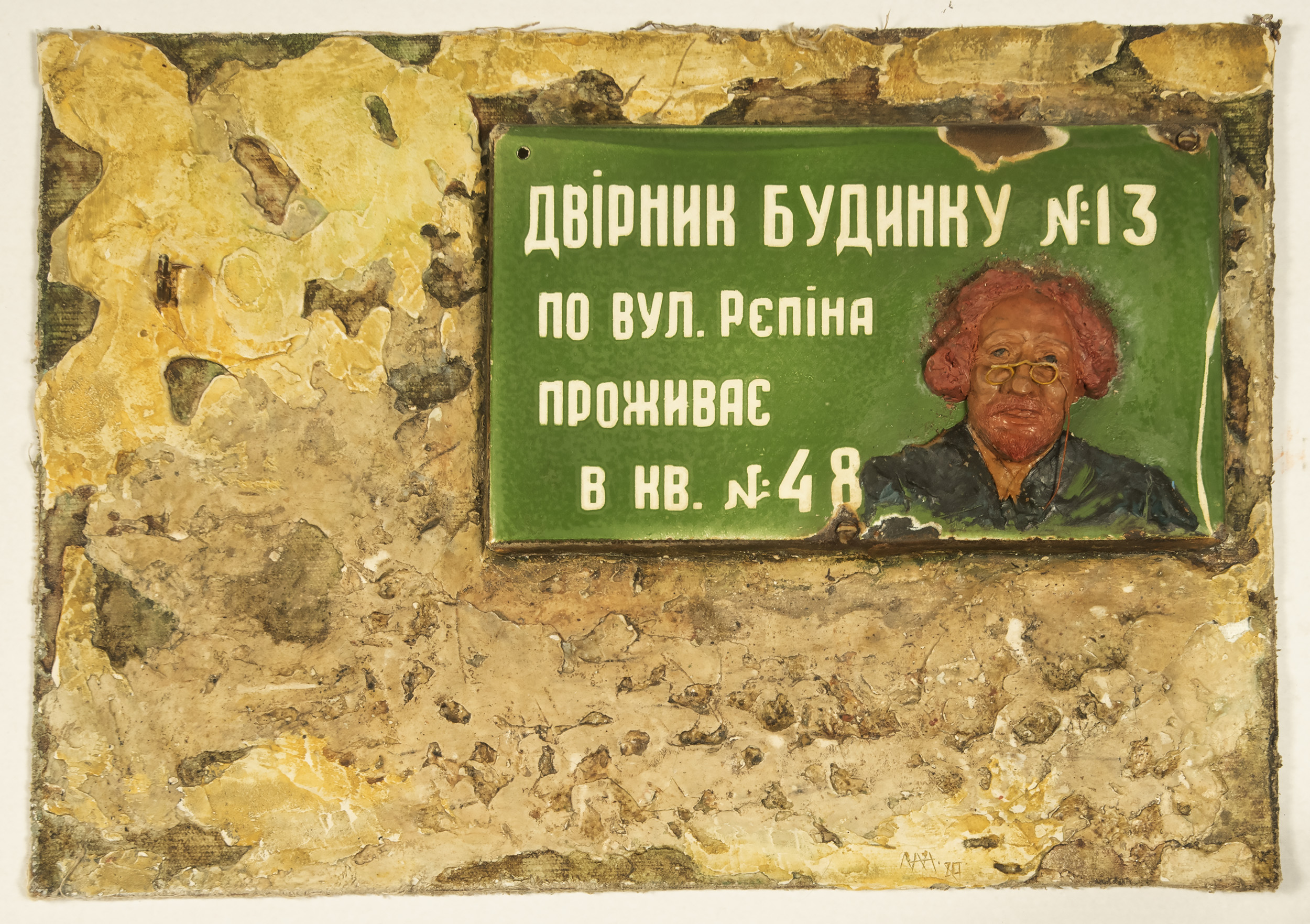
Janitor of the House no. 13, 1980. Mixed media assemblage on canvas mounted on cardboard, 35.5 x 49.5 x 3 cm (14 x 19 1/2 x 1 3/16 in.). Purchased with funds donated by Norton Dodge and Nancy Dodge. 2003.0113
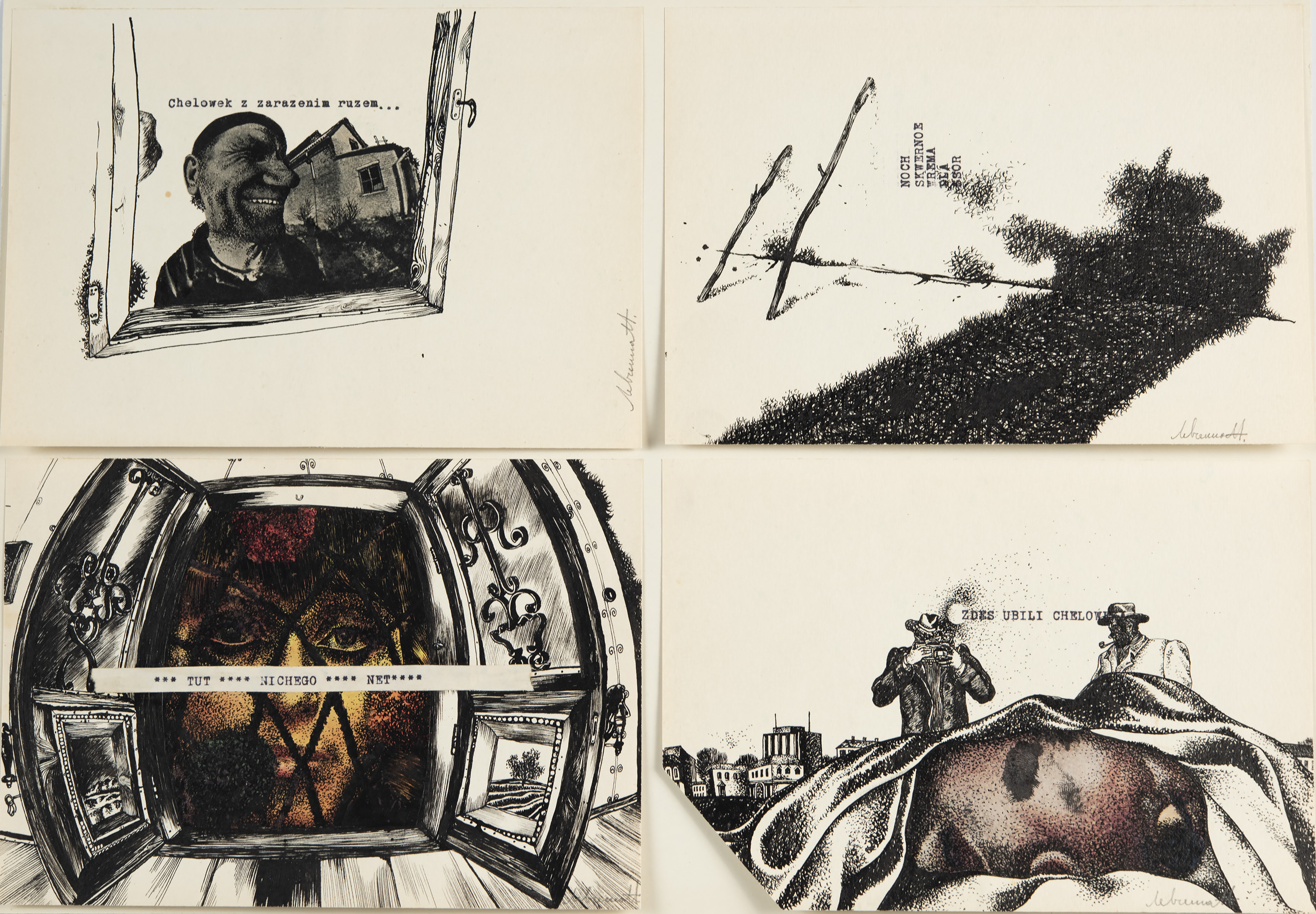
A Man Was Killed Here from the series On the Theme of Foolish Days, undated. Cut and pasted printed paper with ink and typewriting on paper, 30 x 43.2 cm (11 13/16 x 17 in.). Norton and Nancy Dodge Collection of Nonconformist Art from the Soviet Union. D11503
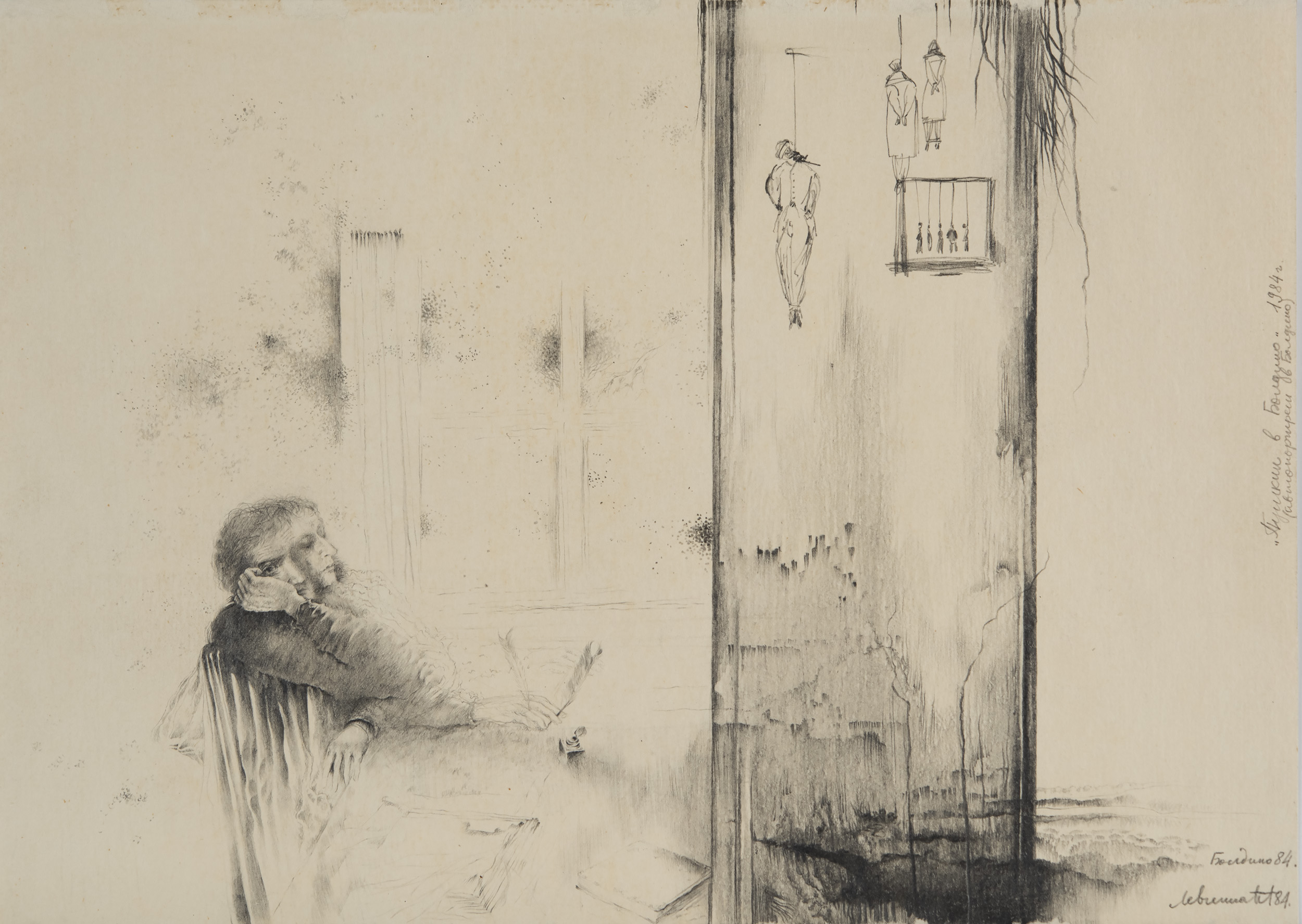
Pushkin in Boldino (Self-Portrait in Boldino), 1984. Graphite on paper, 21 x 29.6 cm (8 1/4 x 11 5/8 in.). Norton and Nancy Dodge Collection of Nonconformist Art from the Soviet Union. D11505
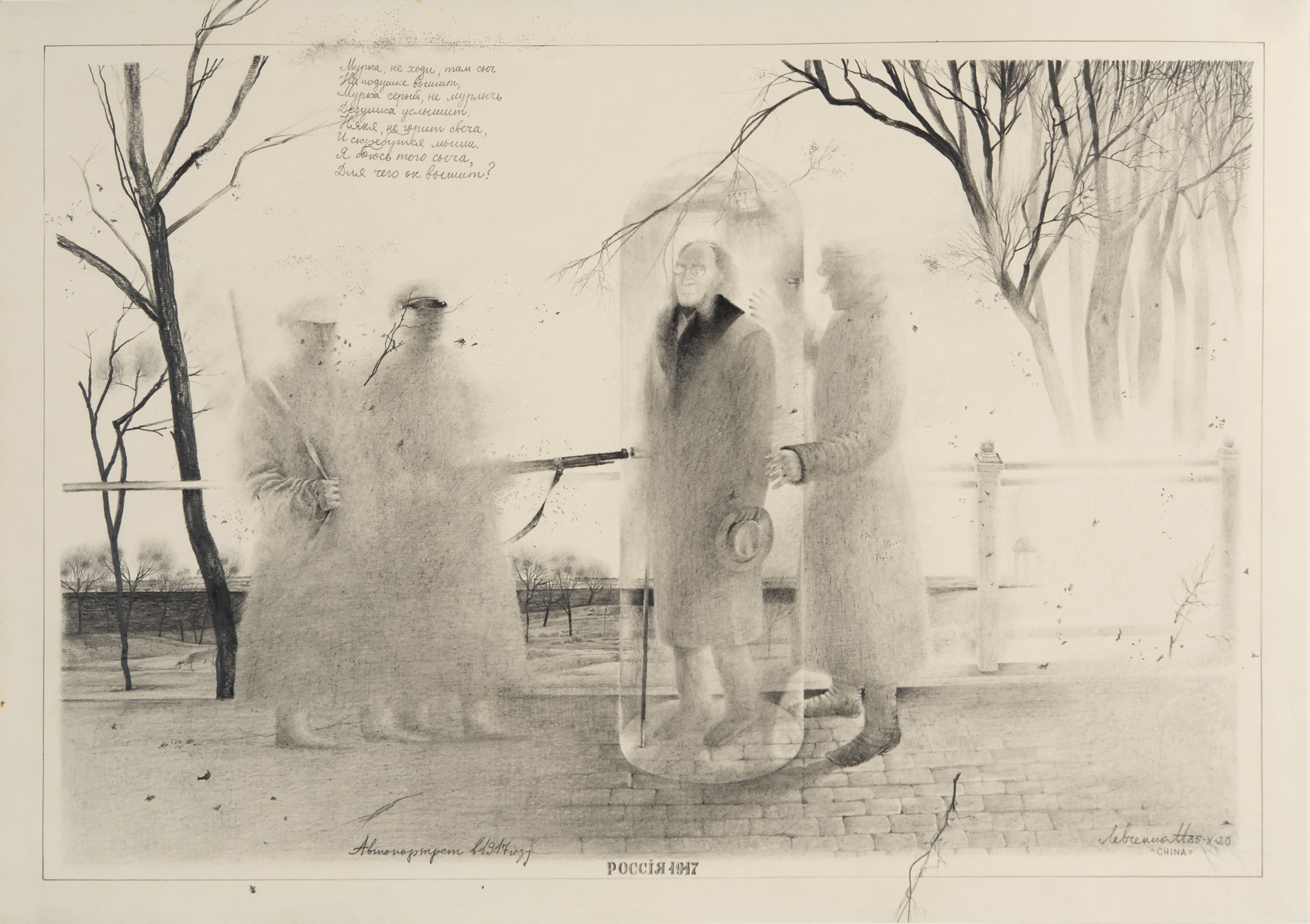
Russia, 1917 – Self Portrait in 1917, 1985. Graphite on paper, 29.8 x 42 cm (11 3/4 x 16 9/16 in.). Norton and Nancy Dodge Collection of Nonconformist Art from the Soviet Union. D11506

House With 33 Windows, 1984. Graphite and colored pencil on paper, 43 x 61.2 cm (16 15/16 x 24 1/8 in.). Norton and Nancy Dodge Collection of Nonconformist Art from the Soviet Union. D11507
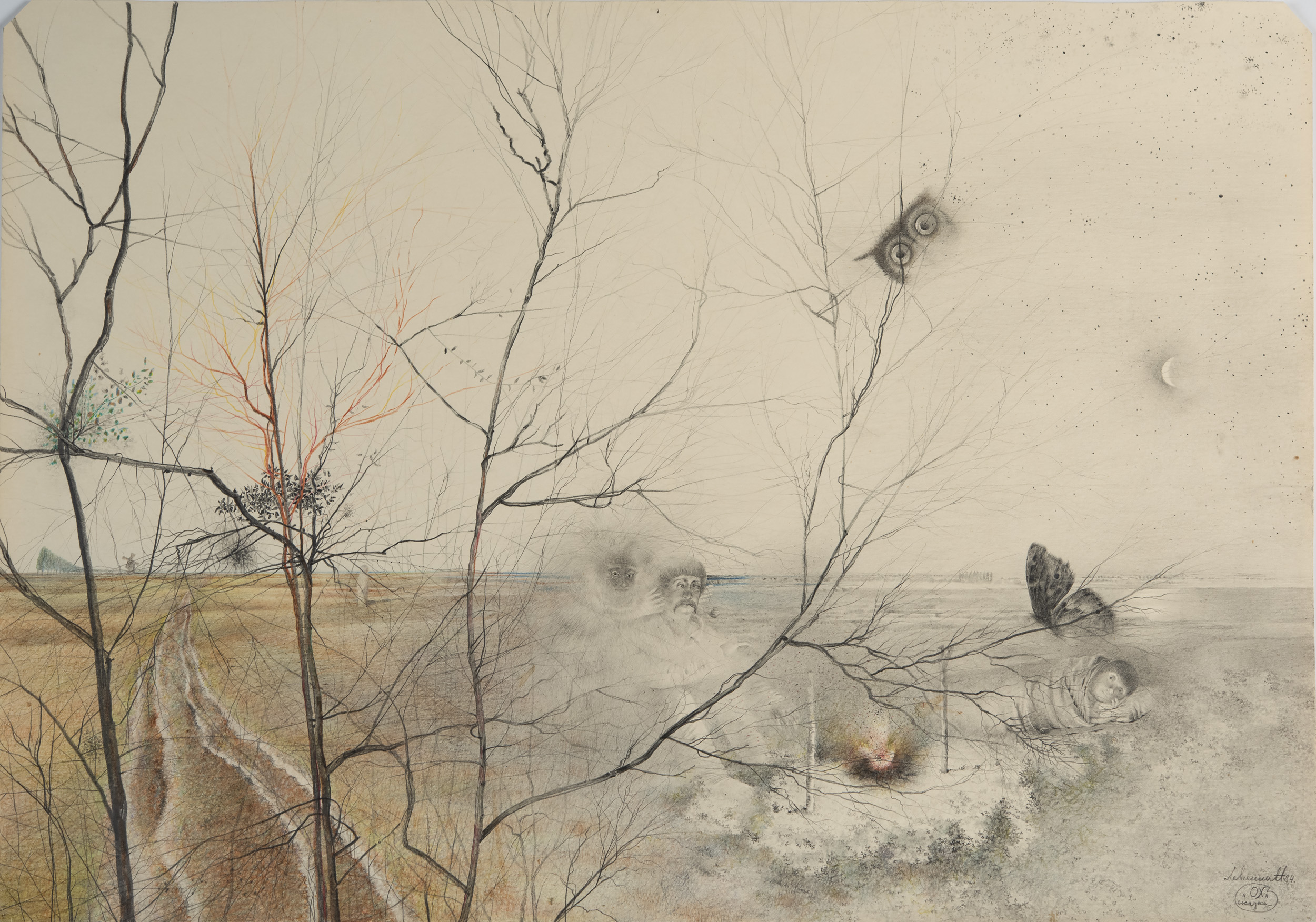
Oh! Fairy Tale, 1984. Graphite and colored pencil on paper, 43 x 61.2 cm (16 15/16 x 24 1/8 in.). Norton and Nancy Dodge Collection of Nonconformist Art from the Soviet Union. D11508
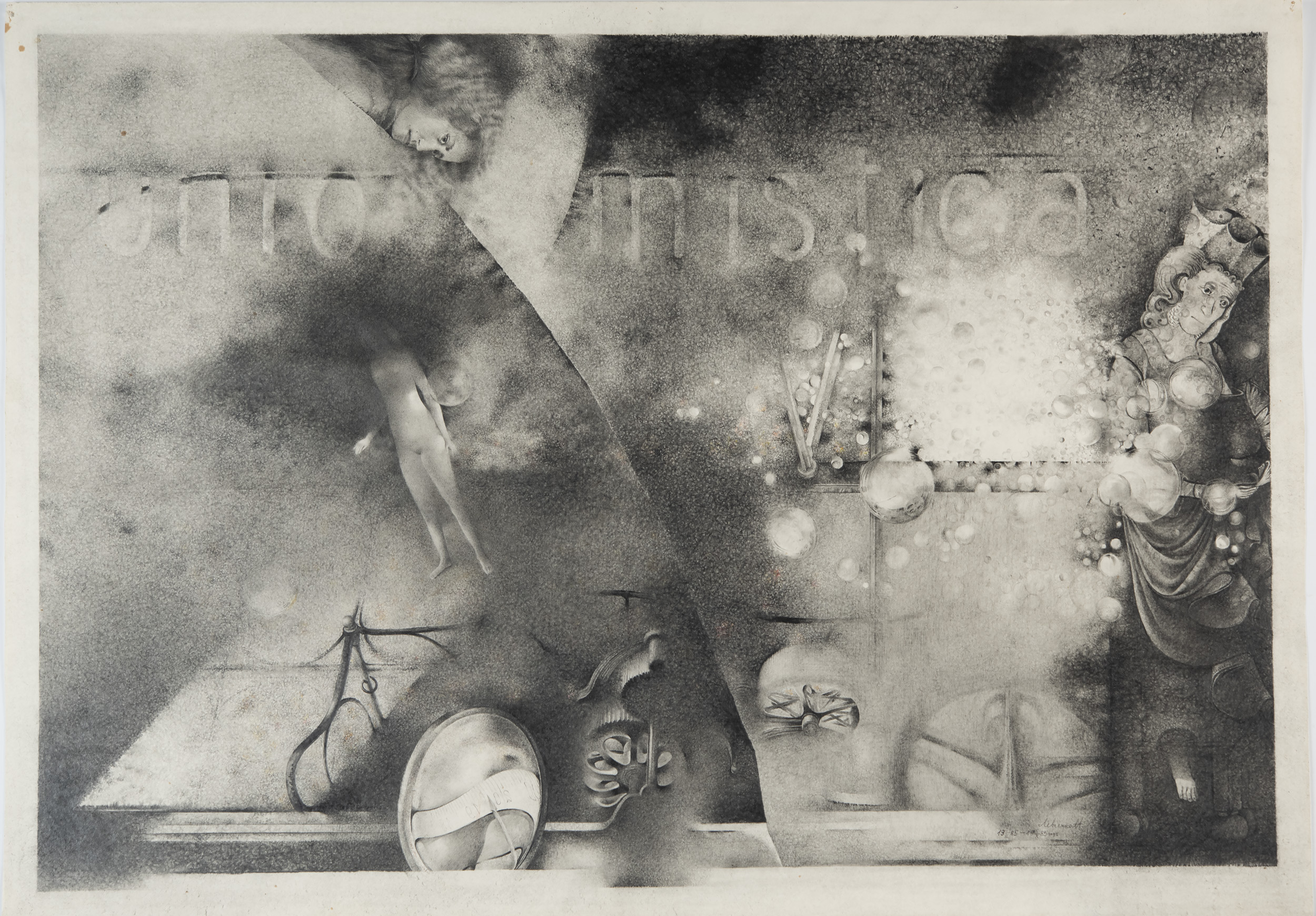
Unio Mistica, 1985. Graphite on paper, 61 × 85.7 cm (24 × 33 3/4 in.). Norton and Nancy Dodge Collection of Nonconformist Art from the Soviet Union. D11510
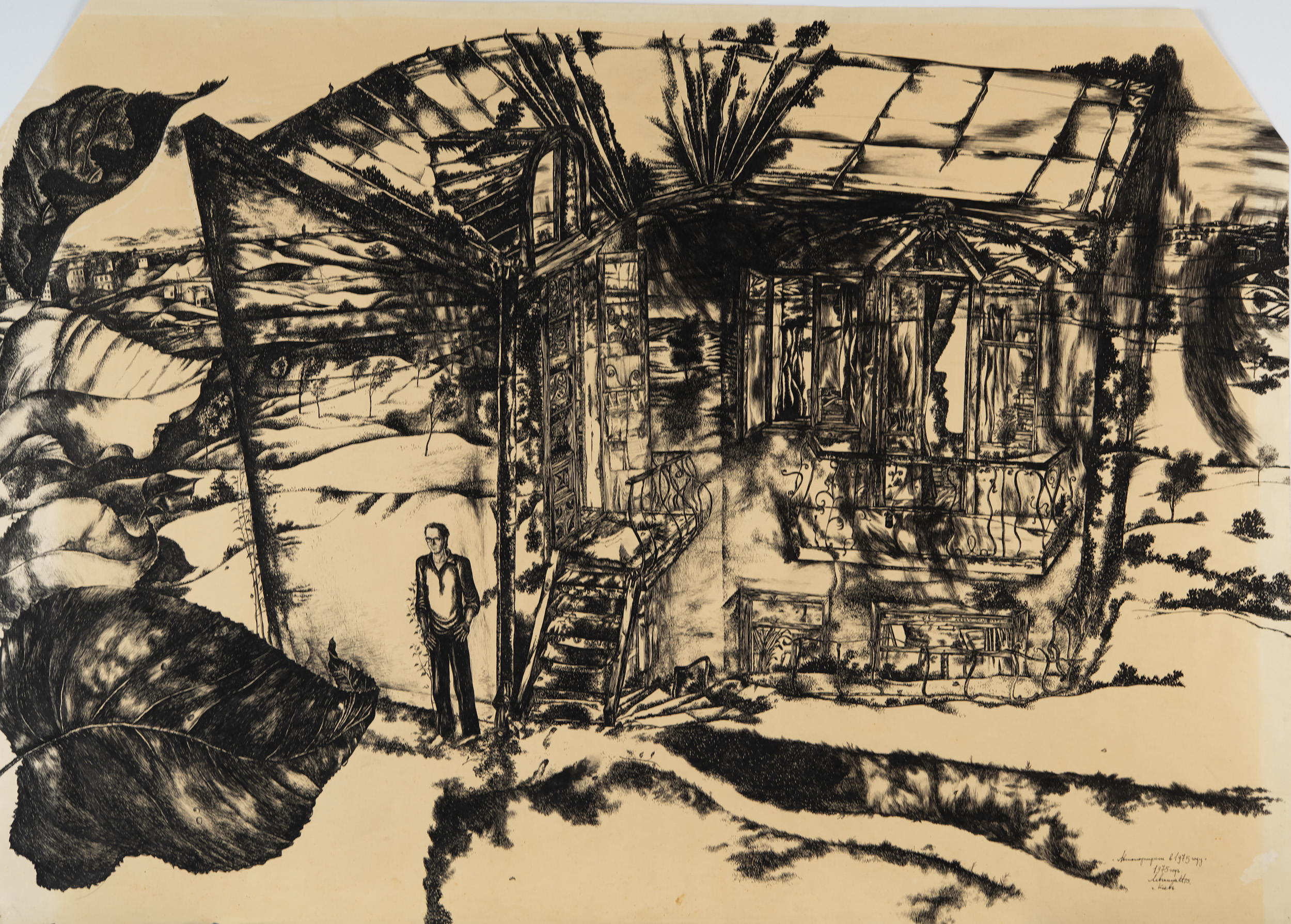
Self Portrait in the year of 1975, 1975. Ink on paper, 60.9 × 86 cm (24 × 33 7/8 in.). Norton and Nancy Dodge Collection of Nonconformist Art from the Soviet Union. D11511
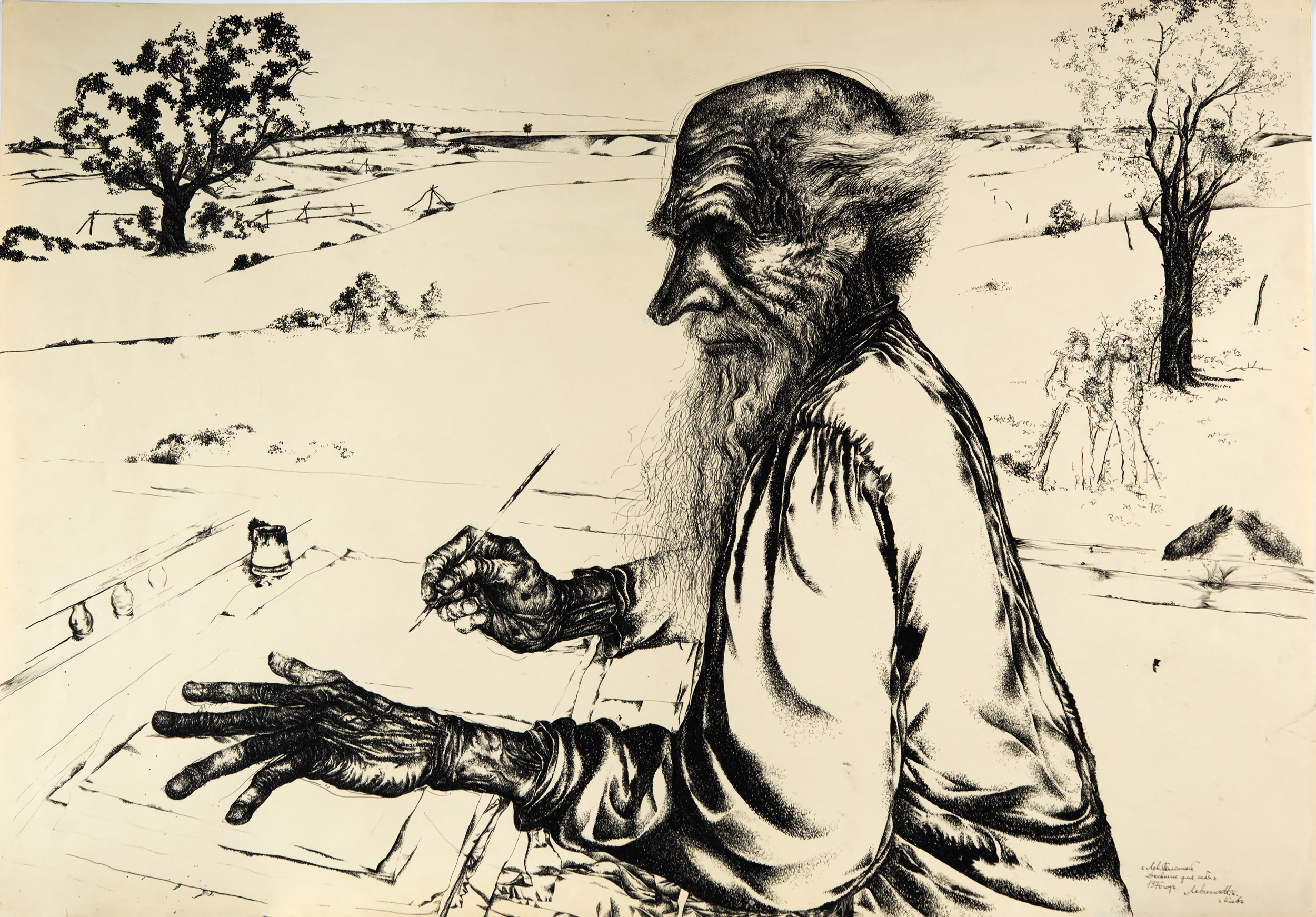
Leo Tolstoy, Diary for Himself, 1976. Ink on paper, 61.4 × 86 cm (24 3/16 × 33 7/8 in.). Norton and Nancy Dodge Collection of Nonconformist Art from the Soviet Union. D11512
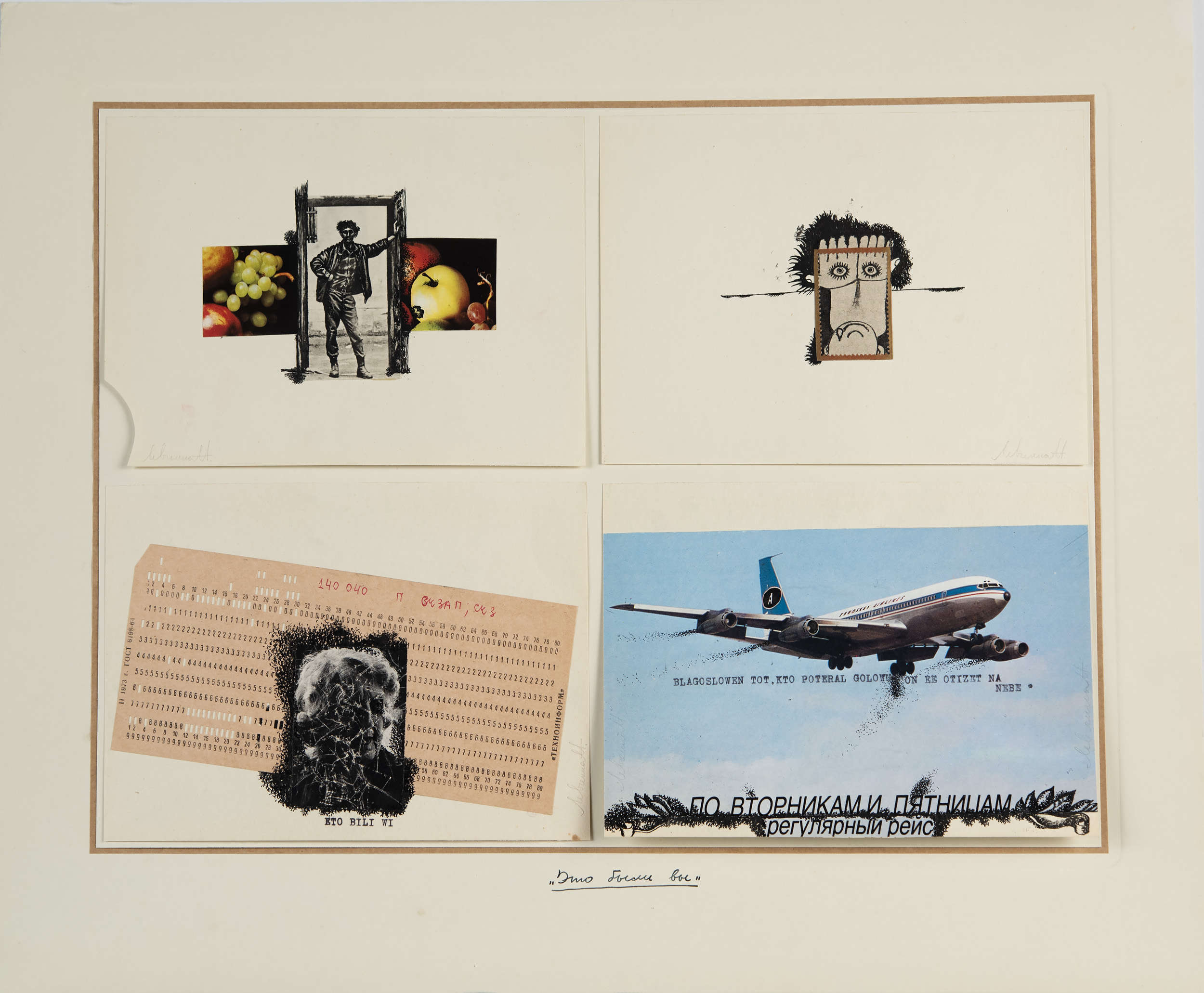
It was you, undated. Collage on paperboard, 29.8 × 42.6 cm (11 3/4 × 16 3/4 in.). Norton and Nancy Dodge Collection of Nonconformist Art from the Soviet Union. D22199