
Oleksandr Dubovyk
a.k.a. Alexander Dubovik
1931 — Kyiv (Ukraine). Lives and works in Kyiv (Ukraine)
Oleksandr Dubovyk is a Ukrainian painter, printmaker, monumental artist, poet, and author of literary essays and philosophical texts about art. He was a leading member of the Kyiv artistic underground, which represented an alternative to official Soviet art of the 1960s to ’80s, and belonged to the 1960s generation (shistdesyatnyky) during the stifling atmosphere of the Brezhnev stagnation era in the USSR. As one of the pioneering artists in the realm of Ukrainian nonfigurative art, he broke free of the bonds of socialist realism and embraced the avant-garde. In the late twentieth century, he became a living legend of Ukrainian nonfigurative art, the transavantgarde, and postmodernism.
The artist was born in Kyiv to the family of the Ukrainian poet Mykhailo Dubovyk, who was sentenced to death by the Soviet regime in 1941 on charges of counterrevolutionary activities. (Along with hundreds of thousands of Ukrainians, he was rehabilitated after Stalin’s death.) In 1948 Oleksandr enrolled at the Kyiv Art Secondary School (now the Taras Shevchenko State Art High School), studying under the famous art teacher Hennadiy Titov. After graduating in 1951, he entered the All-Ukrainian Art Institute (now the National Academy of Fine Arts and Architecture), where Titov also taught and was a mentor to Dubovyk and other later-famous Kyiv artists, including Hryhoryi Havrylenko (1927–1984), Viktor Zaretsky (1925–1990), and Volodymyr Zhuravl. Dubovyk's other teachers included the People's Artists of Ukraine Mykhaylo Khmelko (1919–1975) and Serhiy Hryhoriev (1910–1988).
Soon after he graduated from the Art Institute in 1957, Dubovyk was accepted into the Union of Artists of the Ukrainian SSR. This marked the beginning of a period of great public activity for him. Dubovyk organized and chaired the Initiative Council (1965–66), the first association of young artists within the Union of Artists anywhere in the USSR. He coordinated nationwide study trips across Ukraine to promote contemporary art; organized youth exhibitions, discussions, and press coverage; and served on republican and Kyiv governing bodies and exhibition committees. In 1968, following the end of the Khrushchev Thaw, increased ideological scrutiny prompted his withdrawal from the council as more politically “loyal” leadership replaced him.
In the early stages of his career in the 1950s, Dubovyk demonstrated his mastery of form and color in the classical tradition of realism in works such as Автопортрет [Self-Portrait] (1953), Портрет матері [Portrait of Mother] (1957), Автопортрет [Self-Portrait] (1961), and Портрет жінки [Portrait of a Woman] (1962). The first major international event in which he participated was the World Festival of Youth and Students in Moscow in 1957. There, he exhibited Юліус Фучик [Iulius Fuchyk] (1957), the work completed for his diploma.
Between 1958 and 1961, Dubovyk taught at the Kyiv College of Applied Arts (now Mykhailo Boychuk Kyiv State Academy of Decorative Applied Arts and Design), before entering the postgraduate program of the Academy of Arts of the USSR in 1962. He studied there until 1965 under Serhiy Hryhoriev.
Throughout the 1960s Dubovyk created figurative paintings that rejected the norms of socialist realism by reproducing both real and imaginary space, with distinct signs of his own subjectivity. Examples include Портрет брата [Portrait of a Brother] (1962), Операція [Operation] (1962), Автопортрет [Self-Portrait] (1960–62), Портрет В. Журавля [Portrait of V. Zhuravel] (1966), Букет [Bouquet] (1966), Автопортрет [Self-Portrait] (1967), and Портрет Ірини [Portrait of Iryna] (1969). By the end of the Khrushchev Thaw in the late 1960s, the artist’s work had already shown a tendency toward nonfigurative art as a form of protest. This shift is evident in Bouquet (1966), a landmark work that marked the emergence of Dubovyk’s distinctive authorial style. In this painting, figurative reference gives way to a new visual language shaped by his personal reinterpretation of cubism, abstraction, and the avant-garde, functioning as a “conceptual germ” of his later nonfigurative system based on form, module, and sign. As scholars have noted, Bouquet effectively inaugurates a new creative paradigm in Dubovyk’s practice, signaling his move toward abstraction as both aesthetic and conceptual resistance. [1]
During the Brezhnev era, the artist’s works were banned from official Union of Artists exhibitions, as most of his stylistic ideas were incompatible with Soviet ideological and aesthetic restrictions throughout the 1970s and ’80s, as seen in Пробудження [Awakening] (1970); Політ [Flight] (1970, ZAM, D10518); Залізний букет [Iron Bouquet] (1971); Мадонна з квіткою [Madonna with a Flower] (1972); Noon (1973); Flight into Space, Untitled (1976, ZAM, D10391); Tablets (1977); Requiem (1977); Waiting (1978); Free Flight (1978); Hourglass (1977); Summons (1979); and A-10 Sign (1980).
Dubovyk’s works of the 1970s and ’80s mark a transition to an aesthetic system of thinking that produced a new plastic language and artistic mythology. As the art historian Halyna Skliarenko has noted, “Subsequently, the mythic compositions, born from the artist’s imagination and the unrestrained nature of creative play, formed their own enigmatic (mysterious) symbolic system.” [2] The reclusive artist kept many of his works hidden in his workshop within the territory of the Kyiv Pechersk Lavra. Works such as Чорний квадрат [Black Square] (1980, ZAM, D23055), Цикл [Cycle] (1981, ZAM, D10656), and Без назви (Подія) [Untitled (The Event)] (1985, ZAM, D23083) were conceived as a result of deep reflection on world cultural heritage and the study of contemporary European art in magazines, as the artist recalled: “Despite the Soviet authorities’ fierce bans on foreign literature and any information from the West, the Department of Foreign Literature of the State Scientific Library in Kyiv ordered all existing leading magazines from abroad, predominantly as a result of the needs of Ukrainian architects. This was a ‘gold mine’ of everything that was happening in the world of art, design, architecture in the USA, Europe, Japan, and other countries in the Socialist Bloc. Thanks to this, I was aware of all the most significant artistic trends and events. This was the starting point of my study of Western art movements. Thus, I began to formulate my artistic approach.” [3] These works demonstrate Dubovyk’s deep engagement with world cultural heritage through a deliberate synthesis of major strands of twentieth-century European abstraction—ranging from Malevich’s “cool” abstraction and Kandinsky’s expressive line to Mondrian’s constructive neoplasticism. Rejecting the mimetic demands of socialist realism, he developed a symbolic, sign-based system in which figuration and abstraction coexist, and spatial devices such as direct and reverse perspective articulate the human world in dialogue with the Absolute. Drawing selectively on modernist and early postmodern traditions without affiliating with any single movement, Dubovyk asserted an increasingly singular artistic mythology by the 1970s.
It was not until the 1990s that a wider audience had the chance to get to know both Dubovyk and his work. Only then, with the collapse of the Soviet Union and the start of Ukrainian independence, did artistic thought in Ukraine break free of Soviet restraints, bringing into the light the underground art that had for so long been forbidden and obscured.
The large-scale paintings and graphic series based on intricate geometric structures that Dubovyk created in the late twentieth to the early twenty-first century demonstrate his unique visual system of signs and symbols. As the art historian Olga Petrova observes, “His undeniable cosmic consciousness confirms his consonance with the philosophy of the cosmologically conscious founders of the classical avant-garde: Kazimir Malevich, Pavel Filonov, and Wassily Kandinsky.” [4] From the multifaceted nonfigurative motifs of Bouquet, Dialogue, Phantom, Battle, and Metamorphosis, to the highly abstracted fantasy imagery of the Triumphant, the Overthrown, and Nike (the winged form of Victory), the Prophet, and the Six-Winged Seraph, Dubovyk consistently created a painterly vocabulary rooted in symbolic abstraction. This art rejects formal asceticism, narrow nationalism, and the notion of “beyond art” (as articulated by Joseph Beuys), instead advocating for creative individuality and the ethical responsibility of the artist. Dubovyk’s rejection of the notion of “beyond art” is best understood as a conscious distancing from Beuys’s concept of “social sculpture,” which proposed dissolving art into social, political, and ritual action and asserted that “everyone is an artist.” For Dubovyk, a highly professional painter who refined his craft over decades, such an expansion of art into total life practice undermined the specificity, discipline, and ethical responsibility of artistic mastery. Instead, he upheld creative individuality and sustained commitment to the autonomy of painting as a moral and intellectual practice.
Dubovyk also brought his personal nonfigurative approach and style to his monumental-decorative works for the facades and interiors of public architectural structures built in the 1980s and ’90s. These include large-scale nonfigurative mosaics such as Triumph of Knowledge, Kyiv (1984), and Karelia, Kheliulia, Karelia (1984); abstract stained-glass pieces such as Wind of Wanderings, Feodosia (1986–87), and a series of nonfigurative stained-glass compositions in the New Apostolic Church, Kyiv (1994–95); and the tapestries Procession (1988) and Pastoral (1989).
Dubovyk’s first solo exhibition of nonfigurative works took place at the Union of Architects of the Ukrainian SSR in Kyiv in 1984. Despite its popularity, it was closed after three days at the order of the authorities. His second solo exhibition was organized in 1988, during Gorbachev’s perestroika, at the exhibition hall of the Union of Artists of the USSR on Kuznetsky Most street in Moscow. There, according to the artist, he met Western journalists and diplomats such as Baron Kirshencz from Austria, who would later organize his first international exhibition at the Weiner Gallery in Munich in 1989. Some of Dubovyk’s works from that solo exhibition were acquired by the Tretyakov Gallery in Moscow and the Russian Museum in Saint Petersburg for their collections.
The early 1990s saw exhibitions in Ukraine and abroad of his many works from the 1970s and ’80s, leading to the artist’s meteoric rise to fame. Since then, multiple exhibitions have been presented at home and abroad. In 1996, at the request of the mayor of the small town of Berre-les-Alpes, located near Nice, France, Dubovyk created monumental abstract murals in the previously pristine white interior of the local sixteenth-century church, Notre-Dame des Anges. Prior to Dubovyk’s intervention, the sixteenth-century interior of Notre-Dame des Anges was marked only by a polychrome wooden sculpture of the Madonna on the altar, which the artist deliberately preserved as the spiritual focal point. His murals envelop the church walls with nonfigurative, vertically articulated color structures in saturated ochers, blues, and reds, aligned with the building’s architectural rhythm and subtly inflected with ornamental motifs drawn from Provençal visual culture. Eschewing canonical Christian iconography, the project reflects Dubovyk’s philosophical conception of spirituality as an ascent toward a “Higher Reason,” a vision that was nevertheless approved by clerical, municipal, and civic authorities. [5]
In the 1990s to 2000s, Dubovyk departed from the principles of pure abstraction and integrated narrative fragments—often drawn from classic artworks (mostly Renaissance)—into nonfigurative compositions. As stated by Petrova, “In the collages Галантна прогулянка [Elegant Stroll] (1998), Таємний архів [The Secret Archive] (2000), Вони вже прийшли [They Have Already Arrived] (1999), Той, що стоїть за дверима [The One Standing Behind the Door] (2001), Гойдалка [Swing] (1999), and many others, Dubovyk demonstrates . . . [a] fragmentation of consciousness, which had until that point been presented as a singular whole. Mimetic images were introduced to his nonfigurative compositions. . . . He therefore departed from classical avant-garde principles and adopted the multipolarity of transavantgarde. Dubovyk manages to preserve an aesthetic harmony, as well as the category of beauty, in the elaborate manneristic games of the transavantgarde.” [6]
In the 2010s, Dubovyk became fascinated by the quantum theory of the Uncertainty Principle of the German theoretical physicist Werner Heisenberg and, in particular, its metaphorical, humanitarian implications. Dubovyk employs the metaphor of the White Bouquet, a symbol of purity, another dimension, and a concentration of meaning, to describe a singularity that he aims to reach with his art. He wrote, “The quantum idea of thinking is a watershed between the traditional method of sequential-temporal research and ‘infinite time’ without intervals, influences, borrowings, fashions, predecessors, etc. An unexpected method of invasion of other paradigms, images, interpretations appears. . . . The cosmic paradigm arrives—‑singularity. The world of artificial intelligence and the rebuilding of consciousness is related to cosmic processes. The White Bouquet is its sign!” [7]
Up to the present day, Dubovyk’s “White Bouquet philosophy” remains undeniably central to his creative work, with the quantum idea as its foundation of universality. The sign of the White Bouquet, present in many of Dubovyk's canvases, for instance in Untitled (1976, ZAM, D10391), harmoniously combines the square (Sky) and the circle (Earth), forming a synthetic image of the Human World in the form of an abstracted bouquet “resembling faceless figures of Malevich's mysterious characters of the 1930s,” as Jean-Claude Marcadé noted, continuing: “This pictogram becomes the artist's signature, his talisman, embodying multifaceted meanings. It serves as a musical leitmotif, an archetype of the universe in its formal-colorful multiplicity.” [8]
The central theme of Dubovyk’s works in the 2010s is “Dialogues” with their confrontation of the present and the past. They work as palimpsests, the essence of which lies in dissatisfaction with the real and the search for revelation while seeking a new interpretation of the “old text.” Marcadé observes, “It is not accidental that this Ukrainian artist has chosen ‘palimpsest’ as one of the main paradigms of his creativity, this metaphor meaning the surface (parchment, manuscript, or tablet) where a new text was written over the erased old one.” [9]
The artist’s erudition and creative thinking are evidenced by his philosophical and theoretical texts and his handmade artist books containing poems, drawings, essays, and collages such as Bouquet, Host of Dreams, Book of Wanderings, Phantoms, and Blue Notebook (1980–2022). Marcadé believes that the artist’s creations are unparalleled in world art from the last quarter of the twentieth century to the present day: “Dubovyk forces abstraction, symbolism, and surrealism to coexist awash in dazzling polychromy.” [10]
Dubovyk is an exceptional figure in Ukrainian visual art from the late twentieth to the early twenty-first century. Oleksandr Soloviov writes, “From a universal point of view, he is a synthesizer of two ascending lines of global abstraction—the expressionism of the ‘Kandinsky line’ and the constructivist neo-plasticism of the ‘Mondrian line.’ This combination gives rise to the specific term ‘suggestive realism,’ with which the author himself defined the phenomenon of his abstract painting. It is exemplary of the transformation from modernism into postmodernism. Dubovyk's art is itself a form of palimpsest: this is the art of a philosopher." [11]
Dubovyk is a member of the Kyiv association of monumental artists Погляд (Pohliad, View) and an honorary member of the National Academy of Arts of Ukraine. He was awarded the Gold Medal of the National Academy of Arts of Ukraine in 2012 and has received orders of Christ the Savior and Yuriy the Conqueror of the Ukrainian Orthodox Church of the Kyiv Patriarchate. His work is included in major collections in Ukraine and abroad, among them the National Art Museum of Ukraine (Kyiv), the Andriy Sheptytsky National Museum in Lviv, the Ukrainian Institute of Modern Art (Chicago, USA), the Wurth Museum (Kunzelsau, Germany), and the Museum of Contemporary Art (Tehran, Iran).
Zoya Chegusova
Translated from Ukrainian by Ada Wordsworth
Photo portrait: 2010s, courtesy of the author
Notes:
1. Kateryna Tsyhykalo and Jean-Claud Marcadé, The Signs (Kyiv: Osnovy Publishing), 65.
2. Оlga Petrova, “Fenomen taiemnytsi v tvorchosti Oleksandra Dubovyka” [Phenomenon of mystery in art by Oleksandr Dybovyk], in Tretie Oko. Mystetski studii: Monohrafichna zbirka statei [The third eye: monographic collection of articles] (Kyiv: Feniks, 2015), 305.
3. Oleksandr Dubovyk, Autobiography, in Dubovyk: Slova [Dybovyk: words], vol. 4 (Kyiv: Sofiia-A, 2021), 221.
4. Petrova, “Fenomen taiemnytsi,” 303.
5. Zoya Chehusova, “Oleksandr Dubovyk: lehenda ukrainskoho mystetstva” In Obrazotvorche mystetstvo [Fine art], 2023, no. 3–4: 54.
6. Оlga Petrova, “Transavantgarde po-ukrayinski” [Transavantgarde in Ukrainian], in Tretie Oko, 115–16.
7. Oleksandr Dubovyk, “Hymn of the White Bouquet,” in Dubovyk: Slova, 99–100. See also Oleksandr Dubovyk, White Bouquet Manifesto, Stedley Art Foundation, 2019.
8. Jean-Claude Marcadé, “Dubovyk or Painting as Metaphysical-Poetic Action,” in Dubovyk: Slova, 20–21.
9. Marcadé, “Dubovyk or Painting as Metaphysical-Poetic Action.”
10. Marcadé, “Dubovyk or Painting as Metaphysical-Poetic Action.”
11. Oleksandr Soloviov, “Dubovyk: sumishchennia poniat” [Dubovyk: The convergence of concepts], foreword to Dubovyk: Slova, 5.

Black Square, 1980. Oil on canvas, 130 × 130 cm (51 3/16 × 51 3/16 in.). Norton and Nancy Dodge Collection of Nonconformist Art from the Soviet Union. D23055
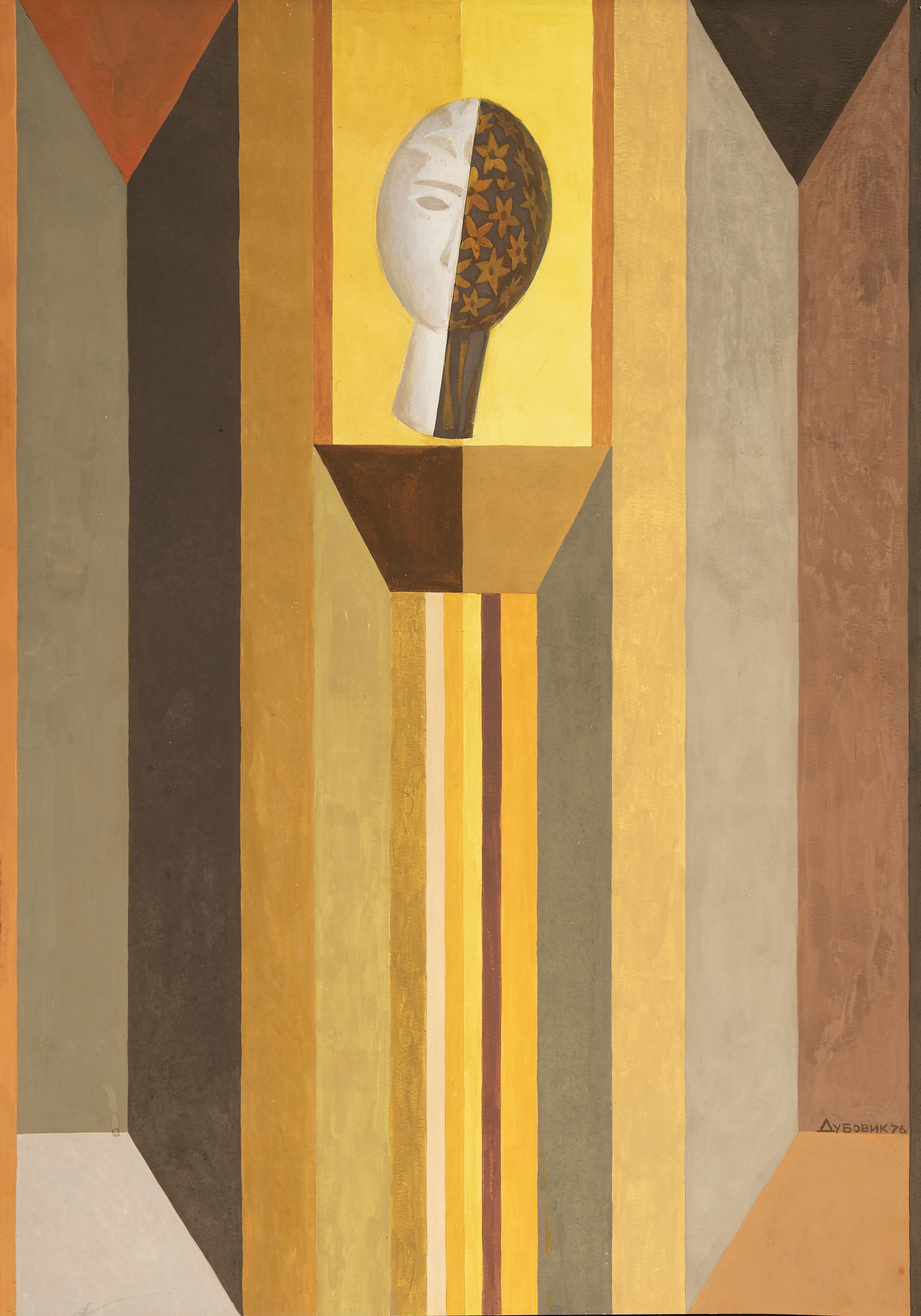
Untitled, 1976. Tempera on paper, 71.2 × 50.1 cm (28 1/16 × 19 3/4 in.). Norton and Nancy Dodge Collection of Nonconformist Art from the Soviet Union. D10391
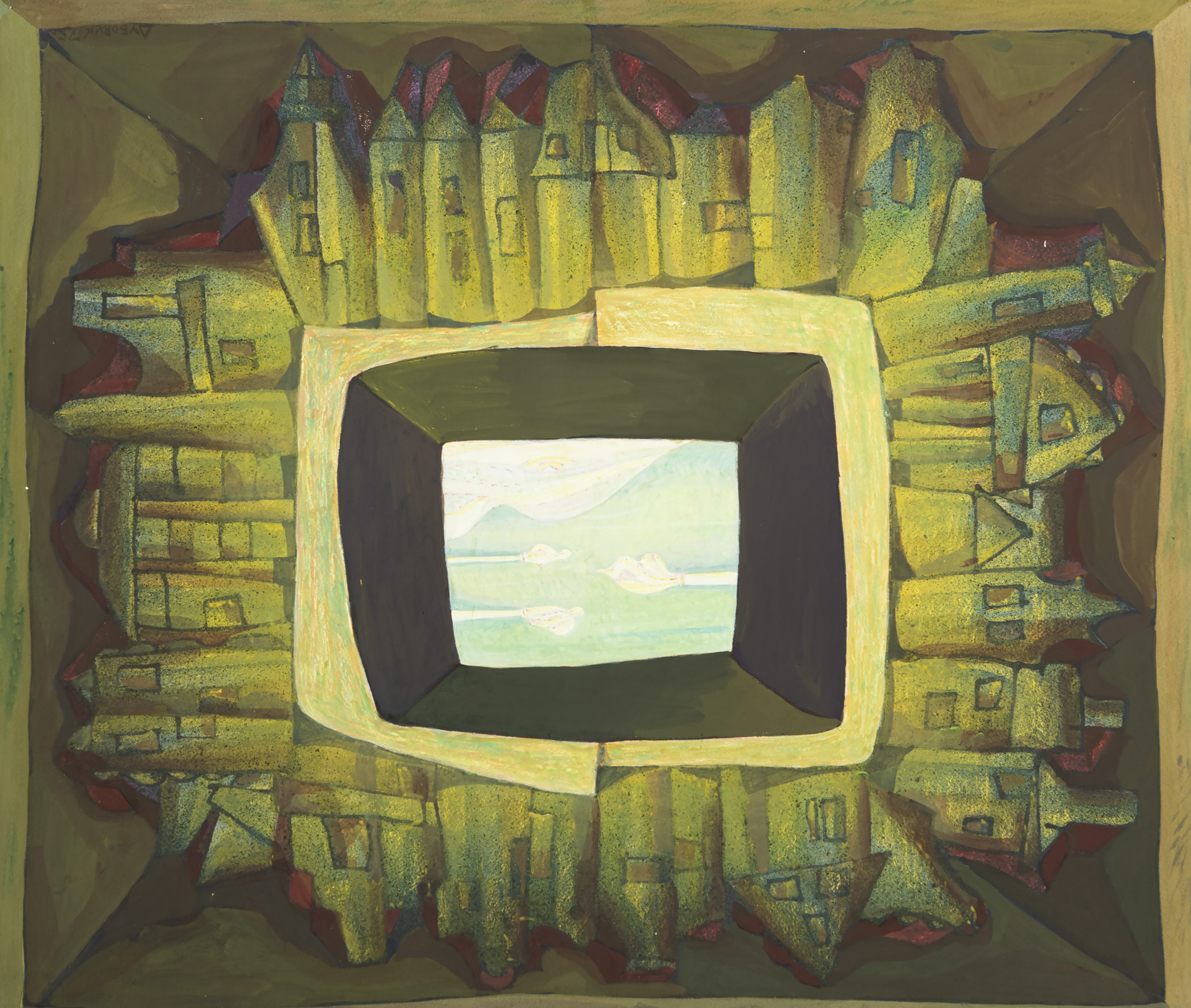
Television in the Night, 1975. Tempera on paper, 55 × 62.9 cm (21 5/8 × 24 3/4 in.). Norton and Nancy Dodge Collection of Nonconformist Art from the Soviet Union. D10517
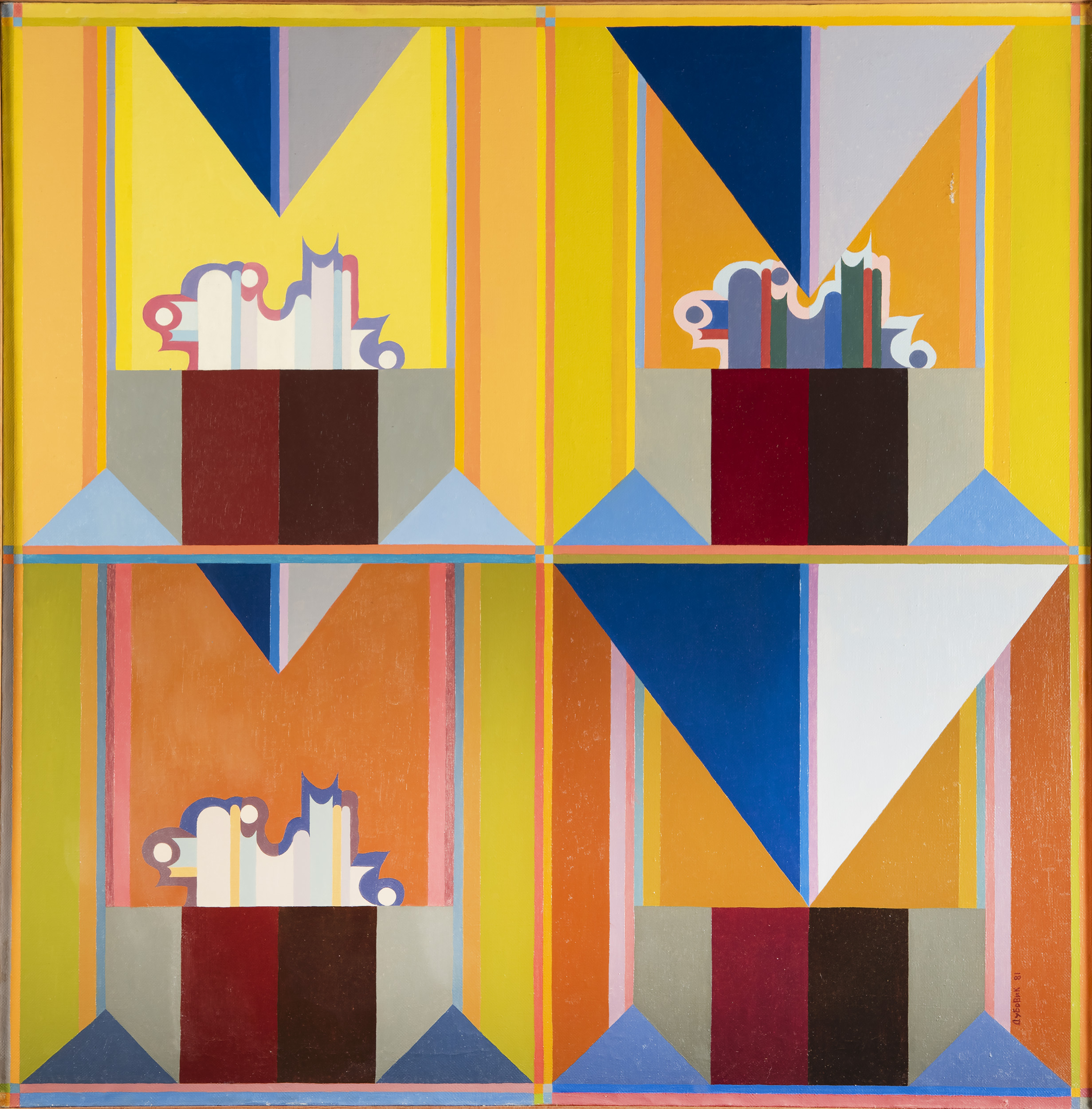
Cycle, 1981. Acrylic on canvas, 100 × 100 cm (39 3/8 × 39 3/8 in.). Norton and Nancy Dodge Collection of Nonconformist Art from the Soviet Union. D10656

Fireworks, 1984. Oil on canvas, 100 × 100 cm (39 3/8 × 39 3/8 in.). Norton and Nancy Dodge Collection of Nonconformist Art from the Soviet Union. D21296