
Oleksandr Borodai
1946 — Dnipropetrovsk (now Dnipro, Ukraine) | 2019 — Kyiv (Ukraine). Lived and worked in Kyiv from 1986
Oleksandr Borodai was a renowned Ukrainian artist known for his monumentalist artworks decorating the interiors of public spaces, as well as paintings, graphics, and drawings. He played a pivotal role in reviving the tradition of enamel art in Ukraine during the late twentieth and early twenty-first centuries, and his achievements in this technique, from studio pieces to monumental works in architectural settings, are unparalleled in contemporary Ukrainian art. [1] He worked across various styles, including realism, abstraction, and “national modernism,” the movement that followed Ukrainian independence in 1991 and the collapse of Soviet socialist realism.
Borodai attended the Dnipropetrovsk State Art School from 1961 to 1966. The school emphasized drawing as the foundation of visual arts, with a special focus on working from gypsum models. Even at that early stage, Borodai’s skillful mastery of line was evident. He continued his studies at the Kyiv State Art Institute (now the National Academy of Fine Arts and Architecture) from 1966 to 1972. There, he explored various academic drawing and painting styles while getting interested in multidimensional art forms and worked in the elite monumental painting workshop of the renowned professor Tetyana Yablonska (1917–2005). It could be said that he turned out to be her most famous student.
Borodai began his professional career in 1972 as a monumentalist artist in Dnipropetrovsk and mastered and improved various techniques and materials in monumental and decorative art in the 1970s. He created the wooden reliefs Conductor and Lyre Player; a series of decorative panels made of embossed leather, Romeo and Juliet, Assol’, Giselle, Macbeth, Mavka, and Don Quixote, in the interior of the Dnipropetrovsk State Opera and Ballet Theater (1974); the stained-glass panels Sun, Thunderstorm and Summer in the restaurant Amur (1974); the stained-glass panels North, East, South, and West in the Aeroflot travel agency offices in Dnipropetrovsk (1977); the encaustic painting Scythian Statues in the interior of the Dmytro Yavornytskyi Dnipropetrovsk National Historical Museum; the triptych Taras Shevchenko, Haymakers and From the Field in the Taras Shevchenko Ukrainian Musical and Drama Theater in Dnipropetrovsk (1979); the ceramic relief Man and Nature, cocreated with V. Danylov, in the Nectar Tasting Hall, Dnipropetrovsk (1978); and the tempera wall painting A Book Is a Window to the World in the House of Books store, Dnipropetrovsk (1980). [2]
From 1986 to 1991 Borodai worked at the Kyiv Art and Production Combine (kombinat) of the Ukrainian SSR Art Fund, where he created monumentalist and decorative art for the architectural and artistic design of public buildings in Dnipropetrovsk, Kyiv, and Poltava. In the 1980s he was the leader and manager of various creative groups of monumentalist artists at the House of Creativity of the Ukrainian Union of Artists in Sedniv, Chernihiv region, and in 1987 he cofounded Погляд (Pohliad, View), one of the first creative associations of Kyiv monumentalist artists.
Borodai’s remarkable abilities in composition, drawing, and painting were fully revealed in his later monumentalist paintings for the narthex and the choir room in Saint Michael’s Golden-Domed Cathedral (1999–2000) and the paintings of the Church of Saint John the Warrior and the Protection of the Holy Virgin (Cossack) Church (2002–4) in Kyiv.
While working in the field of monumentalist and decorative art, Borodai also explored painting, printmaking (including etching, linocut, lithography, woodcut, serigraphy, monotype, and copper engraving), and installation art. But when he first mastered the technique of hot enamel at the International Creative Symposium of Enamel Artists in Kecskemét, Hungary, in 1978, it completely took hold of him, and he was inspired to revive the ancient art. Combining fiery color, the shine and density of metal, and the fragility and transparency of glass, hot enamel could be used to make works for a museum or a more architectural environment, and thus was a medium that was well suited to the artist’s multifaceted talents. Borodai’s enamels on copper, aluminum, and steel—rather than cloisonné, or filigree, used by ancient jewelers—are exceptionally innovative and have no analogue in Ukrainian art history.
Enamel painting became for Borodai a zone of freedom, emancipation, and fantasy. In the 1980s he immersed himself in the power of improvisation in enamel series that bridge purely decorative and easel art: Kyivan Rus’, Flowers, Wings, Cossack Mamai, Seasons, Глеки [Ukrainian Traditional Jugs (hlek)], Night, Hands, Eyes, and Festive Still Lifes. In these works, which are technically, stylistically, and thematically innovative, the artist tried to reproduce his inner fantasies based on the theme of the Ukrainian artistic cosmos: “A turn to the source, the search for the new gives rise to deep interpretations of traditional motifs, classical themes, which, while partially combining with abstract and postmodern forms, are modified into a poetic neomythologism.” [3]
At the same time, Borodai’s romantic view of life gave rise to poetic painting in his enamels, as, for example, in the recurring motif of the silhouette of a traditional Ukrainian jug (hlek), where he deliberately employed a sketchy quality and incompleteness in a form that seems to have absorbed millennia of Slavic culture, conveying the coded female form. As he wrote in his notes of the 1990s: “My ancestors were settlers from the Zaporozhian Cossacks in Left-Bank Ukraine. I have absorbed a love for Ukrainian culture since childhood. This feeling is still an inexhaustible source of creative energy for me. My art is closely connected with the Ukrainian artistic tradition, where the category of the beautiful is decisive, moreover, in its affirming sense, primarily—in the beauty of the material itself.” [4]
While the artistic principles that Borodai professed are generally consonant with avant-garde art’s search for color forms and color plasticity, his enamels shaped as small panels are also imbued with the artist’s very personal national view of the world, conveying his spiritual and emotional experiences through a complex chain of subtle associations. These works are connected in their flow of image and poetic mood, referencing Ukrainian songs, folklore, and historical ballads, as in Cossack Mamai (1986), Paths (1986), Wind over Sea (1991), and Song (1986). The artist wrote in his notes: “Millennia ago, here, on Ukrainian land, the pagan magic of Nature and the Christian wisdom of the Cosmos intertwined in a bizarre way, giving birth to the unique flavor of a renewed culture. However, the history of Ukraine is very dramatic. For centuries, these roots have sunk into oblivion, and the relentless wind of change has brought destruction. That is why today I am looking for my own path behind me. In my opinion, the renewal of the roots of our memory is the true vocation of the artist.” [5]
Realizing that practical knowledge about applying enamel onto metal should be passed from generation to generation, Borodai founded the first informal school of Ukrainian enameling in 1994 (based first at the Kyiv-Mohyla Academy in Kyiv, and then at his own workshop), where for decades he shared his knowledge with students to form a new generation of enamel artists such as his daughter Yulia Borodai (1974–2012), Tamara Turdyieva, Ustym Fedko, Tetiana Kolechko, Serhiy Kolechko, Tetiana Ilyina, Tetiana Dreieva-Barker, Liudmyla Maliarenko-Mysko, and Anastasiia Riabchuk.
In the late 1980s to early 1990s, Borodai became fascinated with multidimensional and installation art. He created multicolored ornamental enamels, enriched with texture, and inscribed them in voluminous wooden structures. His large series of installations with the general title Abandoned Villages (1986–92) were built from wood, miraculously preserved, from old peasant utensils that he found in the empty homes of abandoned Ukrainian villages: wooden wheels from carts, a loom, remnants of wooden furniture, household items, and clay dishes. In his compositions, they become symbols that “in an unexpectedly fresh and organic way, reflect the very spirit of Ukrainian folklore, that understanding of the beautiful, those ethical principles on which the peculiarities of the national artistic vision grew.” [6]
Borodai’s experimental works in enamel in the late 1980s and early 1990s marked the beginning of a fundamentally new direction in monumental and decorative painting in Ukraine. He was the first monumental artist to sharply change established ideas about enamel—its figurative essence, formal language, and even constructive foundations—boldly combining enamel with marble, wood, and leather. He introduced painted enamel into the architectural space for the first time, in works such as Rhythms of the Universe in the Main Observatory of the National Academy of Sciences of Ukraine in Kyiv (1989); decorative panels of copper, enamel, and colored marble based on motifs of the medieval enamels from the Kyivan Rus period in the series Echoes of the Past (1991), made for the interiors of the Vydubychi and Osokorky metro stations in Kyiv, cocreated with Oleksandr Babak (b. 1957); and the enamel decoration of the November Palace of Leisure in Poltava (2003).
From 2012 to 2018, Borodai worked as an associate professor at the Department of Fine Arts of the Institute of Arts of the B. Grinchenko Kyiv University, where he helped create the first metal enameling workshop in a Ukrainian university. In 2015 he founded and helped run the first Museum of Art Enamel in Ukraine (based at the Museum of Ukrainian Painting in Dnipro), where his iconic works formed the core of the museum collection.
A few years before his death, Borodai created his last large group of enamels on copper and steel, Time-Tested: Not Dispersed by Space (2013–15), which includes such works as Energies of the Universe, The Last Melody, Music, Relativity of Time I–VII (a series of seven parts), New Eidetics—I and II, Unforeseen Laws I, II, and a series on the theme of Taras Shevchenko’s poems Fight—You Will Overcome—I and II, The Gambler and The Recruit (from the series The Cossack Sought Freedom, but There Is None). [7] These works embody the author’s enduring desire to revive forgotten and not-yet-lost images and symbols of his people’s cultural identity, developing the concept of “neomythologism,” an idea of which he was fond. As he explained in his notes of the 1990s: “Myth is one of the main categories of art of the 20th century. Its form allows one to combine the past and the present in one stream, to open up the unity of time and generation that form the deep national archetypes of culture. In my works, ‘neomythologism’ is aimed at revealing ancient images that are the basis of the Ukrainian artistic cosmos, dating back to antiquity, the history of the Ukrainian people. Therefore, in my works, the traditions of pop art, Art Nouveau, Ukrainian Baroque, the art of Kyivan Rus, folklore and pagan symbolism intersect and unexpectedly combine.” [8]
In Ukraine, Borodai leaves a rich legacy, “whose highly artistic and fully fledged works combine bright metaphor, emotional expressiveness and subtle lyricism, philosophical wisdom and poetic expressiveness, rebellious passion and romanticism, an alchemist’s passion for experiment and a mature dialogue of a master who rules freely over his material.” [9]
Borodai became a member of the National Union of Artists of Ukraine in 1975 and has participated in exhibitions in Ukraine and abroad since 1969. In 2008 he received the honorary title of Honored Artist of Ukraine. Many of his works are in museum collections, including the mural at the National Art Museum of Ukraine in Kyiv; the mural Cosmic Celebration (copper, enamel, 2007); Night Bird, Festive Dinner, Eye, Bird, and Terrifying Beast (all copper and enamel, 2016); Night Visions (copper, enamel, 2017) at the National Museum of Decorative Arts of Ukraine; the installation Cradle for an Unborn Child (wood, copper, enamel, 1989) at the Museum of Enamel Art in Dnipro; and numerous works that are highlights of the Enamel Museum in Kecskemét, Hungary. From 2009 to 2019 Borodai co-organized and participated in the International Enamel Festivals in Ukraine.
Zoya Chegusova
Translated from Ukrainian by Nathan Jeffers
Notes:
1. Enamel originated as a jewelry technique in ancient Egypt and came to Slavic culture from Byzantium. Bracelets and fibulas made of colored “recessed” enamel were made in the Dnieper region as early as the third to fifth century. In the technique of painted enamel, which spread from Limoges, France, from the fifteenth century, layer after layer of paint is applied, with up to ten or more firings in the oven.
2. These compositions are monumental-decorative works made of glass, executed in the classical stained-glass technique using thin glass and lead soldering, and installed within window openings.
3. Tetyana Ilina, Oleksandr Borodai Enamel (Kyiv: Vydavnytsvo Ukrains’kyi pys’mennyk, 2013), 7.
4. Ilina, Oleksandr Borodai Enamel, 111.
5. Zoya Chegusova, “Oleksandr Borodai – novator starovynnnykh taiemnits’ emali.” [Oleksandr Borodai—an innovator of ancient enamel secrets], Prezydent, no. 11/12 (2002): 112.
6. Halyna Skliarenko, Oleksandr Babak, Oleksandr Borodai Maliarstvo. Instaliatsii. Emal: Katalog vystavky [Painting, installations, enamel: An exhibition catalogue] (Kyiv: Ukrainskyi tsentr tvorchosti ditei ta iunatstva [Ukrainian center for creativity of children and youth], 1992), 3.
7. The title of Oleksandr Borodai’s work appears to paraphrase a well-known verse by Taras Shevchenko:“Шука козак свою долю, а долі немає” (The Cossack seeks his fate, but there is none). Borodai’s version substitutes “воля” (freedom) for “доля” (fate) and changes the verb tense from present to past.
8. Borodai, quoted in Chegusova, “Oleksandr Borodai,” 112.
9. Ilina, Oleksandr Borodai Enamel, 6.
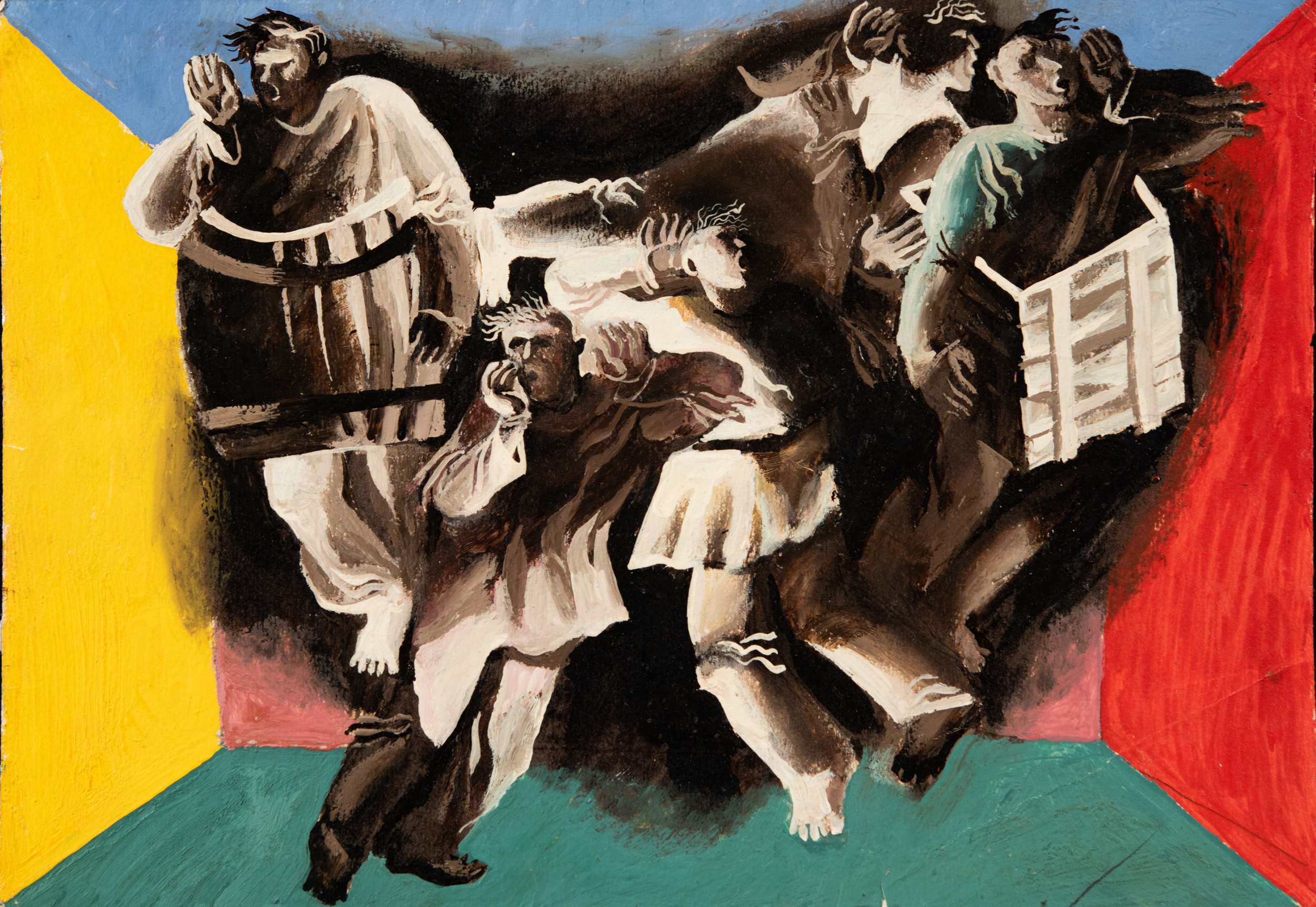
After a Party in a Ukrainian Village, 1968. Oil and ink on paper, 21.5 × 30.8 cm (8 7/16 × 12 1/8 in.). Norton and Nancy Dodge Collection of Nonconformist Art from the Soviet Union. D21109