
Oleksandr Babak
1957 — Kyiv (Ukraine). Worked in Kyiv and Velykyi Pereviz, Poltava region (Ukraine); currently works in Kyiv (Ukraine)
Oleksandr Babak is a Ukrainian artist and has been a member of the Union of Artists of the Ukrainian SSR since 1988, a part of the New Ukrainian Wave postmodernist movement, and a member of the art association “Zhyvopysnyi zapovidnyk” (“Painterly Preserve”) from 1991 to 1995. Babak specializes in monumental art, printmaking, landscapes, videography, and photography. His paintings are in the abstract expressionist style, and for installations he uses ready-made photographs and video art. Thematically, Babak’s work is dominated by the ideas of personal freedom, historical memory, and the awareness of archetypes of national culture, while simultaneously encapsulating a holistic sense of world culture. The artist believes it is important to convey the interaction between man and nature, with its living pulsation and dynamic energy.
In 1975, Babak graduated from the Taras Shevchenko Kyiv Republican Art Secondary School. In 1987, he began at the Kyiv State Art Institute (now the National Academy of Fine Arts and Architecture), where he studied monumental painting under Mykola Storozhenko (1928–2015). Storozhenko not only taught spatial composition but also immersed students in the philosophy of art, supporting a conscious definition of the idea, the form of each work, and the general creative path. The artist’s relationship with Storozhenko was hugely important to Babak, as were the works of his father, Petro Babak, who died when Oleksandr was sixteen years old. The works of artists such as Mykola Hlushchenko (1901–1977) and Borys Rapoport (1922–2006) also proved significant to his development. Throughout the years Babak consistently dedicated work, both individual and entire exhibitions, to these artists. Examples of his monumental artistry include the Vydubychi metro station in Kyiv, which he designed in 1992, and the Astronomical Observatory of the National Academy of Sciences of Ukraine in 1993.
Beginning in the mid-1980s, landscapes became the primary genre of Babak’s paintings. His depictions of the Ukrainian landscape, filled with traces of history, are infused with the artist’s own impressions and saturated with colorful expression. Throughout his creative journey, Babak also portrayed landscapes in Crimea, Zakarpattia region, and the historical city of Kaniv; however, his most featured landscape remained the Poltava region.
By the end of the 1980s, the artist had acquired an estate in this area, in the village of Velykyi Pereviz (Poltava region, Ukraine). This part of the country had previously attracted the attention of such classics of Ukrainian art of the twentieth century as Vasyl (1873–1952) and Fedir (1879–1947) Krychevsky, writer Nikolai Gogol (who intermittently lived and worked there), the scientist Volodymyr Vernadsky, and Oleksandr Dovzhenko, who used the location for the films Zvenyhora and Zemlya. Babak had intentionally chosen this area: “The village is where everything begins—language, relationships, art—and thus is a necessity for existence. It preserves everything that is closer to the BEGINNING, everything that surrounds man and is artistically comprehended by him.” [1]
The paintings Pagan Canons (1993) and Ritual Actions (1993), both minimalistic in their figurative motifs and with a mysterious color palette, are filled with symbolism and the magic of ancient sacred rituals. Four untitled oil paintings from the Zimmerli Museum collection belong to this period (1993, ZAM, D10641, D10642, D10643, D10644). In these works, the relationship between earthly and heavenly principles of man is placed in a form reminiscent of a mandorla, an iconographic frame. In the artist’s own words: “Memory is a space inside of you. . . . Two spaces merge into one when you are alone with the sky, when the first fear disappears, everything that did not bother you before becomes a component of music that has not changed since the time of creation of the world.” [2]
In the late 1980s, Babak became one of the first Ukrainian artists to turn to installation art. Together with Oleksandr Borodai (1946–2019), he presented the installations Cradle of an Unborn Child (1989) and Temple (1991). The installation Christmas (1994) was created by him in collaboration with his wife, the artist Tamara Babak. These installations used old, ready-made village objects and materials from rural life, such as wood, leather, and metal. Installations and art objects have become a significant phenomenon in Ukrainian contemporary art, particularly for its “new archaeological” dimension, which now incorporates the world of rural culture.
This method of artistic reconstruction opened the possibility for research projects with significant social and cultural resonance. In 1998, Babak’s project Parsuna, held at the Central House of Artists in Kyiv, presented large-format films depicting full-length images of villagers who once lived in the abandoned village of Leikove in Poltava region. The portraits were created based on photographs found in empty houses and in the archives of the local history museum. The project title refers to the early form of Ukrainian secular portraiture during the seventeenth and eighteenth centuries (mainly portraits of the Cossack elite), which gravitated towards a linear-planar form. The name of the project and its imagery provoked profound historical analogies and, in turn, reflections on the fate of the country and its people.
For thirty years, the artist has observed changes in the village of Leikove, which was abandoned by its residents. Here gardens sit, whole and tidy, yet next to empty houses, recalling the abandoned villages of the Chornobyl zone. The gradual nature of the village’s demise made the passage of time visible, with the presence of death and the nature of the tragedy. The artist described his observation of the village as an archaeological and ethnographic research project. He compared the state of gradual destruction of each house with life itself and the state of the person who had once lived there. The cemetery was the longest-surviving part of the village because relatives of the deceased would come to the burial sites and adorn the graves with flowers. This paradoxical phenomenon was reflected in the artist’s large semi-abstract paintings.
In 2004, the National Art Museum of Ukraine presented the exhibition Cossack Mamai: Ukrainian Folk Painting, in which Babak installed nearly forty works depicting Mamai, a traditional hero of Ukrainian folk art. In this installation, a screen repeatedly played the artistic process in the creation of Babak’s portrayal of Cossack Mamai. In the video, through the almost ritualistic flow of repeated brush movements, a hundred graphic sheets were produced in a dialogue with the original image. “I came to the need to use artistic means to revive, clearly showcase and preserve our common heritage in artistic objects,” the artist stated.
In 2010 Oleksandr and Tamara Babak, with the support of their patron, Yuryi Oslamovskyi, created an art residency in an estate in Velykyi Perevis, where Ukrainian artists continue to collaborate to this day. For Babak himself, working on the estate gave him the opportunity to fully reveal his artistic gifts.
In his paintings, the images depicted are captured with seeming ease and broad impressions, yet the artist manages to convey the pulsations of energy through the color, brushstrokes, and rhythm of the work. He creates an abstract expressionist space in which the viewer becomes a participant; each work demands its audience engage and reflect on its contents. In this meditation, the viewer is pushed to uncover their deepest emotions and connect their subconscious associations to their own experience and archaic cultural memory. Babak perceives the world’s authenticity through the contemplation of nature. At the moment personal ego dissolves, he writes rapidly on a large canvas to capture the moment of creative energy pouring itself through the paints. Landscapes and still lifes in his compositions may therefore become painterly abstractions, yet they are nonetheless real because they are taken from the author’s own interiority.
As the full-scale war began in February 2022, Babak presented the exhibition A Day Is a Lot in the hall of Kyiv’s Goldens Auction House. The ability to observe, contemplate, and reflect on one’s own impressions in painting has the capacity to transform the natural temporal dimension into the vast space of real life. This acute feeling is intensified by this existential state of vulnerability under the constant threat to human existence. Babak transformed this state into an expressive painting saturated with color: “In this tragic time of war, every new minute of life is now perceived as a gift full of meaning, gratitude and understanding of one’s belonging to the picture of the universe. Despite everything, new lives appear in families and new colors on the canvases, reminding us of what is important, of what has meaning.”
Olha Lagutenko
Translated from Ukrainian by Nathan Jeffers
Notes:
1. Kateryna Rai, “Reconstruction of the village: how the artist Oleksandr Babak explores the death of Ukrainian villages and turns them into art objects,” Officiel Online, March 22, 2018.
2. Catalog of the second exhibition Syntheses-Slavutich, Kyiv (1994): 34.
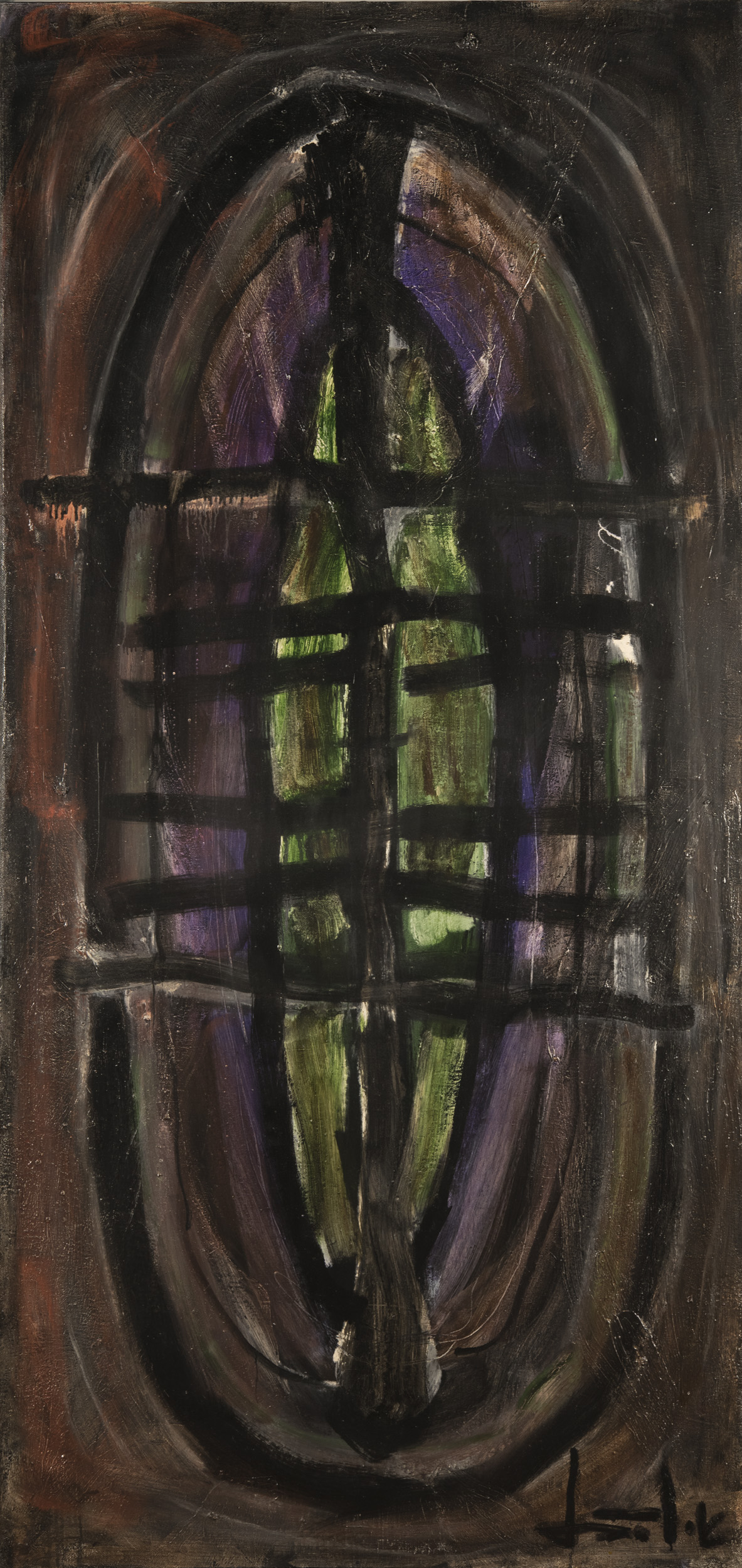
Untitled, 1993. Oil on canvas, 189.3 × 95 cm (74 1/2 × 37 3/8 in.). Norton and Nancy Dodge Collection of Nonconformist Art from the Soviet Union. D10643
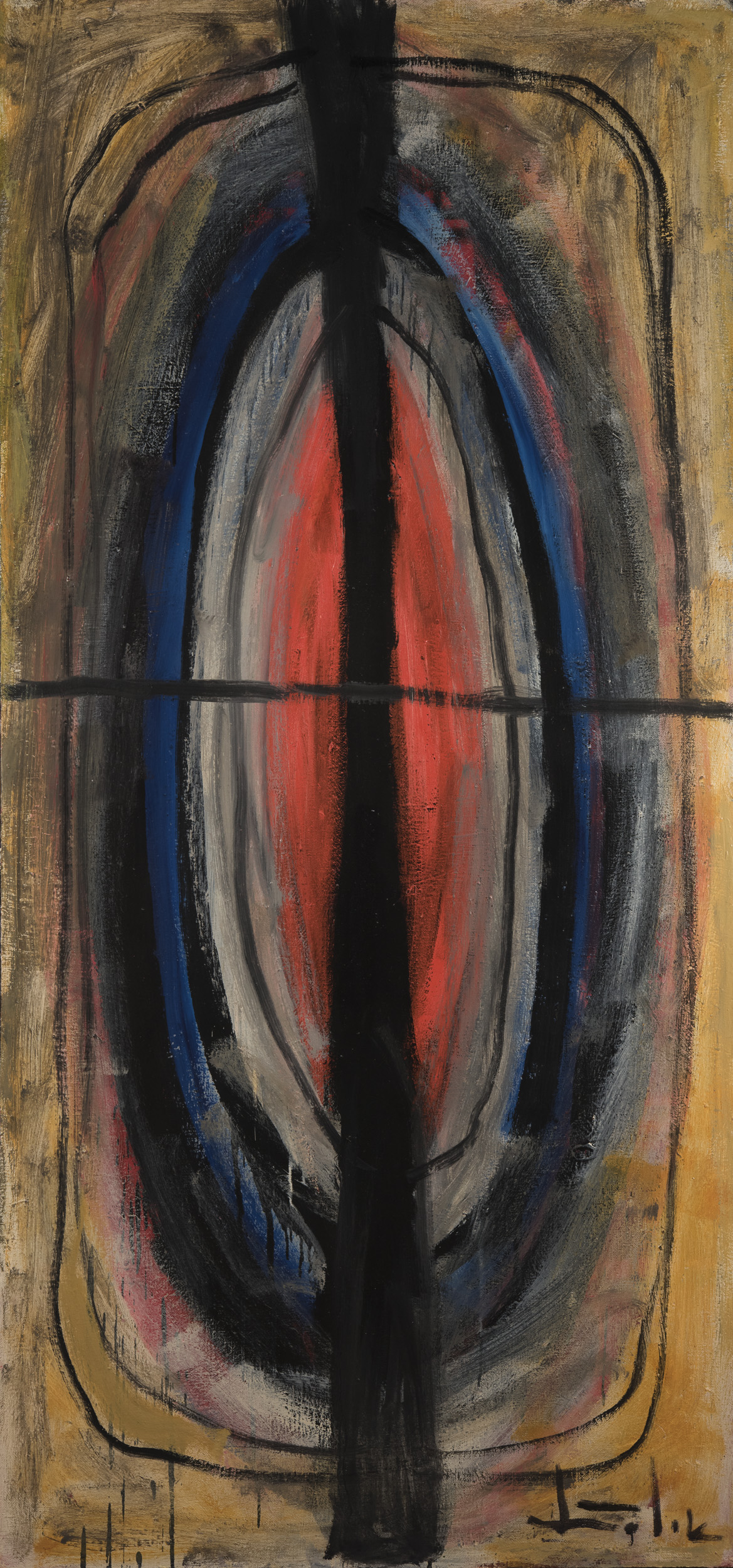
Untitled, 1993. Oil on canvas, 189.3 × 95 cm (74 1/2 × 37 3/8 in.). Norton and Nancy Dodge Collection of Nonconformist Art from the Soviet Union. D10644

Untitled, 1993. Oil on canvas, 189.3 × 82.8 cm (74 1/2 × 32 5/8 in.). Norton and Nancy Dodge Collection of Nonconformist Art from the Soviet Union. D10641

Untitled, 1993. Oil on canvas, 189.3 × 82.8 cm (74 1/2 × 32 5/8 in.). Norton and Nancy Dodge Collection of Nonconformist Art from the Soviet Union. D10642