
Oleg Voloshynov
1937 — Mykolaiv (Odesa region, Ukraine) | 2020 — Odesa (Ukraine). Worked in Odesa (Ukraine)
Oleg Voloshynov was a Ukrainian painter who in 1971 became a member of the Union of Soviet Artists of Ukraine. He taught from 1966 to 1970, he taught at the Mitrofan Grekov Odesa Art College and from 1970 to 1975 at the Odesa State Pedagogical Institute (now the South Ukrainian National Pedagogical University named after Kostiantyn Ushynskyi). In 1993 he became an honorary member of the National University of Kyiv-Mohyla Academy. He worked with oil painting, combining academic techniques with imaginative, poetic subjects and elements of modernist deviation. His signature style can be characterized by a refined and laconic abstraction: His compositions are built on precise, minimal relationships of line, plane, and color, balancing contrast and formal clarity to achieve a still, almost sculptural intensity in otherwise simple, intimate forms.
Voloshynov was born into an artist’s family; his father, Vasily, was a Soviet painter who worked in the genre of socialist realism and was known for his teaching activities. Voloshynov’s younger sister, Tatiana Basanets, was an educator, artist, and art critic specializing in Odesa modern art, and was once married to Valery Basanets, one of the key figures of the Odesa nonconformist movement. During World War II, the family moved from Mykolaiv to the Kirov region (now Volga Federal District, Russia) before relocating to Odesa. From 1951 to 1956, Voloshynov attended the Odesa Art School, where he studied under the artist Oleksandr Atsmanchuk (1923–1974). Right after graduation he spent three years in the Soviet army, stationed in Kazakhstan. According to Voloshynov, he enjoyed the service; he was happy to acquire new skills—for example, driving a tractor—and considered it a lucky coincidence that during his military service he was not assigned to work as an artist. He deliberately concealed his artistic abilities to avoid being tasked with painting ideological posters. [1] Immediately after the end of his military service, he entered the painting department of the Ilya Repin Leningrad Institute of Painting, Sculpture and Architecture (now the Ilya Repin Saint Petersburg Academy of Ats), one of the most prestigious art institutions in the Soviet Union. Among his teachers there was the painter Viktor Reikhet (1922–2000), who instilled strong academic drawing skills in his student.
Upon his return to Odesa, Voloshynov was exposed to a very different situation from the one he experienced at the Leningrad Institute, where artistic life was vibrant but mostly contained within the canon of socialist realism. In Odesa, by 1965, the apartment exhibitions were in full swing. The salon of Aleksandr Anufriev (1940-2024), which was in a room in a communal apartment, was the epicenter of the underground artistic life, whereas the Union of Artists remained loyal to the officialdom. Voloshynov joined the Odesa group and started to participate in the apartment exhibitions, trying at the same time to liberate himself from the academicism acquired during his studies, which, nonetheless, remained his hallmark. From 1966 to 1970, he taught at the Grekov Odesa Art College. In 1971 he became a member of the Union of Soviet Artists of Ukraine, and in 1980 had his first solo show at the Odesa Museum of Western and Eastern Art. Already by the end of the 1950s he had participated in a number of the all-union and republican exhibitions in Moscow, which were sanctioned by the Soviet government and held regularly. This granted him status as an officially recognized artist and enabled his teaching career in Odesa. At the same time, he opened his studio at Kanatnaya Street for informal gatherings and exhibitions. Sometimes a nonconformist artist would pop by the studio with some paintings and within an hour there would be fifty people, looking at the works and discussing them. [2] This latter aspect, namely audience perception, is something that occupied Voloshynov from the early days; he found great satisfaction in discussions and substantive analyses of his work with colleagues.
During Voloshynov’s mature period, in the late 1970s and ’80s, his preferred subject matter was city landscapes. Although they might resemble Odesa, these were imaginary, artistically constructed landscapes. Depictions of the sea, sky, and boats floating on the waves provided another recurring motif. Voloshynov’s work is less lyrical than that of his colleagues but much more intimate; starting from the shapes and outlines of objects, he searches for their fundamental basis. This profoundly introspective search draws from Plato’s ontology and thus implies the existence of the intelligible world. In Bread and Jug (1975, Dymchuk Collection), the loaf of bread and the jug in the foreground do not depict specific objects but rather embody the concept of “any bread” and “any jug,” representing archetypal elements of a traditional still life. Similarly, the generalized, unrecognizable landscape functions as a fully intelligible construct, reinforcing the work’s engagement with universality and abstraction. The small number of forms is organized into a single, compositionally balanced group.
From the 1990s onward, Voloshynov moved away from figurative painting toward nonobjectivity. His main field of experimentation was colors and their combination. Echoing color psychology, the artist asserted color’s unquestionable influence on human behavior, with every color associated with a different emotion. Determined to reach harmony in his paintings, he sought color combinations that positively affected a viewer. His imagery demonstrates a unique aesthetic, created by synthesizing the most technical aspects of academic painting with an unconventional view of the world. The art critic Tatiana Basanets characterized Voloshynov’s method as a personal system of giving shape to nature and things, along with abstraction of conceptual planes of existence. [3]
According to the Odesa-based journalist, collector, and art critic Evgeny Golubovsky, Voloshynov’s work in his last years can be best characterized as minimalism. The artist got rid of the plot, sought to solve artistic, formal problems, and only then introduced a minimal amount of figurative information. [4] Before his death in 2020, he received significant accolades, including being named an honorary member of the National University of Kyiv-Mohyla Academy in 1993 and the title of Honored Artist of Ukraine in 2013.
Kateryna Filyuk
Notes:
1. Gallery TV program “Oleg Voloshynov Portrait,” posted October 25, 2013, by GalleryTV, YouTube.
2. “Oleg Voloshynov Portrait.”
3. Tatiana Basanets, “Oleg Voloshynov,” 2006, accessed September 3, 2025, Encyclopedia of Modern Ukraine.
4. Evgeny Golubovsky, “Oleg Voloshynov: A Hostage of Eternity,” Almanac Deribasovskaya–Richelievskaya, no. 67 (2016): 256–60.

Haystacks in Winter, 1970. Oil on plyboard, 50 x 80 cm (19 11/16 x 31 1/2 in.). Norton and Nancy Dodge Collection of Nonconformist Art from the Soviet Union. 2013.006.032
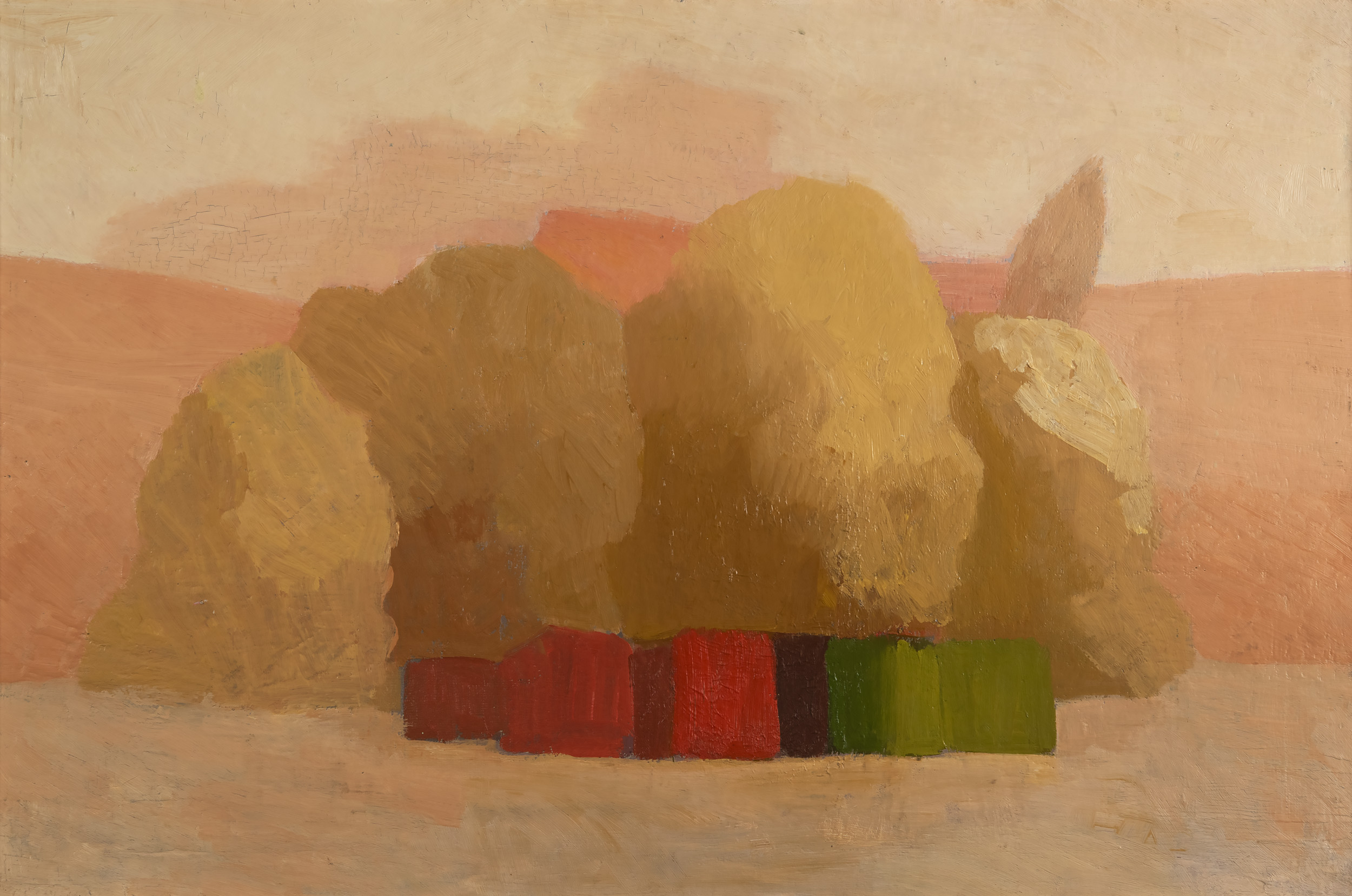
Summer, 1970. Oil on fiberboard, 51.5 x 77.5 cm (20 1/4 x 30 1/2 in.). Norton and Nancy Dodge Collection of Nonconformist Art from the Soviet Union. 2013.006.033