
Oleg Kotelnikov
1958 — Leningrad (USSR). Works in Saint Petersburg (Russia)
Oleg Kotelnikov became a legend in his youth in the Leningrad (now Saint Petersburg) New Wave, but interest in the artist has endured for forty years, over changes of eras, fashions, and generations.
Born in Leningrad, he attended the secondary art school no. 61 and graduated in 1976 as a cabinetry restorer. Like many artists in the city, he received his real artistic education in the encyclopedic collections of the State Hermitage Museum.
Kotelnikov was exposed to non-Soviet contemporary culture through the street black market for records, where the latest musical novelties appeared, packaged in designer sleeves that themselves opened up other worlds to Soviet people. His circle of friends included Timur Novikov, who had attended the same secondary school and was his neighbor in the Shpalernaya Street area, as well as other young men looking for alternative cultural experiences. Their art was born from sitting and talking, listening to music, going to museums, and walking. Wandering around the beautiful, somnambulistic city on white nights was a long-standing Saint Petersburg custom, part of the local way of life and a source of inspiration for many generations of creators. As Kotelnikov said, “Well, how could modern art not emerge here?”
Novikov’s home was open to his friends, and he was always exhibiting art in his room in the communal apartment (kommunnalka), often works by Kotelnikov. The room was called the gallery Assa—named for an exclamation signifying a burst of energy, determination, and fun during the Lezginka Caucasian folk dance that became a kind of watchword in the bohemian circle.
At the time, however, rock music had a far greater influence on the youth than the fine arts. Kotelnikov had been in a school band called the Monsters with Novikov, and he later took part in the activities of the punk group Avtomaticheskiye Udovletvoritely (Automatic Satisfiers) and was a friend of its leader, the famous Saint Petersburg punk rocker Andrei Panov, aka Swin (Boar). Panov's room-studio was a hangout for musicians (aka artists and poets) including the future rock star Viktor Tsoi; Yevgeny Yufit, the founder of necrorealism; and many less-illustrious personalities. It was the headquarters of punk in “Piter” (Saint Petersburg’s informal name). Nobody knew how to play, nobody learned how to write music, nobody cared about sound quality: everything was done according to the punk principle of “the worse, the better.” Highly educated young men, sons of Soviet intellectuals who hated mainstream Soviet culture, played exuberant “idiots,” successfully portraying crude plebeians. Their “idiotic” behavior was accompanied by raucous drinking, outings, public staging of fights, and stunts with a corpse mannequin. “Stupid, cheerful, impudent!” was the motto of the Saint Petersburg punks, whose main source of inspiration were the grisly images in Eduard Hofmann’s 1898 forensic textbook, Atlas of Legal Medicine.
Witnesses marveled at the incredible energy, heroic self-destructive drunkenness, and shamanistic rage into which the participants of the “idiotic trips” fell in the creative process. “Chaos and absolute authorial arbitrariness gave birth to this aesthetic,” recalled Yevgeny Yufit. “From the very beginning, the early works contained the theme of death, suicide and various kinds of psychopathology, and all this was presented in a hypertrophied inverted form of social grotesque and black humor.” [1] “Idiotic behavior” was shot on film, and Yufit eventually founded the studio Mzhalala Film in 1984. In the early 1980s, Yufit and Kotelnikov composed and recorded the necrorealism hymn “Zhirovosk” (Adipocere), named for a substance formed during decomposition of body fat in a cadaver, to the tune of a Soviet song, with lyrics roared with frenzied mirth: “Our body is eaten by fat bugs, after death cool life comes, men.” The hymn was later included in the soundtrack of Yufit's film Lesoruby (Woodcutters).
Necrorealism was a vivid metaphor of the Soviet empire in the 1980s, already a decaying corpse, a kind of zombie that was dead but still functioning, senseless and merciless. Since then, the theme of death has run through all of Kotelnikov's work; his paintings of different periods display dancing skeletons, murderous doctors, and teeth-grinding monsters.
Another link to the artist’s themes of violence, death, and black humor is Soviet poetic folklore, especially children's “scary poems” that are endlessly, anecdotally violent. Kotelnikov wrote poetry all his life and was a friend of the poet Oleg Grigoriev (1943–1992), a major figure in Piter’s cultural landscape. Grigoriev, considered a “children's” poet, became famous for his absurdist, funny, and violent poems. In the mid-1990s, he spent the last months of his life in Kotelnikov's studio and died there.
Simplification of the artistic product was characteristic of Saint Petersburg culture of the 1980s, in general. At the same time, the “primitive” Kotelnikov was extraordinarily eloquent, able to carry on long conversations on varied topics with erudition, wit, and paradoxical wordplay mixed with furious profanity.
In 1982, Kotelnikov joined the New Artists group created by Timur Novikov. The New Artists were not as fierce as the necrorealists; their art was more of a merry mockery, in which they parodied mainstream culture and collaged anything and everything, from Soviet pop to American pop art. According to the precepts of the Russian avant-garde, this was called vsechestvo (acceptance of everything), a term coined in the 1910s by the theorist Ilia Zdanevich (Iliazd). Like almost all underground artists in Leningrad, Kotelnikov began as a neo-expressionist. His works were cheerful and furious comics with a plot that was absurd but plausible, since the whole of late Soviet life around him was an absurdity that was pointless to fight against, but could be played with.
Paintings were made on anything and everything, using aerosols, felt-tip pens, stencils, pictures cut or transferred with solvent from magazines, film, canvas, paper, and plastic. Kotelnikov’s works are always made with minimal means, alla prima, effortlessly and without regard for future preservation, care for representation, or commercial appeal. The artist trusts his intuition and does not consider it necessary to correct or improve anything.
As a member of New Artists, Kotelnikov participated in stage design for concerts by Sergey Kuryokhin's Pop-mechanics and Viktor Tsoi's Kino. At that time, he also collaborated with the Che-Paev cinema studio, making abstract animated cartoons by drawing with ink directly on celluloid film. The jagged rhythm and continuity of the line create a psychedelic, mesmerizing effect. These cartoons would later be included in the acclaimed perestroika film Assa, directed by Sergei Soloviev, to represent the protagonist’s dreams.
In the second half of the 1980s, with the official establishment of the Leningrad Rock Club, youth culture came to be more accepted by the authorities. A punk rock club called NCH/VCH (an allusion to the band AC/DC) opened across from the Bolshoy Dom (Big House), the headquarters of the KGB in Leningrad, and Kotelnikov played in the band of the same name. At the end of the 1980s, he settled into a studio in a house on Pushkinskaya-10 that had been taken over by artists and where he still works.
In the 1990s, with the collapse of the Soviet Union, almost all artists went through withdrawal, and Kotelnikov's works lost their fierceness. The exuberant philosopher turned into a philosopher-contemplator and a minimalist; his works became maxims, aphoristic statements, bringing to mind Zen practices. His works of those years, especially his watercolors, are lyrical, laconic, and gentle, completely contrary to the spirit of the “dashing ‘90s.” In the early 2000s, he married a Japanese woman and spent a lot of time in Japan. His watercolors of those years increasingly gravitated toward calligraphy. Throughout all his changes in style, however, the artist has remained a master of spontaneous pictorial gesture and brushstroke.
The more that Vladimir Putin’s Russia became like Soviet Russia (after he became president in 2012), the more Kotelnikov's work became like his earlier work. During the COVID quarantine, he painted La mort en rose (aka Thin Black Baguette, 2020), a large series of works (exhibited at Arts Square Gallery) that looked like a return of the master as his fans knew him. Since then, he has been creating one exhibition after another in the spirit of post-punk neo-expressionism with marked drive and productivity, to the delight of gallery owners, critics, and collectors.
Marina Koldobskaya
Notes:
1. Quoted in “Necro-realism Dies,” Séance (December 2016).
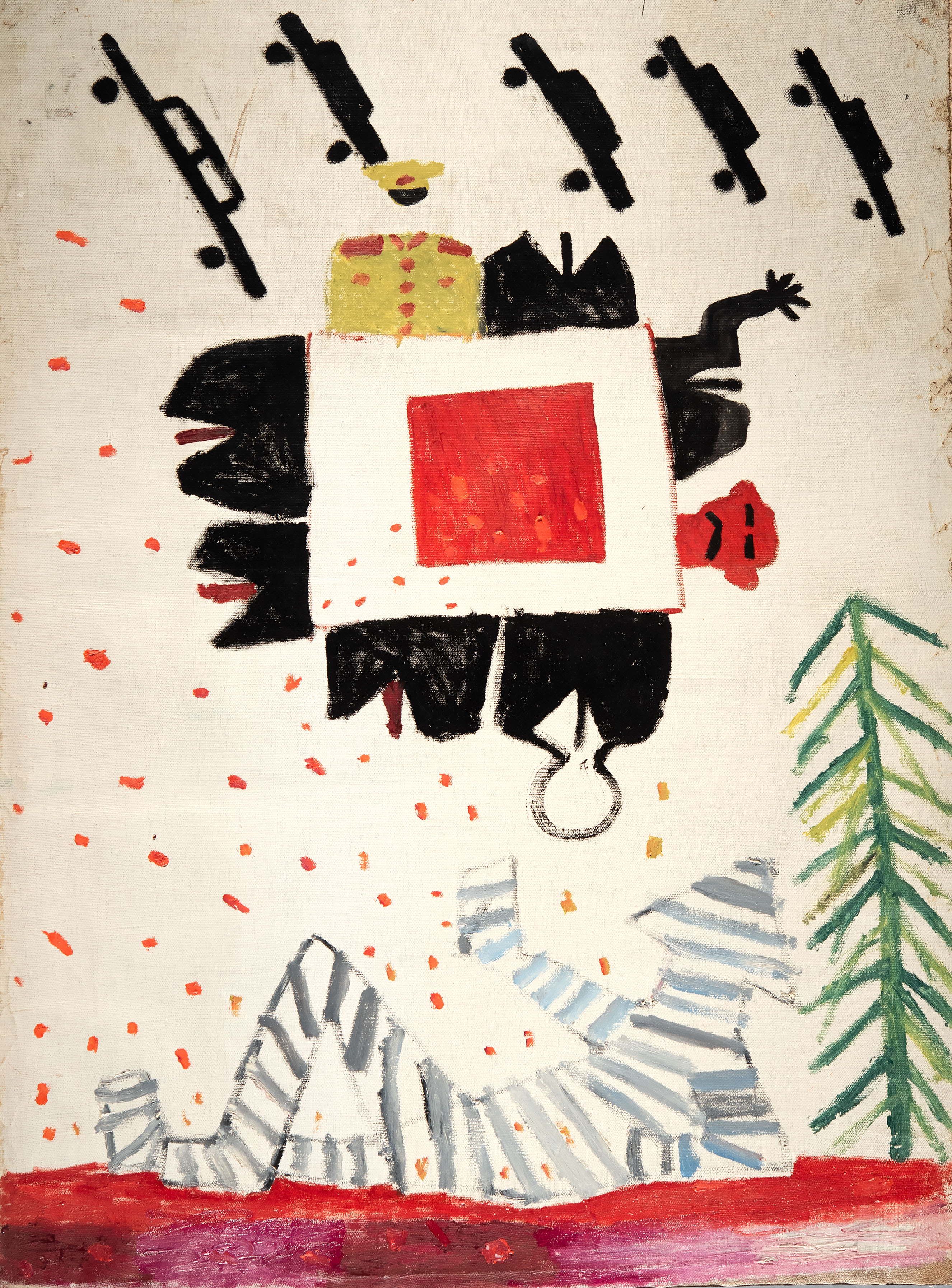
Untitled, 1984. Oil on canvas, 75.6 × 102 cm (29 3/4 × 40 3/16 in.). Norton and Nancy Dodge Collection of Nonconformist Art from the Soviet Union. D04633
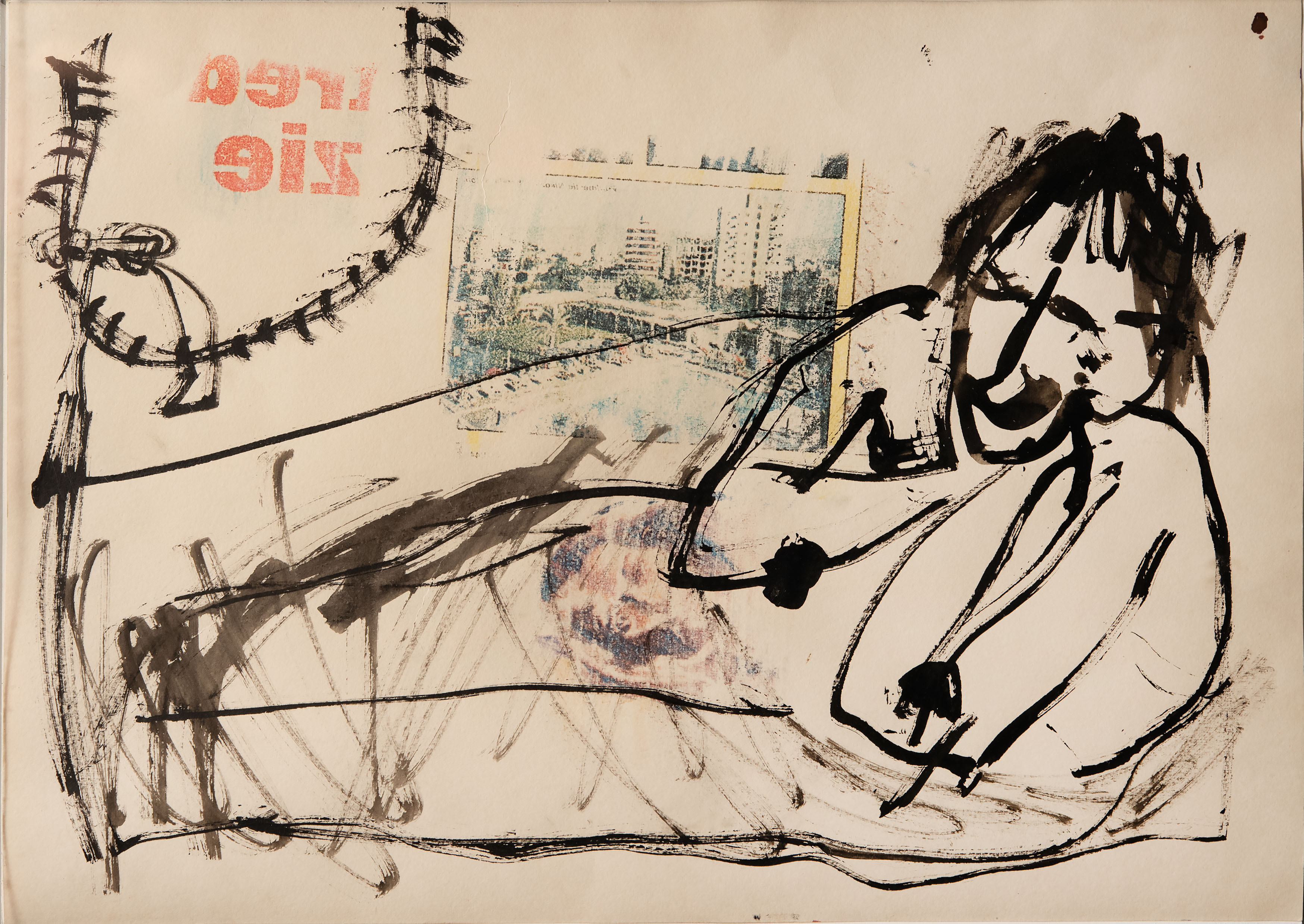
Untitled, 1985. Ink and transfer process on paper, 30 × 42 cm (11 13/16 × 16 9/16 in.). Norton and Nancy Dodge Collection of Nonconformist Art from the Soviet Union. D10214
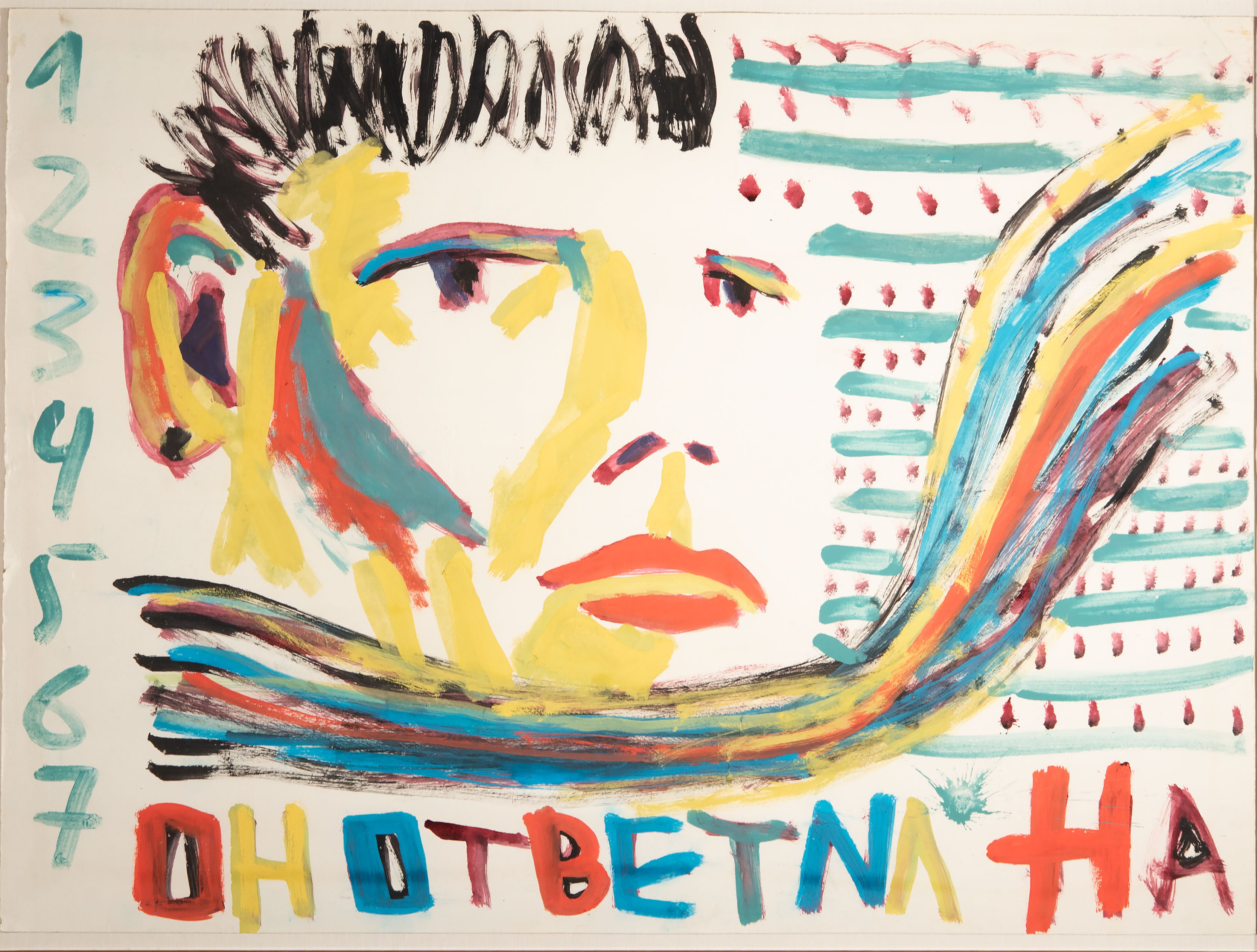
Untitled, 1985. Acrylic on paperboard, 73.5 × 99.5 cm (28 15/16 × 39 3/16 in.). Norton and Nancy Dodge Collection of Nonconformist Art from the Soviet Union. D10316
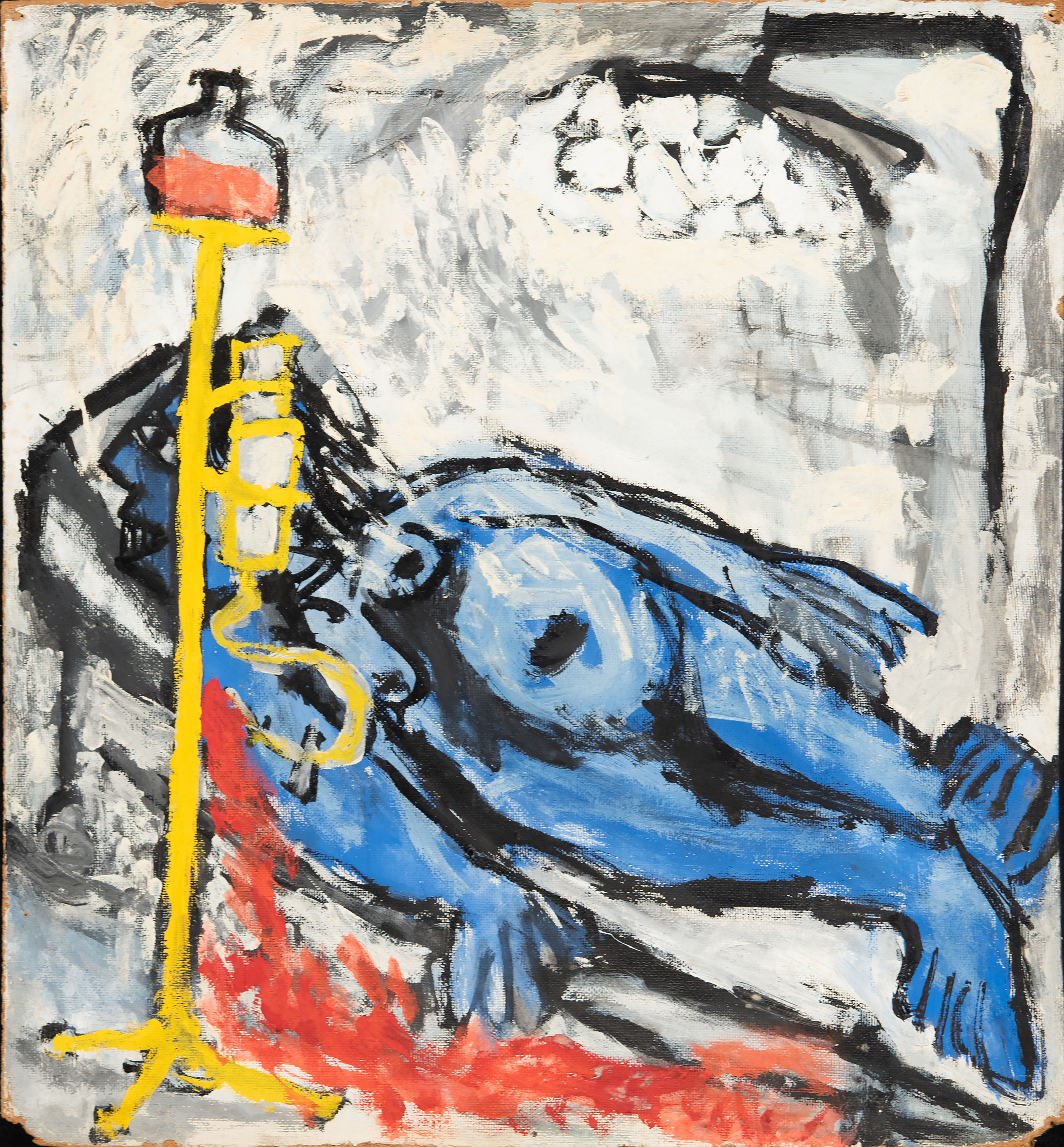
Birth House, 1982. Oil on fiberboard, 62.3 x 59 cm (24 1/2 x 23 1/4 in.). Norton and Nancy Dodge Collection of Nonconformist Art from the Soviet Union. D11204
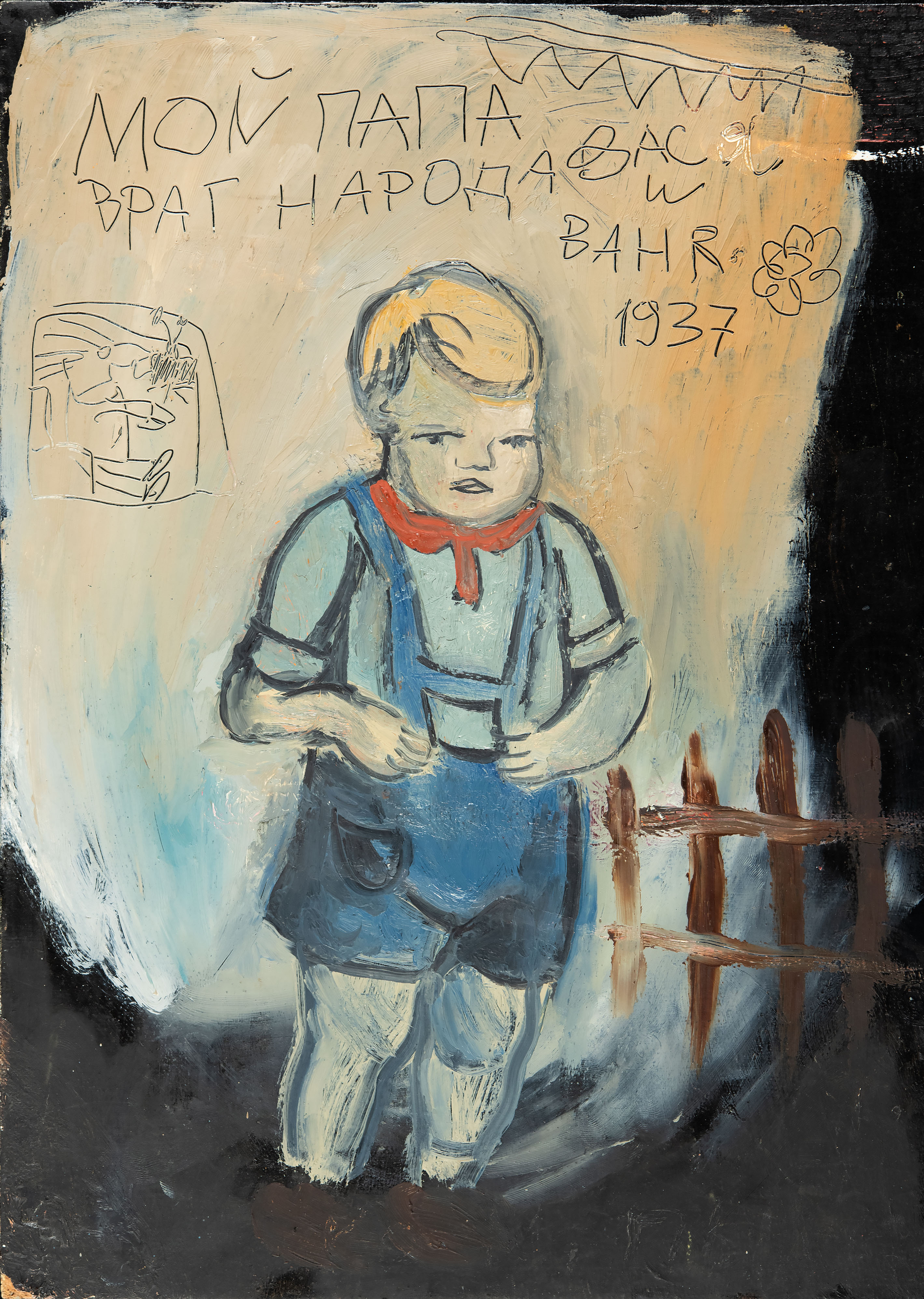
"My dad is the enemy of the people, Vanya, 1937," 1980. Oil on cardboard, 35 x 25.5 cm (13 3/4 x 10 1/16 in.). Norton and Nancy Dodge Collection of Nonconformist Art from the Soviet Union. D19761