
Ojārs Ābols
1922 — Riga (Latvia) | 1983 — Riga (Latvia). Worked in Riga (Latvia)
Ojārs Ābols was an artist and art theorist who worked in painting, interior design, and book graphics. In the 1970s he became one of Latvia’s most knowledgeable theorists about Western art. In his works, he sought to highlight key issues of the time, and he gave passionate speeches about art. He painted works of socialist realism, then turned to the techniques of Cézanne, figurative expressionism, and abstract expressionism.
Ābols’s youth was spent supporting leftist views. From 1935 to 1940 he was an active member of the Latvian Labor Youth Union, working mostly underground. He received his first art education in the studio of the left-leaning Latvian modernist Romans Suta (1896–1944) in Riga, where he gained a love for constructivism and cubism and for the presence of line and drawing in painting. After the Soviets occupied Latvia, he became a campaigner and propaganda worker for the Communist Party (1940). Following the Nazi invasion in 1941, he retreated with the Red Army into Russia. During the war, Ābols was schooled in the Soviet Union as a cultural agitator. In 1942 he attended a course for trade union officials in Gorky (now Nizhny Novgorod). He subsequently worked at the Central Committee of the Art Workers’ Trade Union in Moscow. In 1944 the Soviets assigned him to Latvia. He returned to Riga as a staunch communist and became a member of the Communist Party in 1947.
Ābols was an ardent idealist who wanted to build communism. He entered the Latvian SSR State Academy of Art, from which he graduated in 1951. He did his diploma work under Oto Skulme (1889–1967) in the Monumentalist Painting Workshop; his composition was an ideological painting titled Yakov Sverdlov among Latvian Riflemen in Riga in 1919. [1] He continued his studies at the Repin Leningrad Institute of Painting, Sculpture and Architecture, where he obtained the degree of candidate of art sciences for the painting Storms of Enmity (1956), which depicts a clash between Riga workers and czarist gendarmes in 1899. Starting in 1948, Ābols published articles in the ideological journal Karogs (Flag), in which he described the requirements of form and content necessary for the art of socialist realism. He criticized art that was not naturalistic and that failed to represent subjects demanded in Soviet art—the Socialist Revolution, the Great Patriotic War, workers, and peasants.
After Stalin’s death in 1953, his ideological writings—in which he repeated the theses of the communist dictates created by the USSR—became softer. As Ābols was a staunch communist, he enjoyed special privileges, and he was one of the very few artists allowed to go abroad. In 1956, Ābols and his wife, the artist Džemma Skulme (1925–2019; the daughter of Oto Skulme, rector of the Latvian SSR Academy of Art), traveled around Europe on a cruise ship. After encountering the Western world and real modernist art, his views on art changed radically. Ābols was fluent in English and German, which provided an opportunity to learn more about trends in Western art. After 1956, Soviet citizens were allowed to receive art magazines from abroad, and Ābols’s relatives in the United States sent him fashion magazines. He subscribed to Polish, Czech, Slovak, and Hungarian art publications, studied art history, and gleaned information from prohibited Western radio stations.
In his writings, Ābols began to focus on the Latvian modernists of the 1920s and ’30s and, contrary to the limited means of expression permitted by socialist realism, he began to emphasize the importance of individuality in art. As head of the Painting Section of the Latvian SSR Artists’ Union (1973–81), he influenced artistic developments in Latvia with his opinions, regularly giving speeches and supporting the arrival of new artistic phenomena.
His portraits painted in the early 1960s were influenced by Paul Cézanne amid a transition from socialist realism. In 1961 Ābols’s art changed radically, as he began to paint compositions of figurative expressionism. He placed figures in an abstracted space with sharp, broad strokes, emphasizing the plane and color contrasts. This apparently met the criteria of the so-called severe style, which was the modernized version of socialist realism, and it depicted the heroes of Soviet life as monumental and powerful. The change in Ābols’s painting is shown by the composition Blacksmiths (1962), painted with broad ocher, green, and brown squares. The monumental, robust composition with three figures consists of a combination of simplified color areas. However, critics rejected these works. In 1963–64, during a campaign against modernism in the Soviet Union, Ābols was criticized for “formalism.” During his lifetime, Ābols did not have any solo exhibitions in Latvia, although he regularly participated in joint exhibitions.
In the mid-1960s Ābols strived to show strength, energy, movement, and active space in painting. The Immortal Communard Spirit: Europe, a painting in the cycle Flames of the Revolution (1969), is a composition of dynamics, tension, and counterforces. The semantic acrobatics of the name distorts the interpretation of the event, since in Soviet art, the words revolution and communards were traditionally reserved for the socialist revolution of 1917. Significantly, this painting was created after the crushing of the 1968 Prague Spring uprising, about which Ābols represented students holding a poster calling for “JUSTICE” as they were confronted by soldiers wielding bayonets.
During the ’70s Ābols’s oeuvre also includes a group of decorative still lifes with antique dishes or kitchen items. Here the artist developed the rhythms of aestheticizing graphic lines, highlighting the plasticity of the dishes and creating aged textures with abrasion effects, all while selecting sublimated brown, ocher, and pinkish colors (Antique Motif, 1975; Still Life, 1976)
He also painted conceptual still lifes, which were commentaries on bad taste, misogyny, and the cult of luxury: ornate baroque tables with mirrors, dishes, and candlesticks are painted in thick, dark textures (Anti-Biedermeier, 1970; Still Life in the Style of Louis XV, 1977, ZAM, D06430; and Still Life, 1979, ZAM, 2018.031.174). As a contrast to these critiques of excess, there are still lifes with workbenches in which geometric asceticism appears (Joiners Bend, 1966, ZAM, D06166), with some of them brought to abstractions. After 1965, abstraction appeared in Ābols’s paintings, which made them impossible to exhibit at that time. Ābols was influenced by the painting of Pierre Soulages (1919–2022), and he painted a series of compositions with broad strokes of vertical and diagonal stripes in a combination of black and blue (Composition, 1968, ZAM, D18010). In the 1970s he started the cycle Processes on the Earth, represented in the Zimmerli collection by a collage (1978, 1992.1014) and two paintings (1978, 1992.1016; and 1979, 1992.1059). The compositions are painted from a bird’s-eye view and depict the impact of heavy industry on the earth’s surface and geological layers. In Ābols’s paintings, pipelines and geodetic and topographic measurements on the ground form semi-abstract compositions. He was supportive of the green movement and critiqued consumerism in his writings: “The modern person, up to his neck in things and transactions. Letting nature slip out of your hands. Besieged by spiritless things. An electronic computing machine stands between the human being and nature with its ‘competent insight,’ while the intermediary, the TV, resells reality. The ancient symbols of nature fade.” [2] He also incorporated into his works the cultural stratum—the dangers of entropy destroying ancient temples.
Although formally Ābols was an abstract expressionist, he was actually a conceptualist. In most of his work, the idea has been primary. He has subordinated the form of his work to the expression of an idea. It was important for him to reflect on global trends and politics. In the Soviet Union, the slogan “the struggle for peace” sounded at every turn during the Cold War. Ābols expressed his manifesto of pacifism in several works titled Calculation of Nuclear Destruction (1976). In his abstract compositions, graphic curves represent cybernetic calculation diagrams above the geographical territory of Latvia. In the late ’70s he also started the cycle Absurd Human Projects on Earth (mid-1980s), which was never completed. Inspired by impressions from the Venice Biennale, in 1978 Ābols proposed the exhibition Nature. Environment. Human (1984) in Latvia to critically appraise the relationship between humanity and the environment. The exhibition was forced to close by the censors because of its avant-garde character, but its appearance marks the beginnings of contemporary art in Latvia.
Elita Ansone
Translated from Latvian by Philip Birzulis
Photo portrait: Ojārs Ābols, 1970s. Photo by Gunārs Janaitis
Notes
1. The Latvian Riflemen were military units formed from ethnic Latvians in the Russian Empire during World War I. The Latvian Riflemen were formed in 1915–16 as part of the Imperial Russian Army to defend against German advances into the Baltics.
2. Ojārs Ābols, “Attēla dimensijas” [Dimensions of the Image], L. M., August 10, 1979, 3.
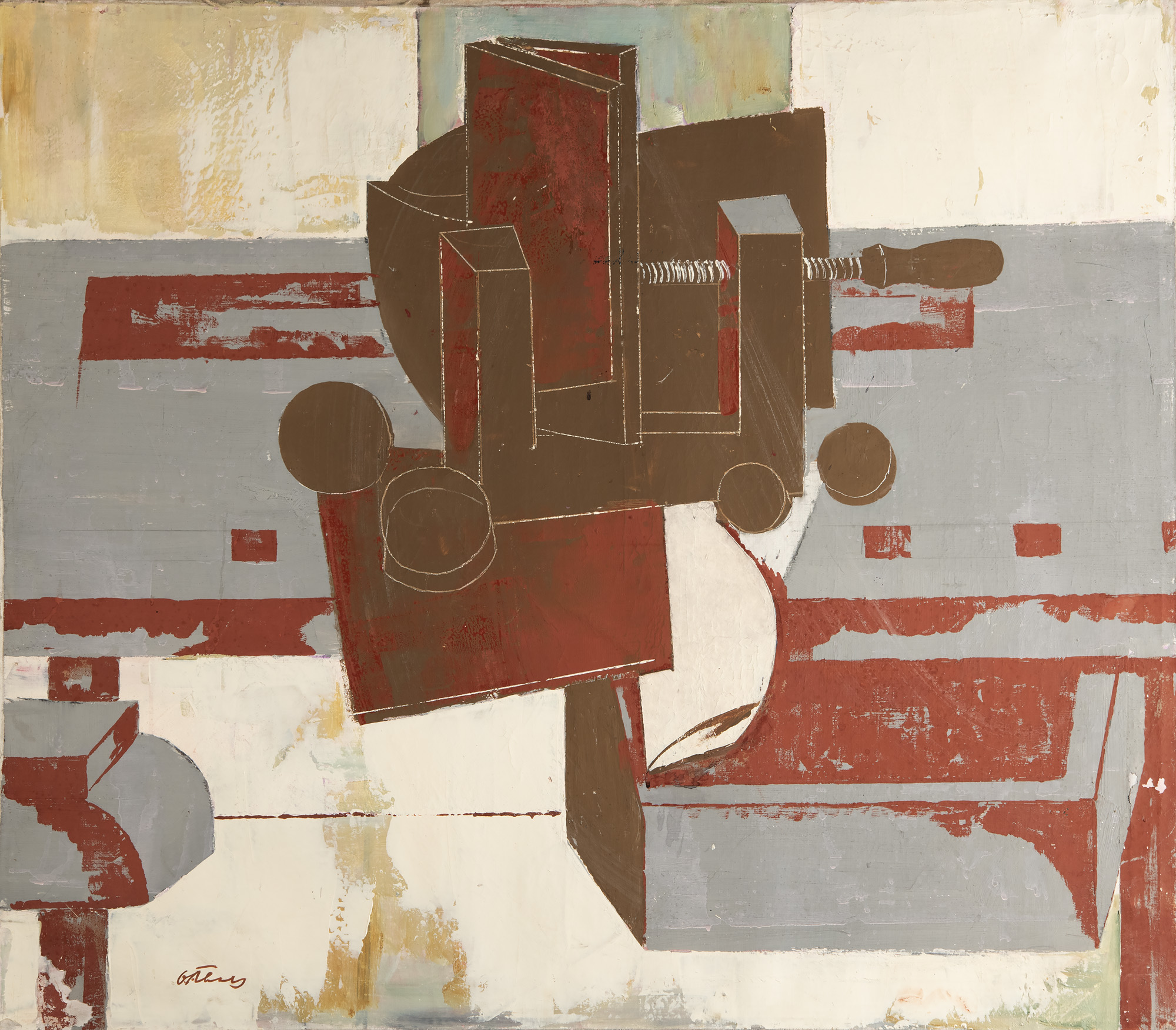
Joiners Bend, 1966. Oil on canvas, 86.5 × 102.5 cm (34 1/16 × 40 3/8 in.). Norton and Nancy Dodge Collection of Nonconformist Art from the Soviet Union. D06166

Processes on the Earth, 1978. Oil and collage on canvas, 100.5 x 100 cm (39 9/16 x 39 3/8 in.). Norton and Nancy Dodge Collection of Nonconformist Art from the Soviet Union. 1992.1014

Processes on Earth, c. 1978. Mixed media on canvas, 99.8 x 99.5 cm (39 5/16 x 39 3/16 in.). Norton and Nancy Dodge Collection of Nonconformist Art from the Soviet Union. 1992.1016
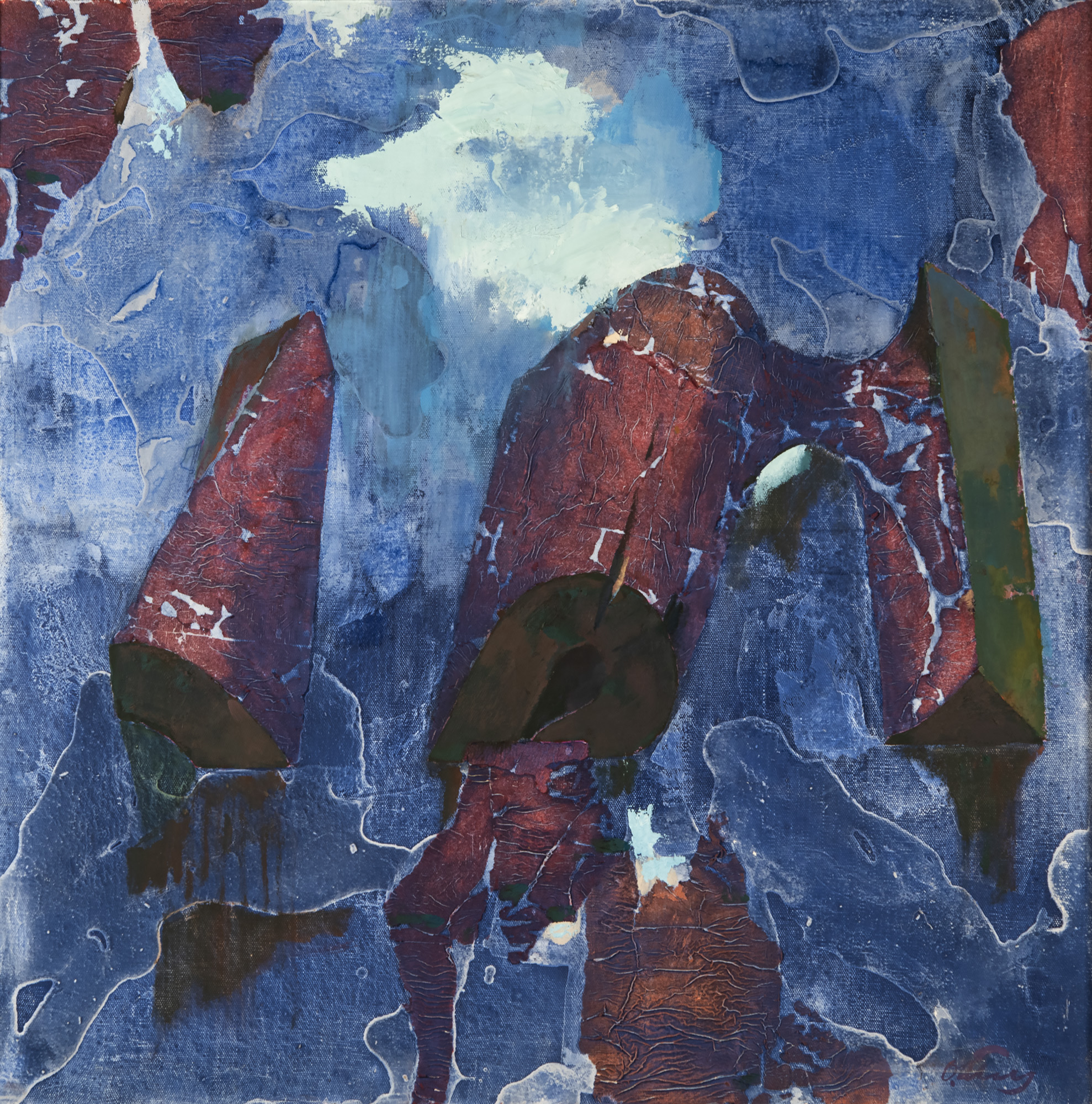
Processes on the Earth, 1979. Mixed media on canvas, 99.8 x 99.5 cm (39 5/16 x 39 3/16 in.). Norton and Nancy Dodge Collection of Nonconformist Art from the Soviet Union. 1992.1059
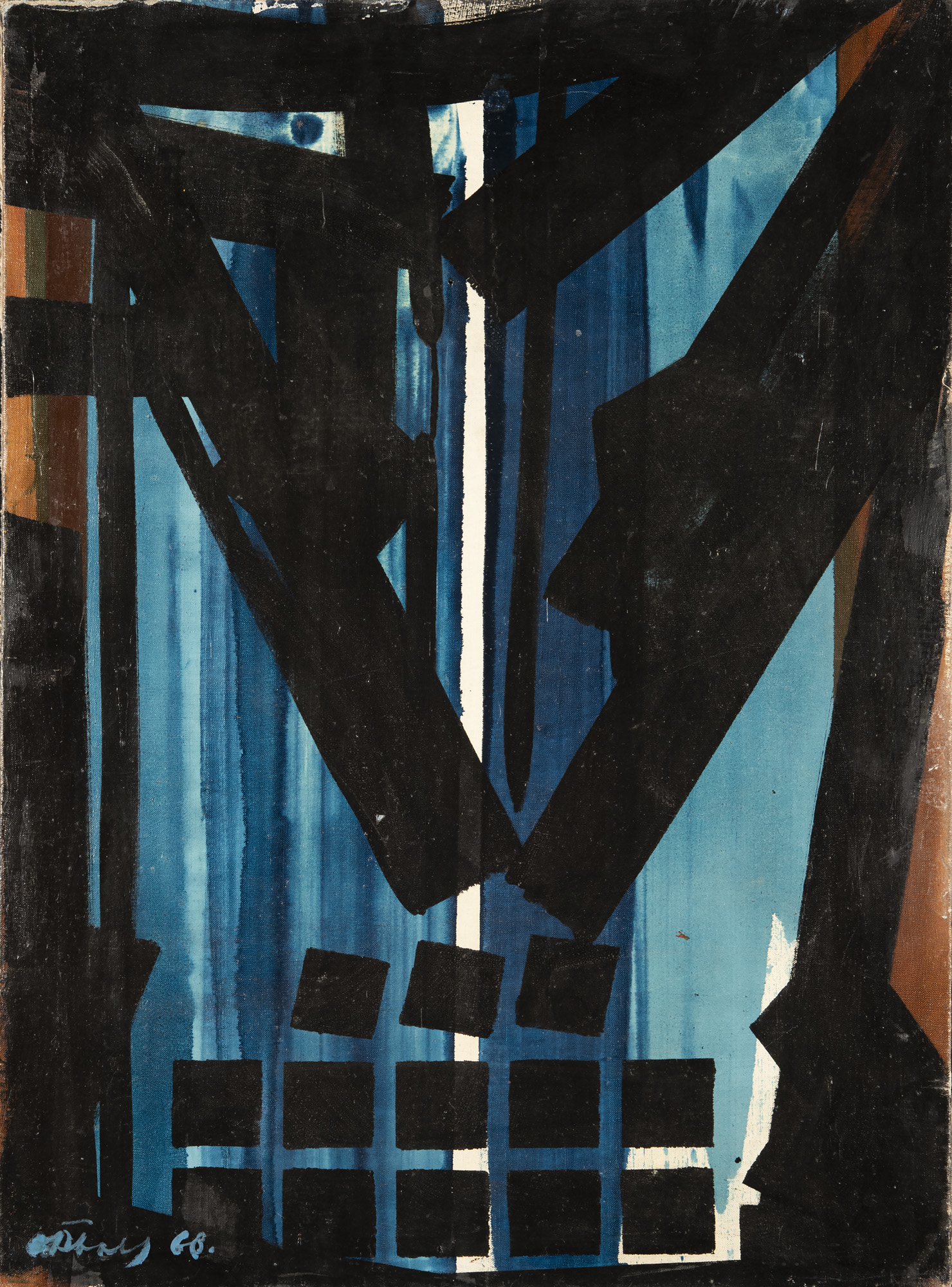
Composition, 1968. Oil on canvas, 75.5 × 53.5 cm (29 3/4 × 21 1/16 in.). Norton and Nancy Dodge Collection of Nonconformist Art from the Soviet Union. D18010