
Nonna Goriunova
1944 — Moscow (Russia). Works in Moscow (Russia)
The name Nonna Goriunova is frequently coupled with that of her artistic partner and husband, Francisco Infante-Arana, a pioneer of Russian kinetic art who was searching for a “metaphor for infinity,” which he manifested through his Artifacts. The first project in which her name appeared was the 1968 performance series Спонтанные игры на природе [Spontaneous Games in Nature], which resulted in the famous photography series Супрематические игры [Suprematist Games], where geometric shapes of painted cardboard, forming abstract compositions, were photographed against the snow, in a tribute to Kazimir Malevich. Suprematist Games is considered a forerunner to Артефакты [Artifacts]—outdoor art installations preserved through photographic documentation. Since the 2000s, Nonna Goriunova’s name has appeared alongside Infante’s in the titles of series and exhibitions as a coauthor. However, her artistic biography also contains a chapter that is unknown not only to the general public but also to most art historians.
Goriunova was born in Moscow, Russia, in 1944, the daughter of the artist Pyotr Goryunov, who was a student of the socialist realist artist Sergei Gerasimov. As a young girl, she dreamed of becoming a ballerina, but in 1962, she enrolled in the Moscow Higher School of Arts and Industry (now the Russian State Stroganov University of Design and Applied Arts), in the department of textiles and interior design. Compared to other educational institutions in Moscow, Stroganovka, as a design school, offered students slightly more freedom, as well as an education in different art historical styles; it didn’t expect them to adhere to the rigid focus on life drawing that was characteristic of the art education system in the Soviet Union. Goriunova, however, recalls not the practical classes but the lectures on art history as having made the strongest impact on her. It was also at the university that she met her future husband, Infante-Arana, the son of a Spanish Republican, who was already “involved with the community of young Moscow artists with a geometric and metaphysical orientation,” which eventually led to her immersion in a new type of art. [1]
After graduation, Goriunova worked as a set decorator at the Moscow Art Theatre under Tatiana Serebriakova—daughter of the famous early-20th-century artist Zinaida Serebriakova—and painted sets designed by Alexander Tyshler, who had gained fame in the 1930s working with Solomon Mikhoels. During those years, Goriunova also produced her first artworks, which formed the foundation of her creative repertoire, which was most actively expanded during the 1980s—collages and assemblages, spatial objects made of paper, monochrome geometric compositions in relief, and her colorful, abstract Импровизации [Improvisations] (1981), in which cutouts are combined with expressive drawings.
Goriunova’s most famous works are made from a single sheet of paper, painted with linear segments of color and folded into a three-dimensional object, an action that disrupts the two-dimensional picture plane, creating a type of spatial refraction. The lines, crossing the different faces of the paper (which now sits at an angle), are transformed, appearing to be in motion. Widely exhibited, several works from this series are in the State Tretyakov Gallery collection. The artist duo’s summer studio, located in a village near Moscow, houses another growing collection of Goriunova’s works: large collages of dried flowers, leaves, and stems from a variety of plants—herbariums assembled into kaleidoscopic patterns.
The Norton and Nancy Dodge Collection of Nonconformist Art from the Soviet Union at the Zimmerli Art Museum contains twenty works from Goriunova’s 1985 series Проект теней [Shadow Project, D03801–20], works in pastel on black paper depicting objects, abstract signs, three-dimensional geometric shapes, individual letters, and short words, along with their shadows. The shadows, however, do not match the objects casting them, sometimes revealing a distorted shape, sometimes an entirely different object, or one diametrically opposed in meaning. For example, the word Да (yes) turns into Нет (no), the letter A into Б, an exclamation mark becomes a question mark, the number five turns into an eight.
The genesis of Shadow Project stretches back to the artist’s childhood, in which she remembers being particularly struck by the optical distortion the handle of a teaspoon made in a glass of water. She would later notice how the shape of an object’s shadow changes as the object moves, and she was mesmerized by a shadow’s color—the blue shadows appearing on white snowdrifts, and the cool emerald hues of the shadows cast by sun on the grass. About the series, she said, “Life is full of paradoxes. The shadow cast by the object does not provide an accurate representation of it. Distortion is a fact of nature, of the Cosmos, of the thought process. The world of phenomena before us is not that obvious, oftentimes the visible doesn’t coincide with the real. The world is paradoxical, it is multifaceted, and what is it really like?” [2]
These experiments with objects, signs, geometric figures, and their reflections can also be traced back to the work she made with Infante, particularly the Artifacts project. For example, the famous cycle Oчаги искривленного пространства [Centers of Distorted Space] (1979, ZAM, 1997.0566–67, 1999.0078, 1999.0081–82, 1995.0803, 1995.0807), in which curving sculptures made of reflective materials refract the surrounding landscape, fusing earth, water, and sky into a single surreal image. Or the experiment На реке [On the River] (2010), in which strips of paper attached to an invisible wire grid that is suspended over water create a reflection that turns straight lines into constantly shifting abstract forms. In the project К ночи [By Nightfall] (2018), a number of photographs also reveal Goriunova’s style. In several works from this cycle, Infante’s colorful “drawings,” reminiscent of 1960s geometric structures, unfold at a sharp angle against the dark backdrop of the sky. The effect is to disrupt the strict arrangement of alternating lines and breaks, which instead comes to resemble a stream of energy or rapid flashes of multicolored radiance. As Goriunova said, the works she came up with for this series are more theatrical, more dramatic.
Shadow Project also echoes the aims of the ARGO group, formed by Infante in 1970. The collective’s name is primarily associated with the Greek myth of Jason and the Argonauts—but it is actually an abbreviation that stands for the Авторская рабочая группа (Authors’ Working Group). The ARGO artists’ most notable works were kinetic projects and large-scale installations created for technological and industrial exhibitions, such as Химия-70 [Chemistry-70] at Sokolniki Exhibition and Convention Centre in Moscow, or Стройматериалы [Building Materials] (1972). In addition to Goriunova, core members of the group included Infante and engineer Valerii Osipov. At different times, engineers Vladimir Nenarokov, Leonid Kaplan, Vladimir Tafel', and Iosif Feiginberg; artists Viktor Nikolaev and Afina Ozerchuk; and art historian Irina Zabavnikova also took part in ARGO’s projects.
The group’s first project was a monumental multimedia installation, or, as Infante called it, a “kinetic space,” titled Звук и свет [Sound and Light] (1970) for Chemistry-70. An enormous screen with embedded light bulbs was supported by a seven-meter (twenty-three-foot) column at the center of the room, while a lace-like structure made from cable connections rotated underneath. Speakers broadcast musical compositions from different eras—from the Middle Ages to the present—arranged by the Moscow Experimental Studio for Electronic Music. Spotlights, which projected changing colors onto different parts of the screen in accordance with the music, were controlled in real time by members of ARGO.
Among the group’s other large-scale projects, Хрусталь [Crystal] (1971, ZAM, 1995.0674.002–004) seems to most closely resemble to Goriunova’s solo work. The installation, designed to demonstrate the achievements of the State Institute of Glass presented at the Consumer Goods pavilion at VDNKh in Moscow, was a monumental construction composed of triangular panels of colored glass. One of the archival photographs shows Goriunova and art historian Irina Zabavnikova, who also worked on the project, standing between structures that resemble backdrops for a science fiction film, or portals to other worlds. Fifteen years later, in her work, Goriunova would still be exploring the porous boundaries between the real and the illusory, between an object and its reflection, raising questions about what the world is really like.
Irina Gorlova
Translated from Russian by Maria P. Vassileva
Notes:
1. Франциско Инфанте. Autoальбом: опыт художника и предстояние [Francisco Infante. Autoalbum: Artist’s experience and presence]. Moscow: Iskusstvo XXI vek, 2013: 54.
2. Nonna Goriunova, interview by Irina Gorlova, February 20, 2025.

Untitled from the series Shadow Project, 1985. Pastel on paper, 40.5 × 30.2 cm (15 15/16 × 11 7/8 in.). Norton and Nancy Dodge Collection of Nonconformist Art from the Soviet Union. D03801
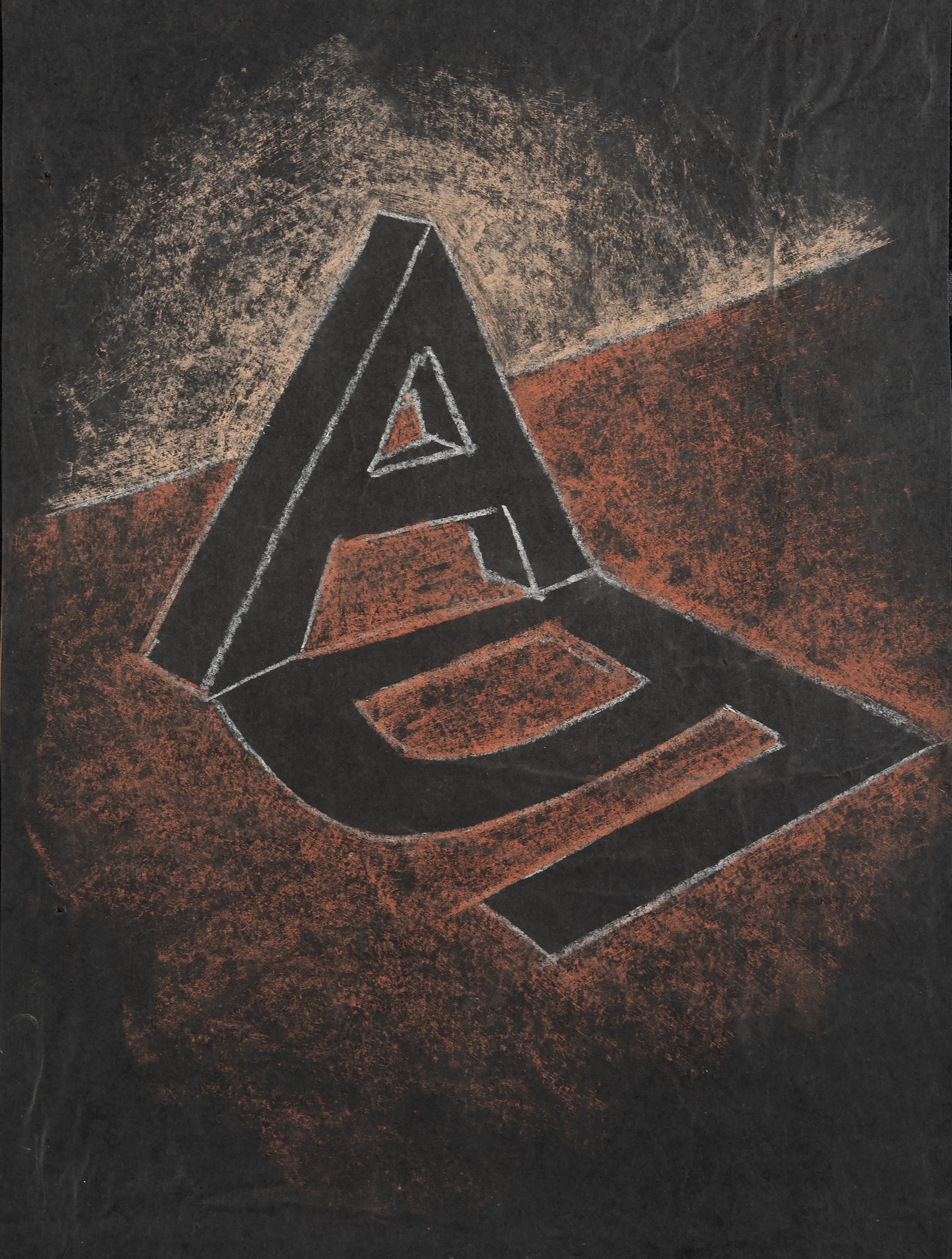
Untitled from the series Shadow Project, 1985. Pastel on paper, 40.6 × 30 cm (16 × 11 13/16 in.). Norton and Nancy Dodge Collection of Nonconformist Art from the Soviet Union. D03802

Untitled from the series Shadow Project, 1985. Pastel on paper, 39.8 × 30.3 cm (15 11/16 × 11 15/16 in.). Norton and Nancy Dodge Collection of Nonconformist Art from the Soviet Union. D03818

Untitled from the series Shadow Project, 1985. Pastel on paper, 39.7 × 30.2 cm (15 5/8 × 11 7/8 in.). Norton and Nancy Dodge Collection of Nonconformist Art from the Soviet Union. D03819

Untitled from the series Shadow Project, 1985. Pastel on paper, 39.6 × 30.4 cm (15 9/16 × 11 15/16 in.). Norton and Nancy Dodge Collection of Nonconformist Art from the Soviet Union. D03820