
Nikolay Sazhin
1948 — Troitsk, Chelyabinsk Oblast (Russia) | 2019 — Saint Petersburg (Russia). Worked in Saint Petersburg (Russia)
Nikolay Sazhin was a painter, printmaker, and drawing teacher whose remarkable personal trajectory took him from the Soviet formalist school to the nonconformist movement. He called his early style “fantastical realism.”
Sazhin was born and raised in the historic city of Troitsk in the Southern Urals of Russia. Founded as a fortress in the mid-eighteenth century, the city was located on the main trading route between Asia and Europe. Despite its distance from Moscow, Troitsk played an important role in Russian history and is associated with the country’s largest popular uprising against the ruling elites, led by Yemelyan Pugachev from 1773 to 1774. As a cultural crossroads, Troitsk was home to people of various nationalities: Russians, Tatars, Bashkirs, Kazakhs, Uzbeks, and Circassians. With its long history and many myths, the city undoubtedly had an impact on Sazhin’s artistic development.
When he was eleven years old, financial problems forced his family to move to Vyborg, Russia, where he found himself at another cultural crossroads, this time between Scandinavia and Russia. As the artist recalled, “This city spurred the growth of my imagination, which was nourished by the silence of that province.” [1] From Vyborg, it was a short journey to the major city of Saint Petersburg, where he studied at the V. A. Serov Leningrad Art School from 1966 to 1972. [2] This trajectory—secondary art school followed by an art academy—was typical for aspiring Soviet artists, and Sazhin stuck to it, enrolling in the department of graphic arts at the Repin Academy of Arts, and graduating in 1978.
However, even during his studies (which prioritized technical skill and a commitment to socialist realism), he noticed discrepancies between what he was taught and his own artistic aspirations. In the 1970s, when he was coming into his own creatively, a new generation of artists had appeared on the Leningrad scene—the so-called “Seventiers”—who sought ways to evade formal Soviet ideological restrictions, working within a conceptual framework that prioritized ambiguity at a time when the slogans, appeals, and declarations of the “developed Soviet socialist society” did not correspond to the lived reality and remained empty formulations. “It should be said,” Sazhin recalled, “that from the time I enrolled in school, I was forced to lead a double life. If in secondary school, the usual thing was: ‘We’re giving you a failing grade, but we’ll take your pieces for the gift fund,’ then at the Academy I understood that it was better not to show anyone anything ‘superfluous and subversive.’ ‘Superfluous’ in this case meant original creative works. And so I was doing one thing at the institute and another thing at home.” [3]
Though his school was a conservative citadel and a bastion of socialist realism, when he was in his third year at the Academy of Arts, Sazhin took part in an exhibition of nonconformist artists at the Ivan Gaz House of Culture. [4] Although the exhibition was officially authorized by Soviet authorities, Sazhin’s participation caused a scandal at the Academy of Arts. As Sazhin recalled, “I was basically saved by my teacher, Gennady Dmitrievich Epifanov; he came to my defense, and without his support I certainly would have been expelled, the way things were going down. Although, frankly, I didn’t really care by then; I was completely fed up with studying at the Academy.” [5]
As an “official” artist with a certificate of vocational training, as well as a member of the youth section of the USSR Union of Artists, Sazhin was entitled to certain benefits and bonuses, and so was granted his first personal studio. [6] However, he didn’t take commissions from leaders of the Soviet state, and instead earned money by teaching drawing at the Serov School, where he worked for twelve years, from 1977 to 1989. It was here that he met a young musicologist and connoisseur of Western jazz, who taught English there, named Alik Kan. [7] This meeting proved life-changing. Sazhin, in turn, introduced Kan to contemporary art, the Leningrad artistic and literary underground, and samizdat. As Kan recalled, “His cramped live-in studio, littered with paintings, on the top floor of a huge, shabby building on Baskov Lane that was stuffed to the gills with communal apartments, was the site of endless meetings, plentiful libations, and furious discussions.” [8] Sazhin’s studio brought together a wide variety of people, from actors who would go on to perform in Vyacheslav Polunin’s Litsedei Clowns and Mimes Theater, to nonconformist artists and active members of the Association of Experimental Fine Arts. [9]
In 1979, Alik Kan (together with Sergey Kuryokhin and Yefim Barban) launched the Leningrad Contemporary Music Club at the Lensovet Palace of Culture, under the aegis of the Ministry of Public Education. Here, the small auditorium hosted performances by the leading Russian interpreters of contemporary jazz: Anatoly Vapirov, the GTCh (Ganelin, Tarasov, Chekasin) trio, Sergey Kuryokhin, and even foreign musicians who came to Leningrad on a tourist visa. In 1982, as part of the same initiative, Kan organized a solo exhibition of Sazhin’s works in the lobby of the House of Culture. As Kan recalled, “Sazhin was in the youth section of the Leningrad branch of the official Artists’ Union, and for this reason alone should not have been considered a nonconformist. However, in his way of life and thinking, in his cultural and artistic interests, and in his circle of friends, he was a quintessential representative of the underground.” [10]
Sazhin called his early style of painting “fantastical realism.” As an artist of the Saint Petersburg academic school, realism was a natural starting point. But then he transgressed against this false reality and moved on to magical and oneiric subjects. “Whether it’s a figurative painting or an abstract one,” Sazhin said, “is not important. The main thing is that it has an energetic charge, the energy of its creator.” The artist’s subsequent development included a period that was closely tied to his childhood in the Southern Urals. This region was the source of the celebrated book Tales of the Urals by the Russian writer Pavel Bazhov, who had collected the folklore of the Urals and worked it into a literary form. The tales, written in the first half of the twentieth century, are rooted in the second half of the nineteenth century, which became a golden age of Russian fairy tale motifs. Artists like Viktor Vasnetsov, Ivan Bilibin, and Elisabeth Boehm illustrated fairy tales for children’s books, creating a trend toward magical realism. Russian fairy tales combined mystical elements, heroic feats, magical powers, and enchantment, reflecting the richness of the country’s mythology and folklore.
Sazhin has repeatedly said that his favorite themes are the inexhaustible ones of love and death, Eros and Thanatos, in their interpenetration and transformation. His compositions, whimsically intertwining realistic and abstract forms, draw the viewer in with their paradoxicality, and the recurring images (he tended to work in cycles and series) fix themselves in the memory. Sazhin situates his subjects in unusual circumstances and phantasmagoric spaces. Figures and objects are depicted with grotesquely distorted proportions reminiscent of Japanese prints from the Edo period (1603–1868). Sazhin’s palette is bright, garish, almost kitschy. In his treatment of subjects, he dispensed with sequential or literary development, opting for free-flying fantasy over traditional dramaturgy. He mixed biblical stories with folktales and intertwined the tragic with the comic, the sacred with the anecdotal.
As the philosopher and critic Valery Savchuk observed, “Usually, without a strong knowledge of art history, it is very difficult to understand the works of twentieth century artists, with their numerous references and allusions. Sazhin successfully broke down this barrier. He was able to create a remarkable atmosphere that invites the viewer inside the painting. The artist regularly works with an '‘anti-human’ purple color, and uses anthropomorphic and phytomorphic motifs. Nature, transformed to fit our standards, elicits a feeling of anxiety. In his recent paintings, particularly in the large triptych Среда обитания [Habitat], Sazhin uses geometric shapes. Urban spaces made up of identical buildings violate the ecology of the visible; they are alien to human beings.” [11]
“Inspired by the human and supernatural worlds of Hoffmann’s stories and Bazhov’s Ural tales, Sazhin developed a unique visual language where reality is intertwined with myth; a secret world of nature and humanity, spirit and matter, and the resulting struggle between forces of light and darkness. For example, the graphic series Линия [Line] (on which he worked from 2001 to 2019) transforms the line of the horizon into a metaphor for life’s journey, mixing scenes from the gospels with kitsch. In these drawn worlds, anthropomorphic and biomorphic forms intersect, as do technical ornaments and strange textures. The landscapes of the embankment, which could be seen from the windows of his studio, gradually redefine the coastline—as a horizon, a timeline of history; as a conversation between a point and a line on a plane, as a line of creativity and thought.” [12]
The last act of Nikolay Sazhin’s artistic self-education at the Academy of Arts came at the height of perestroika. In 1989–90, he taught at the Academy himself, in the department of graphics. After that, he went abroad for the first time, traveling to California, USA. He grew very fond of the West Coast of the United States, with its warm climate and relaxed tempo, spending several months each year there, teaching workshops in graphic art at the University of Washington in Seattle, Washington, and at Reed College in Portland, Oregon. He was not a professor of art, either on paper or by disposition, but rather a visiting instructor, an outsider, whose calling was to transmit to students the freedom of the creative impulse. Sazhin was convinced that a true artist must follow an inner path, a process of personal transformation involving the rejection of outside influences. His approach to teaching was based on liberation from academic dogma, with an emphasis on the artist’s individual path. This approach reflected his personal experience, in which the unofficial artistic milieu had a greater impact on his style than his academic education did. Sazhin emphasized that intuition was an “animalistic feeling” that could not be rationalized. He believed that technique could be taught, but that becoming an artist was instinctive, an internal process of discovery. This idea became crucial to his pedagogy—he encouraged students to trust their own perceptions, even if they contradicted the academic canon. According to Sazhin, the creative persona was formed not within the walls of an educational institution, but in dialogue with like-minded peers, and he imparted this principle to his students.
The Norton and Nancy Dodge Collection has six works by Nikolay Sazhin made between 1970 and 1980, which showcase a variety of artistic techniques. In addition to the traditional medium of oil on canvas, they include lithographs, etchings, and aquatints. If in his paintings he is deliberately glaring and harsh, then in his graphic works he is subtle and virtuosic. Sazhin’s artistic philosophy can be summed up as a reflection on the subjective nature of our perceptions. The artist makes us doubt what we see, and question how we perceive it.
Dimitrii Pilikin
Translated from Russian by Philip Redko
Photo portrait by Nikolai Simonovskij
Notes:
1. Kurbanovskij, Aleksey. “Сказочность реального: Живопись Николая Сажина [The Magic of Reality: Painting by Nikolay Sazhin]”. In Iskusstvo Leningrada [Art of Leningrad], no. 5 (1990): 80–81.
2. The V. A. Serov Leningrad Art School (now the N. K. Roerich Saint Petersburg Art School) is a state professional educational institution located in Saint Petersburg. The school traces its history back to 1839, when the School of Drawing for Nonresident Students was founded. In 1858, the school was transferred to the Society for the Encouragement of the Arts. The instructors included P. P. Chistyakov, L. N. Benois, I. N. Kramskoy, S. K. Makovsky, A. V. Shchusev, and I. Ya. Bilibin. After the October Revolution, in July 1918, the school was reopened, and in 1992, it was renamed the N. K. Roerich Saint Petersburg Art School.
3. “The Magic of Reality: Painting by Nikolay Sazhin”: 80–81.
4. The exhibition at the Ivan Gaz House of Culture (December 22–25, 1974) was the first exhibition of nonconformist artists in Leningrad. Fifty-two artists took part, presenting 220 of their works. The four-day exhibit, and the complete media blackout around it, sparked a great deal of interest; people stood in line for hours, around fifteen thousand attended, and there were detailed reports in the foreign press. The nonconformists demanded that all Soviet artists be given the right to officially exhibit. In response, officials leveled accusations of unprofessionalism, formalism, and bourgeois tendencies that ran counter to the Union of Soviet Artists.
5. Gennady Dmitrievich Epifanov (1900–1985) was a Soviet graphic artist. He was head of the book illustration and design studio at the Leningrad Ilya Repin Institute of Painting, Sculpture, and Architecture from 1973 to 1982.
6. The USSR Union of Artists was a trade union espousing ideological commitment to the principles of “socialist realism.” Its stated goals were “the creation of ideologically committed, highly artistic works of every type and genre, scholarship in art history and criticism, as well as support for the building of communism in the USSR.” Members of the union were entitled to preferential studios in which to work, hard-to-find art supplies, and well-paid state commissions. The Union of Artists published several journals of art criticism, and operated several large exhibition halls and its own printing press.
7. Alik Kan (b.1954) is a jazz critic, producer, journalist, and translator. In the 1970s and ’80s, he organized several important events to promote new music in Leningrad. Since 1996, he has been a columnist for the BBC News Russian. He lives and works in London.
8. Kan, Alik. Пока не начался JAZZ [Before the JAZZ begins]. Saint Petersburg: Amfora, 2008: 154.
9. The Association for Experimental Fine Art (Tovarishchestvo Experimental’nogo Izobrazitel’nogo Iskusstva, TEII) was founded by “unofficial” artists in Leningrad in 1981. The goal of this organization was to overcome the crisis caused by the division into “official” and “unofficial” art. Over the course of ten years, it organized thirteen general, forty-eight group, and seven solo exhibitions. More than five hundred artists took part in these exhibitions, roughly ten thousand works were exhibited, and at least a million people attended. The TEII comprised nine art groups: Инаки (Inaki), Алипий (Alipii), Летопись (Letopis, Chronicle), 5/4, Mit’ki, Остров (Ostrov, Island), Новые художники (Novye khudozhniki, New artists), Некрореалисты (Nekrorealisty, Necrorealists), and Тир (Tir/shooting range). In 1991, TEII was succeeded by the Pushkinskaya-10 art center.
10. Kan, JAZZ: 154.
11. Savchuk, Valery. “Магические сюжеты Николая Сажина” [The magical subjects of Nikolay Sazhin]. In Sankt-Peterburgskie vedomosti 34, no. 5407 (2015): 5.
12. Shalygin, Arkady. “Проявление основных инстинктов в творчестве Николая Сажина” [The manifestation of primal instincts in the work of Nikolay Sazhin]. Saint Petersburg Art Studies Workbooks. Saint Petersburg: Association of Art Critics (AIS), 2011: 40–45.
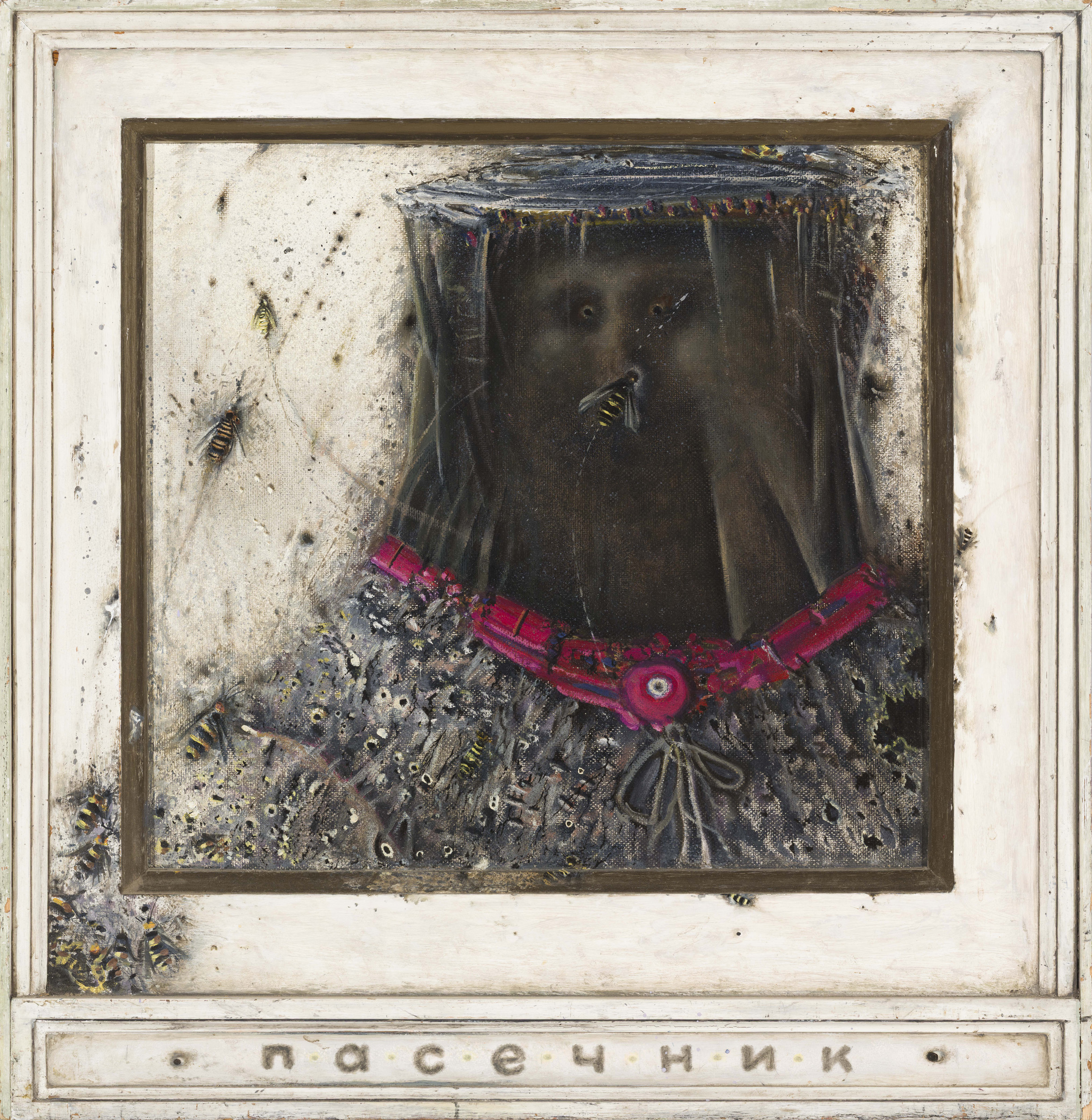
Beekeeper, 1982. Oil on panel, 77 × 75 cm (30 5/16 × 29 1/2 in.). Norton and Nancy Dodge Collection of Nonconformist Art from the Soviet Union. D00526
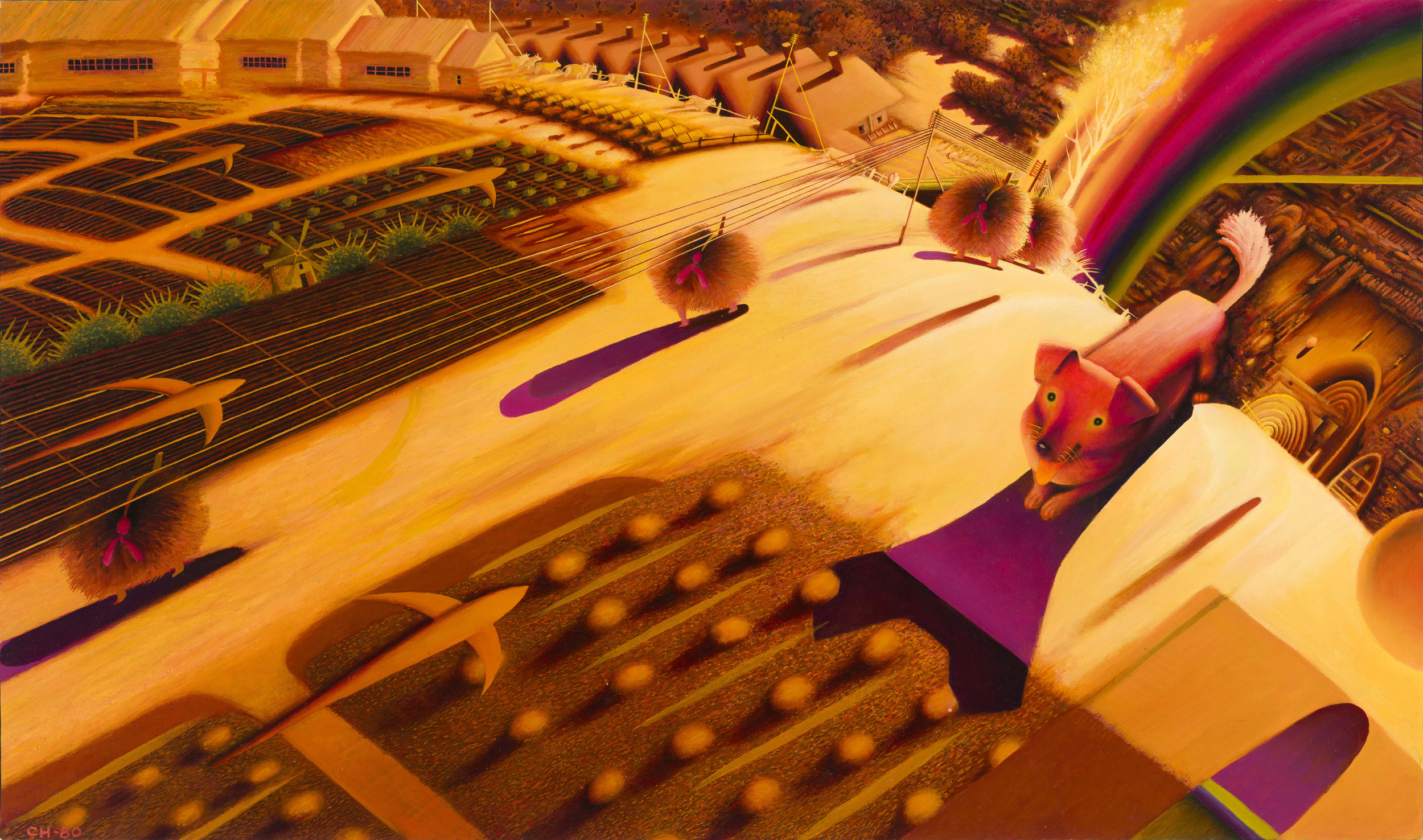
Landscape with Dog, 1980. Oil on canvas, 85 × 143.5 cm (33 7/16 × 56 1/2 in.). Norton and Nancy Dodge Collection of Nonconformist Art from the Soviet Union. D00548
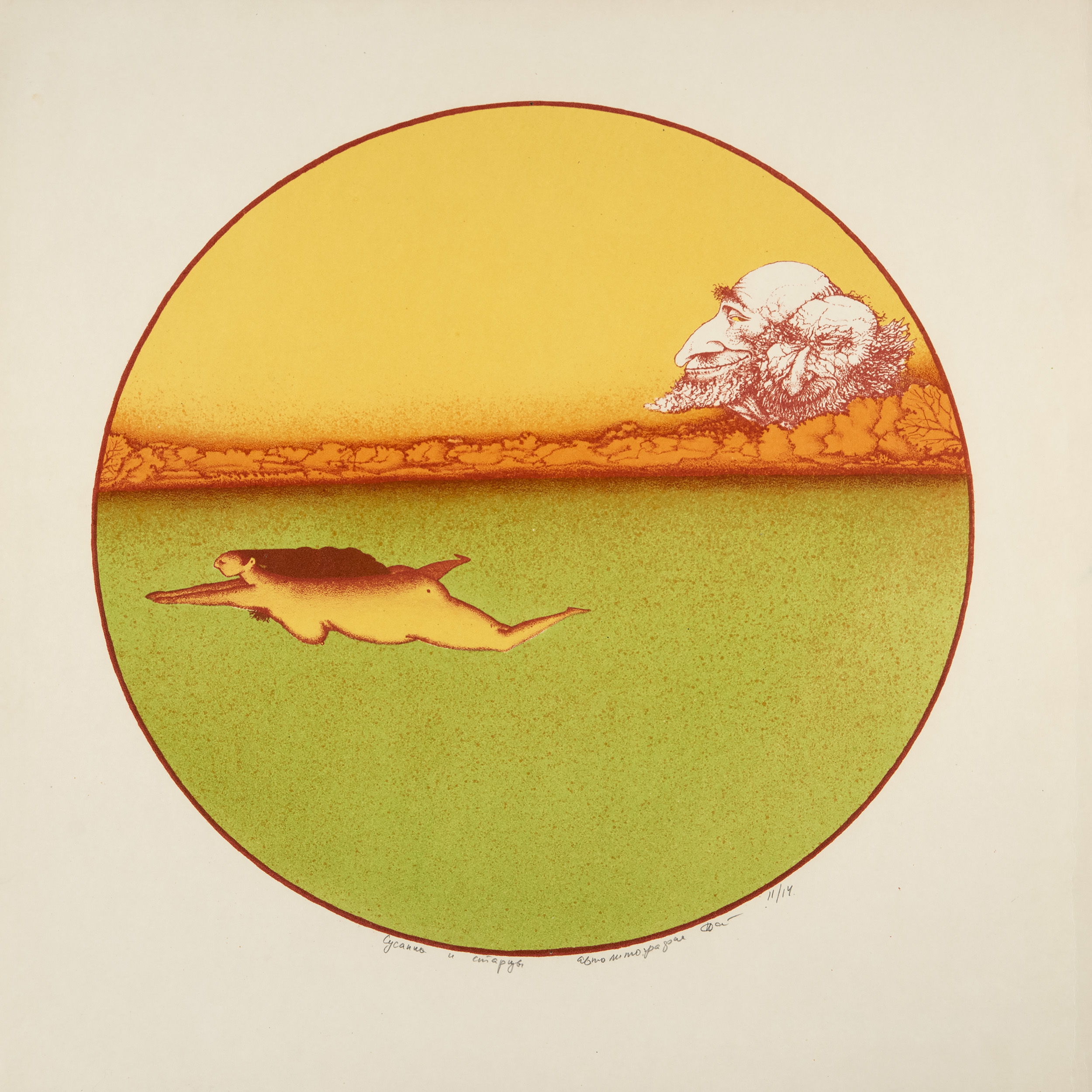
Susanna and Old Men, 1987. Lithograph on paper, 46.7 × 45.1 cm (18 3/8 × 17 3/4 in.). Norton and Nancy Dodge Collection of Nonconformist Art from the Soviet Union. D09006
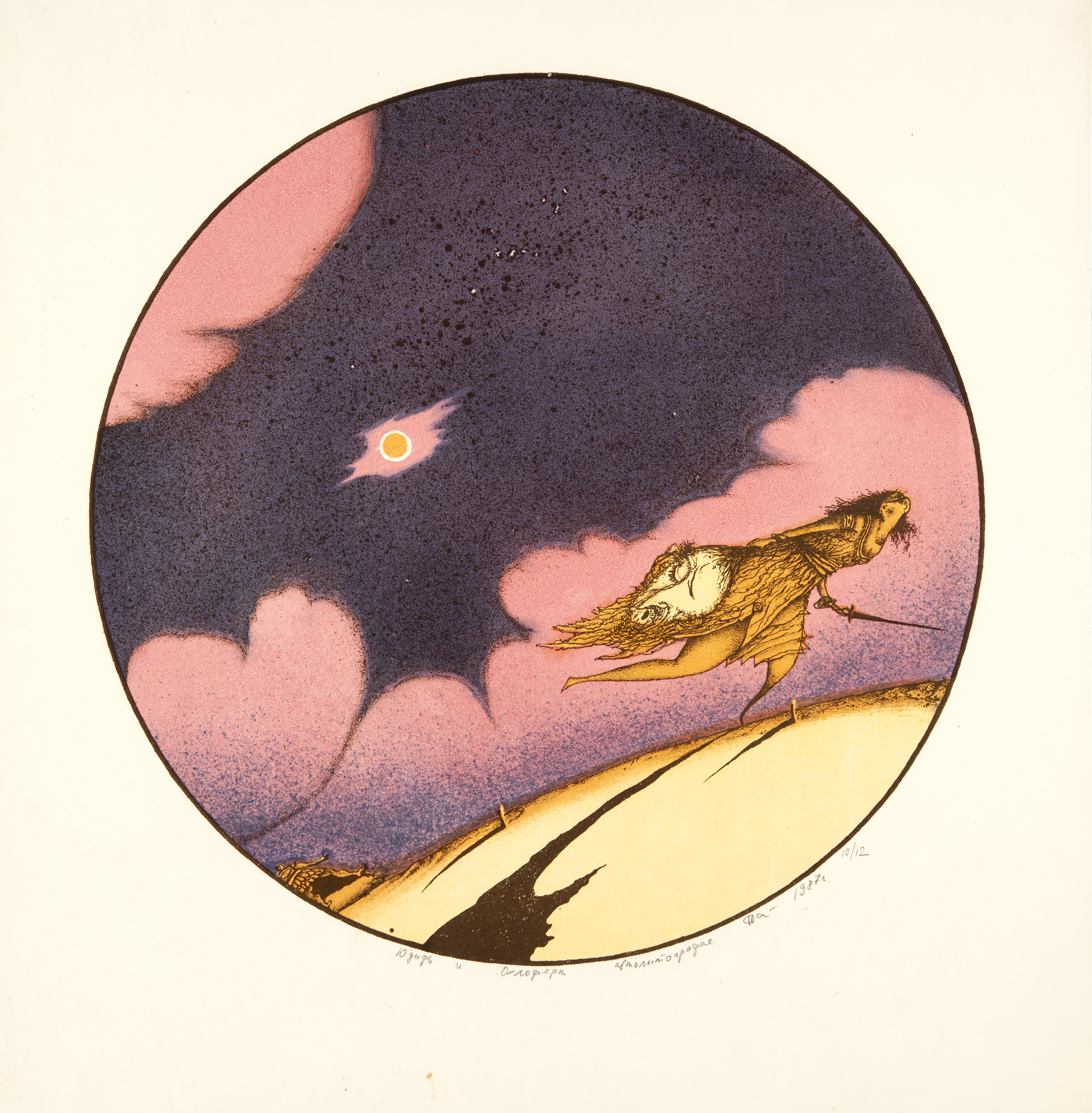
Judith and Olophern, 1987. Lithograph on paper, 45.5 × 44.3 cm (17 15/16 × 17 7/16 in.). Norton and Nancy Dodge Collection of Nonconformist Art from the Soviet Union. D09008
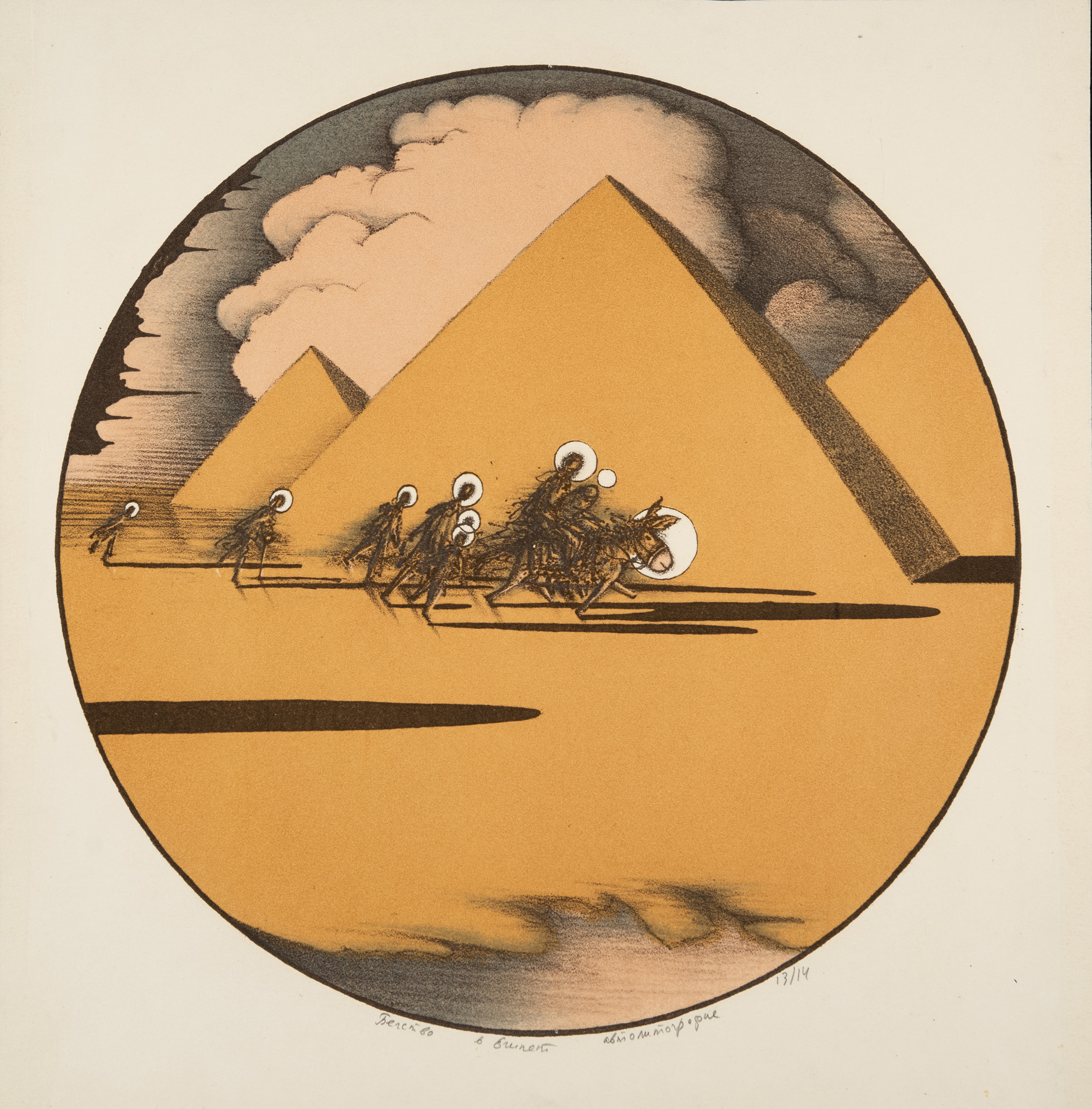
Flight to Egypt, 1985. Lithograph on paper, 40.6 × 40.2 cm (16 × 15 13/16 in.). Norton and Nancy Dodge Collection of Nonconformist Art from the Soviet Union. D09007
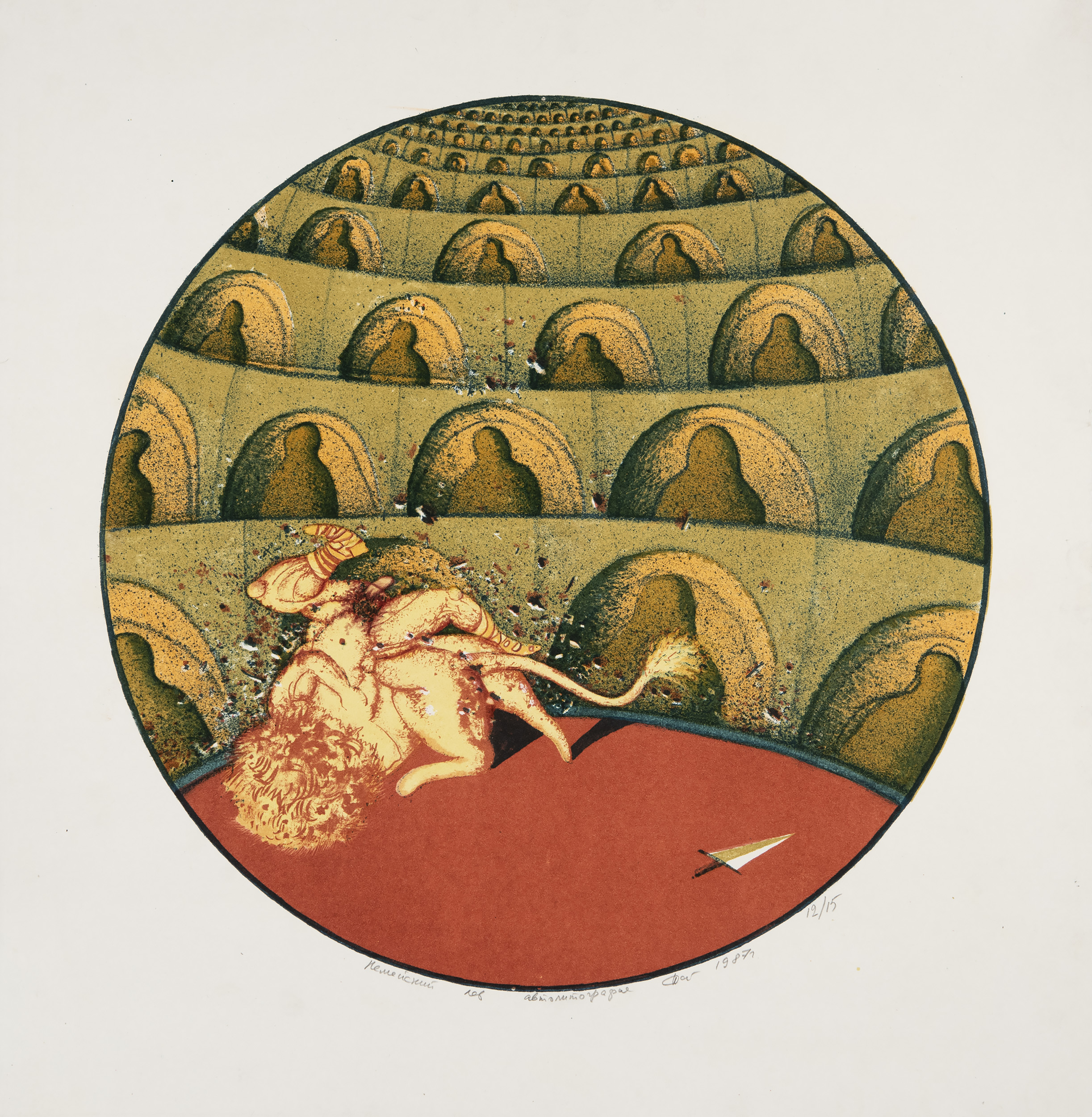
Nimean Lion, 1987. Lithograph on paper, 45.5 × 44.4 cm (17 15/16 × 17 1/2 in.). Norton and Nancy Dodge Collection of Nonconformist Art from the Soviet Union. D09009
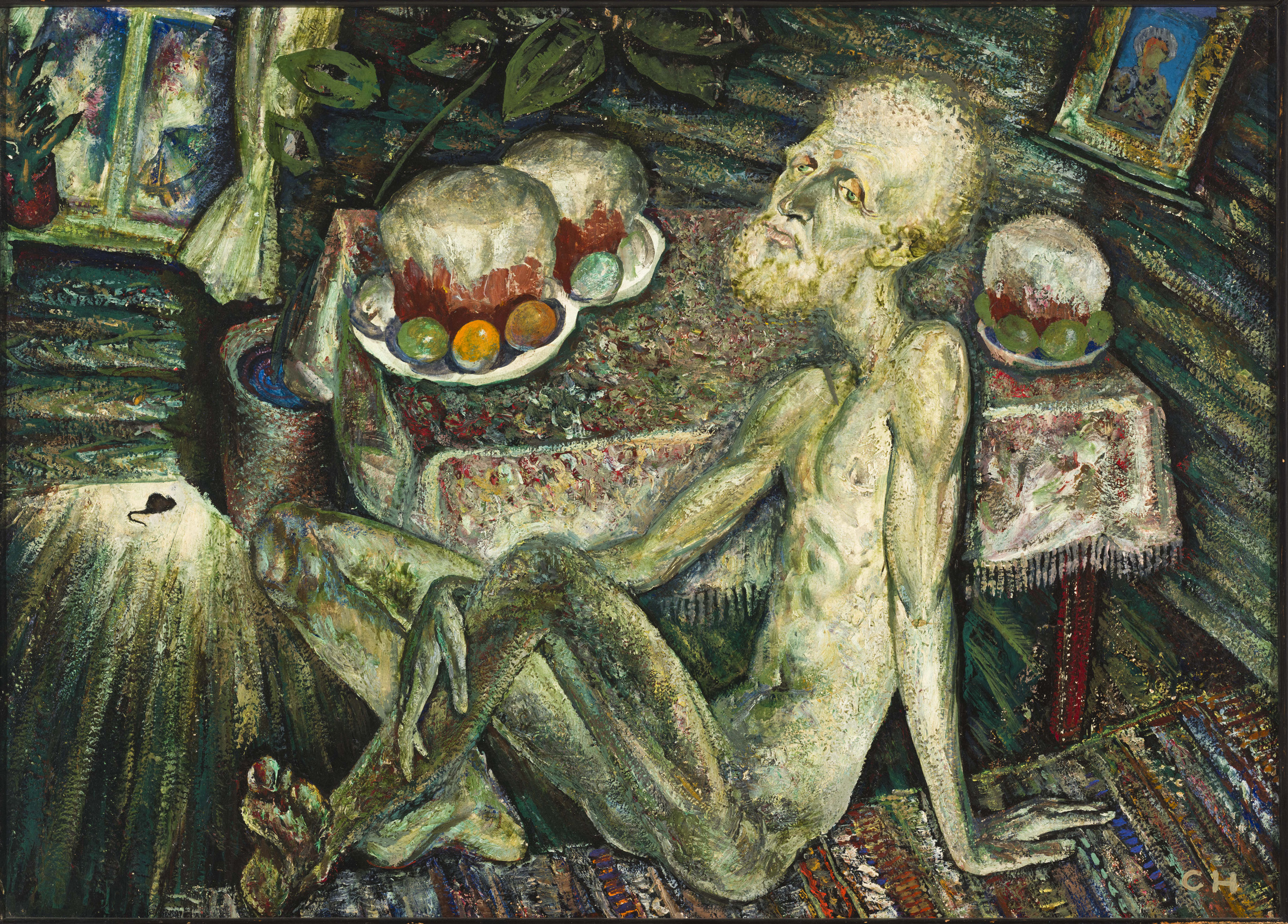
House Spirit, 1971. Oil on illustration board, 48 × 68 cm (18 7/8 × 26 3/4 in.). Norton and Nancy Dodge Collection of Nonconformist Art from the Soviet Union. D11006
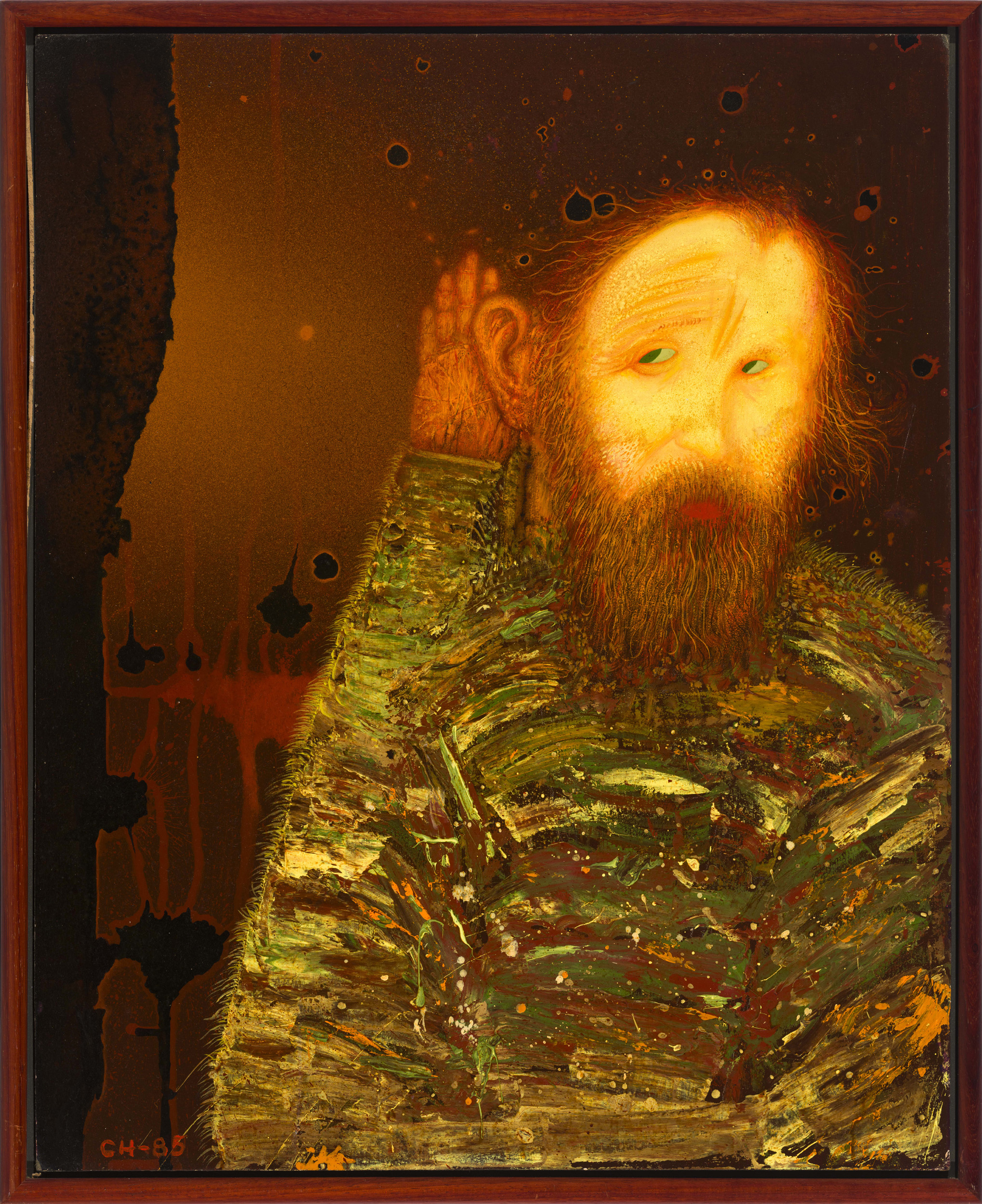
Self-Portrait Deaf Ear, 1985. Oil on fiberboard, 75 × 60.5 cm (29 1/2 × 23 13/16 in.). Norton and Nancy Dodge Collection of Nonconformist Art from the Soviet Union. D11011