

Martiros Sarian
1880 — Nor Nakhichevan (Russian Empire) | 1972 — Yerevan (Armenia). Worked in Moscow (Russia), Paris (France), and Yerevan (Armenia)
Martiros Sarian’s oeuvre marks a milestone in the history of Armenian art and constitutes a major contribution to twentieth-century world art. The artist’s original painting style unites the Russian school, Eastern influences, and European postimpressionism. Sarian’s palette is drenched in sunlight; its bold, fresh, and pure colors are infused with a joie de vivre and an exalted worldview. His body of work spans many media, including painting, graphic art, monumental panels, theater decoration, and book illustration.
Sarian was born into a peasant family in Nor Nakhichevan, a town in southern Russia founded by Armenians in 1779. His ancestors had arrived there from Armenia’s historical medieval capital, Ani. He received his training at the Moscow School of Painting, Sculpture, and Architecture (1897-1903), studying under the famous Russian painters Valentin Serov (1865–1911) and Konstantin Korovin (1861-1939). They not only taught Sarian the essentials of art making but also inspired him to search for a new language of painting.
In 1901, Sarian made his first trip to Armenia. Having arrived at the ideal means by which to capture his artistic impressions, he created the watercolor cycle Fairy Tales and Dreams. In 1907, the cycle, which is permeated by the spirit and aesthetics of symbolism, was presented in Moscow as part of the Blue Rose exhibition.
In 1908-09, Sarian abandoned watercolor for tempera. Around this time, many Russian painters, having become acquainted with collections of French impressionism and postimpressionism, including those amassed by Ivan Morozov and Sergei Shchukin, came under the influence of figures such as Vincent van Gogh, Paul Gauguin, and Henri Matisse. Sarian was no exception. He synthesized these influences with the traditions of Armenian national art. Drawing on medieval Armenian miniatures, geometric carpet ornaments, and sculptural reliefs in Armenian churches, Sarian developed the characteristic elements of his style, marked by simplicity of forms, rhythmic lines, and large, generalized planes rendered in pure, saturated hues.
In 1910-13, Sarian traveled through Turkey (Constantinople), Egypt, and Persia, producing a series of paintings about the East. For the artist, this experience marked an important moment of self-discovery. His works from this period brought him recognition and constituted a milestone in his art. Around this time, in the years prior to the Russian Revolution of 1917, Sarian regularly contributed his works to the largest exhibitions in Russia, organized by the magazine Golden Fleece and the artists’ association Mir iskusstva [World of art]. During this period, Sarian’s works were also acquired by the Tretyakov Gallery.
In 1915, Sarian became aware of the Armenian genocide in the Ottoman Empire (Western Armenia). His response to the tragedy was a large allegorical canvas, Yegiptakan dimakner [Egyptian Masks] (1915, Sarian House-Museum, Yerevan, Armenia). The motif of the Egyptian mask introduces the symbolism of death and tragedy, originating in its funerary function as a sign of the transition between life and eternity. In Sarian’s painting, the masks’ frozen, depersonalized expressions convey a sense of loss, silence, and arrested time. In Sarian’s modernist interpretation, the mask motif acquires a universal character, becoming a metaphor for the fragility of human existence and the tragic legacy of history.
In 1921, Sarian moved to Yerevan, the capital of the newly formed Soviet Armenian Republic. He played an important role in the social and cultural life of the city and in the development of a national Armenian culture.
Another milestone in Sarian’s creative biography was his participation in the Soviet Pavilion at the Venice Biennale of 1924. His avant-garde paintings—wholly unlike the “proletarian” Soviet art of the 1920s—astonished the international art community. Following his success in Venice, Sarian traveled to Paris, where he remained until 1928. On his return to Armenia, traveling aboard the Frigi, many of his recent paintings were destroyed in a fire on the ship at the port of Constantinople. For this reason, little is known about the artist’s time in France.
After his return to Armenia, the Iron Curtain snapped shut behind the artist. Nonetheless, his paintings were prominently featured in exhibitions of Soviet art abroad. In 1937, Sarian exhibited a panel in the Soviet Pavilion at the International Exposition of Art and Technology in Modern Life in Paris; the panel was awarded the Grand Prize.
In 1948, the Soviet regime launched the latest of its campaigns against “formalism”—art that reflected European modernist influences and was deemed the most heinous of artistic crimes. This charge was leveled against Sarian, and both his art and his mental state suffered as a result. His work and his spirits experienced a revival in the 1950s and 1960s, during the period of political and cultural liberalization known as the Khrushchev Thaw.
Sarian’s pantheistic worldview, together with his universal, synthetic artistic language, created a solid foundation for the modern Armenian school of painting. This worldview is founded on the notion of the organic unity of humanity, nature, and the cosmos—a realm where everything is imbued with life and an inner light. In his painting, this vision is expressed through saturated, symbolically charged color; generalized forms; and a rejection of dramatic conflict in favor of the harmony of existence. In Sarian’s work, the world appears as a holistic, spiritualized organism in which natural motifs serve as vehicles for universal meaning. Stylistically, this approach is closely aligned with postimpressionism and fauvism. Although Sarian himself never formally taught, the concept of a “Sarian School” nonetheless exists—encompassing a lineage of adherents who carried his legacy forward throughout the twentieth century, up to the 1980s. Minas Avetisyan may be seen a prime example of Sarian’s legacy, reinterpreted through the artistic lens of the 1960s and ’70s.
In his late period, the decades of the 1940s and ’50s, Sarian worked mainly in oils as well as in watercolors. The Norton and Nancy Dodge Collection features two watercolors from this period, painted in Sarian’s characteristic manner. These are quick sketches, executed outdoors, capturing the artist’s direct impressions. They include Shamshadin gyughy, Hayastan [Village of Sham Shadin, Armenia] (1944, D02944), which was painted on a sunny day during a trip to the region of Armenia known today as Tavush. Here, Sarian rendered the region’s most notable features—rows of mountains on the horizon, shrubs and trees, and sun-scorched rocky earth—in generalized forms and bold colors. The second watercolor in the Dodge holdings, Dilijani antarnery. Hayastan [Woods of Dilijan], Armenia (1964, D02943), was painted on an overcast, rainy day. Its palette is based on transitions between different shades of blue, with occasional glints of yellow.
The Martiros Sarian House-Museum was built in Yerevan per a decree of the Armenian government and opened on November 26, 1967, during the artist’s lifetime. In addition to the House-Museum, Sarian’s works may be found in the collections of the National Gallery of Armenia, the State Tretyakov Gallery (Russia), the State Museum of Oriental Art in Moscow (Russia), the Russian Museum in Saint Petersburg (Russia), in regional museums in Russia, in the Norton and Nancy Dodge Collection at the Zimmerli Art Museum (New Brunswick, NJ, USA), and in private collections in Europe and the United States.
During his lifetime, Sarian received the following honors: People’s Artist of Soviet Armenia (1926), full member of the USSR Academy of Arts (1947), State Prize (1961), People’s Artist of the USSR (1960), and Hero of Socialist Labor (1965).
Sophie Sarian
Translated from Russian by Ilya Bernstein
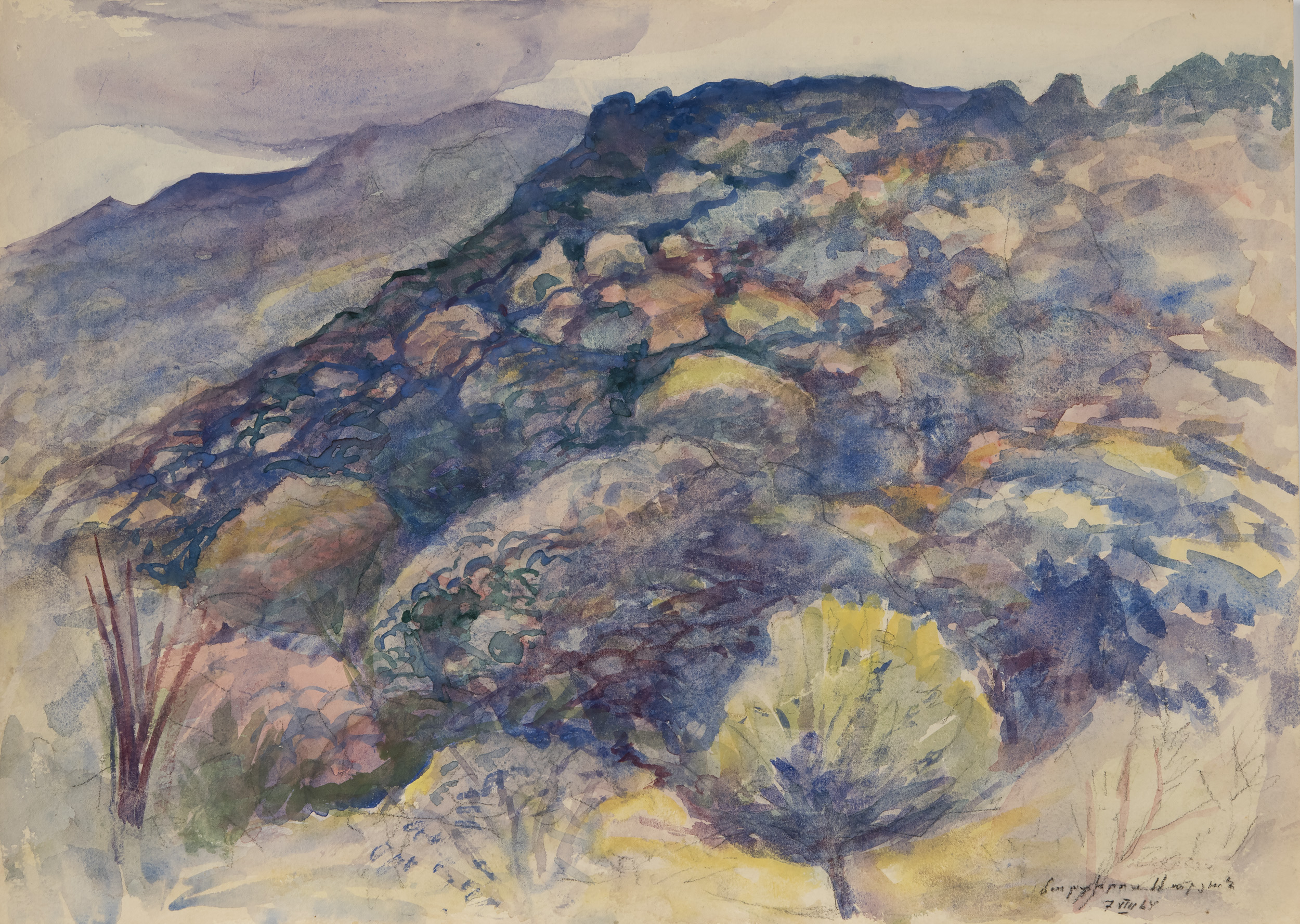
Woods of Dilijan, Armenia, 1964. Watercolor and graphite on paper, 28.3 × 39.7 cm (11 1/8 × 15 5/8 in.). Norton and Nancy Dodge Collection of Nonconformist Art from the Soviet Union. D02943
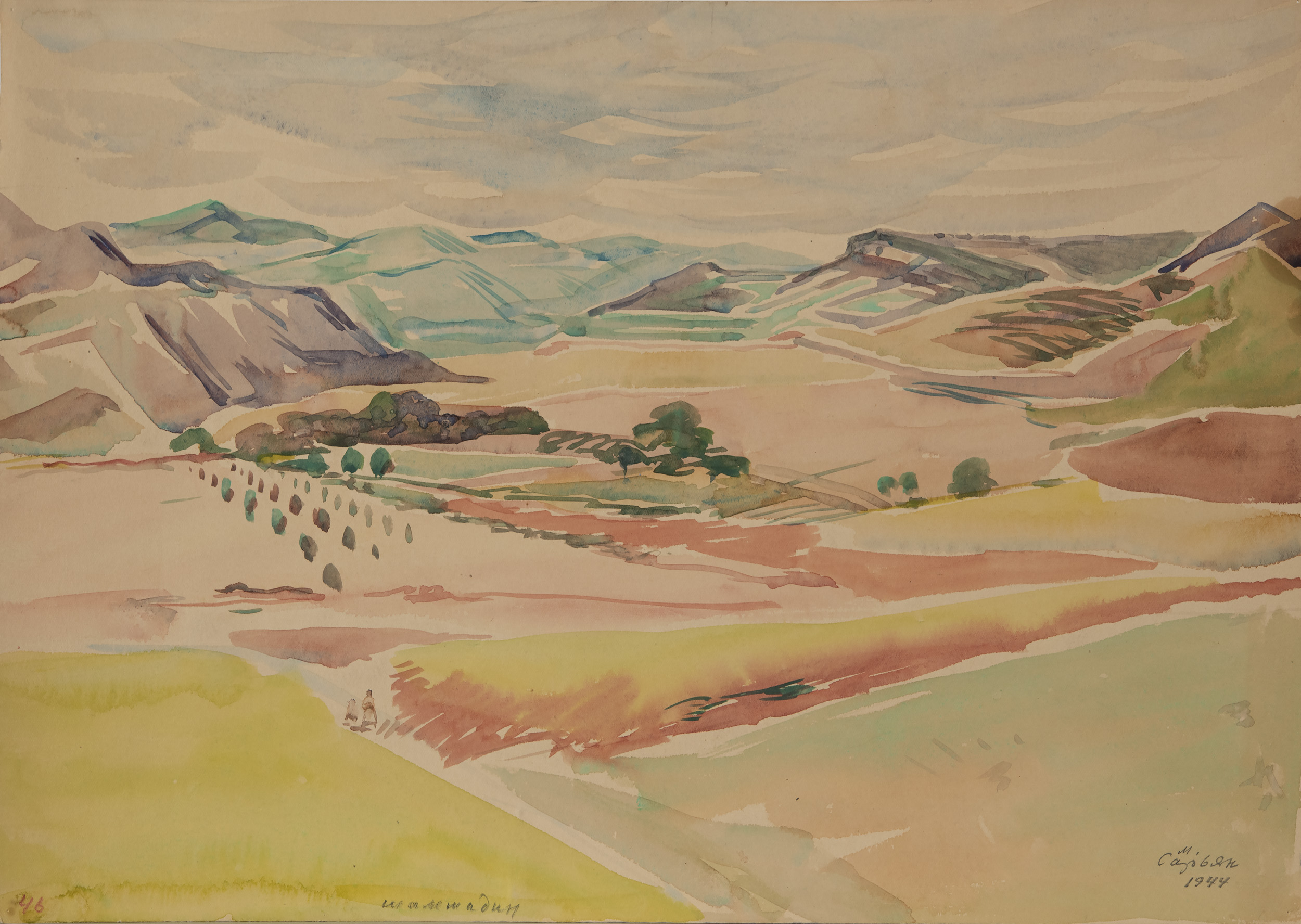
Village of Sham Shadin, Armenia, 1944. Watercolor on paper, 27.5 × 38.7 cm (10 13/16 × 15 1/4 in.). Norton and Nancy Dodge Collection of Nonconformist Art from the Soviet Union. D02944
Selected Exhibitions
1907 Golubaya roza [The Blue Rose], Moscow, Russia
1909 Zolotoe runo [The Golden Fleece], Moscow, Russia
1910 7th Exhibition of the New Society of Artists, Saint Petersburg, Russia
1915 Exhibition of Works by Left-Wing Artists, curated by Nadezhda Dobychina, Petrograd, Russia
1924 14th Venice Biennale, Venice, Italy
1928 Martiros Sarian, Galerie Charles-Auguste Girard, Paris, France (solo)
1936 Solo exhibition, curated by the All-Russian Arts Committee, Moscow and Leningrad, USSR
1975–76 Solo exhibition, curated by the USSR Ministry of Culture and the Italy-USSR Friendship Society, Bologna and Bari, Italy
1980 Solo exhibition, curated by the USSR Ministry of Culture, the Georges Pompidou National Art and Culture Centre, the Art Museum of Le Havre and the M. Paris-Le Havre, and the M. Sarian House-Museum
1986 Solo exhibition, curated by the Ministry of Culture of Germany, the Gallery of Matilde Hole and the M. Sarian House-Museum, Darmstadt, Germany
2003 In the World of the Rising Sun, curated by the National Gallery of Armenia, the M. Sarian House-Museum, and the Picasso Museum of Antibes (solo)
2010-11 Russia’s Unknown East, curated by the Ministries of Culture of the Netherlands and Armenia, the Groningen Museum, and the M. Sarian House-Museum, Groningen, Netherlands
2017 Martiros Sarian solo exhibition as part of the Days of Armenia, curated by the Ministries of Culture of Russia and Armenia, the Armenian Embassy in Russia, the State Tretyakov Gallery, the National Gallery of Armenia, and M. Sarian House-Museum, Moscow, Russia
Selected Publications
Aghasyan, A. Symbolism and the Art of Martiros Sarian. Yerevan: Voskan Erevantsi, 2012 (in Russian, summary in English).
Ghazaryan, M., and M. Khachikyan, eds. Sarian on Art. Yerevan: Sovetakan Grokh, 1980 (in Russian).
Khachatryan, Sh., and L. Mirzoyan, with introduction by A. Kamensky. Martiros Sarian: The Album. Leningrad: Avrora, 1985 (in Russian, English, German, French).
Matevosyan, V. Martiros Sarian. Yerevan: Academy of Sciences of Armenia Press, 1975 (in Armenian, Russian, English).
Razdolskaya, V., introduction. Martiros Sarian: The Album. Saint Petersburg: Avrora, 1998 (in Russian, English, French).
Sarian, M. Fragments of My Life. Moscow: Progress, 1970 (in Russian).
Sarian, R., ed. Sarian and Paris: Notes, Letters, Memories and Articles. Yerevan: Gasprint, 2007 (in Armenian and French).
Sarian, R., ed. Sarian and Russia: Issues, Letters, Poems. Yerevan: Tigran Mec, 2006 (in Russian).
Sarian S., The M. Sarian House-Museum. [Catalogue] Yerevan: Tigran Mec, 2020 (in Armenian and English).
Voloshin, M. Martiros Sarian. Saint Petersburg: Golike and Vilborg, 1913.
See also