
Marje Üksine
1945 — Tallinn (Estonia). Lives and works in Tallinn (Estonia)
Marje Üksine is a printmaker who has also worked extensively in book design and illustration. She was born and has lived her entire life in Tallinn. Üksine studied graphic art at the State Art Institute of the Estonian Soviet Socialist Republic (now the Estonian Academy of Arts) from 1964 to 1970. She entered the Estonian art world with the wave of women graphic artists in the second half of the 1960s.
Üksine worked for the publishing house Eesti Raamat from 1970 to 1978 before becoming a freelance artist. She has participated in exhibitions since 1970, and her first solo exhibition was in 1973 with Naima Neidre (b. 1943) in the Small Gallery of the Tallinn Art Hall. Üksine has participated in international group exhibitions and biennials in Kraków, Baden-Baden, Ljubljana, and Fredrikstad, as well as in the Jyväskylä and Sofia Triennials. She has received numerous awards and accolades, including the Eduard Wiiralt Prize (2015), the Grand Prize at the Estonian National Library’s exhibition and art competition From Artist to Library (2013), the Tallinn International Drawing Triennial “Manu Propria” award (2009), two special prizes at the Tallinn Print Triennial (1983), and others. She has designed more than a hundred publications, including several illustrations of poetry books by women authors such as Eha Lättemäe, Kersti Merilaas, Minni Nurme, Leelo Tungal, and Betti Alver. Üksine has commented that her book design and her free composition have complemented each other. [1] Some motifs and aesthetics from her art practice have ended up in illustrations and vice versa. Üksine has worked in traditional techniques such as drypoint and mezzotint, as well as in color lithography and watercolor.
One of Üksine’s first series depicts women in different actions and compositions, as seen in Tualett [Dressing Up] and Tüdrukud I–III [Girls I–III] (both 1973, Art Museum of Estonia). In Girls I–III we see women in various contexts going about their business, with their hair intertwining with the sky, the landscape, or an interior. In some pictures the women become entangled with their friends. The women Üksine depicts seem comfortable in one another’s company, indicating the importance of female friendship and companionship. Each seemingly similar figure is granted self-sufficiency. This pop-art-like series is quite different in content and form from Üksine’s later work Her trademark technique is a grid of parallel lines, executed mainly in drypoint.
One characteristic of the artist’s work is layering. She uses different graphic techniques to create illusion, displacing clear narratives. Her hybrid images create exciting, fantasy-filled moods.
Üksine also has an analytical interest in her living environment. She observes people, nature, everyday objects, and urban cultural signs, using many symbols and creating subtexts. In the artist’s pictorial space, solid constructed composition and lyrical openness collide. She often plays with different fragments, putting them into new contexts and thus creating somewhat unexpected encounters between realism and fantasy.
In the1970s and ’80s, Üksine usually synthesized different genres—still lifes, landscapes, portraits, and cityscapes—as seen in two works in the Art Museum of Estonia: Inimene ja linn III [Man and City III] (1986) and Narva maanteel [On Narva Road] (1977). Some motifs of Tallinn are completely recognizable, while others evoke only the feeling of the city with a detail or a building. Some of the artist’s works pay homage to metaphysics, such as Monument linnas. Hommage a Giorgio de Chirico [Monument in the Town: Homage to Giorgio de Chirico] (1983, ZAM, D03576). In some cases, objects relate to the urban environment in a way that renders them architectural, as in Asjad [Things] (1983, ZAM, D02444], which is a tribute to Giorgio Morandi and evokes Giorgio de Chirico’s metaphysical realism.
Üksine can also be regarded as a portraitist, but she has emphasized that although she has depicted her friends and acquaintances, she sought to generalize rather than portray a specific person. Portree [Portrait] (1976, ZAM, D05692) depicts her friend the graphic artist Naima Neidre; Külaline [Guest] (1977, ZAM, D03640) depicts her husband and Jüri Hain, one of the main advocates of graphic art of the period; the painter Tiit Pääsuke (b. 1941) can be recognized in Suvepäev [A Summer Day] (1980, Art Museum of Estonia). Her mezzotint Suveõhtu I (Autoportree) [Summer Evening I (Self-Portrait)] (1983, Art Museum of Estonia), in which two birds sit on her shoulders like guardians, is an intriguing self-portrait that is sensual and symbolic.
In still lifes, often several pictorial realities are intertwined, as in Vaade aknast septembris [September View from the Window] (1980), Vaikelu suitsetajaga [Still Life with a Smoker] (1973), and Lambad [Sheep] (1974) (all Art Museum of Estonia). Udune õhtu [A Foggy Evening] (1977, Art Museum of Estonia) juxtaposes different images and the whole composition feels almost nostalgic, yet Üksine’s works are seldom truly nostalgic or sweet but rather are often imbued with humor and a sense of the absurd, as exemplified by Eestimaa motiiv [Estonian Motif] (1986, Art Museum of Estonia).
Since the mid-1980s, Üksine has mainly worked in color lithography. These energetic and expressive works are dynamic and fluid, seeming to capture a quick glimpse of an undefined activity (Mäng III [Game III] (1985]).
Terrassil [On the Terrace] (2007, private collection) is an example of the multilayered pictures that Üksine created in the 2000s. In the foreground of a vast landscape, we see a form compiled of different abstract compositions, patches of color, drawings, and patterns. However, the dynamic scribbles on the surface of the image (very common in Üksine’s work) emphasize the materiality of the image itself, reminding us that we are seeing an illusion.
Marje Üksine´s art of the last decades is built on sometimes abstract, often strongly colored, striking shapes—polygons, elongated rectangles, circles, gears, and crescents—in which are woven smaller details encapsulating flashes of personal memory and culturally charged fragments such as geometric shapes with semi-abstract drawings on them that recall wind or landscapes, as seen in Mõtterännud looduses [Mind Wanderings in Nature] (2022, private collection). Sometimes the central motif is very straightforward, as exemplified by the heads of birds in Hilissügis [Late Autumn] (1998, private collection). In the last couple of years, the central image has taken the shape of an alphabetical letter a few times, and then the layers are added to the abstract image, forming a palimpsest. It all seems to be a game with multiple paraphrases of both the artist’s and the viewer’s cultural memory. By creating new relationships in her memory landscape, Marje Üksine captures the changing past, fragmentation, and relocation shifts characteristic of memories.
Eda Tuulberg
Notes:
1. “Graphic Marje Single,” March 8, 1995, Estonian Public Broadcasting.
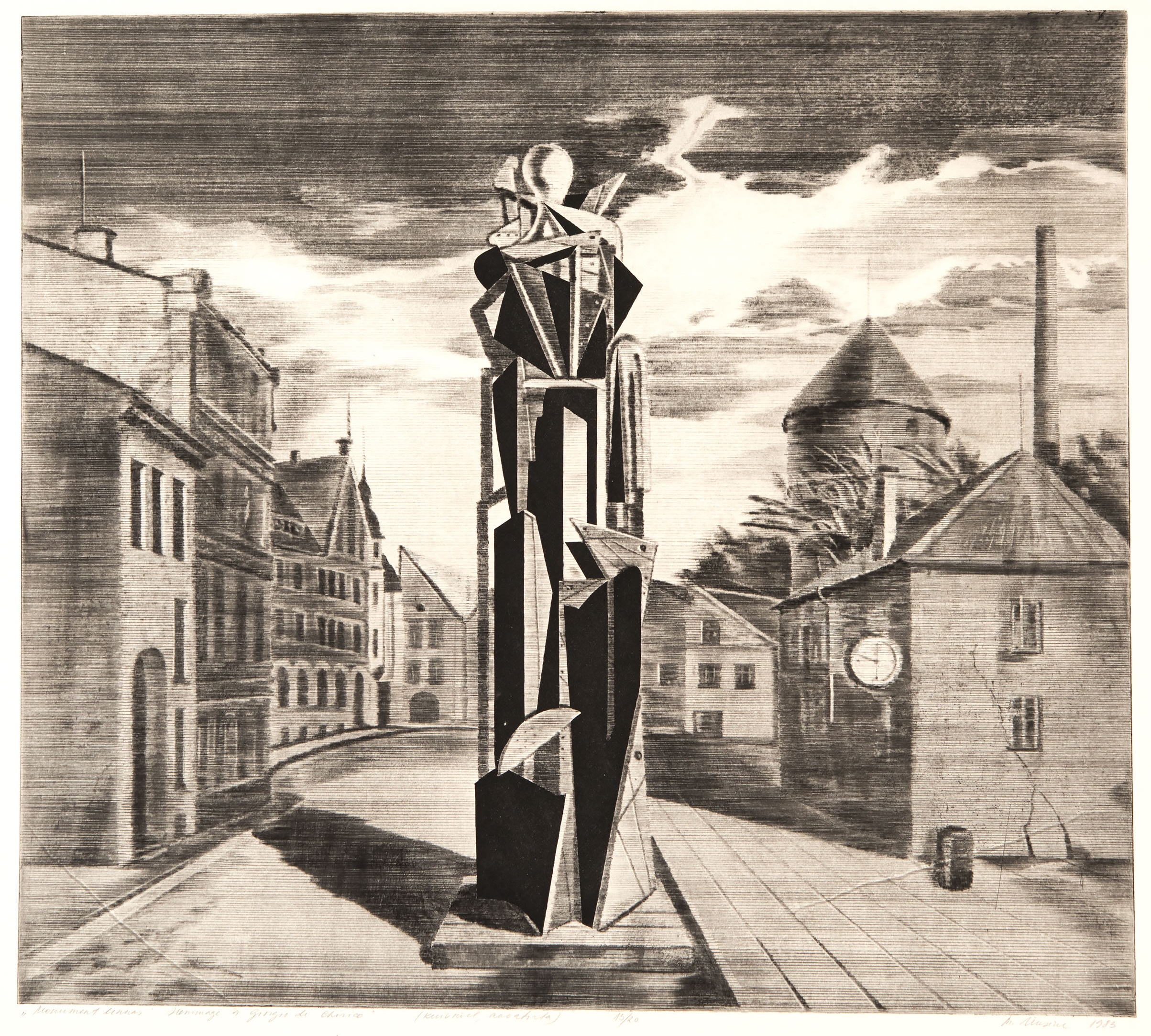
A Monument in Town: Homage to Giorgio de Chirico, 1983. Etching and aquatint on paper, 45.5 × 49.7 cm (17 15/16 × 19 9/16 in.) / 55.8 × 58.3 cm (21 15/16 × 22 15/16 in.). Norton and Nancy Dodge Collection of Nonconformist Art from the Soviet Union. D02444
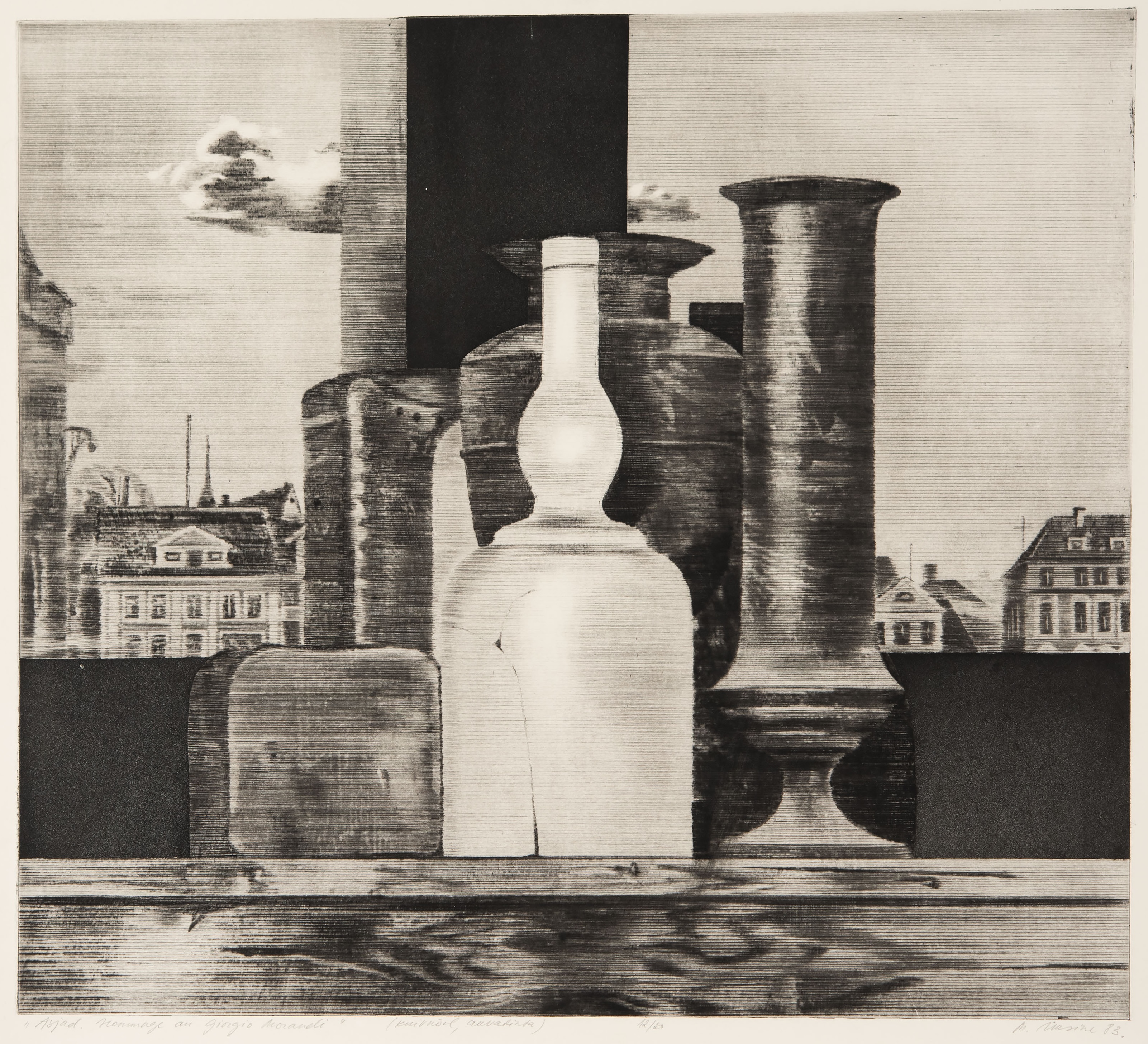
Things, 1983. Etching and aquatint on paper, 44.7 × 49.9 cm (17 5/8 × 19 5/8 in.) / 52.7 × 56.8 cm (20 3/4 × 22 3/8 in.). Norton and Nancy Dodge Collection of Nonconformist Art from the Soviet Union. D03576
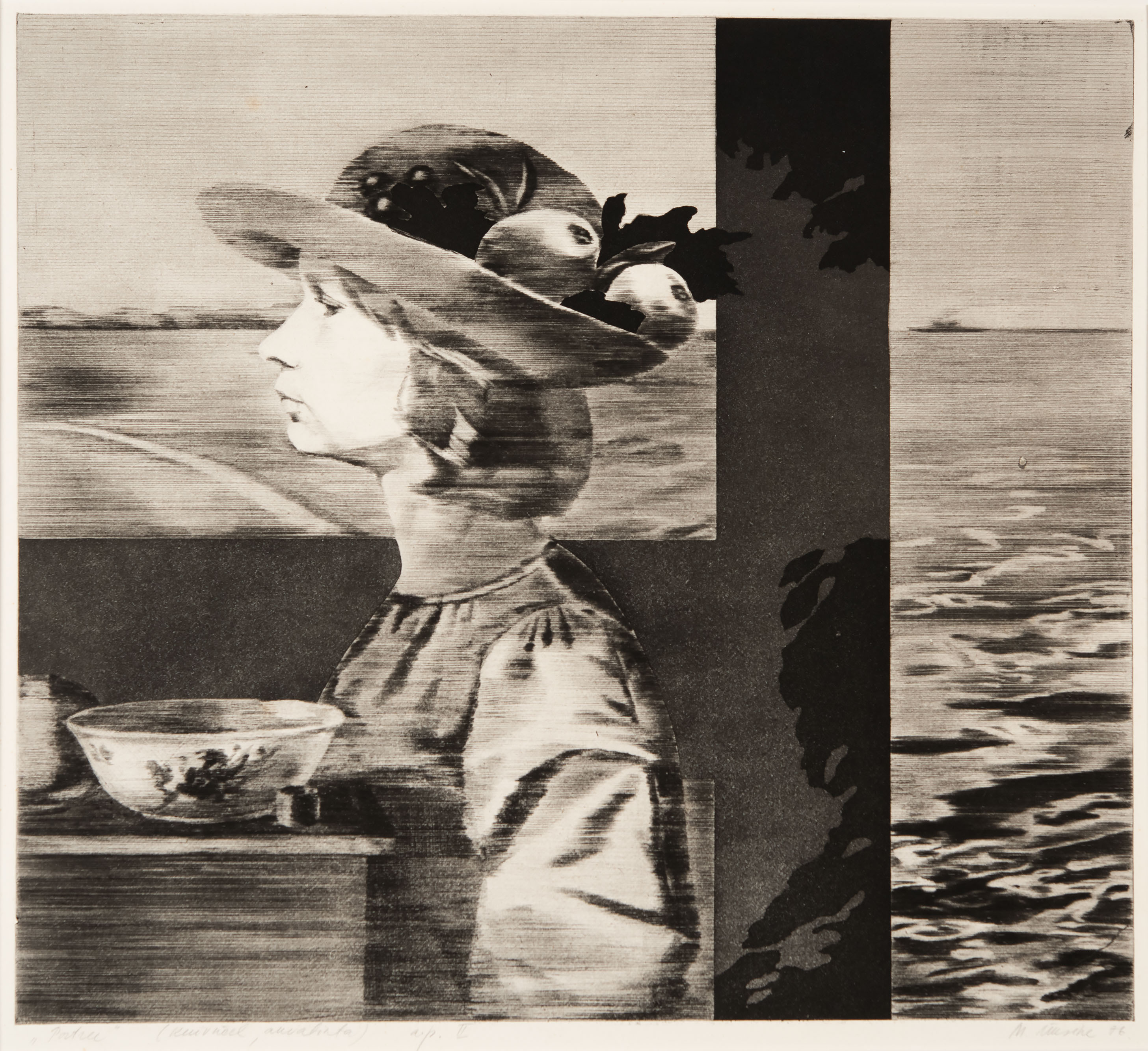
Portrait, 1976. Aquatint on paper, 39.8 × 43 cm (15 11/16 × 16 15/16 in.) / 50.1 × 52 cm (19 3/4 × 20 1/2 in.). Norton and Nancy Dodge Collection of Nonconformist Art from the Soviet Union. D05692
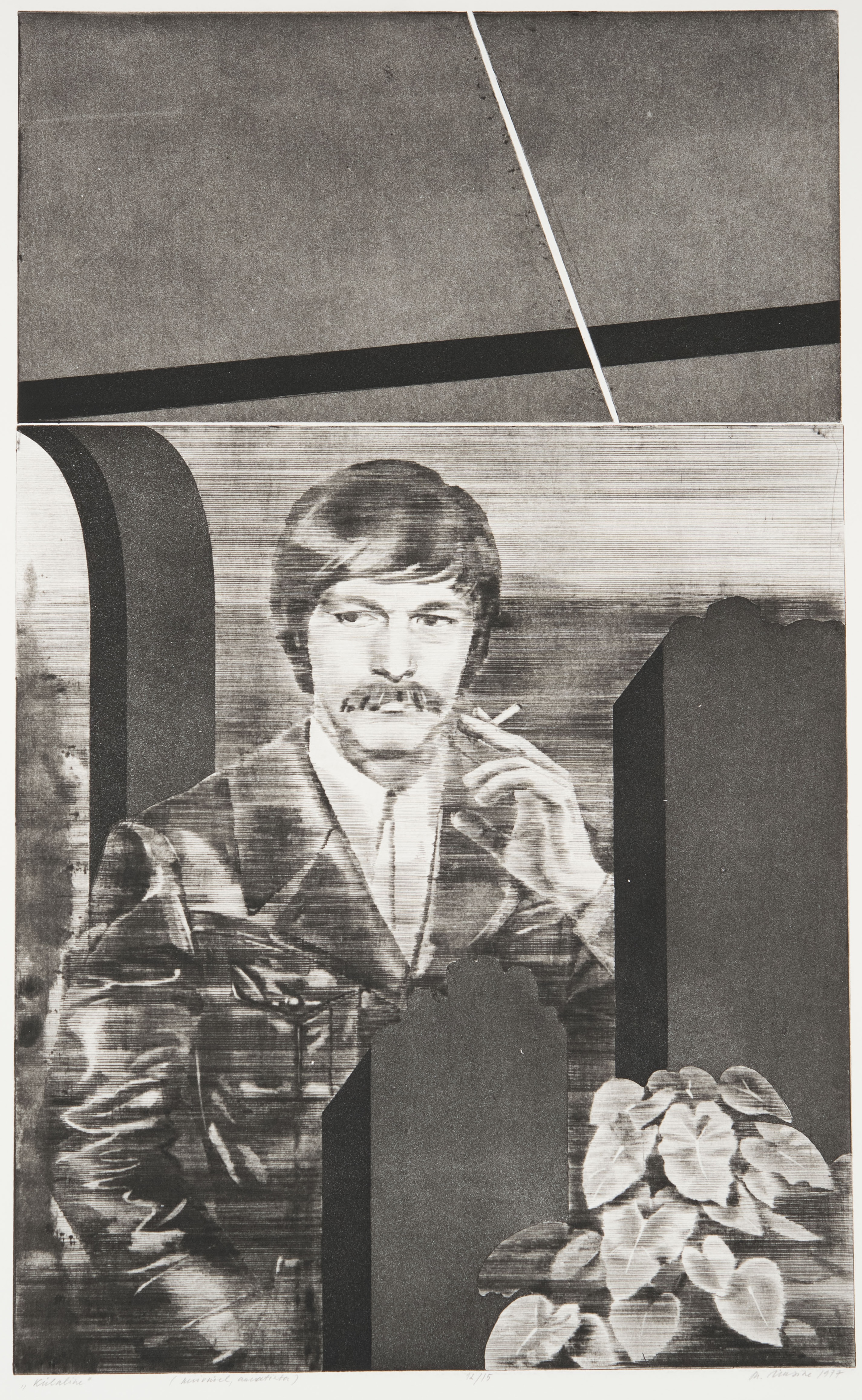
Guest, 1977. Etching and aquatint on paper, 60.3 x 37.1 cm (23 3/4 x 14 5/8 in.) / 74.5 x 52.2 cm (29 5/16 x 20 9/16 in.). Norton and Nancy Dodge Collection of Nonconformist Art from the Soviet Union. D03640