
Malle Leis
1940 — Viljandi (Estonia) | 2017 — Tallinn (Estonia). Worked in Tallinn
Malle Leis was born in 1940 in Viljandi, a picturesque small town in central Estonia. The family moved several times, settling first in Pärnu and then in Tartu, where Leis began her art education at the Tartu School of Fine Arts (now Tartu Art School) in 1958. From 1961 to 1967, she attended the State Art Institute of the Estonian Soviet Socialist Republic (now the Estonian Academy of Arts) in Tallinn, specializing in metalwork but graduating from the stage design department. In 1964 she joined with other young artists at the State Art Institute—Jüri Arrak, Kristiina Kaasik, Tõnis Laanemaa, Marju Mutsu, Enno Ootsing, Tiiu Pallo-Vaik, Vello Tamm, and Tõnis Vint—to form the group ANK ’64 and start to modernize Estonian art of the late Soviet period after the rupture caused by socialist realism. Leis has been called one of the defining members of ANK ’64, which organized lectures about Western art history and experimented with new pictorial possibilities that integrated the posterlike look of American pop art as well as Western art historical influences and Eastern minimalist aesthetics. Leis did not simply embrace ANK ’64’s ideology, however, but strongly shaped the hallmark of “ANKness” with her vivid pop-influenced figures on an elegant dark background in both her oil paintings and her serigraphs.
After gaining recognition with her work in the rest of the Soviet Union, Leis’s signature style—bright, colorful flowers, fruits, and figures on a dark background—also became the trademark of late Soviet Estonian art, which gained notice in Moscow for its “designed look.” Even though Leis chose to pursue traditional oil painting and preferred art historical genres such as still life and portraiture, her compositions were demonstratively flat, and her subjects stylish and modern. In the 1970s Leis started to paint portraits of young women in the setting of still lives with flowers and fruits on the black background. These were not depictions of anonymous models, but portraits of Leis’s friends from the Estonian cultural elite such as the writer Mari Saat, the ceramicist Irja Kändler, and the actress Kersti Kreismann. Notwithstanding their subjects’ status as well-known women of the Estonian creative intelligentsia, it is hard not to interpret these female portraits, combined with fresh fruits and flowers, in the context of fading female beauty and society’s devaluation of women as they age. In 1977 Leis painted another portrait of the graphic artist Milvi Torim (Art Museum of Estonia), one of her favorite and most frequent models in the 1970s and 1980s. For the first time, the fruits in the painting show signs of aging: The bananas have black stains on them, and the apples are covered with worm holes. Leis even painted two flies on the triptych, as if to underscore the vanitas motif, a reminder of the passing of life and certainty of death. However, Leis’s aim with these compositions was not to create psychological portraits of living people, but to turn the women she admired into timeless icons. Even though her female subjects themselves do not show any signs of infirmity, the artist Leonhard Lapin has interpreted Leis’s frozen, lifeless female figures as a symbol of the hopelessness felt by Soviet citizens during the stagnation era. [1]
In the 1970s, in cooperation with her husband, the artist Villu Jõgeva, Leis started to work with serigraphy, developing a mastery of the technique and dedicating it almost fully to botanical imagery. With their bright colors and availability as prints, Leis’s serigraphs quickly became popular among the local audience and found their way to Estonian homes. The Estonian feminist art historian Reet Varblane has examined Leis’s flowers as a symbol of powerful female sexuality and women’s emancipation. [2] Leis had begun using botanical imagery by the end of the 1960s, and together with her female figures, it soon became a leitmotif in her work. Leis used traditional botanical motifs of Western art history as a pop artist, exploiting the sensual beauty of roses, lilies, tulips, apples, cherries, and grapes. The Estonian art historian Sirje Helme has explained the aesthetic escapism of Leis’s work as typical of late Soviet Estonian art, representing a turning away from reality in favor of building an artistic ivory tower. [3] This approach offered a respite from the industrial Soviet environment, often perceived by Estonian artists as chaotic, disorderly, and brutal. The Estonian art theoretician Boris Bernstein has explained the ethics of ANK ’64 as foremost an ethics of nonparticipation, and he goes on to write about the gradual reshaping of the surrounding Soviet environment: “Few people thought that after a decade and a half or two, this system might collapse; a dull but long life seemed to lie ahead, hence the attempts to gradually reshape that life.”
Leis was indeed a painter and graphic artist who embodied the aesthetic mainstream that dominated Estonian art in the 1970s and ’80s, starting with the group ANK ’64. However, according to Anu Allas, the artist’s attitude toward the subjects she depicted remained ambivalent, ranging from banal to nostalgic and sentimental to mysterious, or full of sincere admiration. [4] Her signature style emerged in the 1970s at a time when portraits and still lifes—the two main genres of her art—already seemed a little too beautiful for the reality of Soviet life. Nevertheless, Leis should not be considered an escapist artist who ran from the modern era into the imagined times of her paintings. Though possessed of an otherworldly beauty, her paintings also sum up the late Soviet period in the western periphery of the Soviet Union, which considered itself superior to the rest of the Soviet Union as more modern and more Western.
While female artists of this period are often associated with graphic art and applied arts in Estonia, Leis took up classical painting as her main medium after graduation from the State Art Institute. The most highly regarded medium at Soviet Estonian art exhibitions of the time, painting was still considered a masculine pursuit. Until the 1950s and ’60s, there had been only a handful of outstanding female painters in Estonia. Leis, however, brought such productivity and vigor to the medium that she became a luminary of Soviet-era Estonian art. Her paintings were reproduced alongside those of the preeminent painters Johann Köler and Konrad Mägi in the highly popular 1982 volume Eesti maal [Estonian Painting], found on the bookshelf of every Soviet-era Estonian home. [5] Her works were a prime attraction at the Spring Exhibitions of Tallinn Art Hall, which were more liberal than the Autumn Exhibitions, and therefore were much anticipated by Tallinners and drew long lines.
In 1969 Leis’s first solo exhibition took place at the Tallinn Art Salon. In the 1970s and ’80s, she had numerous solo exhibitions in Estonia as well as Poland, the United States, East Germany, Russia, Ireland, and Finland. A popular and widely loved artist, Leis took part in countless group shows during the late Soviet and post-Soviet eras. In 1988 Leis participated with two of her works in the famous Sotheby ‘s art auction in Moscow. In 2014 the Tartu Art Museum organized a solo exhibition accompanied by a catalogue. In 2023 the Art Museum of Estonia initiated a traveling exhibition of work by Leis, Maija Tabaka, and Marija Teresė Rožanskaitė. Leis’s works can be found in the collections of the Art Museum of Estonia, Tartu Art Museum, Zimmerli Art Museum, New Orleans Art Museum, Tretyakov Gallery, Pushkin Museum, Russian Museum, and many other public and private collections around the world.
Liisa Kaljula
Photo portrait: Malle Leis in front of her work Young Gardeners, late 1960s—early 1970s. Photographer Valdur Vahi. Art Museum of Estonia. EKM j 55306:2 FK 596:2
Notes
1. This interpretation has been attributed to Leonhard, but no published source confirming this reading is currently available.
2. Reet Varblane, “Malle Leis,” in Eesti kunstnikud / Artists of Estonia (Tallinn: Kaasaegse Kunsti Eesti Keskus / Center for Contemporary Arts, Estonia, 2000), 66.
3. Sirje Helme, “Malle Leis,” in East Art Map: Contemporary Art and Eastern Europe, ed. IRWIN (London: Afterall, 2006), 203–4.
4. Anu Allas, “Malle Leis, Flowers I,” Forgotten Heritage.
5. Evi Pihlak, ed., Eesti maal [Estonian Painting] (Tallinn: Kunst, 1982).

Kaleidoscope, 1968. Gouache on paper, 58.8 × 59.5 cm (23 1/8 × 23 7/16 in.). Norton and Nancy Dodge Collection of Nonconformist Art from the Soviet Union. D16955

Untitled, 1982. Watercolor on paper, 60 × 60 cm (23 5/8 × 23 5/8 in.). Norton and Nancy Dodge Collection of Nonconformist Art from the Soviet Union. D05825
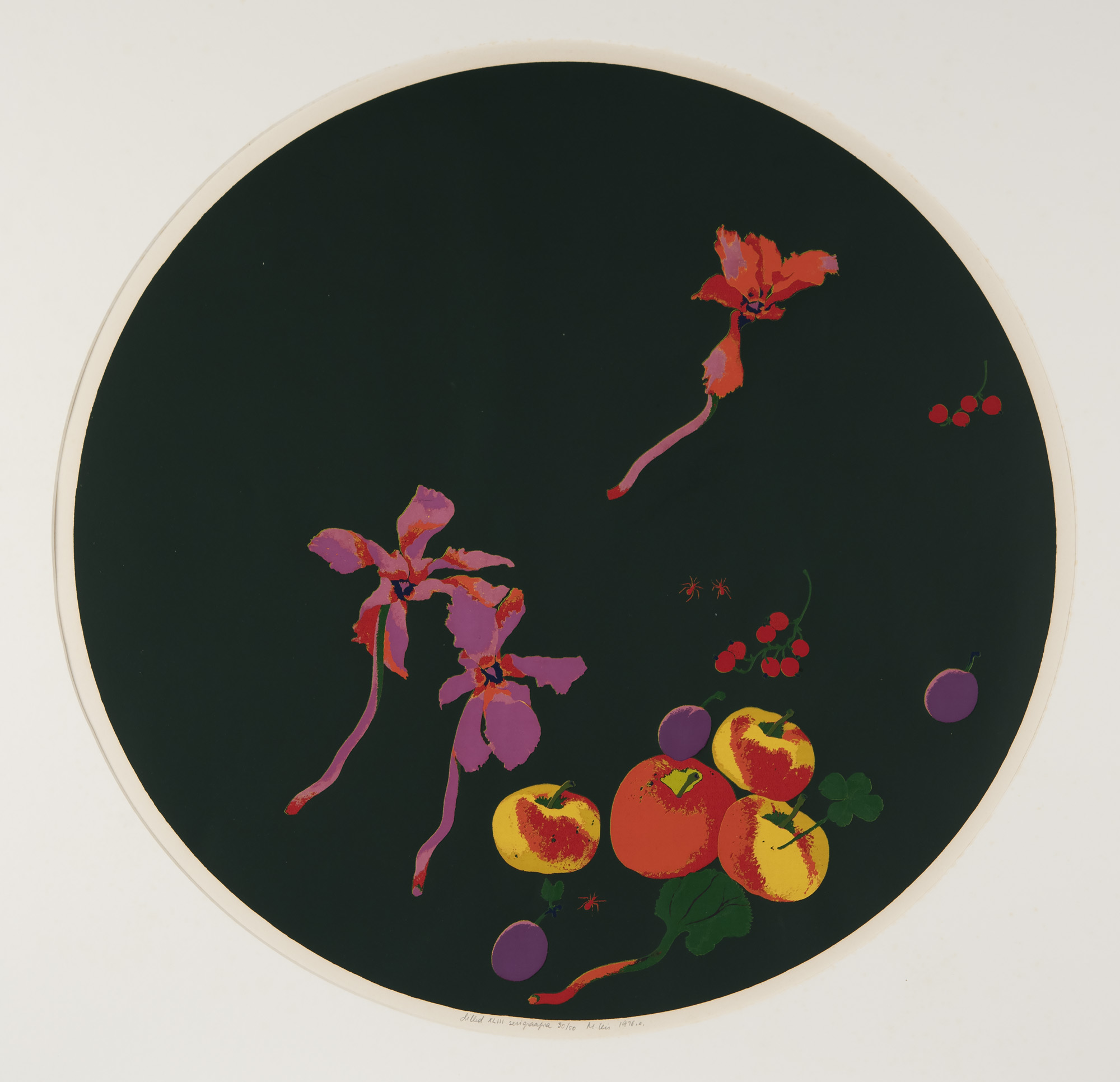
Flowers, 1976. Screenprint on paper, 67.8 × 62.4 cm (26 11/16 × 24 9/16 in.). Norton and Nancy Dodge Collection of Nonconformist Art from the Soviet Union. D05829
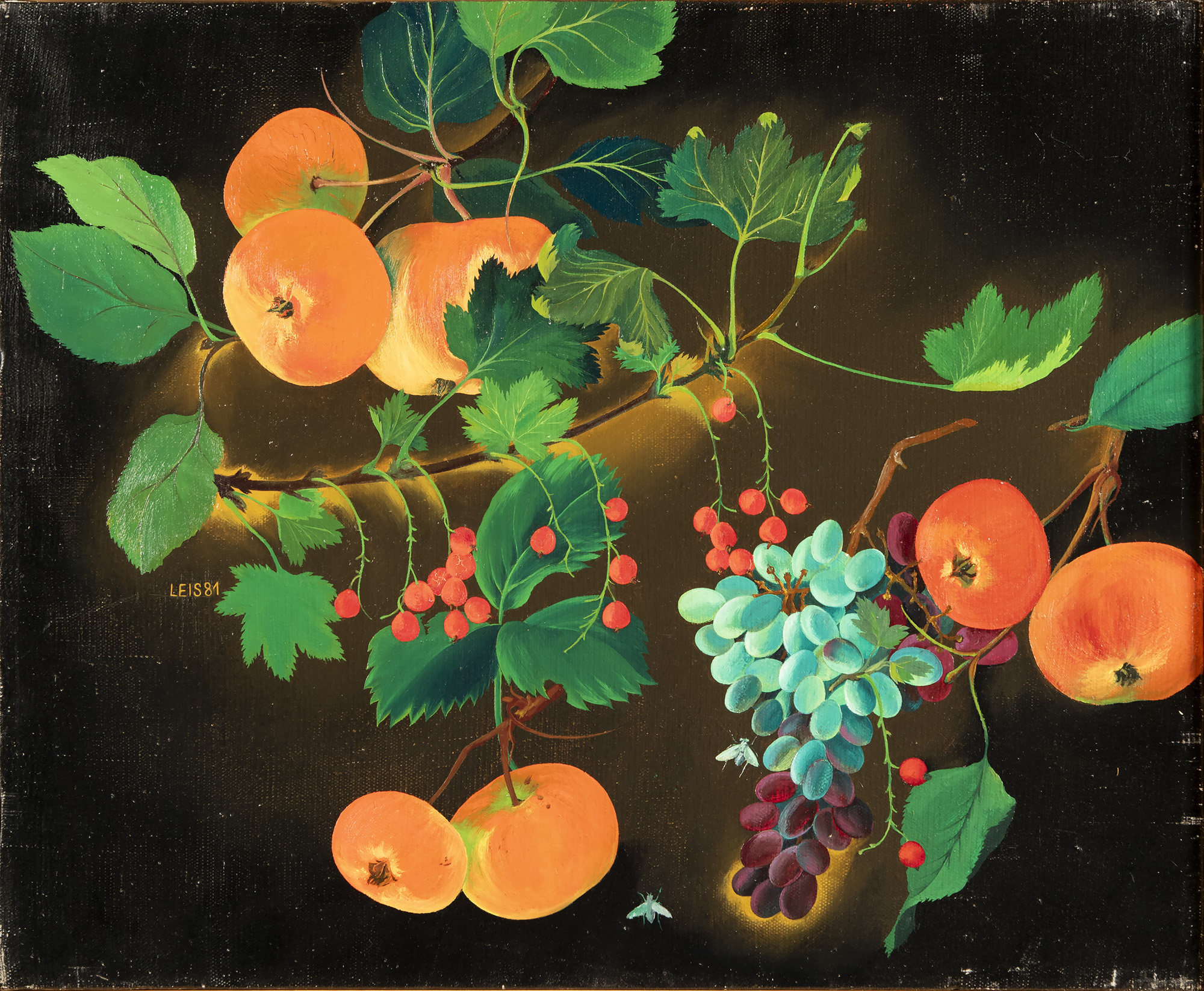
Autumn Apples, 1981. Oil on canvas, 50.3 × 61.2 cm (19 13/16 × 24 1/8 in.). Norton and Nancy Dodge Collection of Nonconformist Art from the Soviet Union. D06411
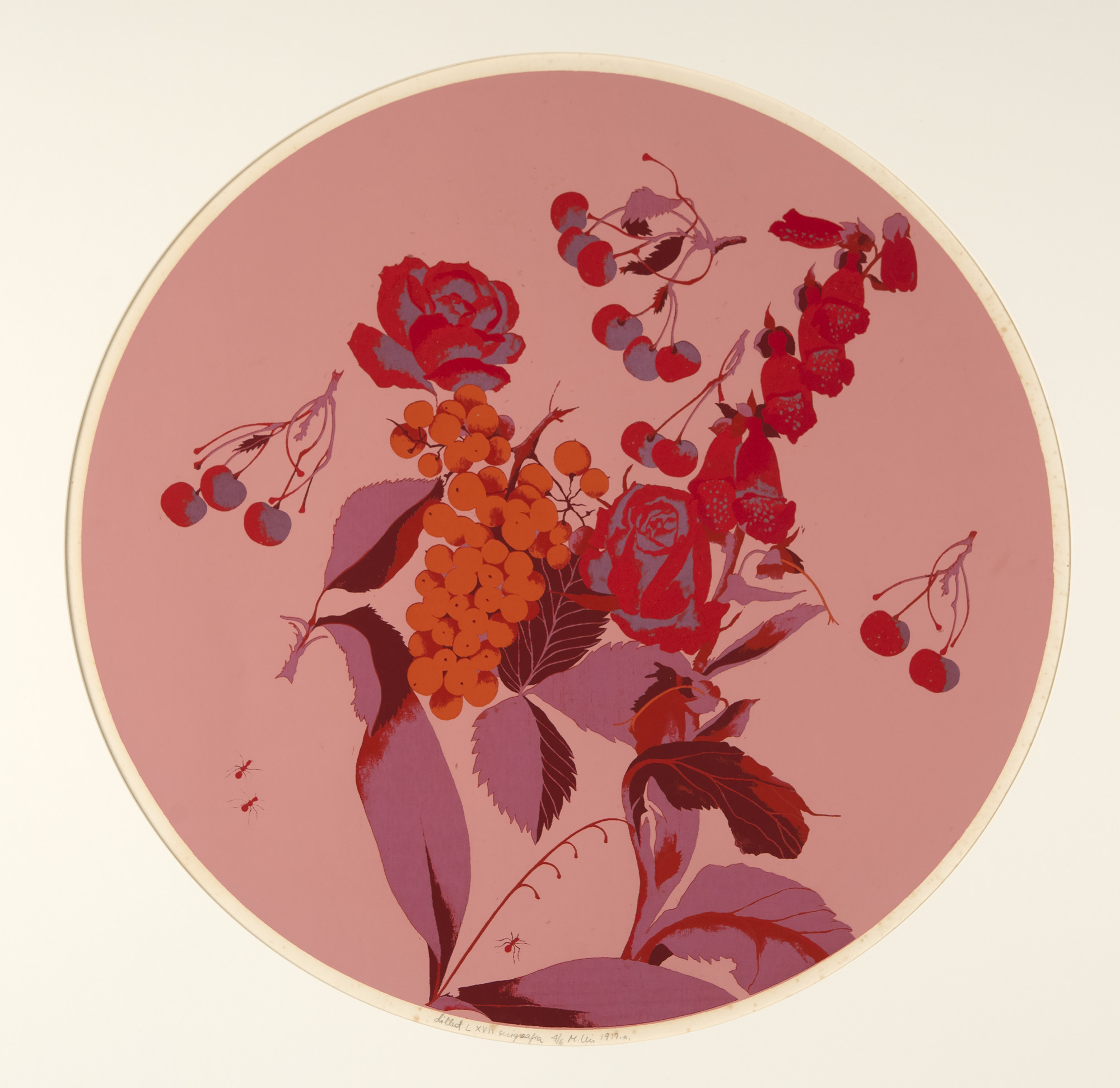
Flowers LXVII, 1977. Screenprint on paper, 77.7 × 61.2 cm (30 9/16 × 24 1/8 in.). Norton and Nancy Dodge Collection of Nonconformist Art from the Soviet Union. D07031
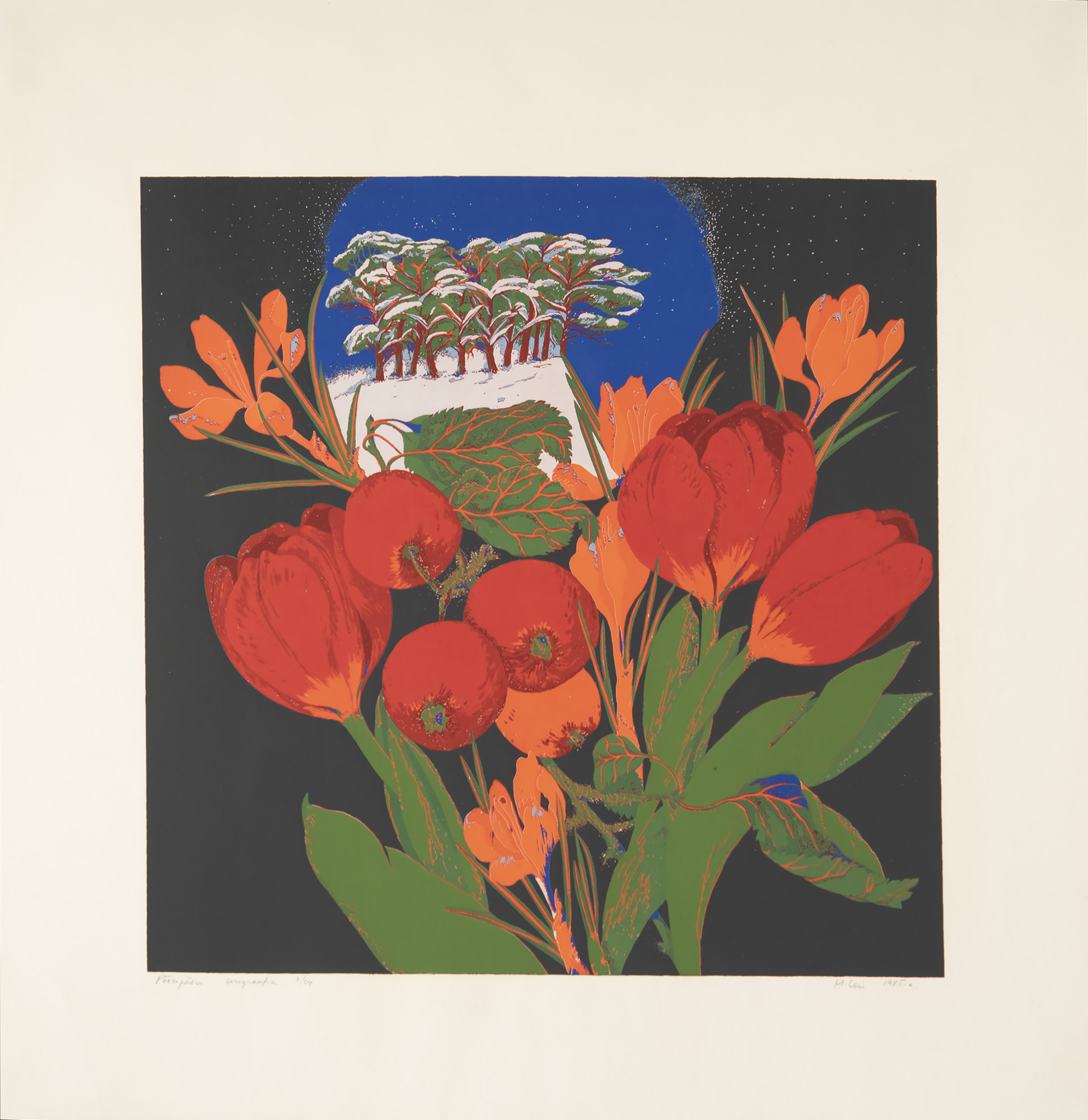
Pooripael, 1985. 42 × 42 cm (16 9/16 × 16 9/16 in.). Norton and Nancy Dodge Collection of Nonconformist Art from the Soviet Union. D07057