
Malda Muižule
1937 — Vasiļi farm, near Priekule (Latvia) | 2022 — Rīga (Latvia). Worked in Rīga (Latvia)
Malda Muižule was born in the family home of blacksmith Jēkabs Preiss and his wife, Līze, at Vasiļi farm near Priekule. She spent her childhood in the small town of Birži. She finished grade seven at the local elementary school, then in 1952 went to the Liepāja Secondary School of Applied Arts in the Department of Decorative Design of Premises (now PIKC Liepaja Music, Art and Design High School Interior Design Education Program). Despite the ideological demands of the Soviet regime and the dogmatic method of socialist realism, which also had to be mastered at the initial stage of art education, there was a strong Latvian atmosphere at the school. Teachers Voldemārs Ansulis (1919–1997), a jewelry artist and art historian, and Valters Uzticis (1914–1991), a painter, talked about folk art in their classes. Especially significant were the lessons given by master of folk crafts Žanis Albužis (1904–1985), who taught his students about ethnographic heritage, paying special attention to the patterns and bright colors used in fabrics and knitwear in the local Kurzeme region. Muižule never forgot the knowledge gained during these lessons, including the bold combination of colors that was different from work made in other regions of Latvia.
In 1957 Muižule graduated with honors from Liepāja Secondary School of Applied Arts, after creating decorative design sketches for the play by Rainis (pseudonym of Jānis Pliekšāns) I Play, I Dance, and she entered the Graphic Arts Department of the Latvian SSR State Art Academy of Art (now the Graphic Arts section of the Visual Arts Department of the Art Academy of Latvia). The leading lecturers of the department were adherents of strictly realistic art. While Arturs Apinis (1904–1975), Gundega Vaska (1917–2005), and Alberts Goltjakovs (1924–2016) gave her good foundations in classical drawing, classes with the painters Uga Skulme (1895–1963) and especially Leo Svemps (1897–1975) were much more engaging, and discussed the insights of French artists about color as a means of expression and a component of composition. After the third year, Muižule began to specialize in book illustration. However, her thesis was an etching cycle, Fishermen of Roja (1963), created under the guidance of Apinis. The budding artist had spent three summers on internships with fishermen, even going to sea with them to collect the visual material necessary for the work. She was not the only one to pursue a thesis on marine topics. The strong drawing and contrasts of shadows, the typecasting of the working man, and the determined faces of the fishermen amid the wind and the waves are all forerunners of the so-called severe style in the graphic arts of the younger generation.
Muižule’s classmates included later outstanding artists of her generation such as Aleksandrs Dembo (1931–1999), Inārs Helmūts (b. 1934), Naftolijs Gūtmanis (b. 1938), and Jānis Reinbergs (b. 1937). However, Muižule herself would only come to prominence in printmaking almost a decade later, because after graduating from the academy, she started working in the publishing house Liesma as a book designer. While she was still a student, Muižule’s drawings were regularly published in the newspapers Padomju Jaunatne [Soviet Youth] and Literatūra un Māksla [Literature and Art], and the magazines Veselība [Health], Liesma [Flame], and especially the satirical Dadzis [Spike]. Moreover, she was so active and creative in this field that she participated for the first time in an art exhibition with her cartoons in 1963, becoming a regular participant in exhibitions by Latvian and Baltic cartoonists for almost a decade.
Muižule was highly adept at stylizing images, highlighting the vices of society with economical expression. She quickly found her individual style as a cartoonist. The line is minimal and precise in its flow, making her cartoons pithy commentators on human characteristics and flaws. In 1966 Muižule was admitted to the Graphics Section of the Latvian SSR Artists’ Union with some etched landscapes and a series of cartoons. One of the artists who recommended her admission was Uģis Mezavilks (1929–1998), a book illustrator, cartoonist, and longtime deputy editor of the magazine Dadzis. However, in the mid-1960s, Muižule’s cooperation with that publication became less frequent, as she focused more on fine arts.
In the mid-1960s, Latvian graphic arts entered a new era. Gunārs Krollis (b. 1932), Inārs Helmūts, Baņuta Ancāne (1941–2024), Arturs Ņikitins (1936–2022), Aleksandrs Dembo, Māra Rikmane (b. 1939), Dainis Rožkalns (1928–2018), and Naftolijs Gūtmanis all made names for themselves, leading Latvian graphic arts to acquire a broader variety of themes and styles. Muižule’s works also significantly enriched the scene. At first, she worked mainly in classical stripe etching, basing the structure of each composition on a strict, accurate drawing and strong contrasts of shadows. Then, in the early 1970s, Muižule became one of the first Latvian artists to intensively explore of color prints. She boldly composed directly on the plate, experimenting with multi-plate etching to cultivate a variety of textures. She used different color combinations in markings from the same plate. She varied and compared them until she found the solution that best corresponded to her idea. Instead of following a classic compositional structure, the artist used the free division of planes, achieving the impression of spatiality and depth with the relationship of color areas. She integrated the color palette of her native Kurzeme region into her prints, simultaneously pursuing a free, creative interpretation of twentieth-century European artistic heritage, especially French. During this time, Muižule also turned to watercolors, in which she worked with equal delight, creating juxtapositions and flows of clean, bright colors. From 1968, she regularly participated in Latvian and Baltic watercolor exhibitions.
Muižule’s themes were multifaceted. These include urban landscapes, nature scenes, and free improvisations on literary themes. However, most often the artist depicted human relationships and the richness of the inner life in generalized figurative compositions. The person or event she portrays is not specific. She was particularly enamored of a very generalized image of a contemporary style, embodying a set of its certain qualities and feelings. The term “associative imagery,” popular at the time, was often used to describe her works. In the 1980s Muižule continued to work in watercolor and etching, mastered the technique of lithography to an equally excellent level, and turned to painting. At this stage of her career, she created many compositions with ethnographic motifs. The depiction of human and natural events in her art became more dramatic and complex, and the intensity of colors increased.
Muižule participated in more than two hundred thematic and group exhibitions, exhibiting screen prints, watercolors, book illustrations, and cartoons, and she regularly held solo exhibitions as well as exhibitions with her husband, Ivars Muižulis (1935–2023). Muižule’s creative work gained extensive recognition. She was awarded a certificate of commendation from the Ministry of Culture of Latvia at the Baltic Republics’ watercolor exhibition (1973); a certificate of commendation at the 4th Tallinn Graphic Art Triennial (1977); and first prize at the 5th Tallinn Graphics Triennial for colored etchings (1980). She was an active member of the Artists’ Union of Latvia as a member of the exhibition acceptance committee, and she worked for a long time in the Experimental Workshop of the Art Foundation, where all her etchings and lithographs were created.
The artist’s works are in the collection of the Latvian Artists’ Union Museum, Riga, Latvia; the National Art Museum of Latvia Riga; the State Tretyakov Gallery, Moscow, Russia; as well as many private collections in Latvia, the US, Russia, Canada, France, Austria, and elsewhere.
Irēna Bužinska
Translated from Latvian by Philip Birzulis
Photo portrait: Malda Muižule, 1987, archives, Artists' Union of Latvia, author unknown

Marine Image, 1973. Etching on paper, 48.4 × 64.7 cm (19 1/16 × 25 1/2 in.). Norton and Nancy Dodge Collection of Nonconformist Art from the Soviet Union. D05777
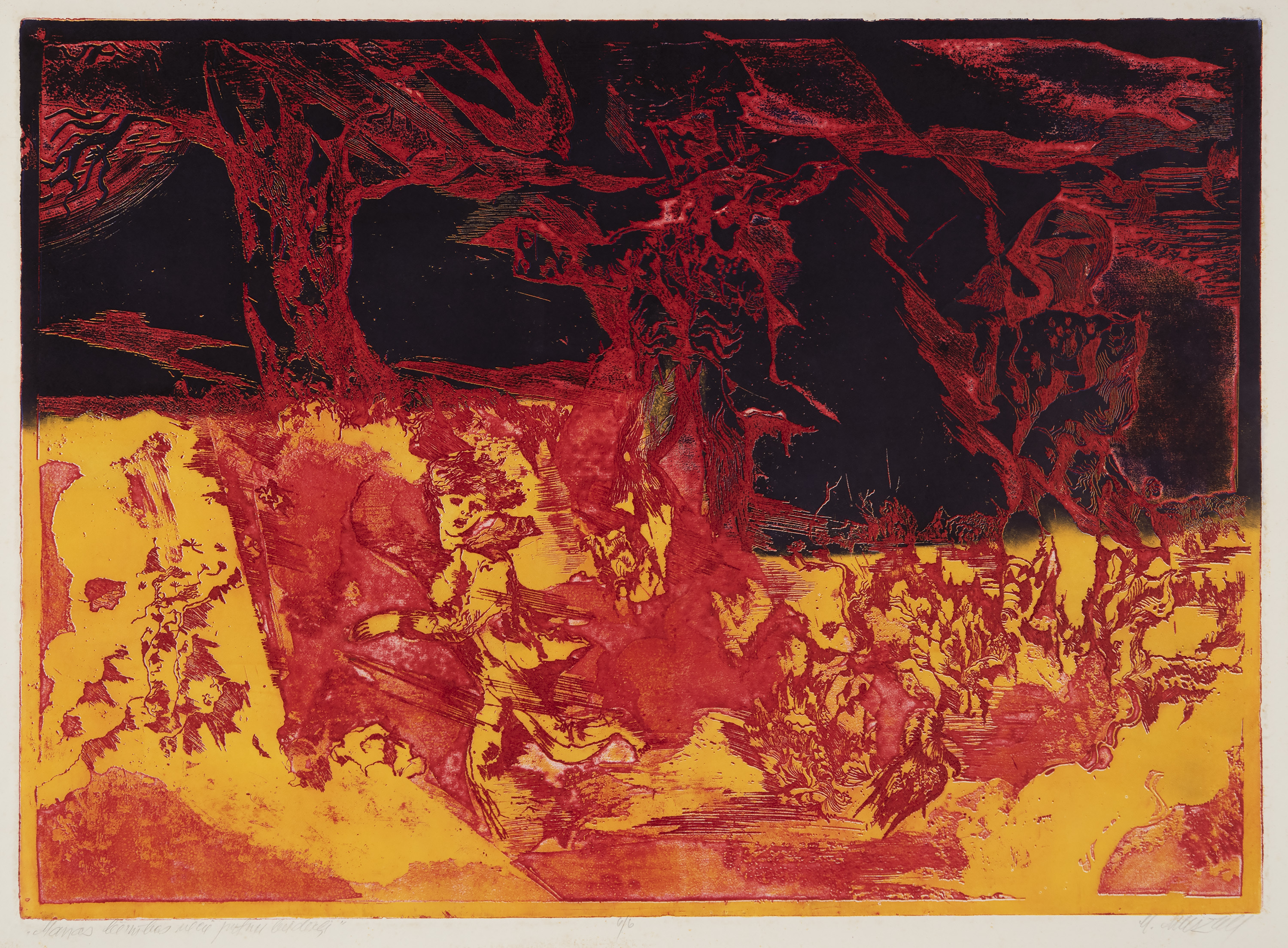
The Old Scarecrows of My Childhood, 1977. Etching and aquatint on paper, 49.3 × 65 cm (19 7/16 × 25 9/16 in.). Norton and Nancy Dodge Collection of Nonconformist Art from the Soviet Union. D07089
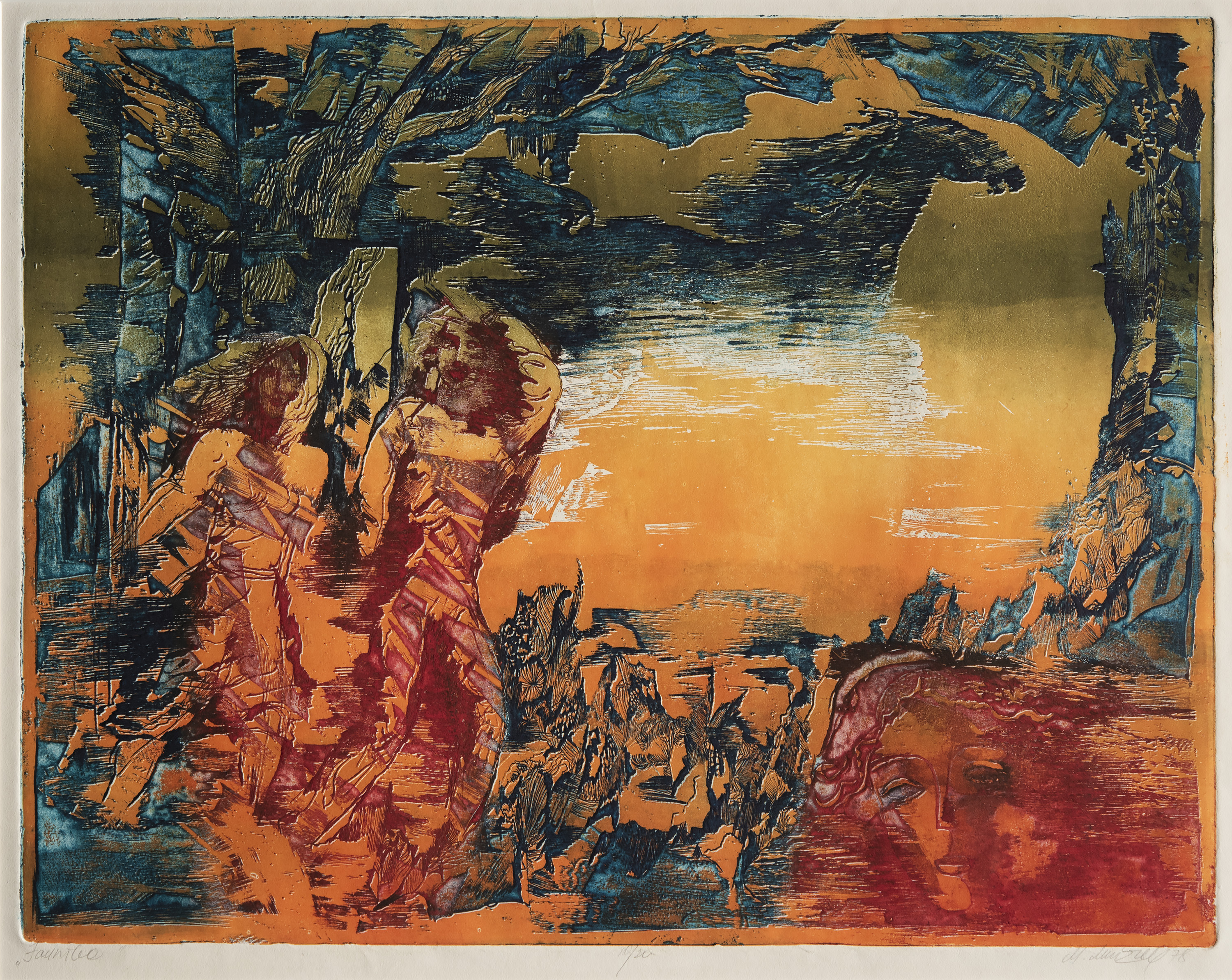
Youth, 1978. Etching on paper, 49.5 × 63.5 cm (19 1/2 × 25 in.). Norton and Nancy Dodge Collection of Nonconformist Art from the Soviet Union. D07088
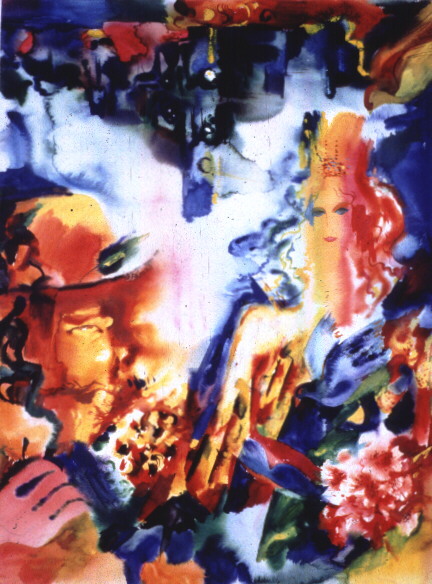
Fairy Tale, undated. Watercolor on paper, 75.3 x 56.2 cm (29 5/8 x 22 1/8 in.). Norton and Nancy Dodge Collection of Nonconformist Art from the Soviet Union. D06953
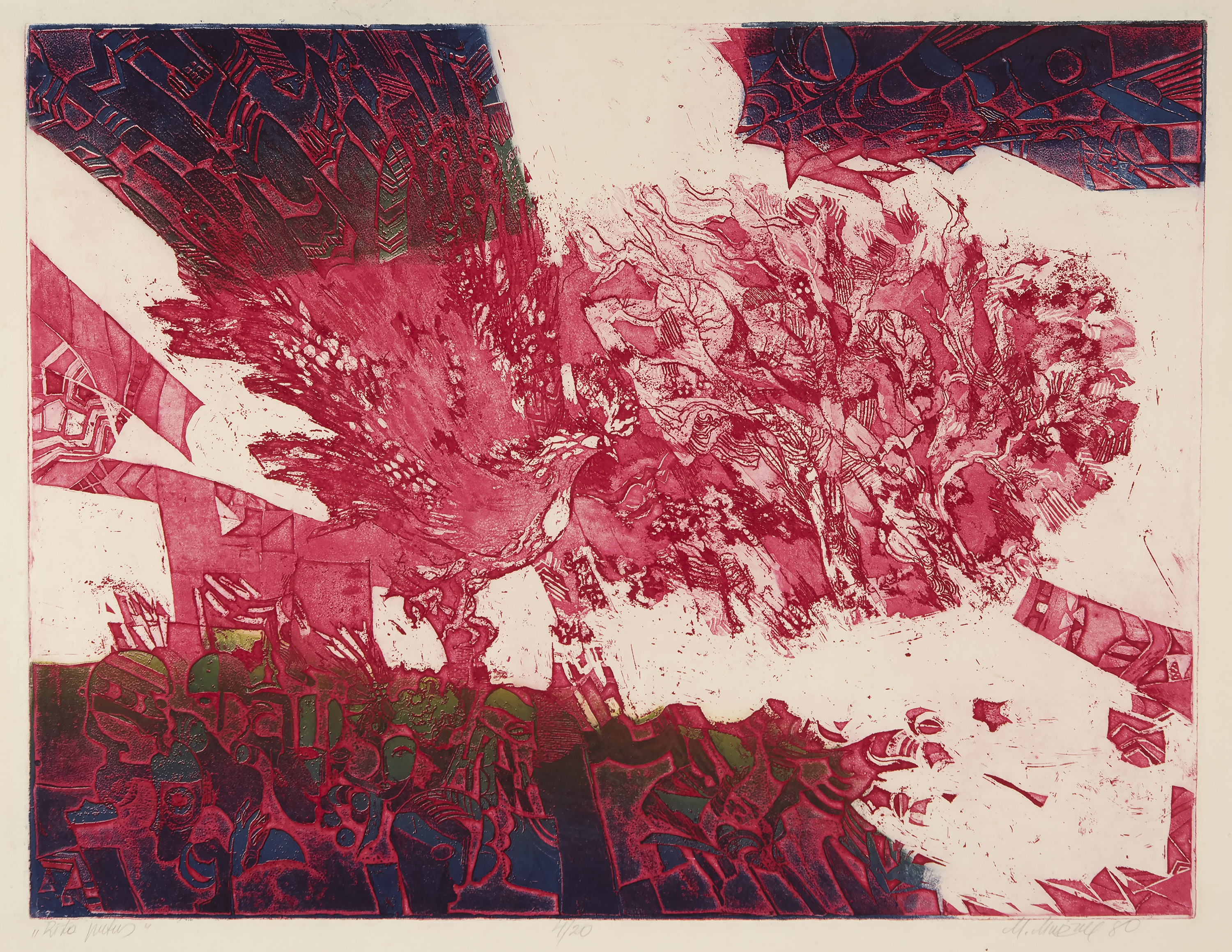
Morning Bird, 1980. Etching on paper, 49.6 × 64 cm (19 1/2 × 25 3/16 in.). Norton and Nancy Dodge Collection of Nonconformist Art from the Soviet Union. D03487