
Lilija Dinere
1955 — Riga (Latvia). Works in Riga (Latvia)
Lilija Dinere was born on September 14, 1955, in Riga, Latvia. Her mother was the well-known writer and translator Cecīlija Dinere (1919–1996). Lilija’s parents were separated and she grew up in her mother’s cultural circle. From an early age, Lilija read books, including avant-garde and banned literature. Her mother was friends with various well-known artists, writers, and poets such as Andrei Voznesensky (1933–2010), Bella Akhmadulina (1937–2010), Bulat Okudzhava (1924–1997), Vizma Belševica (1931–2005), Monta Kroma (1919–1994) and others, who were frequent guests at their home. “It may seem bohemian, but when you grow up like that, it feels natural,” Dinere reminisced. [1]
From 1962 to 1966 Dinere attended Riga’s Primary School No. 47. When two of her classmates left to study at Janis Rozentāls Art High School, Dinere decided that she, too, wants to go to school where she could draw all day. [1] She studied at the art school from 1966 to 1973. [2]
In 1973 she applied to the Painting Department of the Art Academy of Latvia, but loathed the composition assignment to paint an ideological scene of work or sports, and failed. [1] Dinere spent the following year heading a drawing class in the House of Pioneers, in the Kirov District of Riga (now the Center District). [2] In 1974 she repeatedly tried to enter the academy, this time selecting the Theatrical Scenery Painting Department, where she succeeded with their approach towards time and space. Her favorite teachers in the Academy were Gunārs Zemgals (1934–2018), Māra Ķimele (b. 1943), and Andris Freibergs (1938–2022); the latter especially encouraged artistic freedom in young people. [3] Dinere graduated with honors in 1980, developing a set design for Sophocles’s tragedy Antigone for her diploma project. However, she did not pursue a further career as a set designer. [3]
Instead, Dinere veered into graphics. She had made illustrations since her adolescence, and her extensive portfolio opened professional doors. Additionally, she admitted “it was easier for me because my mother was Cecīlija Dinere. If I were an outsider, I doubt it would be that easy for me.” [1] In 1969 she designed her first book, her mother’s poems, Pretrunas (Contradictions). Lilija worked on many of her mother’s literary works and translations from French throughout her creative career. In Latvia she received commissions from the publishing houses Liesma (Flame) and Zinātne (Science). During the Soviet period she illustrated dozens of books by Latvian and foreign authors, including poetry, short stories, novels, and documentary literature, as well as books for children. Several of her illustrations have received nominations, awards, and diplomas of recognition. Dinere’s illustrations also appeared in newspapers and magazines, such as Literatūra un māksla (Literature and Art), Karogs (The Banner), and Avots (The Source). [4]
Dinere began exhibiting in the mid-1970s. Getting into the circuit wasn’t easy. At first, her works were not accepted for exhibitions due to the strictly hierarchical system of Soviet art. She found it easier to enter works on paper shows. Still, when her paintings were shown at a watercolor exhibition in 1974, she faced a quandary, because at the time, mastery of watercolor wash was paramount, whereas Dinere painted dryly; detailed drawing and the philosophical message dominated in her works. [5] Kurts Fridrihsons (1911–1991) and Romis Bēms (1927–1993) were the first to recognize and support the young artist. [5]
In 1979, Dinere became a member of the Young Artists’ section of the Artists’ Union of the Latvian SSR. In 1981 she joined the Artists’ Union of LSSR in the Graphic Artists section, with endorsements from Māra Rikmane (b. 1939), Artūrs Ņikitins (1936–2022), Gunārs Zemgals (b. 1934), and Kurts Fridrihsons.
In the 1970s and ’80s, Dinere mostly worked in acrylic and watercolor painting, lithography, etching, aquatint, and zinc etching techniques. Her masterstroke was floating color transitions, which was a rarity in the Latvian print graphics of the 1980s [6]—for example, see Game with a Circle I, II, III (1980–81) in the Zimmerli collection (D02418, D02419, D02420). Dinere’s work appeared in numerous exhibitions on republican, interrepublican, all-union, and international scales. In 1981 she held her first solo exhibition at the House of Knowledge, also known as the Institute of Scientific and Technical Information and Propaganda, which was set up in an Orthodox cathedral in Riga, a popular venue for cutting-edge exhibitions and youth gatherings. Her next solo shows were held in the late 1980s in India, Japan, and Finland. [7]
Dinere’s approach to art making is introspective and focused, like yoga practice. She believes that she is only a tool; her hand holds the brush, but there is another driving force. “My immersion in the work goes so far that I, Lilija Dinere, disappear. All my ego is gone,” the artist says. [9] One of the key aspects of her work is the notion of time and space. Art historian Elita Ansone wrote, “Lilija Dinere doesn’t use the linear understanding of time. For her, all time is now and always has been. Her overarching theme is the concept of time, or rather, eternity.” [6]
Dinere has developed an idiosyncratic system of images, signs, and symbols, drawing from different cultures and eras. The artist says, “Subconsciously, each of us carry within us different archetypes that have arisen in the stages of the development of humanity. Fantasy is an invitation to elicit eternal universal images from oneself.” [9]
She typically works in cycles. In the 1980s she produced the seminal Game with a Circle, Procession, Pyramid, Inhabitants, and other sets. [10] While the artist herself determines the order of the works in the cycles, a shift in layout allows a new reading of the content. She continued some aspects of the cycles in later years, further developing and expanding on her multidimensional universe. [3]
In the 1990s, when drastic changes took place after the collapse of the USSR and the regaining of Latvia’s independence, Dinere continued to work actively. Her international collaborations expanded and exhibitions became more frequent. She held solo exhibitions and participated in international group shows in Finland, Canada, Sweden, Denmark, and Germany. [11] Contacts with Germany became particularly fruitful as she continues her cooperation with its cultural institutions to this day. [12] She also delved into photography, both analog and digital, exploring digitally treated photography as a backdrop for hand-painted layers, thus merging fantasy and reality in her more recent work. [13]
In the 1980–90s she was entrusted with illustrating fundamental translations of classics from diverse cultures into Latvian, such as François Villon's Poetry (1987), Lord Byron’s Hebrew Melodies (1993), the Oghuz epic The Book of Dede Korkut (1993), the collection of Celtic myths (1995), and the books of the Old Testament (The Book of Job, 1997). In the 2000s Dinere worked on the old French epic The Song of Roland (2010), the Icelandic Poetic Edda (2015), and The Epic of Gilgamesh (2019) together with her son, Roberts Diners (1977–2023). In the latter, the mother’s and son’s artistic expression met each other, from Lilija’s side the interest in painterly sensibilities and from Robert’s sculpting, as from an early age he had made small figurines from plasticine and wax. [14] The works were anthropomorphic and wild, akin to moss, raindrops, or fantasy creatures. As an adult, he directed this passion into bronze and other materials, developed original treatments, and used mixed techniques. The iconography and style of his works had parallels with his mother’s, and they often collaborated.
Lilija Dinere’s works are in the Latvian National Museum of Art, the Museum of the Artists’ Union of Latvia; the A. Pushkin State Museum of Fine Arts and the State Tretyakov Art Gallery in Moscow, Russia; the Frauenmuseum in Bonn, Germany; the Gotland Art Museum in Visby, Sweden; Museum of Coins and Medals in Kremnica, Slovakia; the Zuzāns Collection, Latvia; and private collections in the USA, Estonia, India, Israel, Japan, Canada, Russia, France, Finland, Germany, Norway, and Sweden.
Iliana Veinberga
Translated from Latvian by Philip Birzulis
Photo portrait: 1981, by Leonīds Tugaļevs
Notes
1. Lilija Dinere, interviewed by the author, October 2010, manuscript in the Latvian Centre for Contemporary Art, Riga, n.p.
2. Lilija Dinere, Autobiography, 1981, Artists’ Union of Latvia, Riga, personal file, Lilija Dinere, n.p. (hereafter Art Academy of Latvia, Lilija Dinere file).
3. Lilija Dinere, interviewed by the author, May 24, 2024. Voice recording in the possession of the author.
4. Collection of Clippings, Art Academy of Latvia, Lilija Dinere file.
5. Rita Šmagre, “Es nedomāju par savu oriģinalitāti” [I’m Not Pondering on My Originality: An Interview], Liesma 3 (March 1, 1982): 27.
6. Elita Ansone, “Lilija Dinere,” website.
7. Lilija Dinere, CV, 1995, Art Academy of Latvia, Lilija Dinere file.
8. Dace Vizule, “Attiecības ar neredzamo” [Relationships with the Invisible], broadcast on Atpūta, July 7, 2003, and published in Neatkarīgā Rīta Avīze, September 2003, 19.
9. Dace Vizule, “Zemapziņas rituāli” [Rituals of Unconsciousness], Rīgas Balss, March 8, 2000, 18.
10. Collection of photographs, Art Academy of Latvia, Lilija Dinere file.
11. Lilija Dinere, CV, 2000, Artists’ Union of Latvia.
12. Lilija Dinere, interviewed by the author, May 19, 2024. Voice recording in the possession of the author.
13. Inga Šteimane, “Prāta un dvēseles atmiņas” [Memories of Mind and Soul], Neatkarīgā Rīta Avīze, November 15, 2000, 13.
14. Andrejs Kaufmanis, “Dažiem un visiem zīmētās dziesmas” [Songs Drawn for Some and for All], Diena, September 1, 1997, 12.

The Eternal Theme, 1988. Zinc etching on paper, 62 × 47 cm (24 7/16 × 18 1/2 in.). Norton and Nancy Dodge Collection of Nonconformist Art from the Soviet Union. D09051
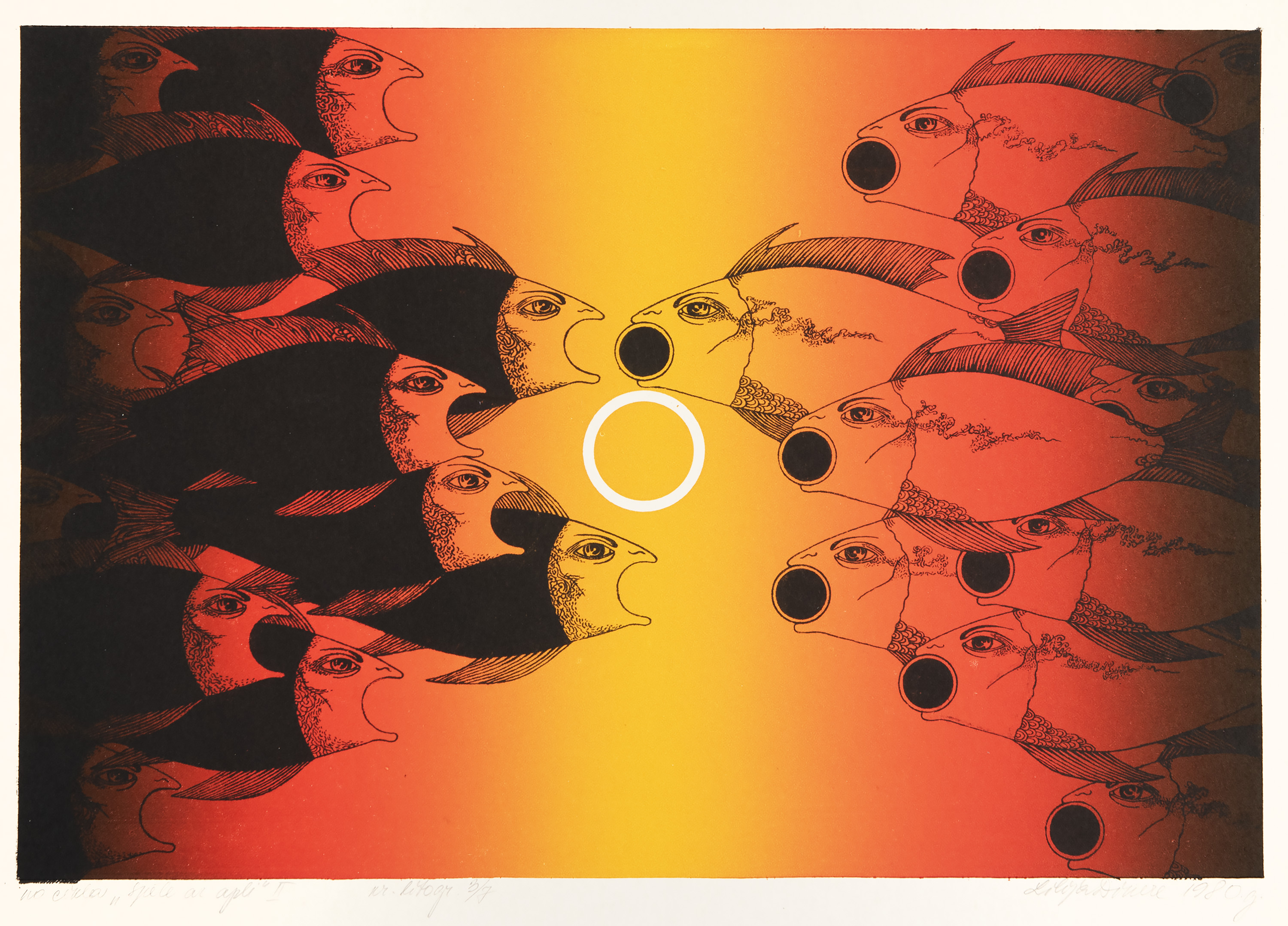
Game with a Circle II, 1980. Lithograph on paper, 26.8 x 39.1 cm (10 9/16 x 15 3/8 in.). Norton and Nancy Dodge Collection of Nonconformist Art from the Soviet Union. D02418
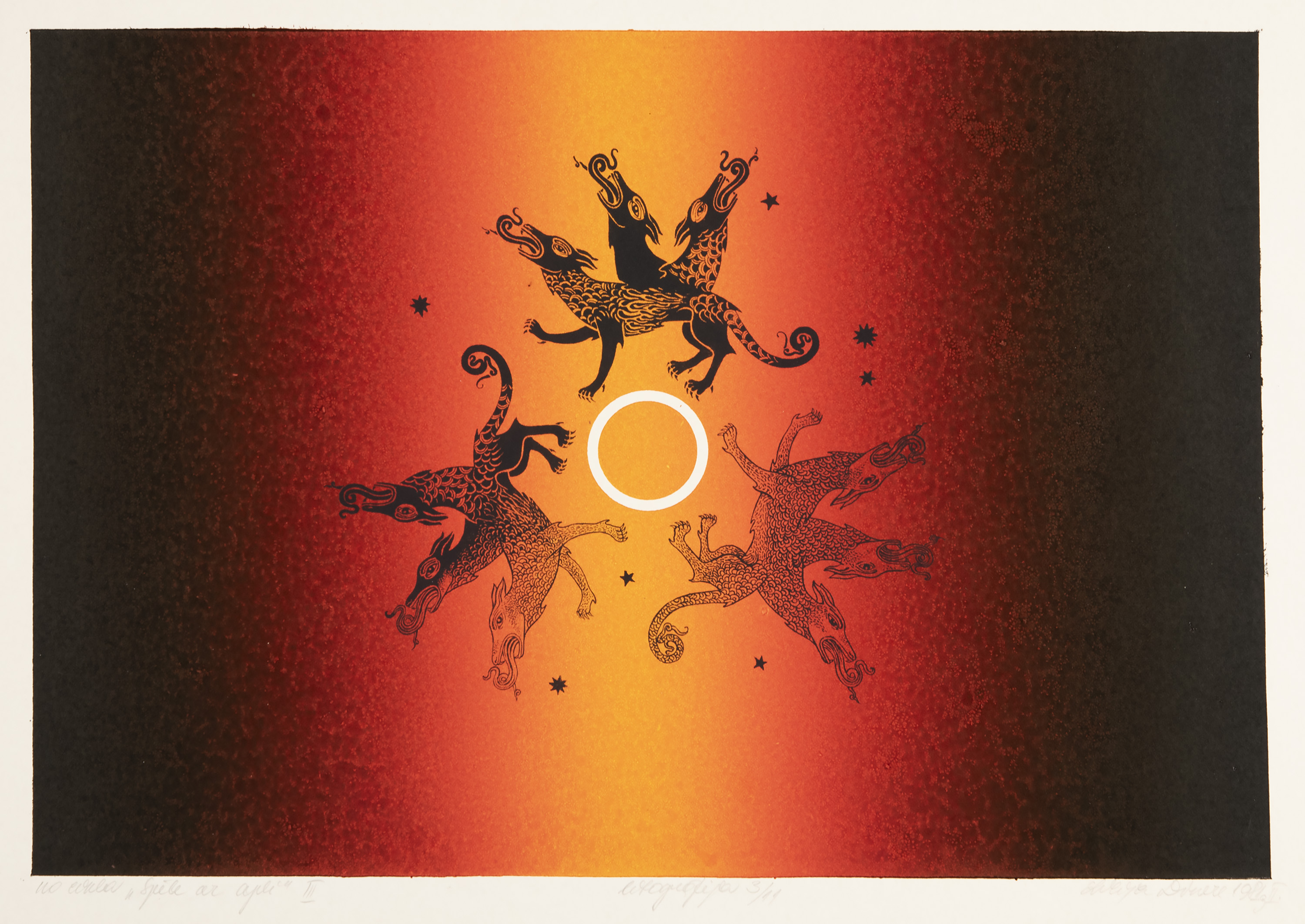
Game with a Circle III, 1981. Lithograph on paper, 26.6 x 39 cm (10 1/2 x 15 3/8 in.). Norton and Nancy Dodge Collection of Nonconformist Art from the Soviet Union. D02419
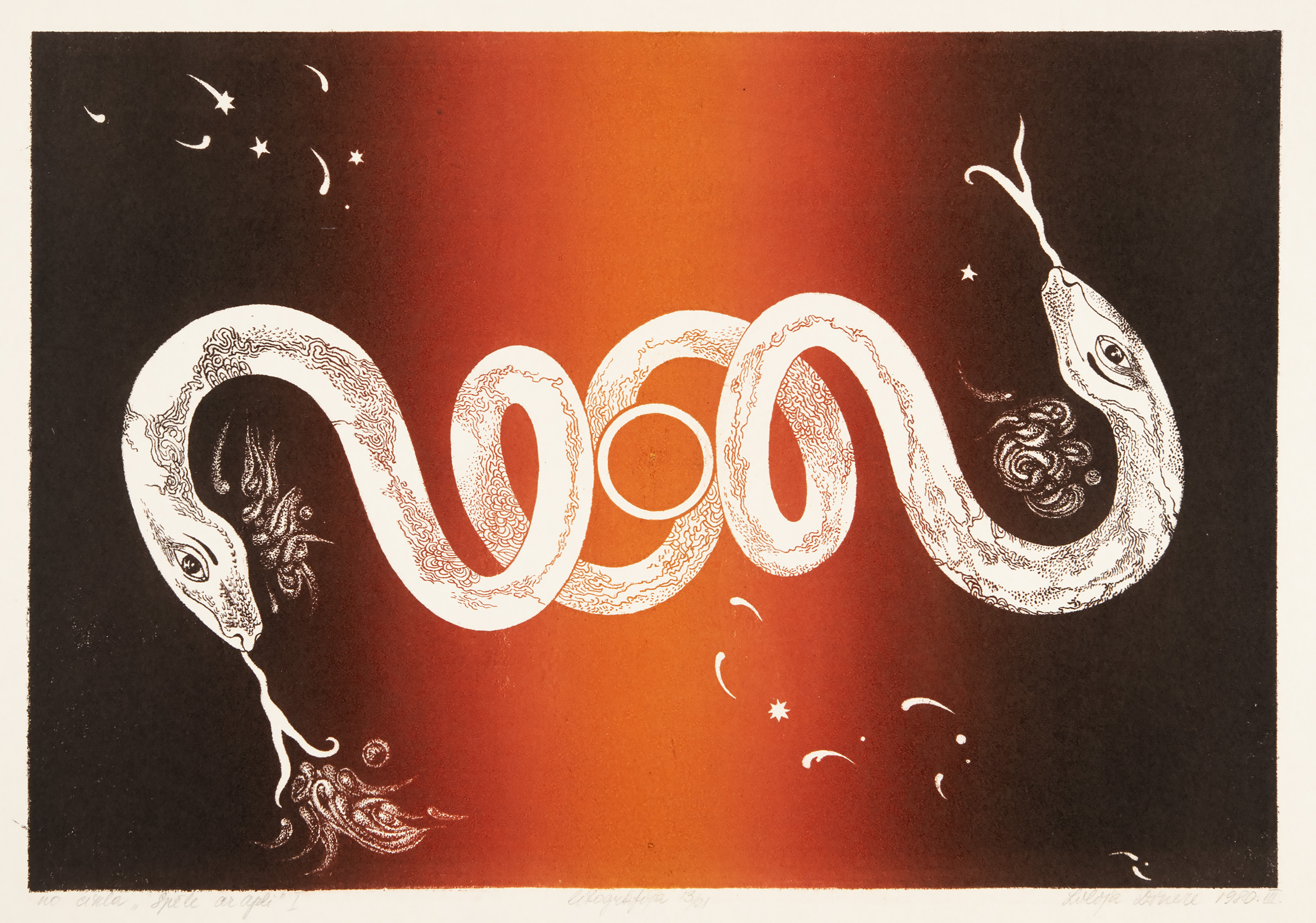
Game with a Circle I, 1980. Lithograph on paper, 26.2 x 39.2 cm (10 5/16 x 15 7/16 in.). Norton and Nancy Dodge Collection of Nonconformist Art from the Soviet Union. D02420