
Levan Magalashvili
a.k.a. Magali
1940 — Tbilisi (Georgia) | 2020 — New York, NY (USA). Worked in Tbilisi (Georgia) and New York (USA)
Levan Magalashvili (also known as Magali) had a diverse artistic career, working in various mediums including easel painting, graphic art, collages, assemblages, and art objects. He refused to adhere to the dictates of socialist realism and instead created nonobjective compositions inspired by abstract expressionism. As seen in his manifesto and in his assemblages, Magalashvili looked to other modern movements as well, among them dadaism, surrealism, and pop art.
Magalashvili was born in Tbilisi in 1940. His interest in art emerged during his youth. Along with his classmates, he visited exhibitions, read books about painters, and explored the city at night, making sketches. He and his friends used to secretly listen to contemporary Western music through the jammed Svoboda [Liberty] radio station at night, and even prior to his student years, he participated in many artistic events. He enrolled in the Faculty of Decorative and Applied Arts at Tbilisi’s Academy of Art in 1971, graduating in 1976.
He was initially drawn to abstract expressionism, which was very popular in the Georgian artistic underground. At that time, European art was suppressed by Soviet censorship. However, young Georgian artists still managed to gain access to information through various journals and newspapers, information they then shared at clandestine meetings. They also developed a sense of protest. The protest against Soviet dictatorship emerged in artistic circles secretly but intensely in the 1970s. At this time, the term “counterculture” was already being used by circles of unofficial Georgian artists. These artists created enormous figural and abstract compositions marked by the influence of expressionism, abstract expressionism, pop art, and the German Neue Wilde.
Magalashvili was not associated with any particular underground art group, but he did collaborate with his friend, the nonconformist artist Otar Chkhartishvili (1938–2006). Together, the two artists participated in various events, including clandestine exhibitions often held in Moscow or Tbilisi apartments. In 1986, after the start of perestroika and the weakening of state censorship, Magalashvili joined the Georgian Artists’ Union.
Some of his works are untitled, while others are titled after mythical themes or historical events. These include two works in the Norton and Nancy Dodge Collection: The Fire of Prometheus (1980, ZAM, D04494) and April 9, 1989 (1989, ZAM, D04725). Although both compositions are abstract, figural elements can be discerned upon close observation. The Fire of Prometheus evokes the elemental forces of fire and water. April 9, 1989 is dedicated to the tragic events of that day, in which a peaceful demonstration in Tbilisi was violently dispersed by Soviet troops, resulting in the loss of innocent lives. The event became a symbol of suffering, resilience, and the desire for freedom. This painting does not present a realistic portrayal of the scene but, instead, conveys an emotional state.
In his abstract works, Magalashvili utilized the technique of automatic painting. He created the illusion of three-dimensionality through the use of dark tones and transparent layers of spilled paint. In his thematic compositions, his characters and surroundings are rendered in gradations of a single color, prompting the viewer to observe them close up. Each time one gazes at these works, new layers and images appear to emerge within the composition. A good example of this is Bank of Kotsito (1981, ZAM, D08819), executed in a single color. Although it appears to be an abstract work, on close observation a human figure can be detected, reclining at the edge of a rocky outcrop.
In addition to abstract expressionism and pop art, Magalashvili also looked to dada and surrealism—both of which were very popular among Georgian artists of this period. Automatic writing in particular was especially influential on these artists, Magalashvili included. This is revealed in his Manifesto of Subjective Art, written in 1973 and published in 1983 via samizdat and disseminated among artistic circles. In this text, the artist opposed socialist realism, prompting criticism in the Soviet press. Magalashvili wrote: “Subjective Art is the spontaneous emergence of a new kind of creativity—a new artistic form that differs from the previous ones and seeks to free art from aggression, pragmatism, and the pressure of contemporary mass culture.” [1]
The ideas expressed in this manifesto suggest the influence of Marcel Duchamp—most notably the readymade, which also informed Magalashvili’s later interest in assemblage and the use of found objects in his work. His assemblage practice involved affixing found objects to the surface to initiate a spontaneous painting process. Through his innovative use of assemblage techniques, the artist arguably created his own unique style of abstract expressionism within the field of pop art.
Among the artist’s best-known assemblages are the pair of works titled The Leviathan I (ZAM, D01504) and The Leviathan II (ZAM, D04882), both from 1982. In these images, which depict the titular legendary sea monster—a symbol of God’s defeat of evil—an oval metal object, possibly a helmet, is attached to the panel surface to represent its head, and a handbag for its mouth. In both compositions, the artist has intervened minimally, using only readymade objects to convey the monster’s character. In The Leviathan I, the eyes and nose are made of cut-out circles; in The Leviathan II, the monster’s facial features are elaborated to highlight its terrifying nature. The figure in the latter is composed of an open handbag, from which a glove hangs, suggesting the Leviathan’s mouth. In both compositions, the artist began painting after attaching three-dimensional objects to the flat surface.
Magalashvili’s artistic approach centered around the idea of renewing his perspective and reimagining the world around him. This approach is illustrated in his series of works titled Metamorphoses. One of these pieces features wooden clothespins arranged to evoke the architecture of Old Tbilisi, including interior courtyards and balconies with wooden balustrades and clothespins hanging from them. The works also include figures of creatures and animals fashioned out of clothespins. In a letter to Norton Dodge, Magalashvili discusses the series in detail. He explains that he had been observing how clothespins, hung from a rope, moved back and forth in the yard: “On one wonderful sunny day, while listening to the music of Errol Carner, I am looking at the clothespins and they are moving and dancing. … I got up, took the most flexible and expressive ones from the rope and … in one moment, I turned them into small and funny donkeys that came alive through my touch.” [2] He imagined these clothespins as little people with their own emotions and life, which then prompted him to re-create this image in his art. After Dodge became interested in his work, the artist and the collector became friends, a relationship that continued after Magalashvili’s immigration to the United States in 1997.
Like many nonconformist artists, while living under Soviet rule, Magalashvili had to display his works in private or face harsh criticism from the government. After the Soviet collapse of 1991, however, he was free to experiment in his studio in Georgia and share his art with visitors.
In 1996, Tbilisi’s Picture Gallery mounted a solo exhibition of Magalashvili’s work. An article on the exhibition titled “There Is a Need for a Eugenic Bomb,” appearing in the newspaper Dilis Gazeti, features an extensive interview with the artist in which he states: “I conceived of a new kind of ‘Bomb,’ not as a destructive weapon, but as a metaphorical force of transformation.” [3] The artist believed that the “eugenic bomb” was a positive force that should be activated within society and circulated throughout Georgia. Named “Jellyfish,” this force could mutate human genes to develop their positive qualities. As the artist saw it, the “eugenic bomb” represented an evolutionary path of humankind: “This is a tele-magnetic bomb invented by me, which scientists have named ‘Jellyfish.’ It is harmless to the environment. It does not kill. It is a eugenic bomb that, in my opinion, will give rise to a human of the future and will improve them.” [4]
The following year, after the collapse of the Soviet Union, various former Soviet republics witnessed severe economic crises. In Georgia, this was compounded by the outbreak of civil war in the early 1990s, which had left parts of the country
devastated. As a result, Magalashvili had to leave the country to continue his artistic career, choosing to move to the United States.
Magalashvili died in New York in 2020.
Tamar Mchedlishvili
Translated from Georgian by Papuna Chivadze
Notes
1. Levan Magalashvili, “Manifesto of Subjective Art,” written in 1973, published via samizdat in 1983, artist’s personal archive (In Russian).
2. Letter from Levan Magalashvili to Norton Dodge, September 21, 2001. Department of Nonconformist Art from the Soviet Union and Art of Eurasia Archives. Levan Magalashvili artist’s file. The “Errol Carner” the artist references in the letter is Erroll Garner (1921–1977), an American jazz pianist and composer.
3. Interview with the artist, Morning Newspaper, May 29, 1996.
4. Interview with the artist, May 29, 1996.

April 9, 1989. Oil on canvas, 120 x 116 cm (47 1/4 x 45 11/16 in.). Norton and Nancy Dodge Collection of Nonconformist Art from the Soviet Union. D04725

Musical Composition, 1984. Ink, paper, and mixed media on paperboard, 80 × 50 cm (31 1/2 × 19 11/16 in.). Purchased with funds donated by Norton Dodge and Nancy Dodge. 1997.0749
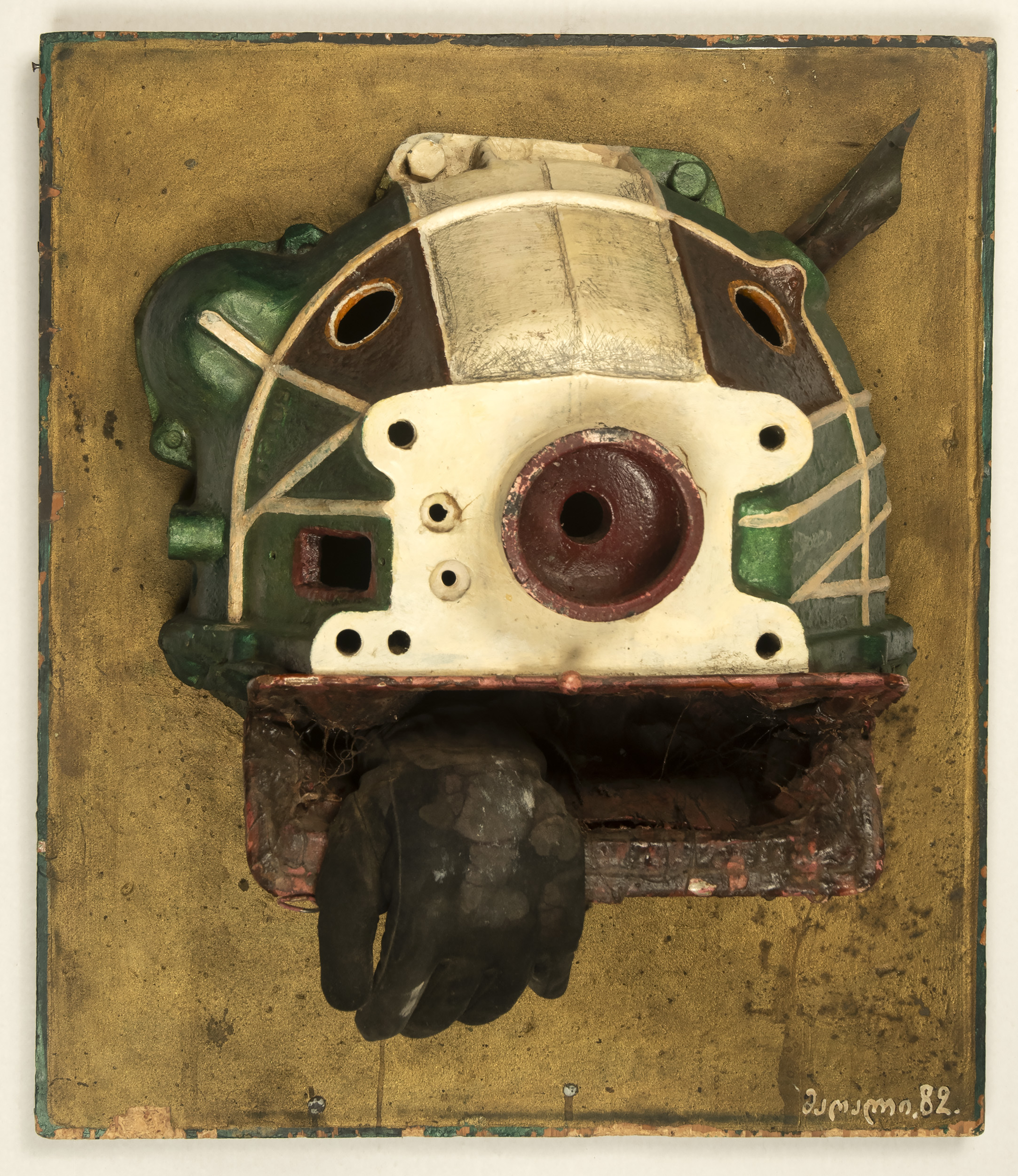
The Leviathan I, 1982. Painted aluminum, handbag, glove, and leather on panel, 52.5 x 45 x 25 cm (20 11/16 x 17 11/16 x 9 13/16 in.). Norton and Nancy Dodge Collection of Nonconformist Art from the Soviet Union. D01504

The Leviathan II, undated. Painted aluminum, handbag, leather, and mixed media on panel, 69.2 × 49.4 × 33 cm (27 1/4 × 19 7/16 × 13 in.). Norton and Nancy Dodge Collection of Nonconformist Art from the Soviet Union. D04882
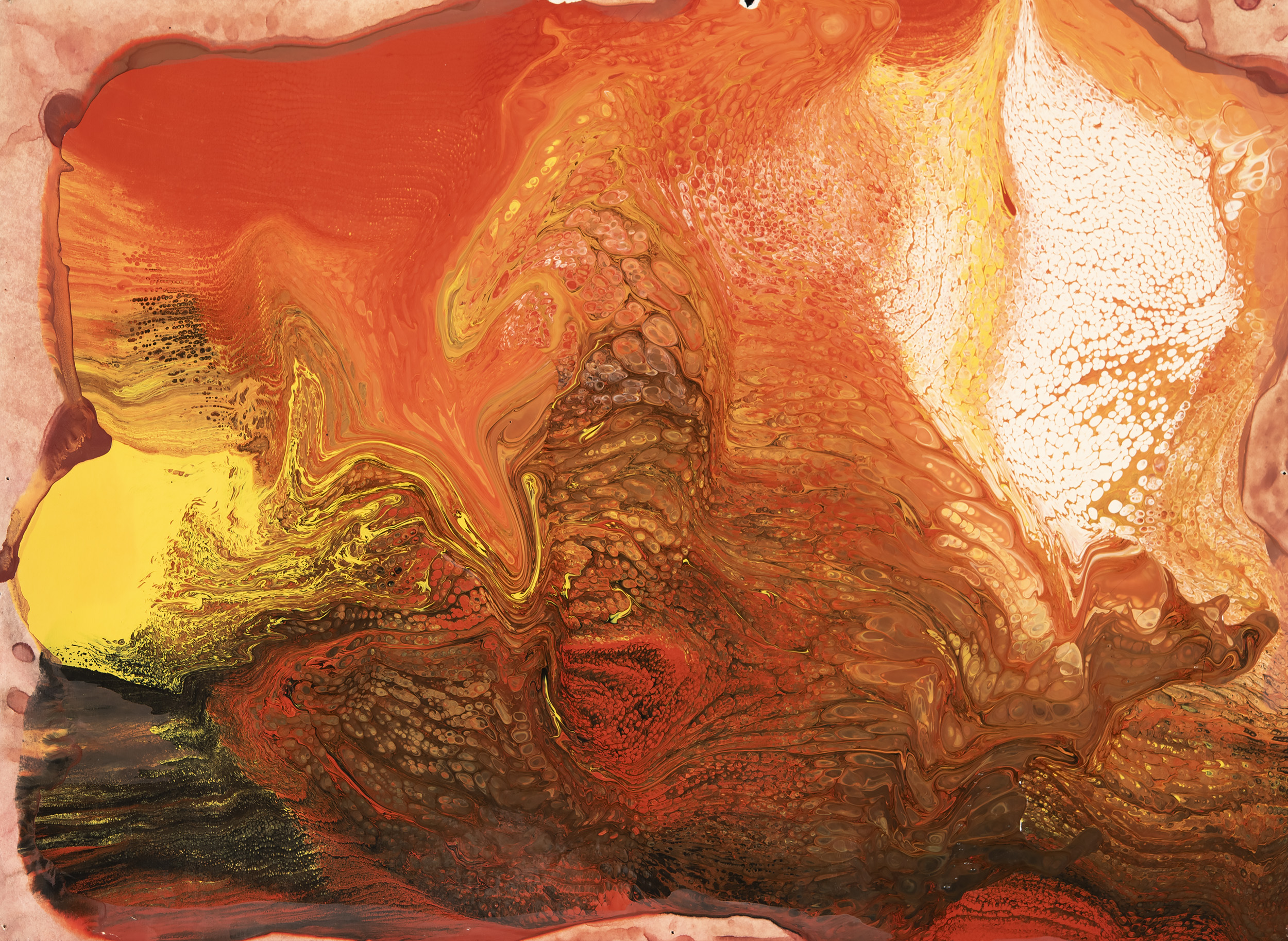
Untitled, 1980. (Unidentified medium) on paper, 31.7 × 44.2 cm (12 1/2 × 17 3/8 in.). Norton and Nancy Dodge Collection of Nonconformist Art from the Soviet Union. D04491

Banks of Kotsito, 1981. (Unidentified medium) on paper, 28.8 × 40.8 cm (11 5/16 × 16 1/16 in.). Norton and Nancy Dodge Collection of Nonconformist Art from the Soviet Union. D08819

Migration, 1979. (Unidentified medium) on paper, 40.5 × 28.6 cm (15 15/16 × 11 1/4 in.). Norton and Nancy Dodge Collection of Nonconformist Art from the Soviet Union. D08818
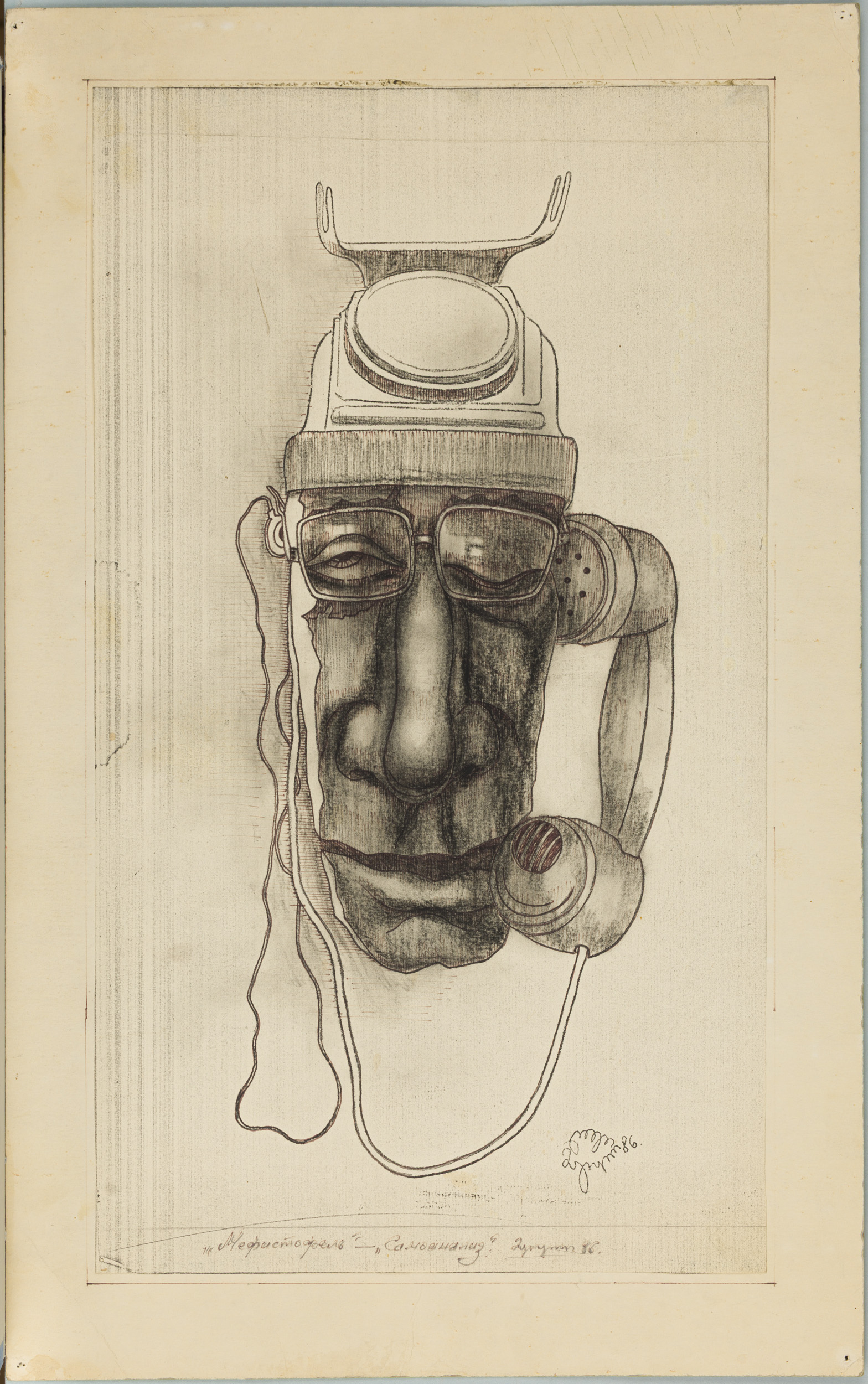
Mephistopheles, 1986. Handcolored linoleum block print with ink and charcoal on paperboard, 59.2 × 37.2 cm (23 5/16 × 14 5/8 in.). Norton and Nancy Dodge Collection of Nonconformist Art from the Soviet Union. D14423