
Kristiina Kaasik
1943 — Tallinn (Estonia) | 2024 — Tallinn (Estonia). Worked in Tallinn (Estonia)
Kristiina Kaasik (née Van Jung) was a painter who studied theater design and painting at the State Art Institute of the Estonian Soviet Socialist Republic (now the Estonian Academy of Arts) between 1961 and 1967. From 1967 to 1969, she worked at a design studio and then as a freelance artist. She participated in exhibitions from 1965 on and, from 1970 on, was a member of the Estonian Union of Artists (after 1990, Estonian Artists’ Association ). Kaasik was a founding member of the legendary young artists’ group ANK ’64. [1]
Theater design and her participation in ANK ’64 were important to the formation of Kaasik’s painting principles. A large part of her studies was connected to theater design, and although she never worked in that field, her earlier paintings often blend theatrical and surrealist elements. Kaasik was born in Tallinn, and she recalls how as a wartime child, she was surrounded by a landscape of ruins, which enhanced her sense of surrealist spaces. She has also said that she was especially fascinated by the art of Roberto Matta (1911–2002), André Masson (1896–1987), Yves Tanguy (1900–1955), and the later works of Wassily Kandinsky (1866–1944)—all abstract surrealists fueling her interest in psychic automatism. In 1965 she married the architect Veljo Kaasik, who belonged to the group of Estonian architects called the Tallinn Ten. [2] Her interest in space and spatial problems was surely related to her connection with architecture. As she has commented, “I have always wanted my paintings to be spatial and inviting for people to step into them.” [3]
Kaasik’s works Orgaanilised vormid [Organic Forms II] (1966, ZAM, 2000.0504) and Rõõm (Teatris) [Joy (In the Theater)] (1968, Art Museum of Estonia) can be regarded as early introductions to her oeuvre, in which various artistic interests that would continue to shape her work are already evident. In Rõõm (Teatris), we can see Kaasik’s tendency to construct a staged pictorial space, as well as her affinity for an expressive, contrasting, and vibrant color palette that lends the image a dynamic quality. The central figures form a flame-like motif that extends vertically, a compositional feature that recurs throughout her artistic career. Kaasik has the ability to unite opposing elements, bringing together emptiness and alienation with coziness and grandeur. She is known for her love of intense color and her aspiration toward metaphysical sensations.
From platforms, staircases, and spatial objects in theatrical scenery (Vaade trepilt [A Glance from the Stairs] (1974); Antrakt [Interval, 1975–76], both Art Museum of Estonia) to beach, bog, and winter landscapes that can be read as critical yet poetic comments on environmental and social issues (Ruhnu rand [Ruhnu Beach] (1983); Haige talv [Weary Winter] (1975); both Art Museum of Estonia), her visions very often provide a strong sense of the sublime. Environmental themes, reflecting rapid industrialization and urbanization in Estonia during the 1970s, are also evident in Kaasik’s works. Vaade aknast [A View from the Window] (1974, Art Museum of Estonia) displaces the viewer’s perception of space, calling attention to the complex relations and interplay between the natural and built environments. The landscape in this work, painted in contrasting and aggressive colors, feels both cozy and desolate. Kasvuhooned [Greenhouses] (1973–74, Art Museum of Estonia) also emphasizes the contrast between nature and the human-made world, but here, it is not clear whether lush nature is taking over the architectural structures or if the protagonist is the concrete structure that keeps aggressive natural elements from overtaking the environment created by humans.
Kaasik´s Põllu kuivendamine [The Field Drainage] (1974, Tartu Art Museum) seems to visualize the aggressiveness of industrial farming and Soviet-type economic planning, and seems to be connected with the so-called bog wars [4] and nature conservation movements of the 1970s in Estonia. Kaasik herself has commented that nature has always been an invigorating influence for her. More than painting a natural motif, however, she has sought something more paradoxical or primeval that lies behind the visible. Pääs kitsale rajale [A Way into a Narrow Lane] (1979, Art Museum of Estonia) also evokes the opressive restrictions to travel or emigration, the exclusion zones, and special permits of the Soviet period.
Like many painters, Kaasik at one point started using photographs as a source for visualizing the imaginary world of her paintings. In the 1980s the colors and compositions in her paintings changed, with lighter patches and clusters of colors appearing in the darkness of the red, blue, brown, and black tones (Stiihiad [The Elements], 1984, private collection). In the 1980s some references to national architecture appear in Kaasik’s paintings, such as the old well in Kaev [The Well] 1987, Tartu Art Museum), where the almost glowing architectural element feels symbolic. In the 1990s and 2000s Kaasik’s landscapes became more suggestive and abstract (e.g., Kutse [The Call, 1996, private collection]; Tee [Journey], 2000, private collection). The connection with a specific landscape, cityscape, or space became quite fragile or altogether lacking, replaced by an illusion of space created by colors (Mõeldes mägedele I–II [Dreams of Mountains I–II], 1989, Art Museum of Estonia].
Kristiina Kaasik’s boldly expressive and distinctive painting style and sensitive sense of color were inextricably linked to the conceptualization of creation and spiritual inquiry. Kaasik was interested in inner freedom and the search for a purer, timeless world that is both within and outside of us.
Eda Tuulberg
Photo portrait: Kristiina Kaasik, 1981. Photo by Valdur-Peeter Vahi. Estonian National Archive. EFA.412.0.114260.
Notes:
1. The artist group ANK’ 64 was formed by art students studying at the State Art Institute of the Estonian Soviet Socialist Republic in Tallinn. It was active from 1964 to 1969. The group did not follow any specific style or cultivate any specific philosophy, but its members all had a keen interest in contemporary art. The central figure of the group was artist Tõnis Vint (1942–2019), and other members included Aili Vint (b. 1941), Jüri Arrak (1936–2022), Malle Leis (1940–2017), Marju Mutsu (1941–1980), and others. The name of the group has no direct meaning; the members left it open for interpretation. ANK ’64 had connections to the Moscow unofficial art scene of the time.
2. The Tallinn School (Tallinn Ten) was a group of architects active in Tallinn in the 1970s and ’80s. The majority of the group’s members were graduates of the Estonian State Institute of Arts. The group’s members were critical of modernism, but at the same time they valued pre–World War II Estonian architecture.
3. Annika Poldre’s interview with Kristiina Kaasik, Maaleht, March 30, 2011.
4. A fight against the drainage of bogs in the beginning of 1970s Estonia was initiated under the leadership of Professor Viktor Masing (botanist, biogeographer, anthropologist, ecologist and popularizer of natural sciences), raising public awareness. The plan to drain all bogs was abandoned when it was recognized that bogs as ecosystems are important and unique to Estonia and must be protected.
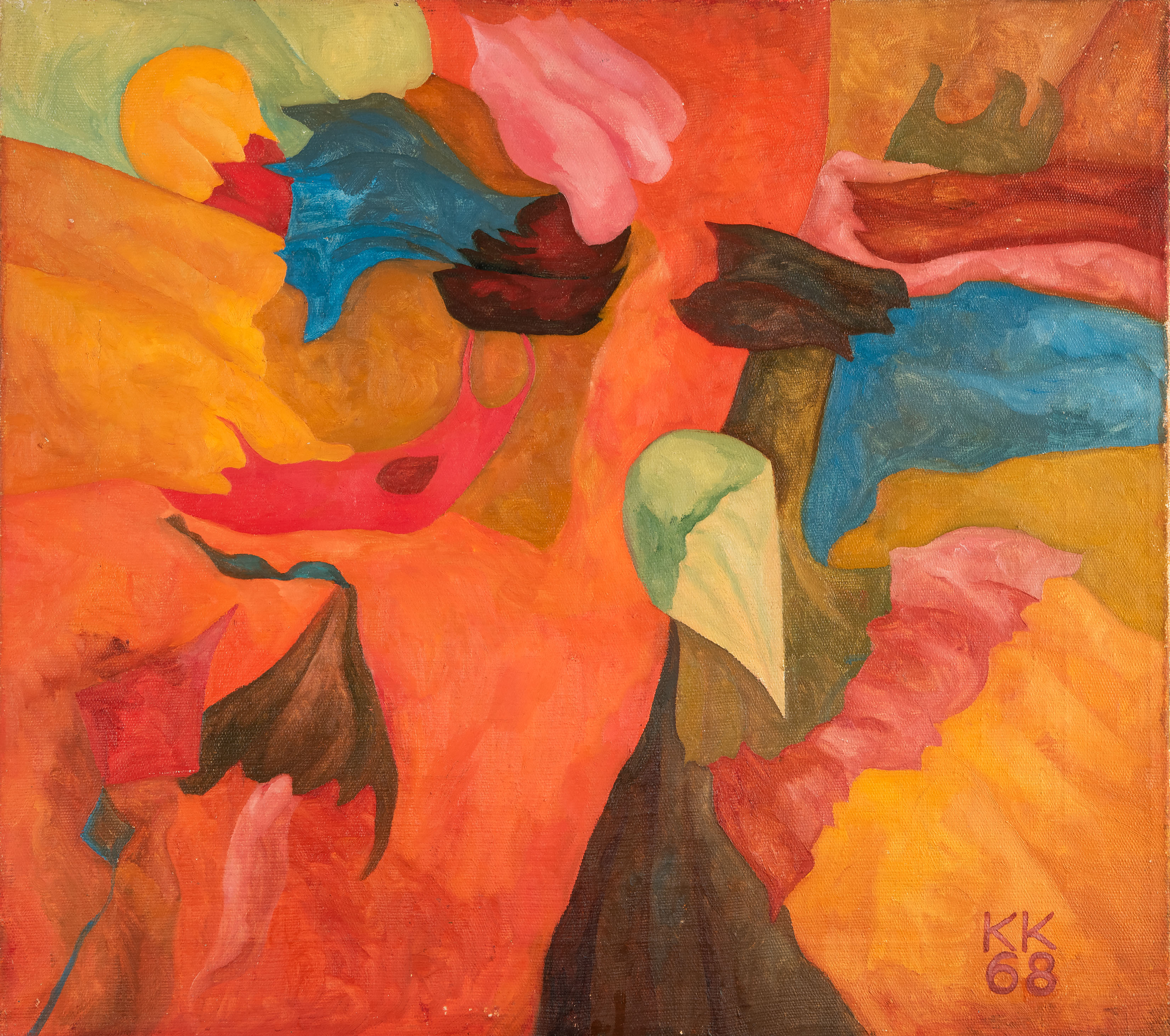
Heat, 1968. Oil on canvas, 50.2 × 55 cm (19 3/4 × 21 5/8 in.). Purchased with funds donated by Norton Dodge and Nancy Dodge. 2000.0505
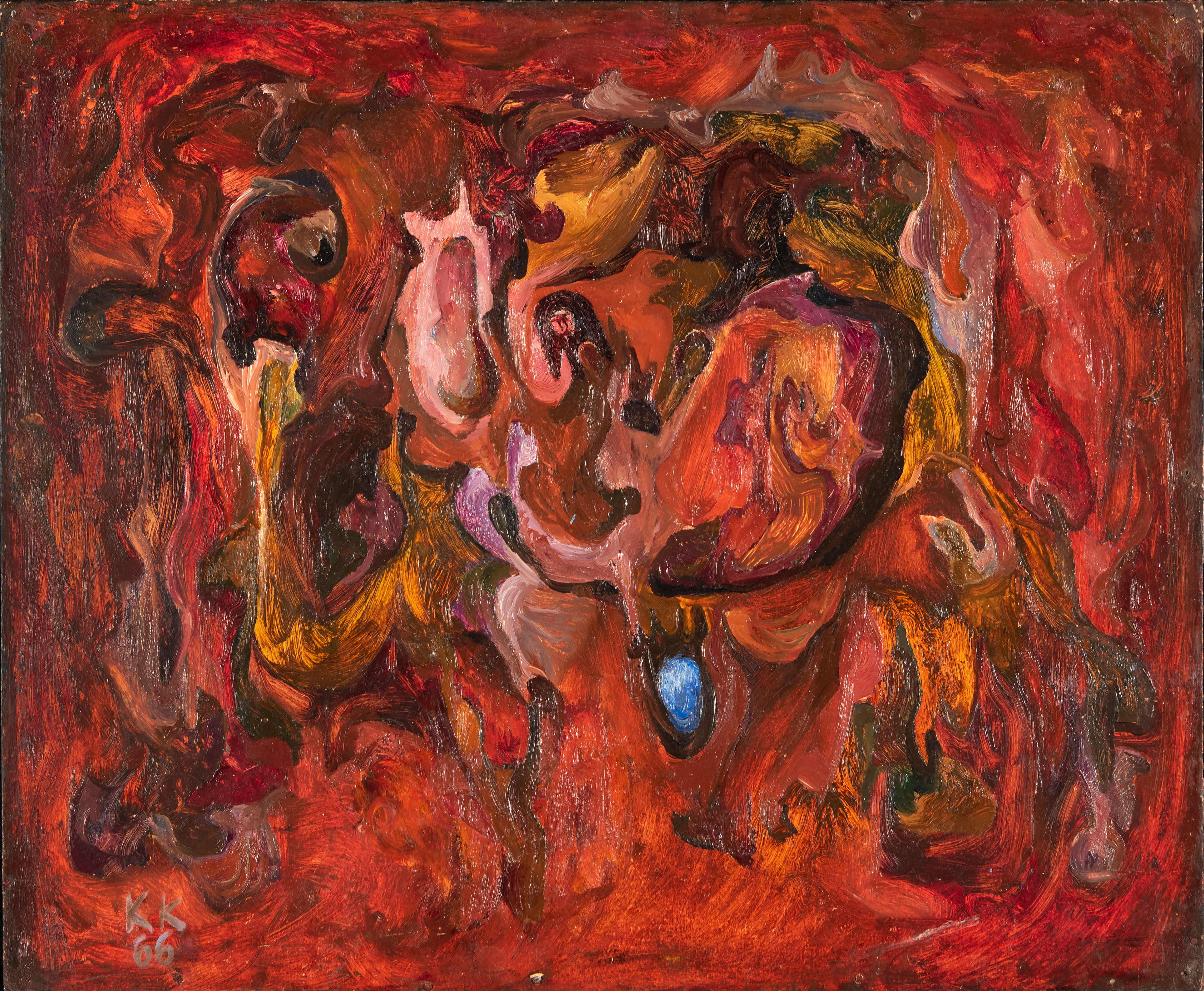
Organic Forms, 1966. Oil on paperboard, 40.2 × 50 cm (15 13/16 × 19 11/16 in.). Purchased with funds donated by Norton Dodge and Nancy Dodge. 2000.0506
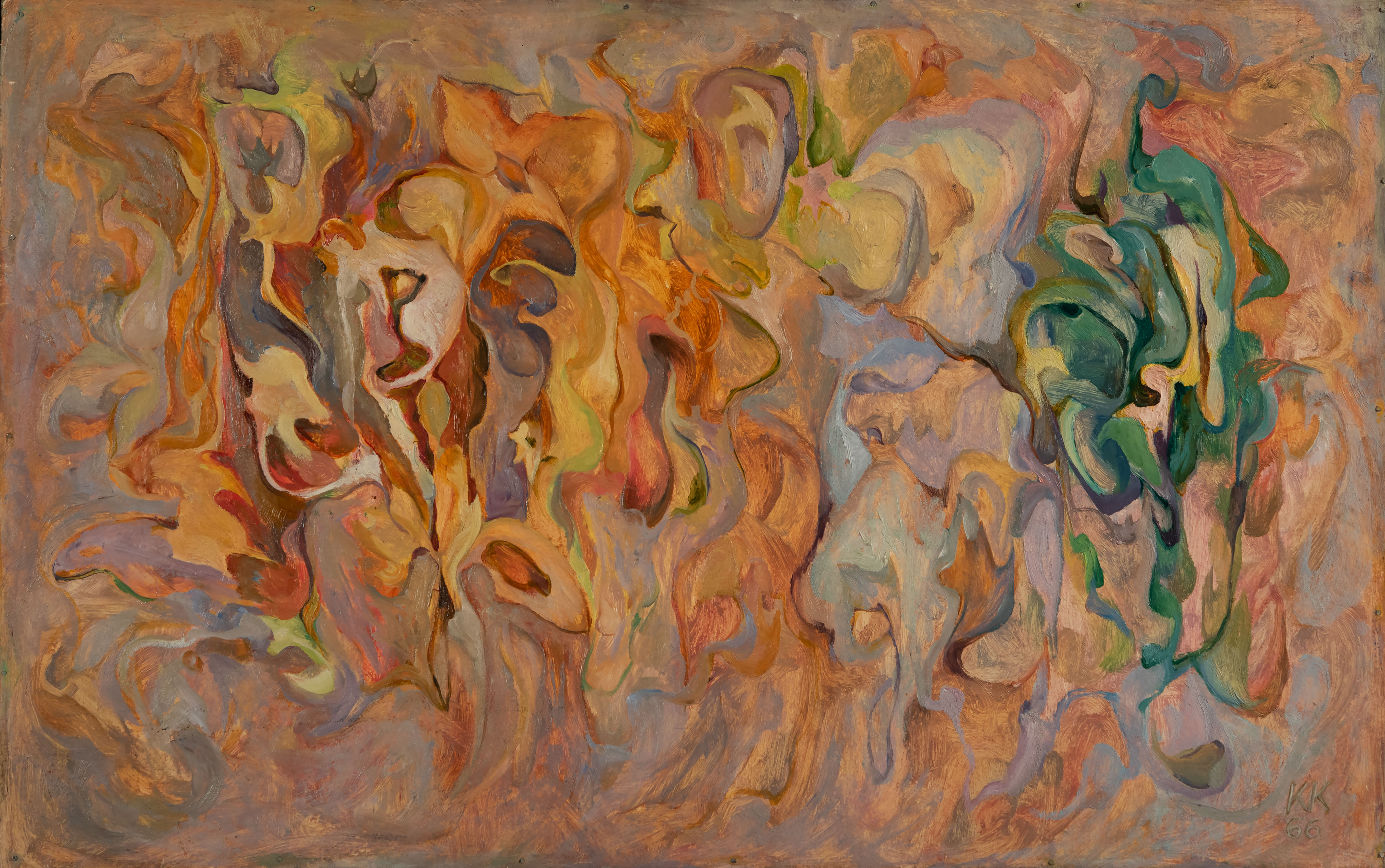
Organic Forms II, 1966. Oil on paperboard, 50 × 80 cm (19 11/16 × 31 1/2 in.). Purchased with funds donated by Norton Dodge and Nancy Dodge. 2000.0504