
Kristaps Ģelzis
1962 — Riga (Latvia). Works in Riga (Latvia)
Kristaps Ģelzis is one of the pioneers of conceptual art in Latvia, known for his installations, objects, and video pieces. Working across a wide range of media, themes, and artistic strategies, he explores different techniques and nontraditional materials to evoke emotional and intellectual responses that resonate with everyday reality and its contradictions and absurdities. While his artistic vision shows parallels with pop art, minimalism, and conceptualism, none of these movements dominates as his primary artistic method.
Ģelzis graduated from the Teodors Zaļkalns Latvian SSR State Academy of Art (now the Art Academy of Latvia), Department of Graphic Art, in 1986, and began participating in exhibitions in 1985. He has had more than twenty solo exhibitions in Latvia and abroad. His entry into art coincided with the years of perestroika, during which the Eastern Bloc culture opened up relatively freer opportunities for expression. As a result, along with artists like Oļegs Tillbergs (b. 1956), Ojārs Pētersons (b. 1956), Sarmīte Māliņa (b. 1960), Andris Breže (b. 1958), and others, he belongs to a generation known in Latvian art history as the “trespassers” (robežpārkāpēji), recognized for broadening the concept of art in the late Soviet period.
In the early stages of his creative career, Ģelzis produced expressive, allegorical graphics. While studying at the academy, he became involved with the Super Graphics group, creating large-scale silkscreen prints with deformed figurative motifs imbued with anxiety and dramatism. The creative endeavor of Super Graphics was part of a common aesthetic program that developed alongside neoexpressionism m in Western culture and other Eastern Bloc countries. Ģelzis’s silkscreens depict existentially charged, expressive scenes with human and animal figures (The Fall, 1988) and even brutal violence (Aggression, 1987). His works of this period often portray relationships between the individual and authority, expressing the moods of a disorientated, subjugated individual. Ģelzis burned the work Aggression during the Art Days festival in 1987 as a public gesture, thus turning real violence against the representation of violence.
Later, he combined silkscreen with other techniques and was one of the first Latvian artists to make prints on canvas, metal, and aluminum. Toward the end of the 1980s, a few years before the fall of the Berlin Wall, several works by Ģelzis included the wall theme. For example, for the Days of Cinema festival (1986) Ģelzis created the video work The Wall, in which the artist wandered around the city of Riga and, at the end, smashed a glass plate with a brickwork ornament that can be considered a symbol of political oppression. In the legendary 1988 exhibition Riga: Lettische Avantgarde in the Staatliche Kunsthalle, West Berlin, his video installation Dismantling the Wall (1988)—considered to be one of the first video installations in Latvian art history—featured a labyrinth of drawings and ornamental structures reminiscent of the style of Keith Haring (1958–1990). The theme of the wall continued to emerge in his works in the 1990s, exemplified by pieces like the postmodern silkscreen Portrait 2000 (1990) and Olimpia X (1991).
Throughout the 1990s, Ģelzis regularly participated in the largest and most important art exhibitions in Latvia and abroad, representing the most contemporary generation of Latvian artists engaged in the process of catching up with the West in the post-Socialist countries. In 1990 Ģelzis created an installation, Washing Day, for the group exhibition Latvija–20. gadsimta kūlenis. 1940–1990 [Latvia: 20th-Century Somersault, 1940–1990]. This work introduced a sarcastic, ironic tone, which later became a hallmark of Ģelzis’s work. During the 1990s, he began to focus on materiality and perception, exploring problems of style, time, and age in a concentrated and laconic way. Initially, Ģelzis created formally compact objects and installations reminiscent of minimalism, examining the mechanisms of perception (The Three Graces, 1990; Twin Elements, 1994). At the beginning of the 1990s, Ģelzis began creating objects and installations made of wire braids—laconic geometric forms nuanced in their proportions, as well as demarcations of segments of space (Red Tennis, 1994). This marked the start of a career-long exploration of quintessential materials of shielding and containment, including lead sheets, aluminum screens, steel mesh, chain mail, and chain-link fencing.
In Ģelzis’s solo exhibition Virtuale (1996) at the Latvian National Museum of Art in Riga, his objects showcased an exploration of complex psychological processes faced by individuals in the realm of virtual reality. This investigation extended to encompass fields such as mass media, advertising, and artificial intelligence. In the second half of the 1990s, global pop culture imagery gained significance in Ģelzis’s works. Art historian Mark Allen Svede has highlighted the recontextualization of global mass and pop culture characters, symbols, situations, as well as corporate brand images (Playboy, 1996; Joy, 1996; Stuffed Free Potato Eater, 1997; the Mask series, 2001–2; Mrs. Smith’s DNA, 2007), as expressions of “commentary on corporate cultural imperialism.” [1] Criticism of capitalism and consumer society was a common theme in the culture during the transition period of post-socialist countries. However, within the context of Latvian contemporary art, Ģelzis stands out as one of the few artists whose work is notable for its sharp and critical observations and reactions to the surrounding social reality, both locally and internationally.
Ģelzis employs shared vernacular symbols and archetypes that evoke communal feelings or address uncomfortable, unspoken truths. His work also delves into critically examined questions surrounding Latvian national identity and the concept of statehood (as seen in pieces like What’s Happening in Latvia, 2005, and Anthem, 2015), and explores the dynamics between the individual, authority, and control mechanisms (Monument, 2009; Once Again Nothing is Happening, 2010).
From the early 1990s until 2007, Ģelzis worked in the advertising industry, and this professional experience influenced several of his artworks. For instance, Personal Cube (Parade Self-Portrait, 2001), a large-scale nude self-portrait by the office desk, interrogates the artist’s role in society and reflects on the emergence of Clerk Art as a phenomenon of modern-day culture. After leaving his advertising job in 2007, Ģelzis returned to a more active exhibition life, which included the solo exhibition Waterfire (2007) at the Riga Gallery. In Waterfire, Ģelzis showcased watercolor paintings—a surprising departure for an artist known for conceptual work. However, he approached this traditional technique with a contemporary lens, exploring its broad potential to convey nonrepresentative meanings within the language of contemporary art. For instance, he experimented with combining watercolors and ultraviolet lights in installations featuring fluorescent paintings (Bedtime Story, 2008; Home Video, 2008). Later, he experimented with watercolor, graphic art, and drawing techniques, exploring his characteristic subjects—geopolitical developments, pop culture icons, and ironic everyday artifacts—recontextualized into witty and aesthetically intriguing scenes.
In 2011 Ģelzis was awarded the Purvītis Prize, the main visual arts award in Latvia, for his large-scale watercolor solo exhibition Maybe (Māksla XO, 2009). That same year, his Artificial Peace (Contemporary Landscape) was in the Latvian pavilion of the 54th Venice Art Biennale, presenting an installation of fluorescent paintings. Since 2012 Ģelzis has been developing his own unique technique of plastic painting, using materials such as polyethylene and plastic tapes, adhesive tape, and acrylic pigment (as in the exhibitions Substance to Rethink [2012] and 19112015 [2015], both held at the Māksla XO Gallery).
Santa Hirša
Photo portrait: Kristaps Ģelzis, 2011. Photographer unknown. Artist’s personal archive
Notes
1. Mark Allen Svede, “KRIX, or Can You Identify the Man Who Assaulted You?,” in Inese Riņķe, ed., Kristaps Ģelzis: Darbu katalogs [Kristaps Ģelzis: Catalogue of Works] (Riga: Rīgas galerija, 2005), 10.
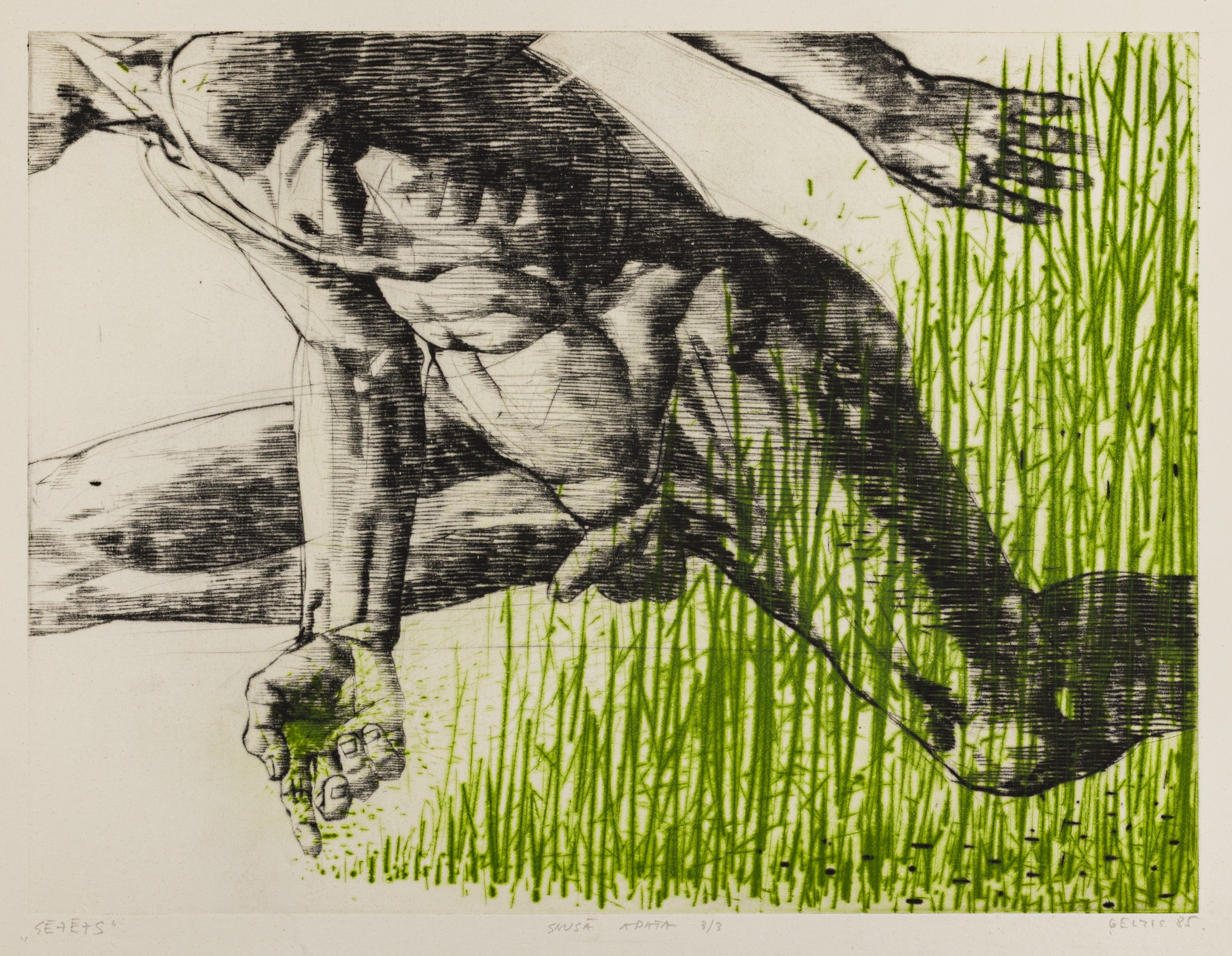
The Sower, 1985. Etching on paper, 49 × 64.8 cm (19 5/16 × 25 1/2 in.). Norton and Nancy Dodge Collection of Nonconformist Art from the Soviet Union. D11264
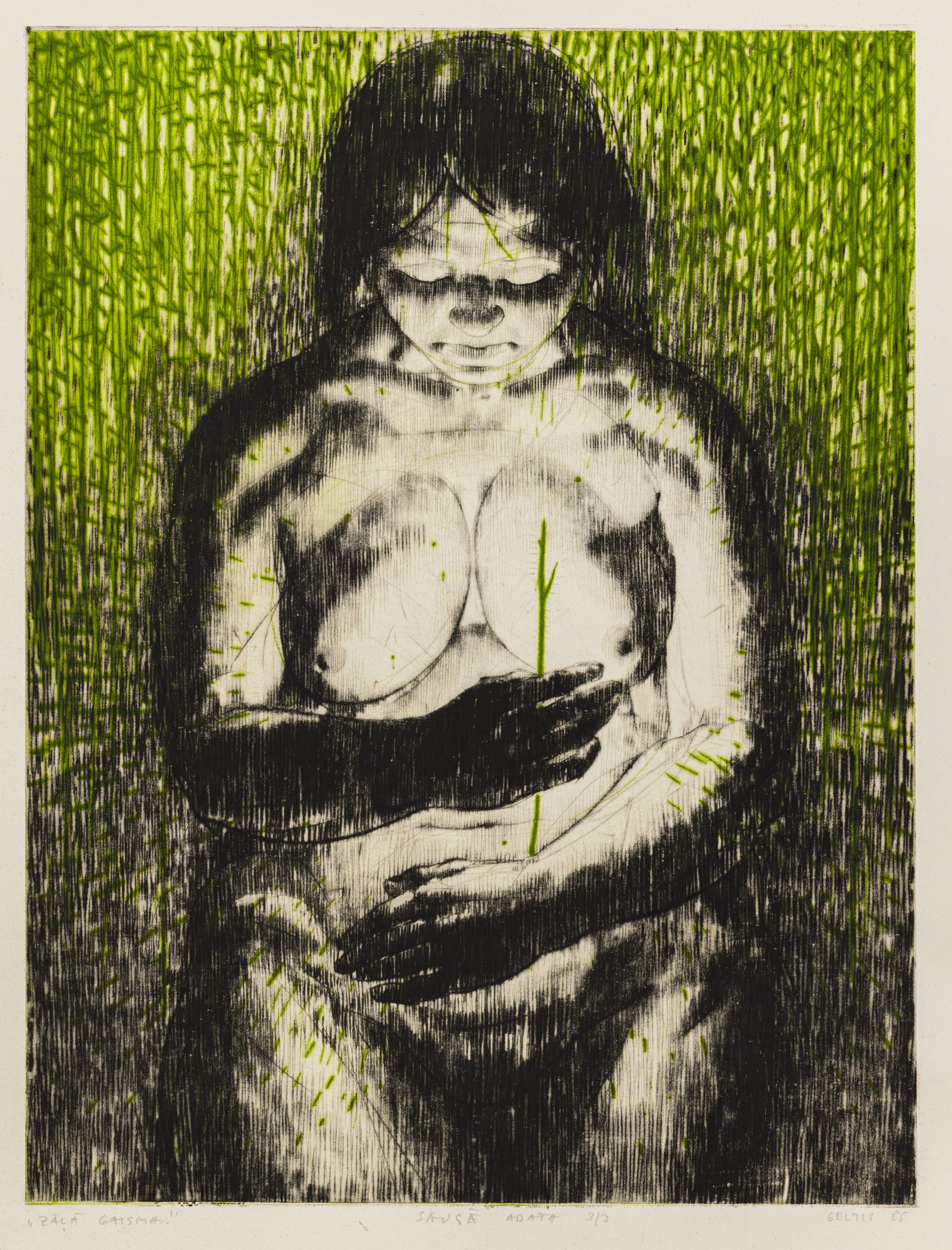
The Green Light, 1985. Etching on paper, 65 × 49.2 cm (25 9/16 × 19 3/8 in.). Norton and Nancy Dodge Collection of Nonconformist Art from the Soviet Union. D11263
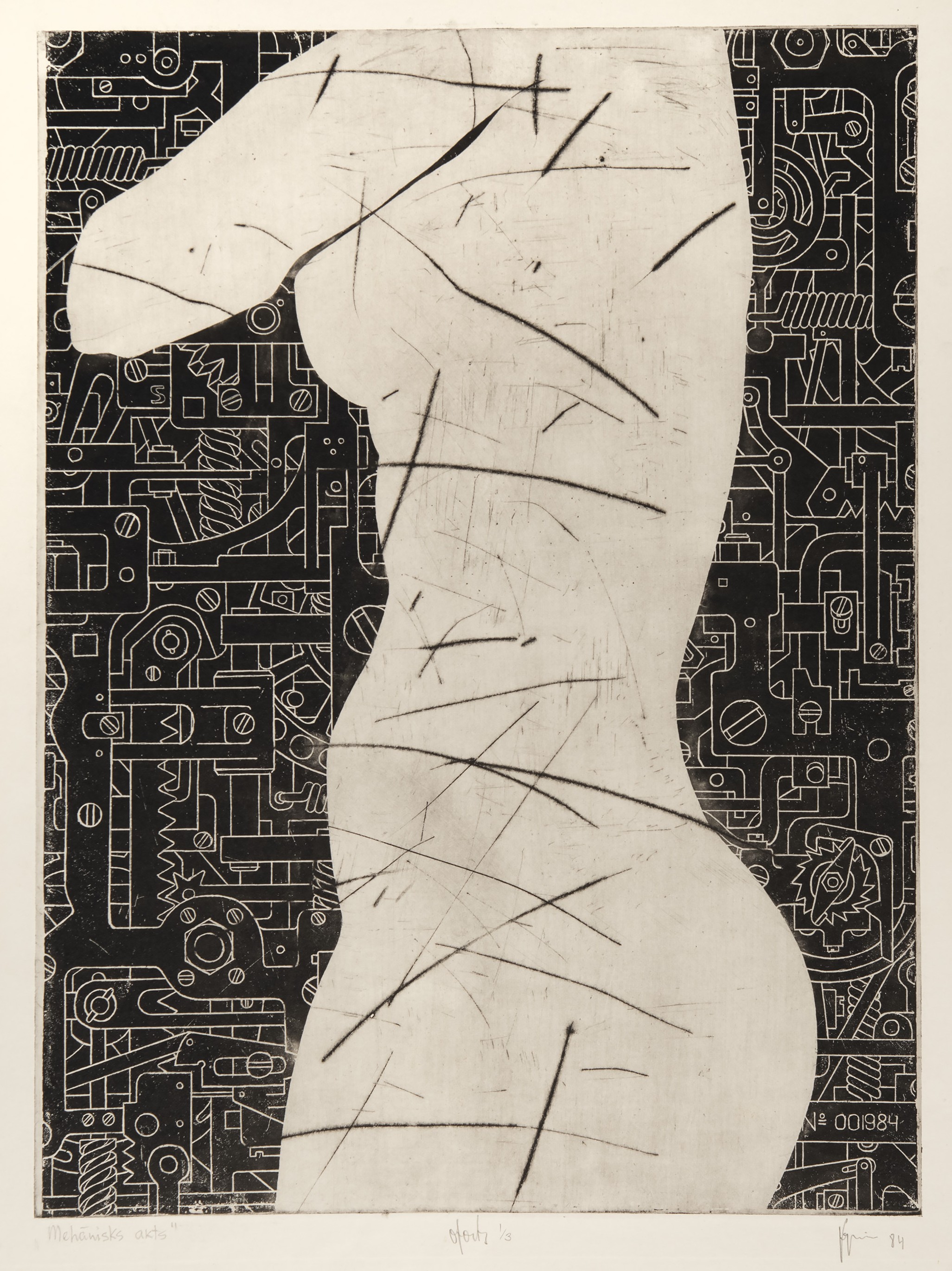
Mechanical Nude, 1984. Etching on paper, 49.5 × 36.8 cm (19 1/2 × 14 1/2 in.). Norton and Nancy Dodge Collection of Nonconformist Art from the Soviet Union. D11266
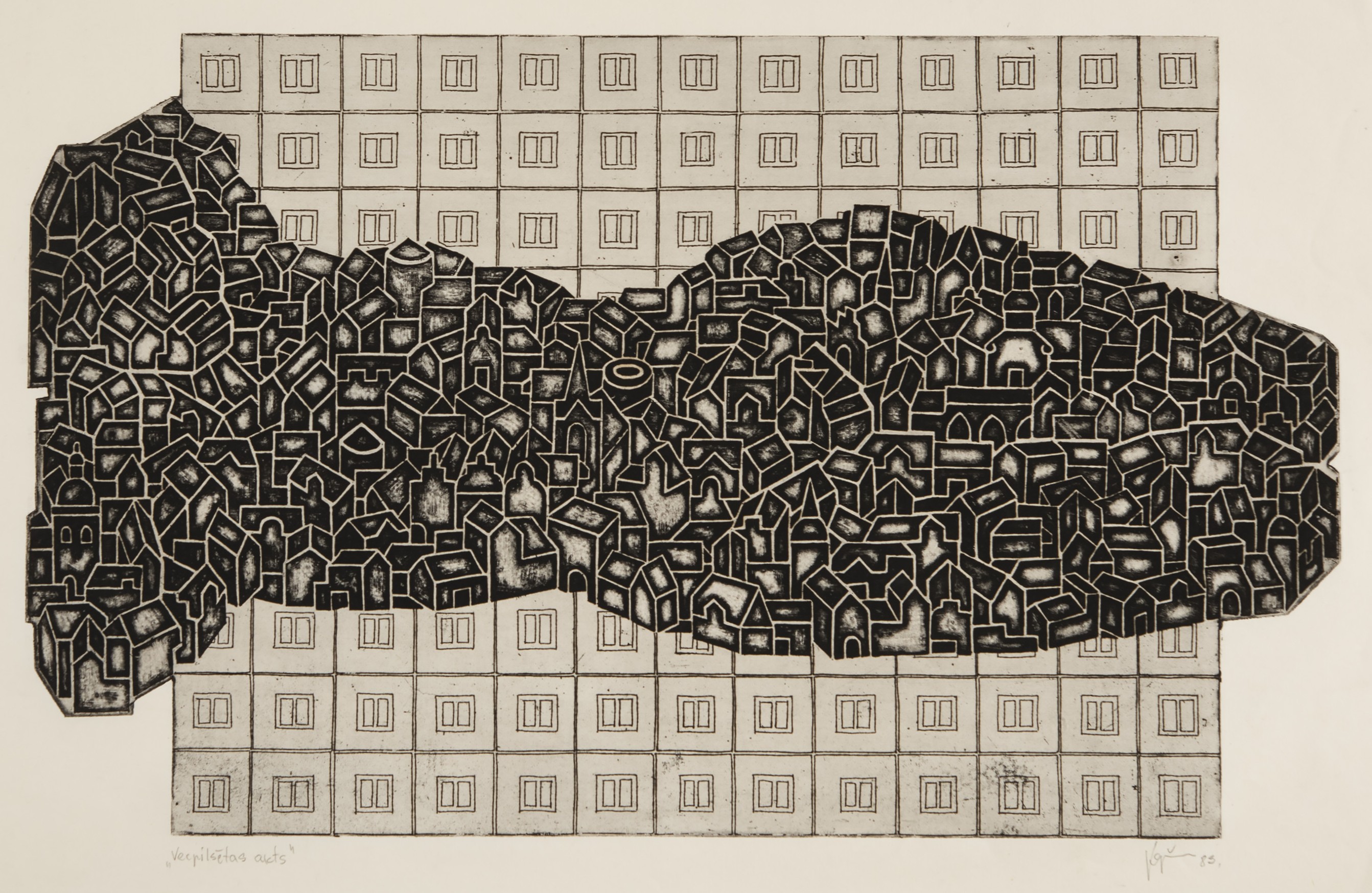
Old City Nude, 1983. Etching on paper, 30.1 × 49.5 cm (11 7/8 × 19 1/2 in.). Norton and Nancy Dodge Collection of Nonconformist Art from the Soviet Union. D11265
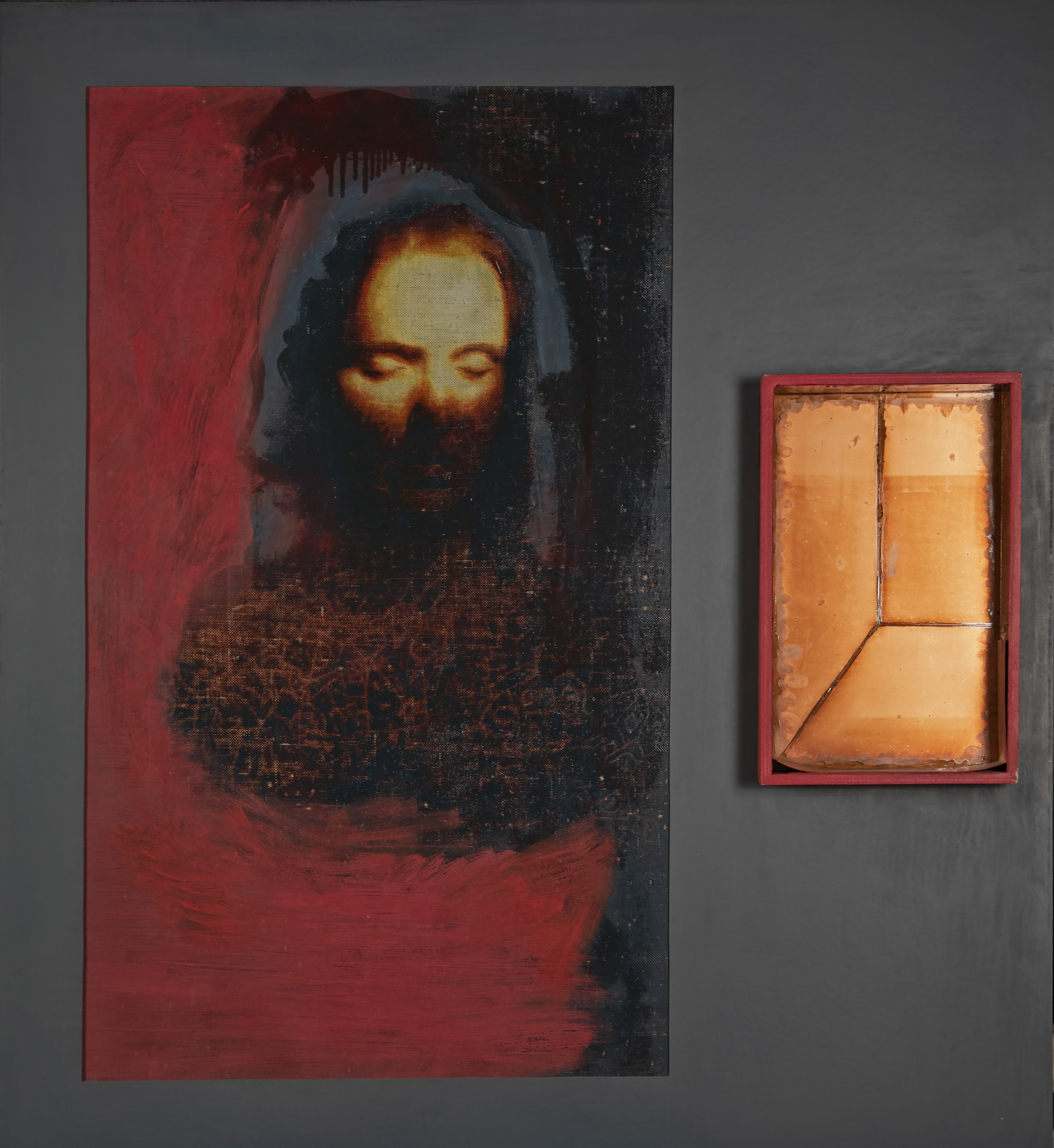
Dialogue, 1986. Oil on canvas, wood, and metal relief, 116 × 105.5 × 13.3 cm (45 11/16 × 41 9/16 × 5 1/4 in.). Norton and Nancy Dodge Collection of Nonconformist Art from the Soviet Union. D01524