
Kostas Dereškevičius
1937 — Antakalnis village, Prienai district (Lithuania) | 2023 — Vilnius (Lithuania). Worked in Vilnius (Lithuania)
The beginning of Kostas Dereškevičius’s journey into art is rather anecdotal. He was raised by parents who toiled in demanding rural jobs, yet they instilled in their children the importance of education. After elementary school, Dereškevičius enrolled in the Kaunas Teacher Seminary (later, during the Soviet era, known as Kaunas Pedagogical School). He found himself in a state of panic at the seminary when faced with the first assignment of the “drawing and painting methods” discipline: drawing a maple leaf and coloring it with watercolors. His brother Albinas, trained in architecture and skilled in the art of watercolor, gave him some tips. The task was excecuted so well that the teacher had no doubt that the boy should attend the art class after school. After this early pursuit in drawing, perceptive teachers encouraged him to venture into the world of painting.
Dereškevičius eventually enrolled to study painting (1960–67) at the State Art Institute of the Soviet Socialist Republic of Lithuania in Vilnius (renamed the Vilnius Academy of Arts in 1990), where he was mentored by two of Lithuania’s most prominent colorists, Vladas Karatajus (1925–2014) and Antanas Gudaitis (1904–1989), the latter being one of the former leaders of the Ars group, the influential expressionist painters from the interwar period. Dereškevičius’s early painting style was molded by the local expressionistic traditions and early twentieth-century French colorism. From as early as 1965, while still a student, he took part in the annual national exhibitions of students and young artists that were regularly held at the Lithuanian SSR Art Museum (today Lithuanian National Museum of Art) in Vilnius. These shows served as an important platform for emerging artists within the state-supported art scene. He became a member of the Lithuanian SSR Artists’ Union in 1974, and in 1976 joined the faculty at the State Art Institute, where he initially began teaching drawing. A few years later, his teaching expanded to include painting and composition, marking the start of a long-standing engagement with art education. Having integrated into the official art system, Dereškevičius had the opportunity to travel abroad. As part of an artist exchange program, he visited Erfurt in the GDR (1975), stopping in Dresden on the same trip. In 1978 he resided at the Hajdúsági International Artists’ Colony in Hajdúböszörmény, Hungary, where he was awarded the Hungarian People's Republic Artists’ Union Prize. He traveled to Almaty in 1982. In 1984 he exhibited in an international plein-air painting event held in Prilep, Macedonia. He also joined state-organized tourist trips abroad—one of the limited and closely supervised ways Soviet citizens could travel outside the Eastern Bloc—visiting Finland in 1968 (where he saw original works of Western art for the first time), Italy in 1977, and France in 1985.
Alongside the passion for color Dereškevičius developed during these years, his early fascination with the work of Edvard Munch (1863–1944) and Henri Matisse (1869–1954) inspired and informed his taste for bold colors and manipulations of form—for example, Landscape with a Woman (1970), The Notice (1970; both at MO Museum [MOM], Vilnius, Lithuania), and Dancing (1970, Vilnius Academy of Arts Museum [VAAM]). Later, referring to himself, Dereškevičius explained, “The most important thing is a person’s character and nature. If someone is born to be a colorist, they can do without any theories, whether they paint figures or abstract works.” [1] Figuration and abstraction have been alternating in the painter’s work since the beginning of his career. While representational art dominated during the Soviet period, Dereškevičius eventually stood out for depicting social reality through a thick layer of irony, the grotesque, and even outright sarcasm, skillfully combining colorist expressionism with principles of pop art and photorealism. As recently observed by Lithuanian art historian Erika Grigoravičienė, “Dereškevičius’s self-reflexive, transgressive, intermedial (primarily photographic) paintings trolled the system, shaping a certain optical and political consciousness.” [2]
In 1970 Dereškevičius, along with his former institute companions Algimantas Kuras (b. 1940), Arvydas Šaltenis (b. 1944), and Algimantas Švėgžda (1941–1996), came together as an informal group later known as Ketveriukė (the Quadruple). Having set themselves the direction to depict the harsh realities of Soviet life, they ventured into what they referred to among themselves as “active critical realism.” [3] In 1973 they held their first exhibition at the art salon run by the Vilnius Fine Art Fund, which was subtly censored by the authorities before opening. Their work, characterized by depictions of gray, impoverished, and bleak Soviet everyday life, was a stark contrast to the romanticized imagery prevalent at the time. The group’s final exhibition, which received critical acclaim, took place in 1979 at the Arts Exhibition Palace, the most significant art institution in Soviet Lithuania. After this, the artists of Ketveriukė pursued individual paths. A few years later, art critic Alfonsas Andriuškevičius would recognize their work as a key phenomenon within the broader movement of de-romanticization in Soviet Lithuanian art. [4]
Beginning in the early 1970s, Dereškevičius mocked the art regulations by avoiding idealization and pathos, instead depicting the harsh, dignity-crushing realities of Soviet daily life, as seen in his paintings Adelė the Gas Station Operator (1972, VAAM), Užkandžiaujantys [Snack Time] (1971, Lithuanian National Museum of Art [LNMA], Vilnius, Lithuania), Cow by the Highway (1972), and The Beach (1971; both at MOM). In the same vein, he has dutifully portrayed cultural figures and pioneers of work, fulfilling commissions from Soviet Lithuanian state institutions such as the ministry of culture, the factories, or the kolkhozes (cooperative farms) with portraits: Portrait of the Composer Vytautas Paltanavičius (1970), Portrait of Paulina Kairienė, High Achiever of the Plastic Goods Factory (1977), and Portrait of Salezijus Pavilionis, Doctor of Medicine (1979, LNMA).
Dereškevičius painted a self-portrait with a generous dose of irony, featuring a yellow milk truck tank’s oval encircling his head like a halo (Self-Portrait, 1974, Lithuanian Artists’ Association); that was followed by a series of works depicting the boredom and absurdity of everyday Soviet life, dominated by the window grids of newly built Soviet apartment blocks, buses, and cars; these works hold the observer’s gaze into these tight spaces, creating a feeling of isolation. Moreover, fragments of interiors and public transportation became tools for representing space and models for painterly experiments, with reflections occasionally becoming the central motif (On the Road IV, 1975, MOM). He also began experimenting with the window as a stand-alone motif, first painting it in 1969 as a bare double frame with visible crossbars and an opaque, white glass that obscured the view (see The Window, 1969, private collection). In later works, he began to open the window to various landscapes and views, integrating the motif as a structural element of the painting’s composition (see Aunt’s Window, 1977, and A Window to the Garden, 1979, both in private collections, and Evening in Eržvilkas, 1985, MOM).
Unlike his compatriot Šaltenis, who focused on depicting the unified masses of people in public transportation, Dereškevičius often portrayed the sensual bodies of random women, emphasizing the fleshiness of calves, thighs, and breasts, as in Crossing the Plain by Minibus (1976), Traveling by Train (1977), and On the Weekend (1984; all at LNMA). One of Dereškevičius’s boldest works shows a blond woman in bright red pants, dumping trash into a container, the title referring to a typical garbage collection day in the Soviet era: Thursday (1976, MOM). He created eroticized, vulgarized, and sometimes frightening portraits of women, which, according to the German art historian Eckhart Gillenn, can be seen in the context of the images created by artists ranging from Edward Hopper (1882–1967) to Martin Kippenberger (1953–1997): Woman with Sausage (1974, MOM), A Girl in the Outskirts of Town (1975, M. K. Čiurlionis National Museum of Art, Kaunas, Lithuania), The Resort Lady (1976–78), and The Naturalist O.B. (1980; last two both LNMA). [5] He painted a fetishized handbag in Roma's Handbag (1977, VAAM), and used the recurring motif of a plastic shopping bag with an image of open red lips biting a cigar in a style of pinup posters in A Painting with a Bag (1978, ZAM, D11066) and Walking Home (1986, MVAA). As Grigoravičienė aptly pointed out, “It’s like an inverted pop art, based not on the repetition of banal mass-consumption objects but on the fetishization of things and images. In Soviet society, it arose not from popularity or mass appeal but from scarcity, longing, and dreams of a better life. The magical foreign object, contrasting with the surrounding Soviet reality, makes the painting heterogeneous and functions as a fetish—a substitute for the desired object. Dereškevičius links the fetishism of objects with erotic fetishism, turning it into a powerful force in painting (which later largely contributed to the collapse of the system).” [6]
Since the late 1970s, Dereškevičius combined expressionistic colorism with echoes of photorealism and pop art principles, painting highly detailed urban and industrial objects, as seen in works like The Wagon (1978, ZAM, D01539), Car with Milk Bottles (1979, LNMA), A House in Žirmūnai (1982, MOM), and Mail Boxes (1987, MOM). He experimented with overlaying images from different genres, painting from photographs, as in A Woman I Met (1978, LNMA) and A Picture with a Ladder (1986, ZAM, D00255), and he created a series of works featuring torn billboard posters (see Posters in the Spring [1984, ZAM, D10288]), iconographically linked to the imagery by artists such as Raymond Hains (1926–2005), Mimmo Rotella (1918–2006), and Jacques Villeglé (1926–2022), all of whom used décollage technique instead. While gradually moving away from narrative scenes of everyday life, Dereškevičius turned his focus toward structural compositions and the abstraction of reality, using color and form as his primary tools yet always drawing from real-world references. Since 1990, after Lithuania regained independence, Dereškevičius fully distanced himself from figurative representation, reducing his visual language to abstract, rather repetitive forms; one of the earliest works of this kind is Untitled (1981, ZAM, D10203).
Dereškevičius entered independent Lithuania’s art world by holding the last major retrospective solo show during the Soviet era at the Arts Exhibition Palace in 1987, after which he was awarded the title of Meritorious Artist of the Lithuanian SSR, and by contributing to the founding the band of semi-nonconformist painters Grupė 24 [Group 24], active in 1989–99. He remained at the Vilnius Academy of Arts until 2006, having been awarded the title of professor in 1993 and holding various positions—including dean of the Faculty of Fine Arts (1993) and vice-rector for studies (1995–2000)—before returning to the painting department to teach painting and composition (2000–2006). In 2002 he donated thirty-six paintings and a dozen drawings to the Museum of Vilnius Academy of Arts. In 2007 Dereškevičius had a major retrospective exhibition at the Radvila Palace Museum of Art in Vilnius, after which he was awarded the Lithuanian government’s Prize for Culture and Art (2008).
Dovilė Tumpytė
Photo portrait: 1997 by Kęstutis Stoškus.
Notes
1. Arvydas Šaltenis, “Rami konfrontacija: Arvydas Šaltenis kalbina Kostą Dereškevičių” [Peaceful Confrontation: Arvydas Šaltenis Interviews Kostas Dereškevičius], Dailė [Art] 2 (2007): 97.
2. Erika Grigoravičienė, “Rankinės prieš mėmalę: Kosto Dereškevičiaus tapybos ir piešinių paroda ‘ne(GRAŽUS) gyvenimas’ galerijoje ‘Akademija” [Handbags Against Mints: Kostas Dereškevičius’s Exhibition of Paintings and Drawings ‘Un(BEAUTIFUL) Life’ at the Gallery Akademija],” 7 meno dienos 21, no. 1470 (May 2, 2023).
3. Algimantas Kuras, “Dienoraščiai” [Diaries], in Elona Lubytė, ed., Tylusis modernizmas Lietuvoje 1962–1982 [Quiet Modernism in Lithuania 1962–1982] (Vilnius: Tyto Alba, 1997), 119.
4. Alfonsas Andriuškevičius, “Deromantizavimo tendencija tapyboje” [The Trend of De-romanticization in Painting] (1982), in Alfonsas Andriuškevičius, ed., Lietuvių dailė: 1975–1995 [Lithuanian Art: 1975–1995] (Vilnius: Vilniaus dailės akademijos leidykla, 1997), 38.
5. Eckhart Gillen, “Unfinished Journey of Artistic Discovery: Lithuanian Painting After 1960,” in Raminta Jurėnaitė, ed., Lithuanian Painting 1960–2013, trans. Olivia Reinshagen-Hernández (from German) and Darius Sužiedėlis (from Lithuanian and Polish) (Vilnius: Modern Art Center, 2014), 32.
6. Grigoravičienė, “Rankinės prieš mėmalę.”
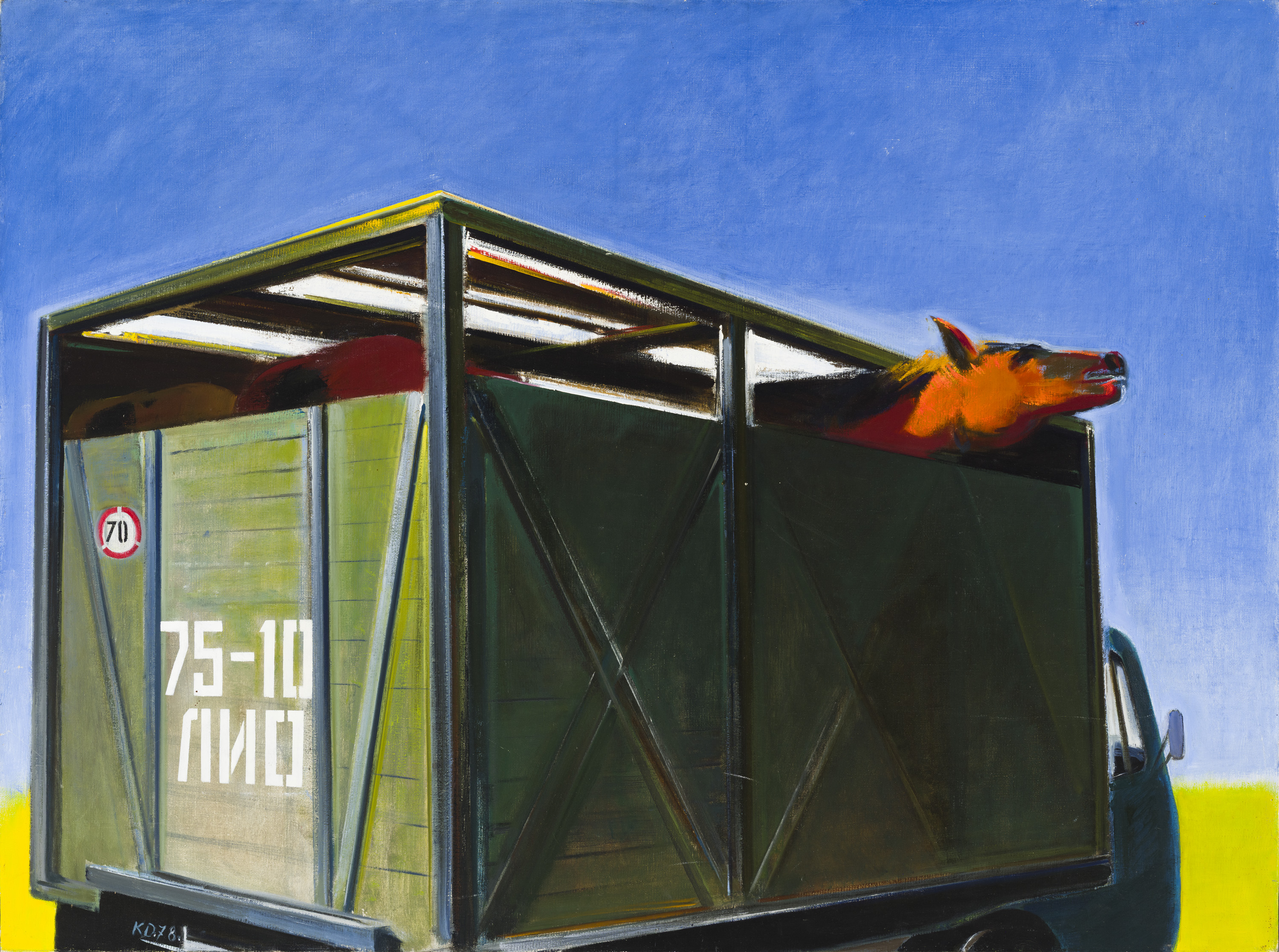
Wagon, 1978. Oil on canvas, 97 × 130.3 cm (38 3/16 × 51 5/16 in.). Norton and Nancy Dodge Collection of Nonconformist Art from the Soviet Union. D01539

Untitled, 1981. Oil on canvas, 81 × 60 cm (31 7/8 × 23 5/8 in.). Norton and Nancy Dodge Collection of Nonconformist Art from the Soviet Union. D10203

Posters in the Spring, 1984. Oil on canvas, 82 × 60 cm (32 5/16 × 23 5/8 in.). Norton and Nancy Dodge Collection of Nonconformist Art from the Soviet Union. D10288
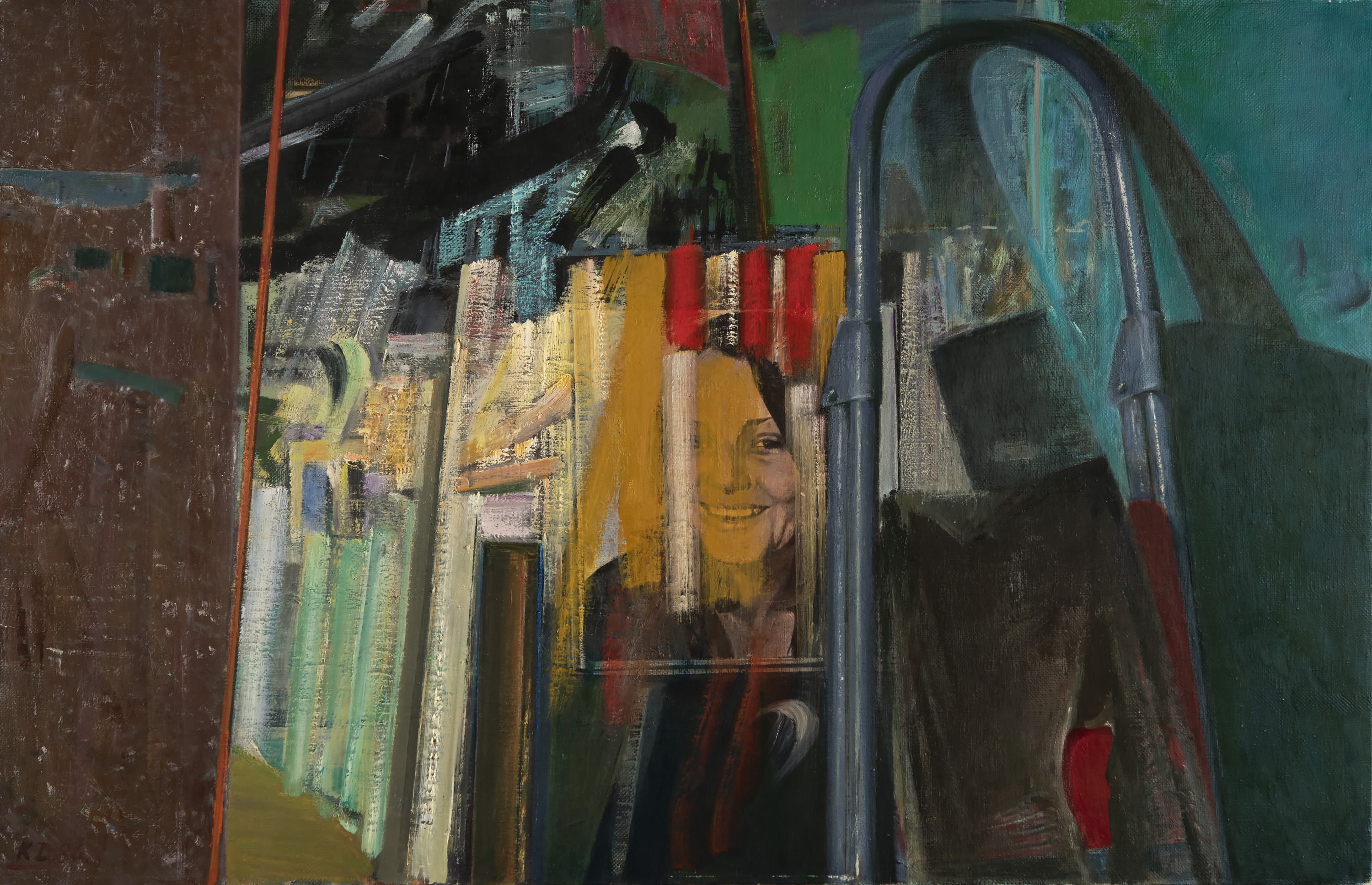
A Picture with a Ladder, 1986. Oil on canvas, 65.5 × 100 cm (25 13/16 × 39 3/8 in.). Norton and Nancy Dodge Collection of Nonconformist Art from the Soviet Union. D00255