
Konstantin Kuzminsky
1936 — Leningrad (USSR) | 2015 — Lordville, NY (USA). Worked in Leningrad (USSR), Austin, TX, New York, NY, and Lordville, NY (USA)
The designation “enfant terrible” is usually used to refer to figures who impress their contemporaries with the energy of their (self-)destructiveness and outrageousness. Konstantin Kuzminsky’s is a rare case in which the term turned out to be connected not only with his unquestionably provocative work and behavior, but also with his contribution to the preservation and canonization of unofficial Soviet culture, in two spheres at once—poetry and visual art.
Kuzminsky has entered the history of twentieth-century Russian-language literature as, above all, the compiler of the monumental Blue Lagoon Anthology of Modern Russian Poetry (1980–86, in five volumes and nine books). As an art collector and exhibition organizer, Kuzminsky contributed significantly to the promotion of Soviet nonconformist visual art in the United States; as an art dealer, he helped to form the Norton Dodge Collection, which forms the basis of the Zimmerli Art Museum collection. His poetry and prose are currently little studied, and his artwork is virtually unknown. Four works from the cycle Russian ABC (1980, D04614.01–04) in the Zimmerli collection provide a view of Kuzminsky’s work, activities, and personality from an unusual angle.
Kuzminsky considered himself an heir to the Russian futurists and repeatedly emphasized this connection on a variety of levels. His father, also named Konstantin Konstantinovich Kuzminsky (1905–1941), was, according to his son, “a student of Chekhonin and Kruglikova in graphic art, and of N. N. Punin in art criticism, a teacher of manual labor and а maker of constructivist furniture.” [1] The younger Kuzminsky was briefly married to Nika Kazimirova—the stepdaughter of Nikolai Punin, a theoretician of left-leaning art—and published Punin’s article “Khlebnikov, Blok, Einstein. The Theory of Space-Time” in 1983 in Volume 2A of his anthology, noting in the preface: “After reciting Khlebnikov by heart in first editions at the age of 17–19, and then rereading him in other editions at the age of 25, have not read him since: NOT ALLOWED.” “By heart” is unlikely an exaggeration: Kuzminsky, who was called the “wandering tape recorder,” was known in Leningrad for his fantastic memory and could recite articles by heart for hours. Two pieces from Russian ABC—Grob [Coffin] and Gryob [Rowed]—are, by all appearances, a response to a poem by Kuzminsky’s idol, the poet and playwright Velimir Khlebnikov: “Grob / Gryob / Dobrolyubivo…” (1908).
Along with poetry, Kuzminsky was interested in contemporary painting, and from his youth, he moved in the circles of Leningrad’s unofficial artists. From late 1963 to early 1964, Kuzminsky, along with artists Mihail Chemiakin (b. 1943), Oleg Lyagachev (b. 1939), and Vladimir Ovchinnikov (1911–1978), the poet Vladimir Uflyand, and others, worked as a menial assistant in the warehousing department of the Hermitage Museum. After the appearance of the notorious editorial “Literary Drone” (November 29, 1963) in the newspaper Vecherny Leningrad, which marked the beginning of the persecution campaign against the poet Joseph Brodsky, Kuzminsky wrote a letter in Brodsky’s defense to the newspaper’s editors—an act that did not pass unnoticed. In the paper’s editorial from January 3, 1964, with the headline: “There is no place for parasites in our city: Readers’ responses to the article ‘Literary Drone’,” it was noted: “Who, then, are these people who have stood up for the parasite? … Among them is K. Kuzminsky, who is essentially also a parasite; only recently did he get a job doing menial work at the Hermitage. Kuzminsky is one of those who diligently retype and distribute Brodsky’s decadent, pessimistic poems.” After this article, Kuzminsky was fired from his job at the museum. However, he participated in organizing the officially sanctioned First Exhibit of Artworks by Artists Working in the Warehousing Department of the State Hermitage Museum (or, as it was later called, “the riggers’ exhibit,” which included works by Vladimir Kravchenko, Lyagachev, Ovchinnikov, Uflyand, and Shemyakin); it opened on March 30, 1964, and was shut down by the authorities on the very next day. Subsequently, Kuzminsky organized several unofficial exhibitions of artists and photographers in his Leningrad apartment, which became important events in the life of the Leningrad artistic underground.
Brodsky was not the only poet whose poems were copied and distributed by the “parasite Kuzminsky.” Kuzminsky compiled the first samizdat anthologies of unofficial poetry: The Anthology of Soviet Pathology (1962); the two-volume anthology Living Mirror (1973–74), which included poems by twenty-seven leading unofficial Leningrad poets; and the prose anthology Leper Colony-23, compiled at the same time. Kuzminsky's activities attracted the attention of the KGB, and the same measures were taken against him as against Brodsky: Kuzminsky was strongly advised to take advantage of the permission he had received to leave for Israel. In July 1975, Kuzminsky left the USSR and never returned.
After a six-month stay in Vienna, Kuzminsky received permission to enter the United States. In 1976–77, he taught at the University of Texas at Austin, where he met John Bowlt, a researcher and historian of Russian art. Together with Bowlt, Kuzminsky began working at the newly formed Institute of Modern Russian Culture at Blue Lagoon, where he oversaw the Department of Poetic Practice. His duties included helping to prepare catalogues for art exhibitions, working with archives, and organizing poetry readings and publications. Kuzminsky’s main composition, his magnum opus, was a multivolume anthology of unofficial Russian-language poetry, begun while he was in Texas, which also contained a wealth of illustrative material and information about the artistic life of Leningrad.
In 1981, Kuzminsky moved to New York City, where he continued working on his anthology and actively participated in the artistic life of the émigré diaspora. He brought the atmosphere of the Leningrad artistic underground to his gallery, aptly named Podval [Cellar], which opened in the building of the Nekrasovka art commune in Brooklyn. During the 1980s and 1990s, the gallery changed addresses several times. After moving from New York, Kuzminsky gave the name “The Last Cellar” to his home in the town of Lordville on the New York–Pennsylvania border, where his last books were published, including a two-volume illustrated monograph about the artist Vasily Sitnikov. It was also where the poet died on May 2, 2015.
Kuzminsky’s poems and performances were pointedly provocative, outrageous in character. In 1982, he showed up dressed in the costume of the “futurist of life” Vladimir Goldschmidt—that is, naked—at a costume ball dedicated to the 100th anniversary of the birth of father of Russian futurism, David Burliuk. The ball was held at the estate of art collector Ella Freidus in Lloyd Harbor, New York. In 1981, he wrote the poem “The Story of Jack the Ripper,” dedicated to John Bowlt. Kuzminsky said he was motivated by the fact that “[among the individuals] suspected of the serial murders of London’s prostitutes, in addition to all sorts of princes, dukes, and peers, is also a Polish emigrant by the name of... KUZMINSKY.” [2] The poem contains the following lines:
earth covers the cold corpse
it sees scarlet lips no more
and on the grave a mushroom [grib] grows
and also a hornbeam tree [grab]
It cannot be ruled out that two collages from 1980 in the Zimmerli collection found “reflection” in this poem: Grib [Mushroom] and Grab (in Latin characters). The Latin lettering of the latter title involves a kind of polylinguistic play that was typical of Kuzminsky: his “poem–construction” (poema-konstruktsiia) The Tower of Babel (1967–72) and individual chapters of the novel Hotel zum Тюркен (1975–2003) were also executed using polylinguistic play. In German, the word “grab” means “grave,” over which a mushroom [Russian: grib] has grown and in which a coffin [Russian: grob] lies. If there were other works from the Russian ABC cycle, they are currently unknown. Kuzminsky’s authorship, however, is beyond doubt. The cover of his book Spruce. Second Book of Nothings (1981) is executed in a similar primitivist manner: a tree drawn in a childlike style. It cannot be ruled out that in the case of Russian ABC we are dealing with a typically Kuzminskian provocation: regularly selling works by other artists to Norton Dodge, Kuzminsky—as he went through the Russian alphabet—might well have deliberately slipped in his own compositions under the letter G. [3]
Ilja Kukuj
Translated from Russian by Ilya Bernshtein
Photo portrait: Konstantin Kuzminsky in his gallery, Podval. New York, 1984. Photo by Nina Alovert.
Notes:
1 Kuzminsky, Konstantin. Roman-gazeta [Newspaper-novel], vol. 2A. Lordville, NY: Poslednii podval, 2018: 30.
2 Kuzminsky, Konstantin. Pismo na derevniu devushke [Letter to a young woman in the village]. Lordville, NY: Poslednii podval, 2013: 550.
3 Cf. “govno” (Russian for “shit”).
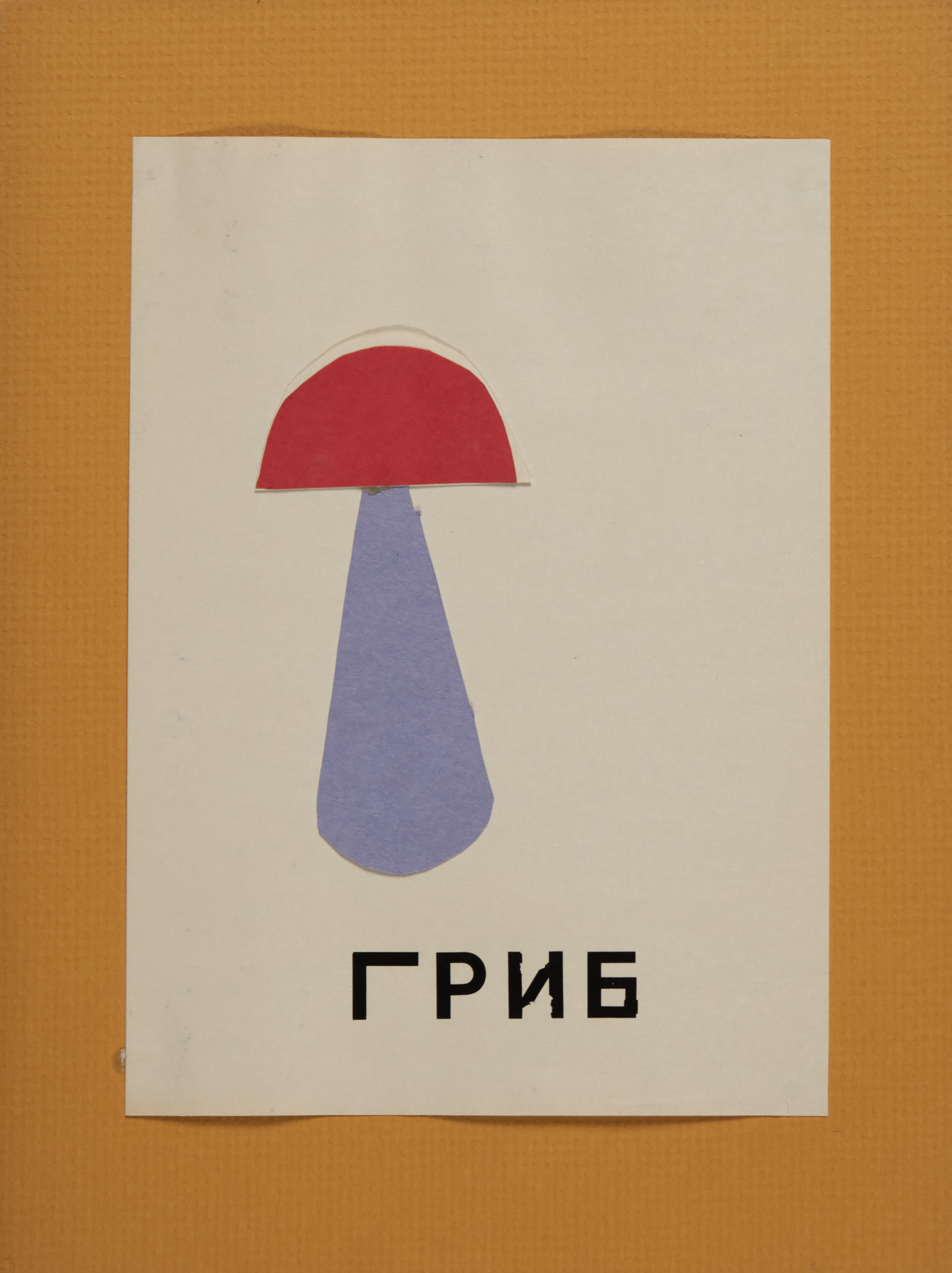
No. 1 from the series Russian ABC, 1980. Collage on paper, 19.2 × 13.9 cm (7 9/16 × 5 1/2 in.). Norton and Nancy Dodge Collection of Nonconformist Art from the Soviet Union. D04614.01
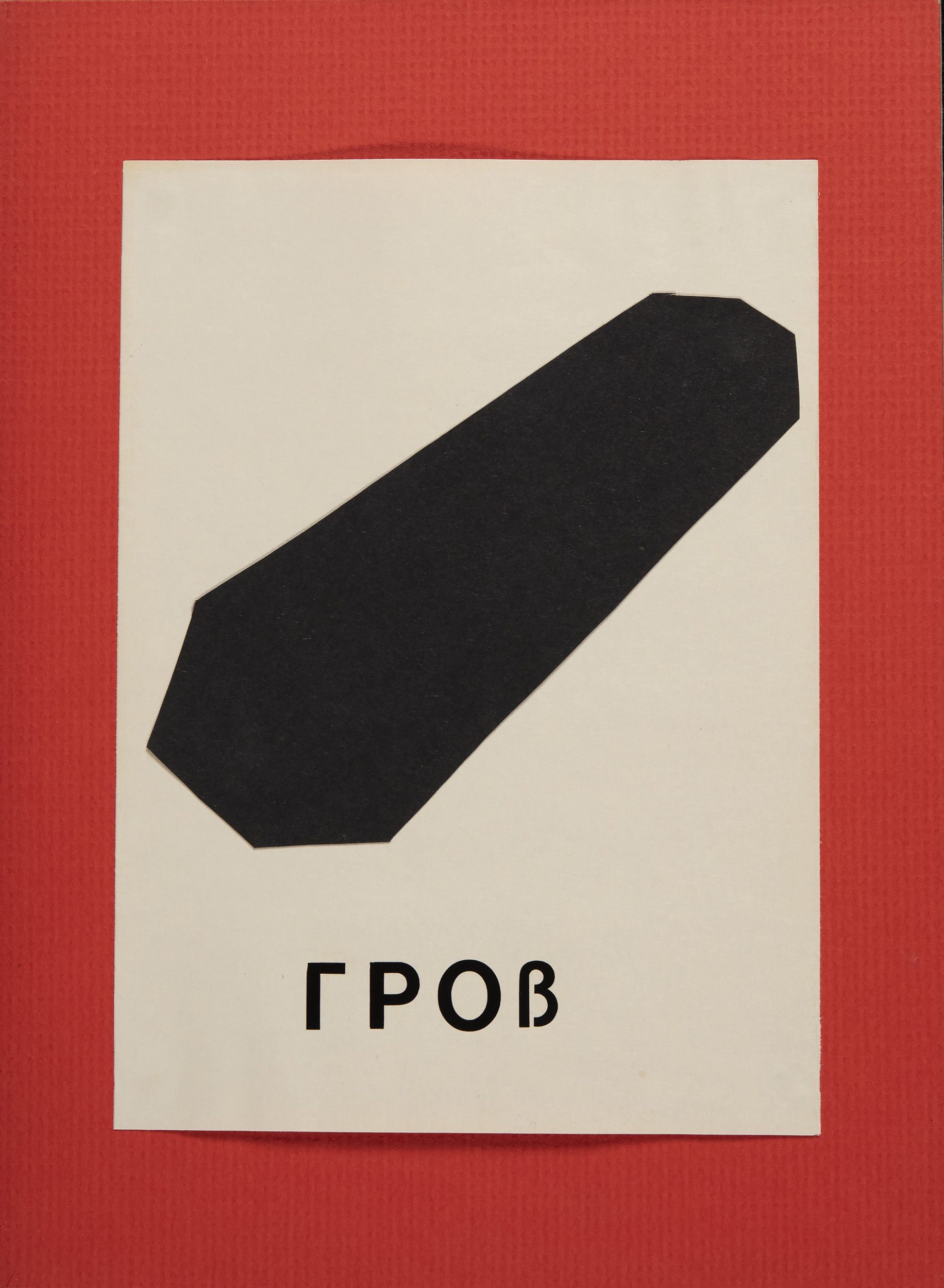
No. 2 from the series Russian ABC, 1980. Collage on paper, 19.3 × 14 cm (7 5/8 × 5 1/2 in.). Norton and Nancy Dodge Collection of Nonconformist Art from the Soviet Union. D04614.02
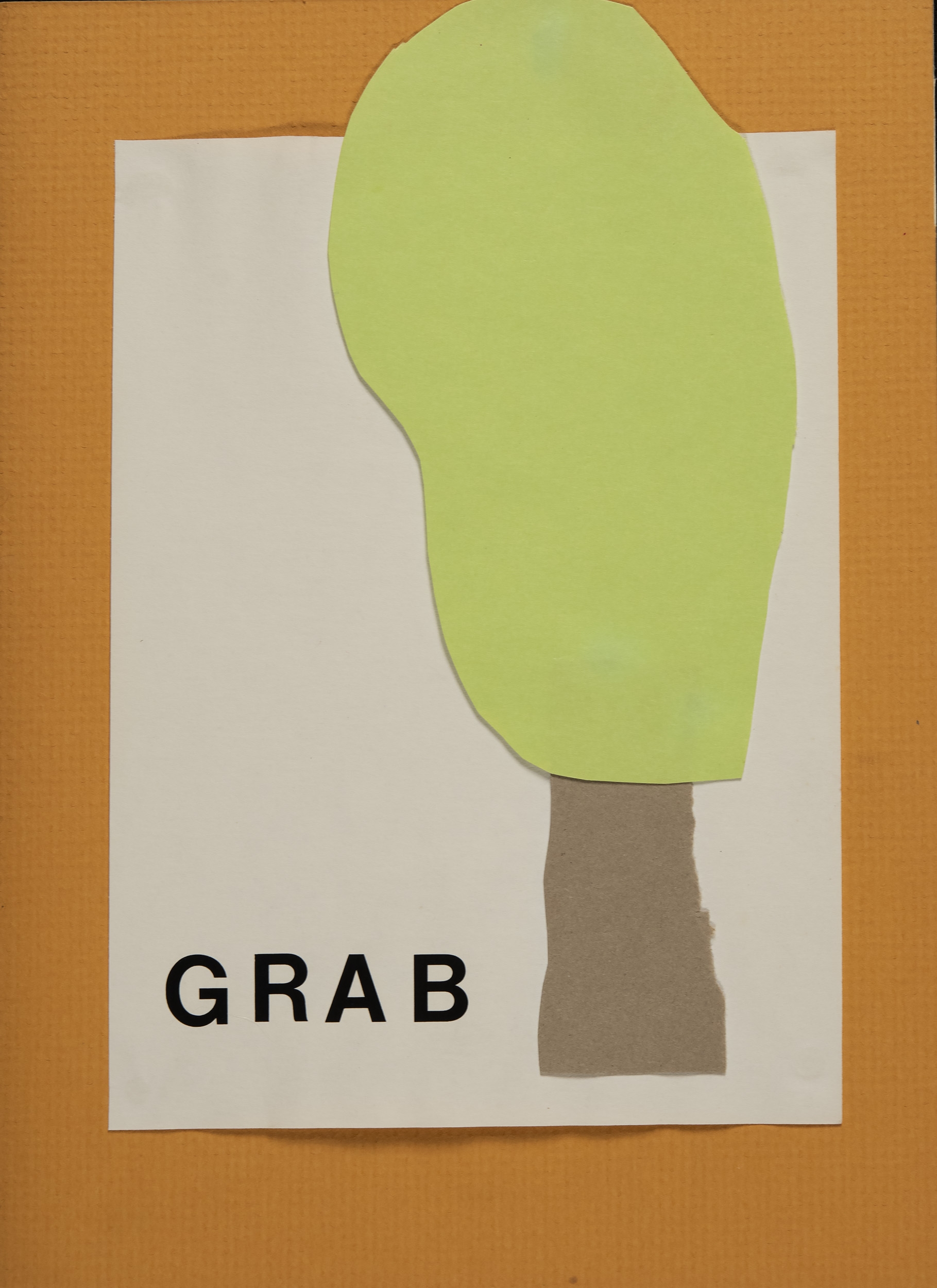
No. 3 from the series Russian ABC, 1980. Collage on paper, 22 × 14.1 cm (8 11/16 × 5 9/16 in.). Norton and Nancy Dodge Collection of Nonconformist Art from the Soviet Union. D04614.03
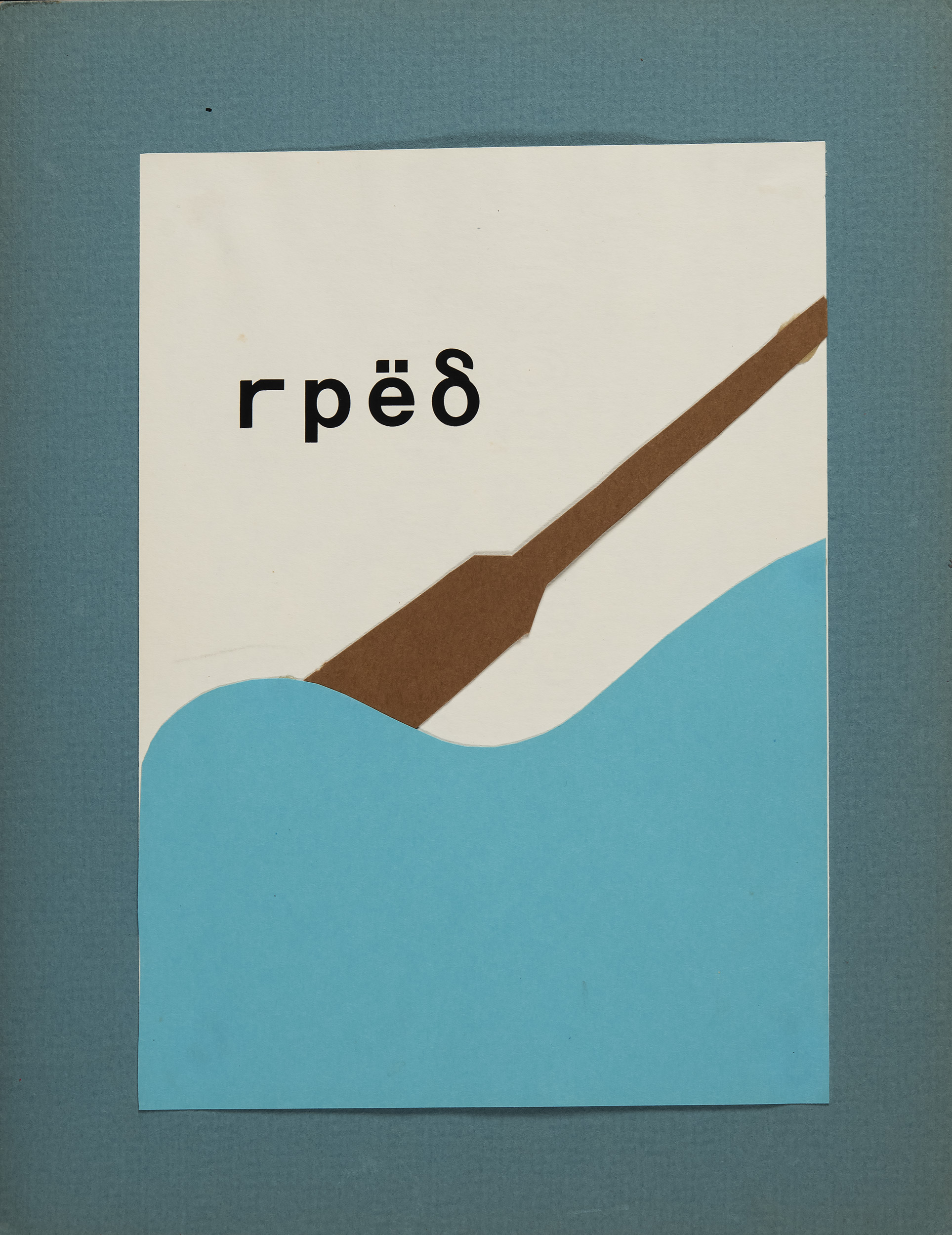
No. 4 from the series Russian ABC, 1980. Collage on paper, 19.3 × 14 cm (7 5/8 × 5 1/2 in.). Norton and Nancy Dodge Collection of Nonconformist Art from the Soviet Union. D04614.04