
Kirill Zdanevich
1892 — Kojori (Georgia) | 1969 — Tbilisi (Georgia). Worked in Tbilisi (Georgia), Moscow (Russia), Paris (France)
Painter, book illustrator, theater designer, and writer Kirill Zdanevich trained and worked in Paris, Saint Petersburg, Moscow, and Tbilisi. He was of Georgian ancestry on his mother’s side, and on his father’s he was a third-generation descendant of a Polish officer exiled to Georgia for engaging in a revolt against Russian czarism.
At the outset of his artistic career, around 1905–10, Zdanevich attended the Tiflis (today’s Tbilisi) school of Boris Vogel and Nikoloz Sklifosovsky. There, he explored lines and colors, as documented in numerous sketchbooks in his archive. To further his education, in 1910 he moved to Moscow, where he studied with P. Kelin alongside Vladimir Mayakovsky—who became an early admirer of his work and would go on to become the leading poet of the Russian Revolution. After a brief stint at the Moscow School of Painting, Sculpture, and Architecture, Zdanevich relocated to Saint Petersburg.
In July 1911, Zdanevich traveled to Tabriz, Persia, where he created various works including Scorching Tabriz (1911, Shalva Amiranashvili Georgia State Museum of Arts). Featuring a masterful handling of color, the painting depicts a landscape nearly melting amid the sun’s intense heat.
The following month, Zdanevich was in Saint Petersburg, taking academic drawing lessons with Lev Dmitriev-Kavkazski. During this time, he became associated with the avant-garde group Union of Youth (Soyuz Molodyozhi), whose members worked in the style of cubo-futurism, an amalgam of cubism and futurism. In this period, Zdanevich began developing his unique approach. Blending influences from cubism and futurism as well as Paul Cézanne, he created works, such as Tiflis (1910s, oil on canvas, private collection, Moscow), that dissolved forms into faceted segments and featured distorted motifs.
In February 1912, Zdanevich met prominent Russian avant-garde figures Mikhail Larionov and Natalia Goncharova in Moscow, and from then until 1914, he participated in several of their exhibitions, including Donkey’s Tail and Target. His Landscape was reproduced in the combined catalogue for Donkey’s Tail and Target, where Zdanevich is described as a “stormy young man who is a lover of vivid colors.” [1] In 1913, he was among the signers of the Manifest Luchistov i Budushchnikov [The Manifesto of the Rayonists and Futurists], issued by a group of painters associated with Larionov during the 1913 Moscow Target exhibition. Other signers of the manifesto include Goncharova, Larionov, Timofey Bogomazov, and Mikhail Le Dentu.
During the Easter holiday in 1912, Zdanevich returned to Tiflis, bringing with him Le Dentu. The two friends scoured the city for examples of folk art, and in the process, they happened upon the work of self-taught Georgian painter Niko Pirosmani (1862–1918) in a local tavern. Enthralled, Zdanevich and his brother Ilia Zdanevich (Iliazd) began collecting, popularizing, and studying Pirosmani’s work.
In October 1913, Zdanevich resumed his artistic training, this time at the Académie Julian in Paris. There, he was fortunate to find a mentor, developing a close relationship with Alexander Archipenko (1887–1964), a Ukrainian sculptor known for his modernist, cubist-inspired pieces, who exhibited alongside Pablo Picasso and Georges Braque in Paris salons. Inspired by Archipenko, Zdanevich became “convinced of the potential for a new art” and went on to develop a distinct method. [2] His painting Nude (1910s, Shalva Amiranashvili Georgia State Museum of Arts) shows clear influences from Archipenko’s sculptural style. Zdanevich even held a solo exhibition in Archipenko’s studio.
In 1914, Zdanevich left Paris for Moscow, and later served as a junior officer in the Russian Army during World War I. After being demobilized in 1917, he received the Imperial Orders of Saints Stanislaus and Anna for his military service, and thereafter returned to Tiflis.
The capital of newly independent Georgia, located in convenient proximity to Europe, Tiflis offered an idyllic respite from the tumult of war and revolution. In 1917, Tiflis saw the publication of 1918, the first collection of Russian avant-garde poetry, featuring Vasili Kamensky’s visual “ferroconcrete” poems “Tiflis” and “The Sun,” illustrated by Zdanevich. The poems are constructed through letter substitutions and carefully arranged sets of echoing words, deliberately dispersed across the page. Kamensky’s experimental language inspired innovative visual interpretations by Zdanevich, who made four abstract compositions for the collection. Both conceptually and aesthetically, the book was a seminal work of Russian-language futuristic poetry. Futurist poet and artist Alexey Kruchenykh hailed the collaboration, exclaiming, “We are publishing some books together with Kirill Zdanevich in Tiflis. Hurrah! Hurrah! ‘1918’ has been issued! This is a whole exhibition, not just a book!” [3]
In October 1917, Zdanevich mounted a solo exhibition in the basement of Blanc et Noir, a well-known art-supply shop, where he displayed 128 works created in Saint Petersburg, Moscow, and Paris between 1912 and 1917.
Zdanevich arrived at the concept of “orchestral painting,” an important contribution to the avant-garde movement. Orchestral painting employed and harmonized multiple artistic styles—realist, primitivist, and cubo-futurist. “A single canvas might incorporate a cubist portrait, an impressionist landscape, a futurist still life, and a rayist arrangement. The orchestration of several pictorial elements within a single composition was so intense … that even a small-scale work attains the spatial force of frescoes and the solidity of architectural structures.” [4] The resulting synthesis was akin to Iliazd and Mikhail Le Dantu’s concept of “everythingism” (vsechestvo), an artistic and aesthetic program that advocated the mixing and combination of diverse idioms. Regrettably, much of Zdanevich’s orchestral painting series has been lost; nevertheless, the extant graphic works reveal a compelling approach to the formal and figural treatment of the pictorial surface.
In 1918, Iliazd, Alexei Kruchenykh, and Igor Terentyev formed Company 41°. The group, for which Zdanevich served as artistic director, published books featuring zaum poems and cubo-futurist illustrations. His role in designing these notebook-like volumes significantly bolstered the global recognition of the Tiflis avant-garde.
From 1919 to 1920, Zdanevich participated in various exhibitions and workshops in Tiflis, working closely with Georgian artists Lado Gudiashvili and Ziga Waliszewsky as well as Iliazd. In the spring of 1918, he painted murals for the Peacock Tail music studio and the Argonauts’ Boat theater, for which he also designed stage sets. In August of that year, he journeyed to Paris, where he reunited with Larionov, Goncharova, and his Tiflis friends Gudiashvili and Davit Kakabadze.
En route to Georgia he met Iliazd, who was in Constantinople awaiting a visa to travel to Paris. Despite wishing to return to Europe, Zdanevich was unable to obtain a visa and thus had to go back to Tiflis. Soviet rule was established in Georgia in February 1921. Over the next year, Kirill produced several cubo-futurist and “orchestral graphic” series, some of which he sent to Iliazd in Paris.
Around this time, Zdanevich shifted his focus to scenography, designing sets for operas including Verdi’s Aida and Wagner’s Lohengrin at the Tbilisi Theater of Opera and Ballet. In 1923, he collaborated with Irakli Gamrekeli and Kote Marjanishvili on the Rustaveli Theater’s productions of Ernst Toller’s Masses Man and Grigol Robakidze’s Maelstrom. In 1926, Zdanevich contributed an article to, and designed the cover of, a book about Pirosmani. He divided his time between Tbilisi and Moscow, where he collaborated with Mayakovsky and the LEF group. The theater director, choreographer, and writer Nikolay Foregger also invited him to collaborate on theatrical works.
Initially tolerant of avant-garde innovations, the Soviet regime in the mid to late 1920s tightened its grip on cultural policy, imposing narrow strictures within which official art was expected to conform. Like many Soviet artists, Zdanevich was compelled to adopt a pictorial style more in line with state dictates. In the spring of 1930, amid the threat of confiscation, he and Iliazd reluctantly transferred their Pirosmani collection to the National Gallery of Georgia, retaining only five paintings for themselves.
In 1949, Zdanevich was wrongfully accused of espionage and exiled to the Vorkuta labor camps just north of the Arctic Circle. After nine long years of imprisonment, he was rehabilitated amid the early years of the Khrushchev Thaw, but thereafter remained silent regarding his time in the Gulag.
From 1959, Zdanevich lived between Tbilisi and Moscow. Beginning in the 1960s, Zdanevich expanded his purview beyond painting to include literary and art-historical pursuits. He wrote articles on Georgian painters including Gudiashvili, Kakabadze, and Waliszewsky and in 1963 published a monograph on Pirosmani.
In November 1966, Zdanevich traveled to Paris to see Iliazd, marking the first time the two brothers were together since being separated in Constantinople in 1921. In Paris, Zdanevich created watercolor sketches, which he took back with him to Tbilisi.
His later art lost some of the innovative spirit and freedom that characterized his early quest for new artistic forms. Yet his still lifes and landscapes—florid, ornamental, and sometimes reminiscent of stained glass in their colorful transparency—remained far from mundane or overly ideological (Untitled, 1960s, ZAM). Particularly in his landscapes, fleeting glimpses of dramatic intensity could be discerned. Seemingly ordinary landscape motifs would transform, attaining symbolic depth and evolving from simple scenes into monumental works filled with inner turmoil (Untitled, 1968, ZAM, D22192).
Zdanevich’s works may be found in various museum collections including the Georgia National Museum (Tbilisi, Georgia), Centre Pompidou (Paris, France), the Jane Voorhees Zimmerli Art Museum (New Brunswick, NJ, US), the State Russian Museum (Saint Petersburg, Russia), and the State Tretyakov Gallery (Moscow, Russia).
Nana Shervashidze
Translated by Mariam Shildelashvili
Photo portrait courtesy of Karaman Kutateladze
Notes:
1. Parkin, Varsonofij. “Osliny khvost i mishen’” [The Donkey’s Tail and the Target]. In Anthology: Oslinyy khvost i mishen’ [The Donkey’s Tail and the Target]. Moscow, 1913: 66.
2. Zdanevich, Kirill. “I Remember,” from Kirill Zdanevich, 1892-1969: Pages From the Archive. Diaries, Memories, Letters. Tbilisi: National Museum of Georgia, 2021: 175.
3. Aleksei Kruchenykh’s letters to Mikhail Matyushin and Vadim Shemshurin; extracts from T. Nikolskaia, Antasticheskii gorod (Moscow, 2000): 24.
4. Zdanevich, Kirill. “Leftism: Painting in Russia.” In Mnatobi, no. 4 (1924): 228 (in Georgian).
5. Zaum (literally “beyond-mind” or “transrational”) was a non-referential poetic language developed by the Russian cubo-futurists Velimir Khlebnikov and Aleksei Kruchenykh around 1913. It employed neologisms, sound symbolism, and invented words to move beyond conventional logic and semantic meaning.
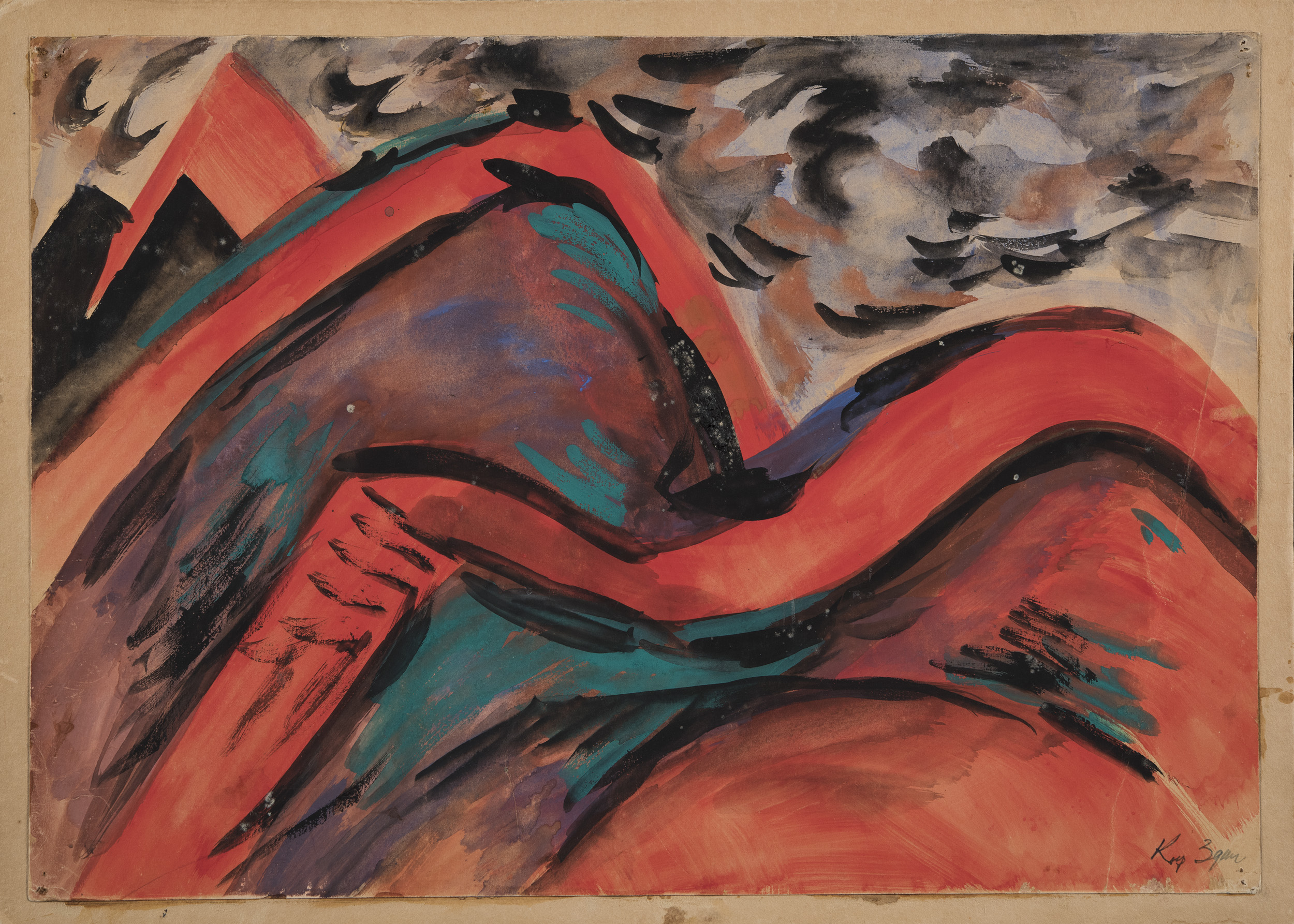
Untitled, 1968. Watercolor and gouache on paper mounted on paperboard, 33.3 × 46.6 cm (13 1/8 × 18 3/8 in.). Norton and Nancy Dodge Collection of Nonconformist Art from the Soviet Union. D22192
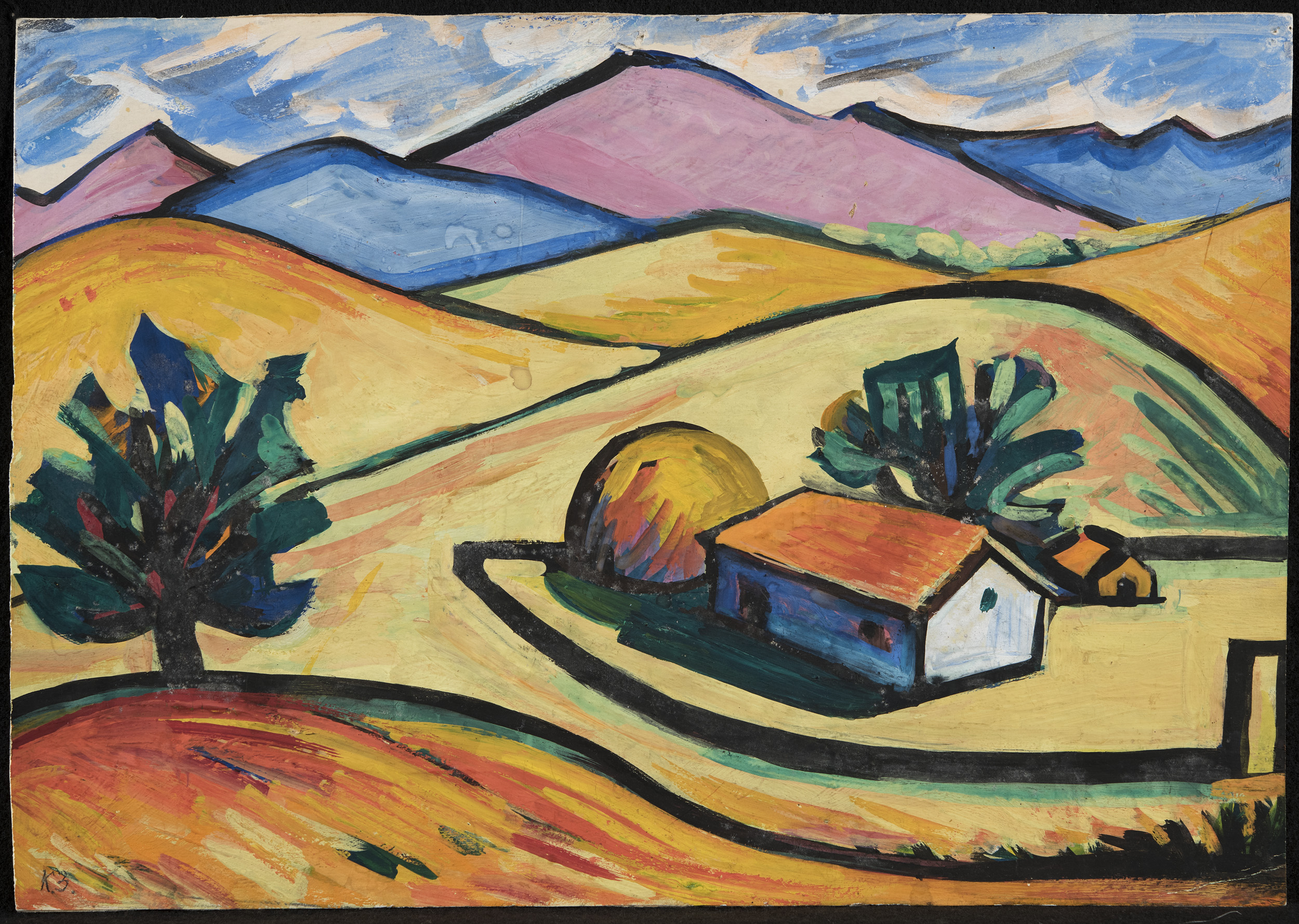
Untitled, undated. Gouache on paper mounted on illustration board, 27.9 × 40 cm (11 × 15 3/4 in.). Norton and Nancy Dodge Collection of Nonconformist Art from the Soviet Union. D22193
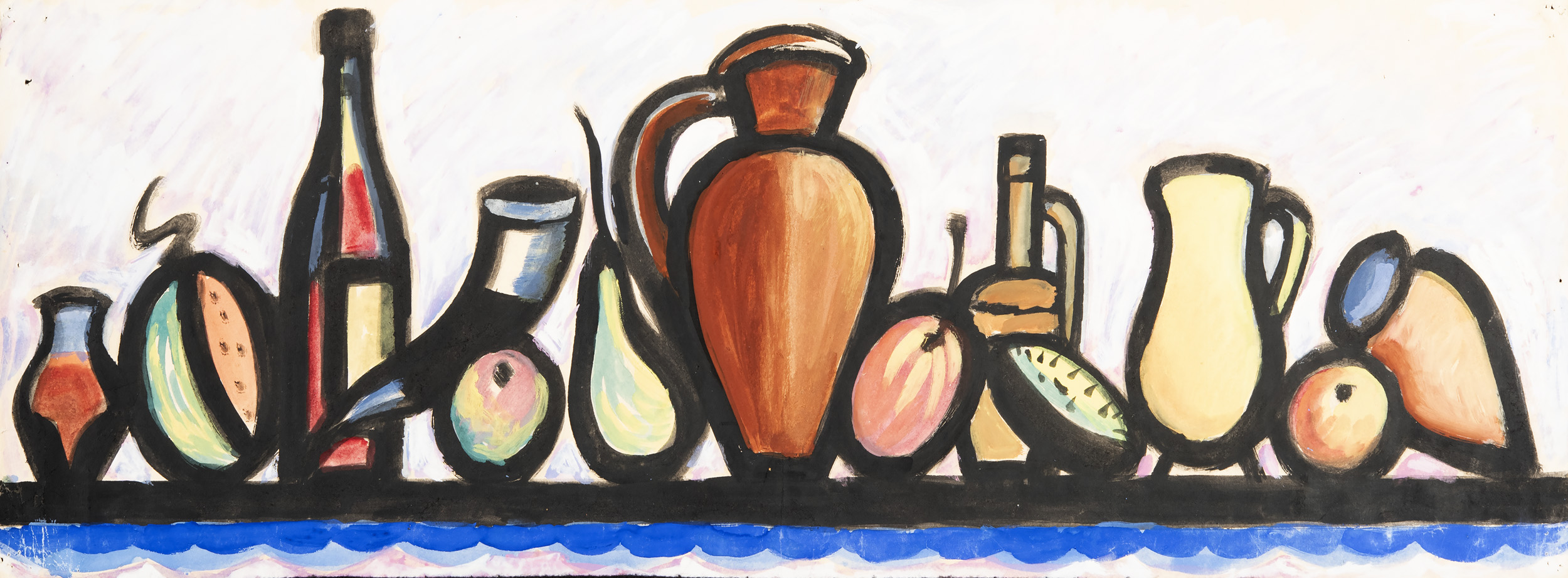
Untitled, undated. Gouache and watercolor on paper, 28.3 × 86.4 cm (11 1/8 × 34 in.). Norton and Nancy Dodge Collection of Nonconformist Art from the Soviet Union. D08429
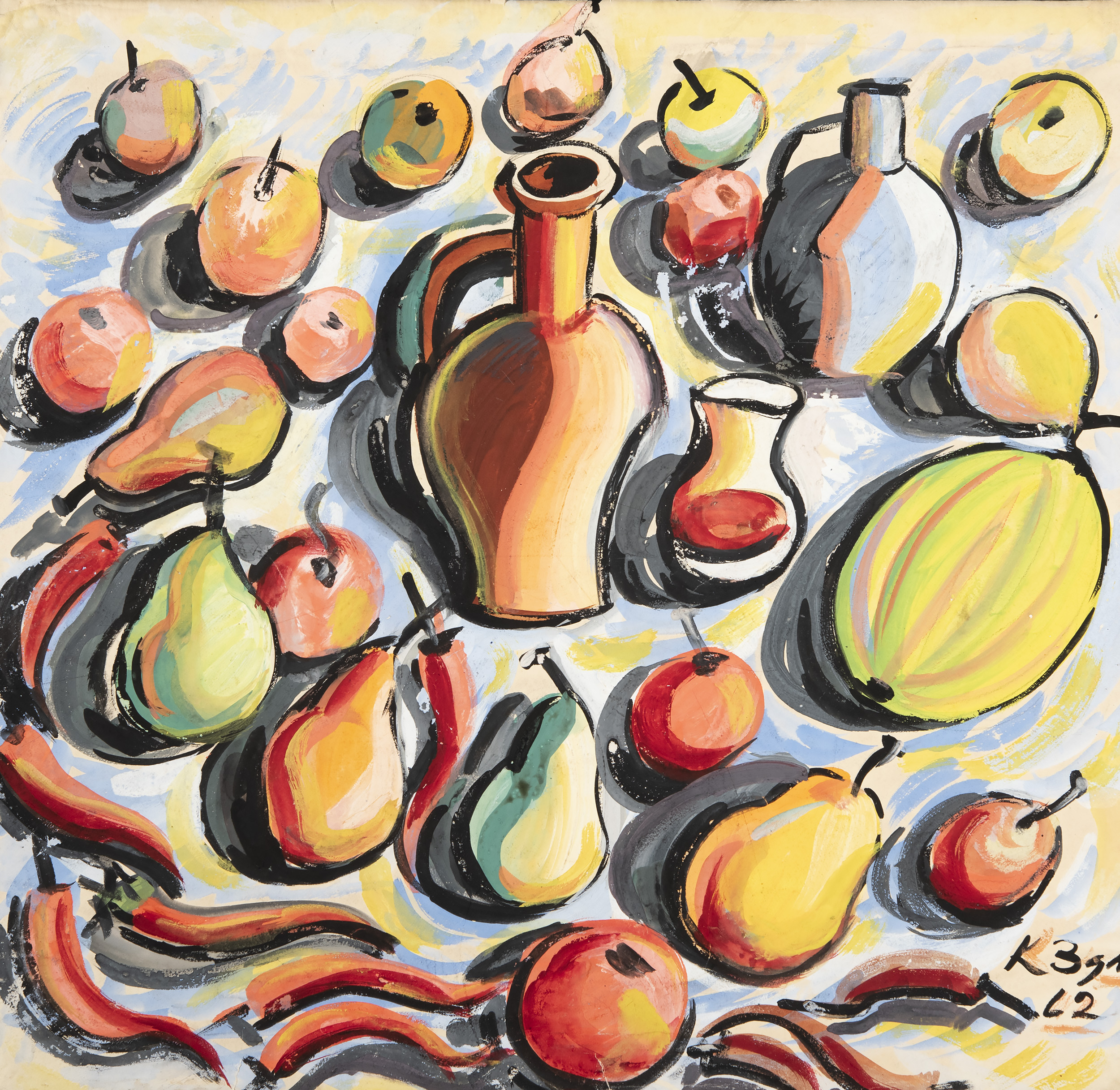
Untitled, 1962. Gouache on paper, 59.2 × 60 cm (23 5/16 × 23 5/8 in.). Norton and Nancy Dodge Collection of Nonconformist Art from the Soviet Union. D08430