
Kazimiera (Kazė) Zimblytė
1933 — Briedžiunai, Lithuania | 1999 — Vilnius (Lithuania). Worked in Briedžiunai and Vilnius (Lithuania)
Kazimiera Zimblytė, known as Kazė to her friends (and the name she signed on her works), was a pioneering abstract artist in Lithuania with a background in textile art. She created monotypes, paintings, collages, assemblages, and was one of the first in the country to create installations.
She was born in 1933 in Briedžiūnai, a small village in the Ukmergė district. Her grandfather and mother worked at the nearby Lokinė Manor. Growing up in the manor environment, she was immersed in its culture from a young age. Since childhood she spoke, read, and wrote in both Lithuanian and Polish—which would later allow her to read Polish art magazines for a glimpse into the broader world of Western art, despite the restrictions of the Iron Curtain. Kazė attended a girls’ gymnasium in Ukmergė, where she started writing diaries filled with romantic and patriotic drawings. Her childhood home in Briedžiūnai was her greatest creative and spiritual refuge throughout her life; her later diaries often mention local nature and refer to its motifs in her art.
In 1952 Zimblytė enrolled to study in the textile department at the LSSR State Art Institute. There she befriended students who would later become part of the same unofficial artistic circle—Judita Šeriene (1931–2022), Marija Ladygaitė-Vildžiūnienė (b. 1931), and Saulė Kisarauskienė (1937–2023)—and met Vincentas Gečas (1931–2020), a painter whom she would marry. Although their marriage likely sparked her interest in painting, it didn’t last long, and she remained single afterward. Her early drawings and sketches feature scenes from her daily life as well as landscapes from Crimea, seaside and beach views, and other scenes from her travels.
After completing textile studies in 1959, Zimblytė worked on some original fabric printing designs for mass factory production; these were showcased in Warsaw in 1959 and in Moscow in 1960. However, to fully benefit from opportunities in textiles she would need to be employed by a factory, who would then own the work. She didn’t want to pursue this impersonal creative path.
In 1963 Zimblytė left the textile industry and joined the textile section of the Artists’ Union of the Lithuanian SSR. Around this time, she also began creating abstract paintings. However, since she was a member of the textile section, she was restricted from buying painting supplies, which were only available to members of the painting section. To circumvent this, she often used collage techniques in her work. She created compositions using pieces of fabrics, leather, foil, aerosol paint, and bronze-colored powder meant for painting radiators.
In the mid-1960s Zimblytė met Anatoly Strigaliov, a renowned Russian avant-garde theorist from Moscow. She began visiting Moscow frequently, staying for extended periods. Through Strigaliov she connected with underground artists in the city. Moscow also offered her access to a wide range of cultural publications and impressive collections of Russian avant-garde art.
By choosing to create abstract art, which the Soviet government considered empty and flawed, Zimblytė was effectively barred from official art exhibitions. Like many other Lithuanian artists who opposed the Soviet regime, she displayed her work in semipublic or private spaces in Vilnius, such as the homes of her friends Vytautas and Judita Šerys, and Marija and Vladas Vildžiūnas in the Jeruzalė district. These were venues of so-called quiet modernism—a term coined by critic Elona Lubytė in 1997 to describe the artistic activities from the 1960s to the early 1980s outside of public and official spaces in Vilnius that didn’t meet government standards.
Zimblytė’s first solo exhibition took place in 1968 in one of these more private, progressive spaces: the meeting room of the Vaga publishing house in the center of Vilnius. There she exhibited twenty paintings with smooth, monochrome backgrounds. These compositions featured constructed figures and fragments of abstract details that were painted in serene earth and sky colors along with black and white brushstrokes, and reflected the artist’s interest in the works of Paul Klee and Antoni Tapies. The exhibition, which attracted the attention of her colleagues, also included an original poster and a handmade checklist of the works, which Zimblytė typed on tracing paper. One of them, painter Vincas Kisarauskas, noted: “The artist’s work can be described as a world of silver and gold, of dissolved evening twilight, where there are no objects, no painting in the conventional sense. . . . It is a rare and strange ability to paint nothing but the mood itself.” [1] Despite the novelty of the works presented and positive feedback from the fellow artists, the authorities disapproved and shut down the exhibition after just two days.
She continued to develop similar creative principles, transitioning from geometric figures and abstract compositions to monochrome black and brown paintings. She later incorporated gold or bronze paint, silver shimmer, and a melancholic pale green color. Zimblytė stands out among Lithuanian abstract painters of her generation for her unique approach to the painting’s surface. She used unusual materials and techniques such as layering, folding, pleating, cutting, and gluing various materials onto the canvas. Art critics often highlight the materiality, as well as the meditative and transcendental qualities of her works.
In the late 1970s, Zimblytė created her first outdoor installations in her village of Briedžiūnai and in the Jeruzalė Sculpture Garden. She painted and drew on long strips of paper that fluttered in the wind and almost blended into the surroundings. According to Elona Lubytė, “The flag of the freedom of abstractionism, waving in the wind, symbolized the artist’s free, Western, tradition-transcending self-expression, placing abstraction in the environment of the socialist regime.” [2]
Zimblytė’s first solo exhibition in the official exhibition space—the Vilnius Art Exhibition Hall (since 1992, Contemporary Art Center, Vilnius, Lithuania)—was held only in 1988. Later, her work was gradually included in exhibitions with her contemporaries. She passed away in 1999, leaving behind a large body of work.
In the history of Lithuanian art, Zimblytė stands out as one of the most experimental artists of her generation, who broke away from figurative and narrative painting tradition. Her works remain relevant today and is often exhibited, especially in survey and thematic shows. During the Soviet era, only a few of her early textile works were acquired by the Lithuanian SSR State Art Museum (The National Gallery of Art, previously known as the Museum of the Revolution of the Lithuanian Soviet Socialist Republic). Most of her 734 works now in the Lithuanian National Museum of Art were transferred after her death by the private gallery Lietuvos Aidas, which had helped the artist survive the hardships of change; they took care of the presentation and dissemination of her work. Kazimiera Zimblytė’s works can also be found at the MO Museum in Vilnius and in private collections in Lithuania and abroad.
Julija Fomina
Photo portrait: 1989, by Algirdas Šeškus
Notes
1. Elona Lubytė, ed., Tylusis modernizmas Lietuvoje 1962–1982 [Quiet Modernism in Lithuania 1962–1982] (Vilnius: Lietuvos dailės muziejus, 1997). She writes: “Quiet modernism is a metaphor which refers not to artists or works, but to the nature of the process... The publicly non-tolerated art that wasn’t shown in exhibition halls would occasionally find refuge—even if only for a day—in more discreet spaces, sometimes private homes.”
2. Vincas Kisarauskas, “Apie Kazimieros (Kazės) Zimblytės tapybą” [On the Painting of Kazimiera (Kazė) Zimblytė], in Elona Lubytė, ed., Tylusis modernizmas Lietuvoje 1962–1982 [Quiet Modernism in Lithuania 1962–1982] (Vilnius: Lietuvos dailės muziejus, 1997), 96.
3. Elona Lubytė, “Laisvės efektas abipus Atlanto: Aleksandra Fledžinskaitė Kašubienė (Kasuba) ir Kazimiera Zimblytė (Kazė)” [The Freedom Effect on Both Sides of the Atlantic: Aleksandra Fledžinskaitė Kašubienė (Kasuba) and Kazimiera Zimblytė (Kazė)], in Margarita Matulytė, ed., Lietuvos nacionalinio dailės muziejaus metraštis [Yearbook of the Lithuanian National Museum of Art] (Vilnius: Lietuvos nacionalinis dailės muziejus, 2021) 23:134.
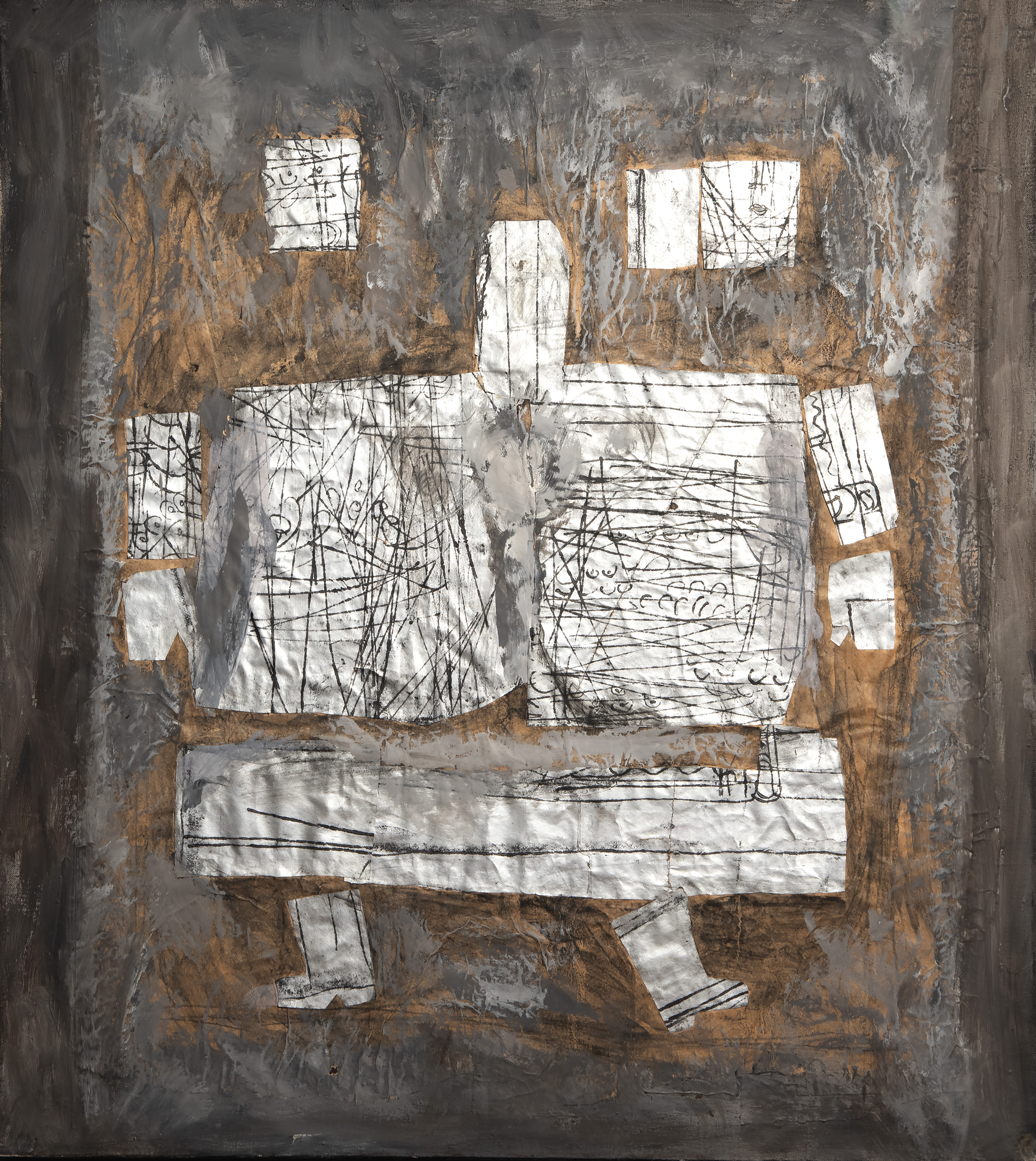
Silver Man, 1967. Oil and collage on canvas, 100 × 89.5 cm (39 3/8 × 35 1/4 in.). Norton and Nancy Dodge Collection of Nonconformist Art from the Soviet Union. D01870

Untitled, undated. Paper and paint collage on fiberboard, 109 × 106 cm (42 15/16 × 41 3/4 in.). Norton and Nancy Dodge Collection of Nonconformist Art from the Soviet Union. D01424
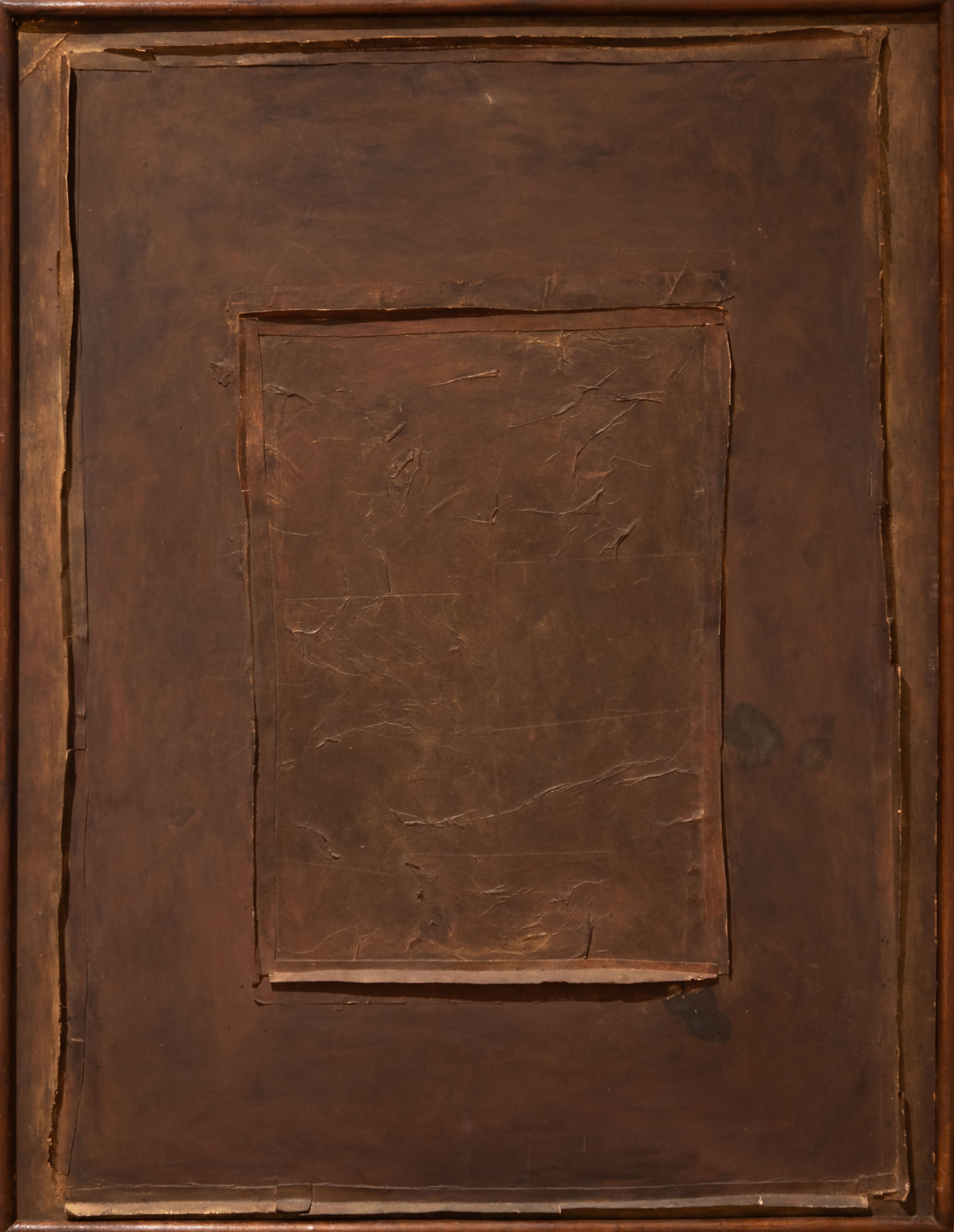
Composition, 1970. Paper and paint collage on fiberboard, 122 x 90 cm (48 1/16 x 35 7/16 in.). Norton and Nancy Dodge Collection of Nonconformist Art from the Soviet Union. D01423

Composition, 1966. Mixed media and paper on canvas, 129 × 97 cm (50 13/16 × 38 3/16 in.). Norton and Nancy Dodge Collection of Nonconformist Art from the Soviet Union. D16840