
Karlo Kacharava
1964— Samtredia (Georgia) | 1994— Tbilisi (Georgia). Lived and worked in Tbilisi (Georgia)
Karlo Kacharava played a central role in Tbilisi’s art scene of the 1980s and 1990s. His prolific career as an artist, poet, art historian, and art critic was cut short by his untimely death at age thirty.
Kacharava’s father, also named Karlo Kacharava (1925–1966), was an engineer and head of the Western Georgian Railway’s Building and Construction Department, stationed in Samtredia. Kacharava’s mother, Gogutsa Kacharava (1928-2005), was a philologist and taught Georgian at the Tbilisi Vakhtang Chabukiani Choreographic School. In 1966, when Kacharava was two years old, his father died suddenly of a heart attack; at this time, his mother was pregnant with his sister, Lika, who was born a few months later. Soon after, the three moved to Tbilisi. The siblings were raised by their mother, who never remarried, and Karlo became a stand-in father figure for Lika.
As a child, Kacharava was drawn to artistic and intellectual pursuits. From an early age, he painted and was very interested in art history, literature, world history, geography, and German. In 1980, while at Tbilisi Experimental School No. 1, Kacharava, together with two classmates, launched Dadaists, a handwritten magazine, titled after the early-twentieth-century avant-garde movement, that published student poems and sketches. In 1981, he graduated from high school and continued his studies in the Faculty of Art History at the Tbilisi State Academy of Arts, graduating with honors in 1986.
In 1984, while still a student, Kacharava, along with Goga Maglakelidze, Gia Loria, and Mamuka Tsetskhladze, founded Archivarians, an artist collective. The group’s moniker—which means “keeper” or “saver”—derived from an archivist character in E. T. A. Hoffmann’s novel The Golden Pot (1814). Kacharava authored the group’s manifesto, and in 1984, they held an exhibition in Loria’s home.
In 1986, upon graduating from the Tbilisi Academy, Kacharava was called up for mandatory military service in Mirny, Siberia. His service was originally supposed to last eighteen months but ended up being reduced to eight months. The arctic climate was detrimental to his health. In addition—and perhaps more importantly—he struggled to adapt to the military’s harsh regimen. Thanks to his family’s heroic efforts, Kacharava was deemed unfit for Soviet service after seven months and released from duty.
Upon his return to Tbilisi in 1987, Kacharava began working at the Institute of Georgian Art History, where he remained for the rest of his career. He also rejoined his friends in the city and became active in the artist’s collective Tenth Floor, which in 1986 was based in Tsetskhladze’s studio in the Tbilisi Academy. Featuring members of Archivarians but larger than the earlier group, Tenth Floor was the first artist collective to organize actions and happenings in Tbilisi, sometimes mounting exhibitions in unusual locales including the underground passage beneath the newly constructed Republic Square. Its members worked with nontraditional materials such as industrial paint and iron. Tenth Floor artists worked in an expressionist style related to the unraveling of the Soviet Union and Georgia’s 1991 civil war and these events’ effects on the Georgian population, who lost their jobs, land, and faith. In 1987, the collective relocated to the workshop of the Marjanishvili Theater and organized its first exhibition at Karvasla (Tbilisi History Museum). The group went on to play an important role in Tbilisi artistic life in the 1990s.
Kacharava served as Tenth Floor’s chronicler and theorist and participated in its exhibitions. Like his fellow Tenth Floor artists, Kacharava worked in a style informed by German expressionism and neo-expressionism. Content-wise, his oeuvre featured recurrent motifs: a bearded, balding man (a nod to the artist himself); sad, naked, or scantily clad young women—surrogates for his muses, especially Helena Lundberg; and father-daughter compositions, speaking to his paternal attitude toward his sister as well as his desire for fatherhood.
The General (1988) is Kacharava’s largest work, measuring 300 by 300 centimeters. The painting depicts a figure of a military man, truncated below the hips, executed in rapid brushstrokes and outlined in red-burgundy paint drips. The General’s helmet is adorned with flowing feathers, while his stern visage gazes directly ahead. He strikes a commanding pose, his right hand holding what appears to be a horse bridle. Despite his imposing presence, Kacharava’s gestural brushwork makes the portrait appear dynamic, as if the subject is in motion. The work engages the viewer on a profound emotional level, portraying the general as a heroic figure while featuring a dedication to to Helena Lundberg, with “Für Helena” inscribed in black paint on the left. Kacharava met Lundberg, a Finnish literary historian, in Leningrad in the mid to late 1980s; they were romantically involved for several years. Even after their romantic relationship ended, she remained his lifelong friend, and, as in The General, many of his artworks are dedicated to her.
In his critical writings, poems, paintings, diaries, and letters, Kacharava would create narratives that, alongside stories of his daily life, were frequently accompanied by quotes from books he had read or films he had seen. In Kacharava’s diaries, drawings, and paintings, text and image are often interchangeable. For example, in his journal from Cologne, Germany, where he traveled for a conference in 1990 (a facsimile of which was published with the support of the Goethe-Institut in 2012), daily sketches and notes include a quote by writer Georges Bernanos, a Berlin train ticket, and a postcard advertising an exhibition of work by artist Ida Applebroog.
The inscriptions and quotes in Kacharava’s paintings are largely in German and Georgian, although English phrases, mostly quoting rock or pop songs (for example, Peter Gabriel’s “In Your Eyes” [1989]), occasionally appear as well. The German word für (for)—conveying his respect, dedication, and admiration for cultural figures or the women with whom he was in love—occurs with particular frequency. He also dedicated works to neo-expressionist artists, writers, and intellectuals including Georg Baselitz, Francesco Clemente, Marguerite Duras, Jörg Immendorff, Anselm Kiefer, and Susan Sontag.
In addition to teaching at the Institute of Georgian Art History from 1989 onward, Kacharava was a member of the editorial board of the journal Literature and Art. In 1990, he joined the board of the International Association of Art Critics (AICA Georgia). In 1990–91, he participated in conferences in European cities including Cologne, Barcelona, Berlin, and Paris.
In late March 1994, Kacharava suffered a brain aneurysm. After undergoing two surgeries, the artist died shortly thereafter, on April 9, at age thirty.
Since his untimely passing, Kacharava’s apartment in Tbilisi where he lived with his mother and sister has served as an unofficial house museum. The apartment, which displays his works and photographs, has remained intact, as has the library, with its collection of books in Georgian, German, and Russian.
In 1997, Kacharava received the George Chubinashvili State Prize for his contribution to Georgian art history—the first time this award was posthumously bestowed.
Irena Popiashvili
Photo portrait by Javar Lomidze
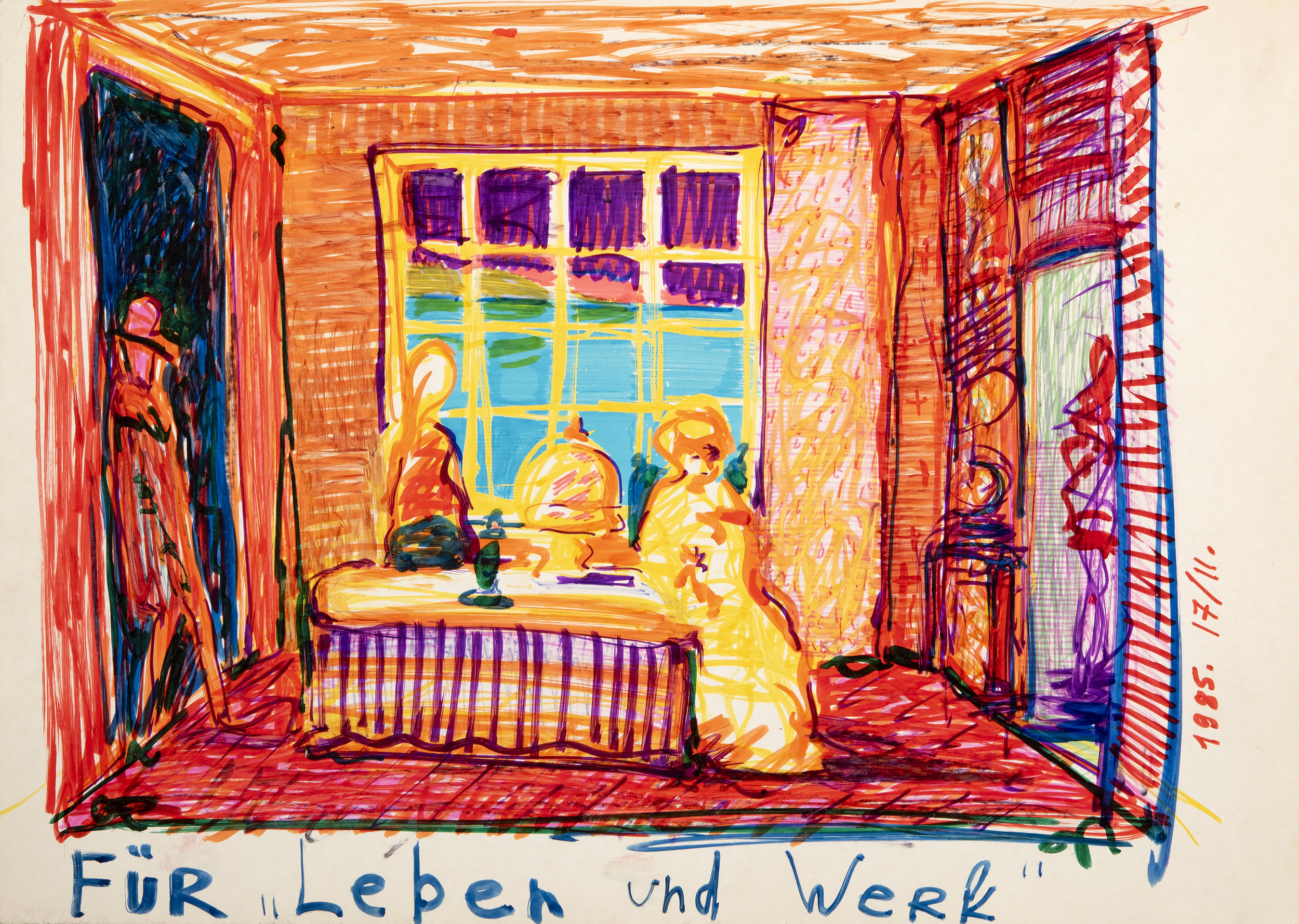
Für "Leben und Werk," 1985. Ink on paper, 29 × 41 cm (11 7/16 × 16 1/8 in.). Norton and Nancy Dodge Collection of Nonconformist Art from the Soviet Union. D14498

Sara, 1986. Tempera on paper, 30.5 × 43 cm (12 × 16 15/16 in.). Norton and Nancy Dodge Collection of Nonconformist Art from the Soviet Union. D14499
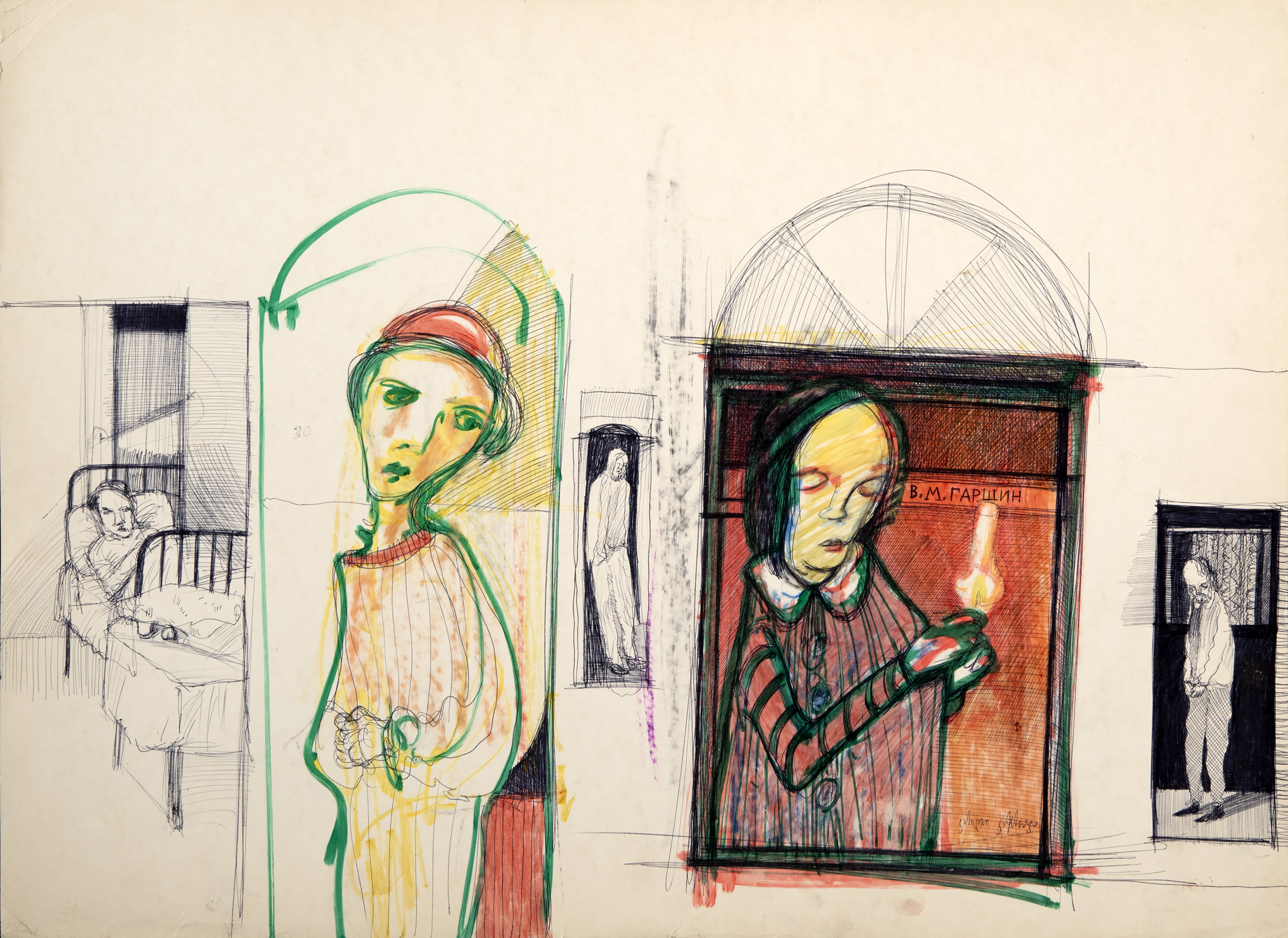
Untitled, 1981–82. Ink on paper, 31 × 42 cm (12 3/16 × 16 9/16 in.). Norton and Nancy Dodge Collection of Nonconformist Art from the Soviet Union. D14500