
Juris Putrāms
1956 — Pļaviņas (Latvia). Works in Riga (Latvia)
Juris Putrāms studied at the Riga Technical School of Construction in the Department of Architecture before transitioning to the Graphic Department of the Art Academy of Latvia (at that time, the Latvian SSR State Academy of Art), from which he graduated in 1981. Initially, like many of his contemporaries, Putrāms worked primarily in poster art. Posters had gained significant popularity in Latvia in the 1970s and ’80s. Exhibitions and contests highlighted a variety of designs, and publishing houses ramped up print runs, fueling a poster-collecting frenzy. This trend was also supported by the more relaxed environment of the Poster Section within the Latvian SSR Artists’ Union at the time. Putrāms’s art, along with that of his Latvian contemporaries, evolved following their participation in national graphics and poster exhibitions, including the Tallinn Print Triennial of the Baltic Republics in Tallinn, Estonia (1983, 1986, 1989), and The Baltic Poster '87—7th Poster Triennial of the Baltic Republics in Riga, Latvia (1987). Yet, from the very beginning, the graphic artists in Putrāms’s circle distinguished themselves from traditional artists by their intricate detail and expressive style. Notably, these artists—who were initially recognized for their poster art and, later, large-scale screenprinting—swiftly evolved into multifaceted practitioners. Initially labeled the Super Graphics (supergrafiķi in Latvian), they were redubbed as “installers” (instalatori in Latvian) a decade later.
Juris Putrāms emerged on the Latvian contemporary art scene in early 1980s as a graphic artist. Predominantly engaged in experimental approaches, the artist also continued to value the traditional disciplines of painting and graphic art. Along with his peers, who included Ojārs Pētersons (b. 1956), Andris Breže (b. 1958), Oļegs Tilbergs (b. 1956), and Henrihs Vorkals (1946–2018), Putrāms is renowned in Latvian contemporary art circles as one of the members of the robežpārkāpēji (trespassers) group for his early adoption of nontraditional mediums in the mid-1980s. Amid sociopolitical turbulence, the characters in the works of Putrāms and his contemporaries emerged as symbolic opponents of the widespread political apathy and institutional repression of the era; they captured the absurdity of life under a system marked by censorship, stagnation, and ideological control. Putrāms’s artistic circle was labeled the “new harsh wave” and “the Latvian neoexpressionists of the 1980s,” noted for their expressive and often stark portrayals. However, Putrāms’s work and persona are perceived as being more fragile than those of his peers, more prone to moodiness and anxiety: “not an analyst, but perhaps a chronicler of his own emotional states,” [1] in the words of curator Daiga Rudzāte.
Putrāms’s oeuvre includes installations, objects, large-scale metal paintings, photography, and videography. According to the Latvian art critic and curator Helēna Demakova, “The enumeration of techniques in Juris Putrāms’s artistic repertoire proves superfluous. However, his adeptness in autonomously realizing each conceived creation merits attention, underscored by his fastidious craftsmanship and academic grounding.” Since the early 1980s, the concept of energy has been a central theme in Putrāms’s art, and until the early 1990s, his works carried a pronounced socially active message. His expressive figurative images are distinguished by their unique directness, yet they also allow for ample viewer interpretation.
In 1985 Putrāms co-curated a group exhibition with Ojārs Pētersons and Andris Breže at the Gustavs Sķilters Memorial Museum in Riga, where Putrāms introduced the cycle Passerby (1985), now hailed as a seminal work of twentieth-century Latvian graphic art. Featuring a series of grotesque, masklike portraits of anonymous pedestrians, the work critiques Soviet-era conformity and reflects on the fragility of human connection—solidifying Putrāms’s role in the artistic vanguard. Miraculously, it has survived and can be reconstructed. This display of graphics and objects of these artists marked a radical departure in form, directly challenging the aesthetic norms of their time. The boldness of their vision met with institutional resistance and the Latvian SSR Ministry of Culture ultimately banned the exhibition’s opening.
Putrāms’s artistic direction in the early 1980s was profoundly influenced by his collaborations with like-minded artists. In a quest for innovative modes of public engagement, one summer afternoon Juris Putrāms began handing out prints of his graphic art to passersby in the pedestrian tunnels near Riga Central Station, a practice he continued from 1986 to 1988—a highly uncommon artistic expression for Soviet Riga.
Putrāms’s career took a significant turn in 1988 when he participated in the exhibition Riga—Lettische Avantgarde, curated by Barbara Straka in West Berlin’s Staatliche Kunsthalle. This landmark exhibition introduced Latvian contemporary art to an international audience for the first time, marking a pivotal moment in the global recognition of the region’s artistic output. In 1990 Putrāms was featured in an exhibition curated by Demakova, Latvia: 20th-Century Somersault, 1940–1990. Until that point, Putrāms had consistently employed stark and classical contrasts like “darkness versus light, descent versus ascent, and solitude versus unity,” as Straka noted. [2] According to Demakova, this exhibition was the last to showcase this tendency, featuring “a metallic kamikaze hurtling toward destruction, intent on obliterating others, contrasted by a red fire toad that signifies rebirth.” [3] As curator Solvita Krese observes, in another major exhibition curated by Demakova, Monument (1995), Putrāms’s Monument of Staburags resonated with ethnic pathos during a time of change and the search for national identity, visualizing references to Latvian folklore and cultural history. [4] Its title refers to a limestone cliff that once rose from the Daugava Valley long revered in mythological stories and destroyed during the construction of the Pļaviņas hydroelectric power plant in 1966—symbolizing a lost natural and cultural heritage.
Until the early 1990s, the artist was deeply engrossed in exploring socially engaged artistic narratives, revealing a critical stance toward Soviet-era conformity, alienation, and censorship. His expressive paintings, imbued with figurative intricacies, exude a unique literary quality, yet remain open to the viewer’s subjective interpretation. Later the artist delved deeper into expressive oil paintings, gravitating toward definitive abstraction. According to art historian Raivis Austriņš, departing from direct reality, Putrāms’ work “embraced a symbolic, intuitive approach.” [5] Simultaneously, the artist’s exploration extended into installations, objects, and computer graphics. His work is particularly noted for its conceptual richness and scope, illustrating Helēna Demakova’s observation that Putrāms skillfully tailors the medium to meet the needs of his artistic expression. In the early 1990s Putrāms experienced severe mental health challenges that deeply influenced his artistic practice. He is one of the few Latvian artists to speak openly about his struggles, which were powerfully reflected in his work. “At the peak of my career, I blew a fuse from overload,” he recalled—neuroses, insomnia, depression, physical disturbances, and a complete disconnection from reality were among the difficulties he encountered. [5]
As noted by art critic Jānis Borgs, Putrāms’s iconic characters—including the Chameleon, Embryo, and various demons—have persisted across decades of his practice, continuously evolving in response to shifting cultural conditions and the artist’s changing sensibilities. [6] The 1990s, marked by Latvia’s transition from socialism to capitalism and the disintegration of collective ideals under market pressure, became a volatile yet generative moment in his trajectory. This period prompted a turn inward: Figures that once served as satirical critiques of Soviet conformity—such as grotesque bureaucrats or shape-shifting chameleons—were recontextualized as more personal metaphors, reflecting inner conflict, spiritual ambiguity, and psychological transformation.
While his distinctive visual language—anchored in allegory, grotesque figuration, and ironic detachment—remained intact, the conceptual underpinnings of his work shifted significantly. Putrāms moved away from overt sociopolitical critique and instead developed a more poetic and introspective approach, grappling with themes of identity, memory, and metaphysical fragility. His material choices—such as rusted tin, industrial piping, and ephemeral surfaces—further underscored a deepening engagement with impermanence, entropy, and the absurdity of permanence. Although he is no longer explicitly an activist, his work has retained a critical edge, now aimed at exposing the subtler mechanics of cultural inertia, ideological residue, and existential uncertainty in the post-Soviet condition.
Žanete Liekīte
Photo portrait: Juris Putrāms, 1991. Image source: Archive of the Latvian Centre for Contemporary Art
Notes
1. Daiga Rudzāte, “Putrāma dzīves līnija” [Life Line of Putrāms], Diena, February 3, 2006, 9.
2. Helēna Demakova, Par Jura Putrāma enerģētisko evolucionēšanu [On Juris Putrāms’s Energetic Evolution] (Rīga: Jāņa sēta, 1995), 9–10.
3. Barbara Straka, Riga: Lettische Avantgarde, exh. cat. (Berlin: Elefanten, 1988).
4. Solvita Krese, “Exhibition Rhetoric, or, What Shapes the Art Language of the 1990s?,” in Ieva Astahovska, ed., Nineties: Contemporary Art in Latvia (Riga: Latvian Centre for Contemporary Art, 2010), 70.
5. Raivis Austriņš, Juris Putrāms: “Es esmu ķerts, nevis idiots!” [I’m Crazy, Not an Idiot!], Archive of the Latvian Centre for Contemporary Art, 2008, 80–83.
6. Jānis Borgs, “Nemiernieks, kurš apsedlo dēmonus” [The Rebel Who Possesses Demons], Diena, 2015, URL no longer available.
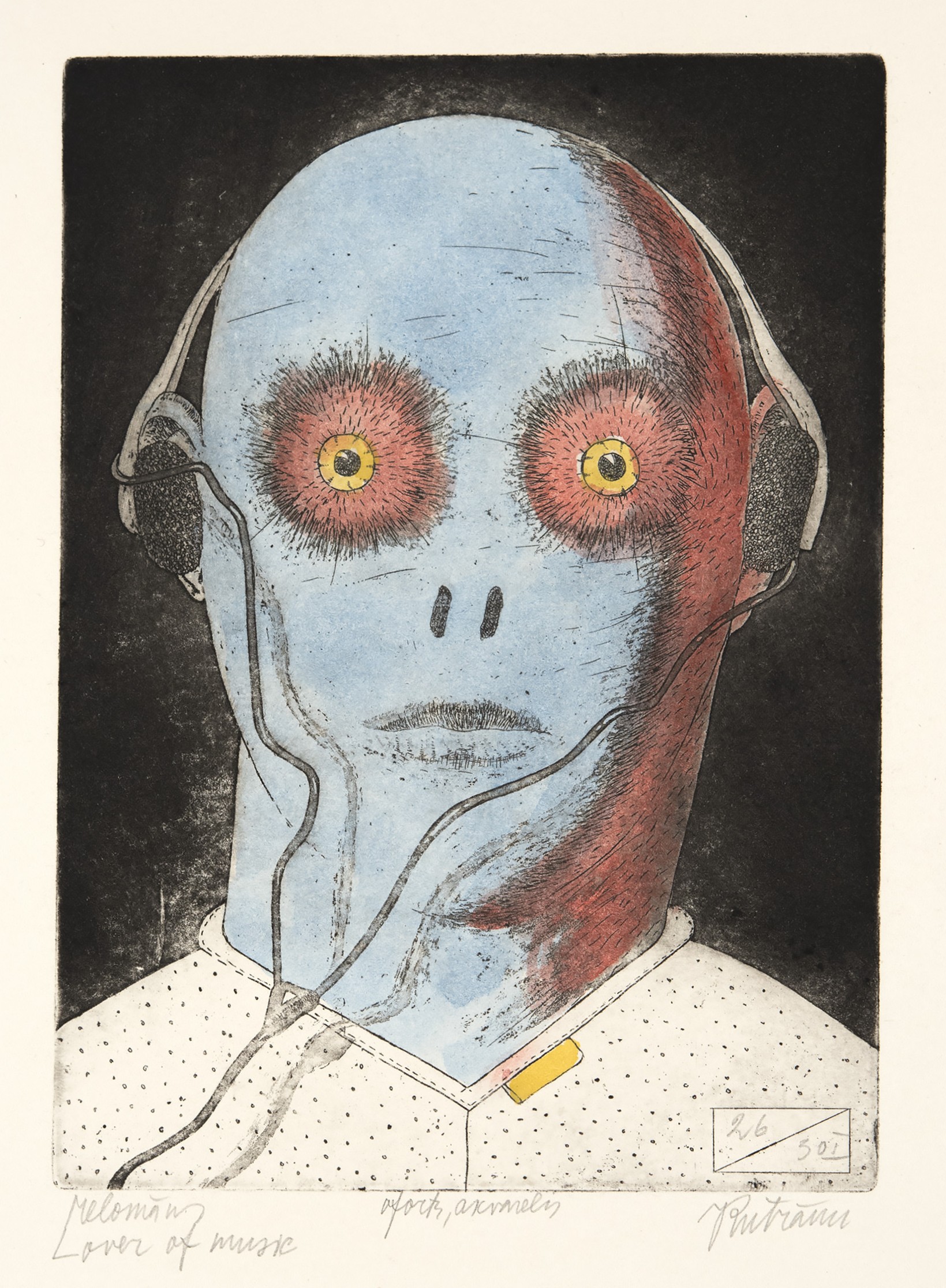
Lover of Music, 1986. Etching on paper, 18 x 13 cm (7 1/16 x 5 1/8 in.). Norton and Nancy Dodge Collection of Nonconformist Art from the Soviet Union. D01333
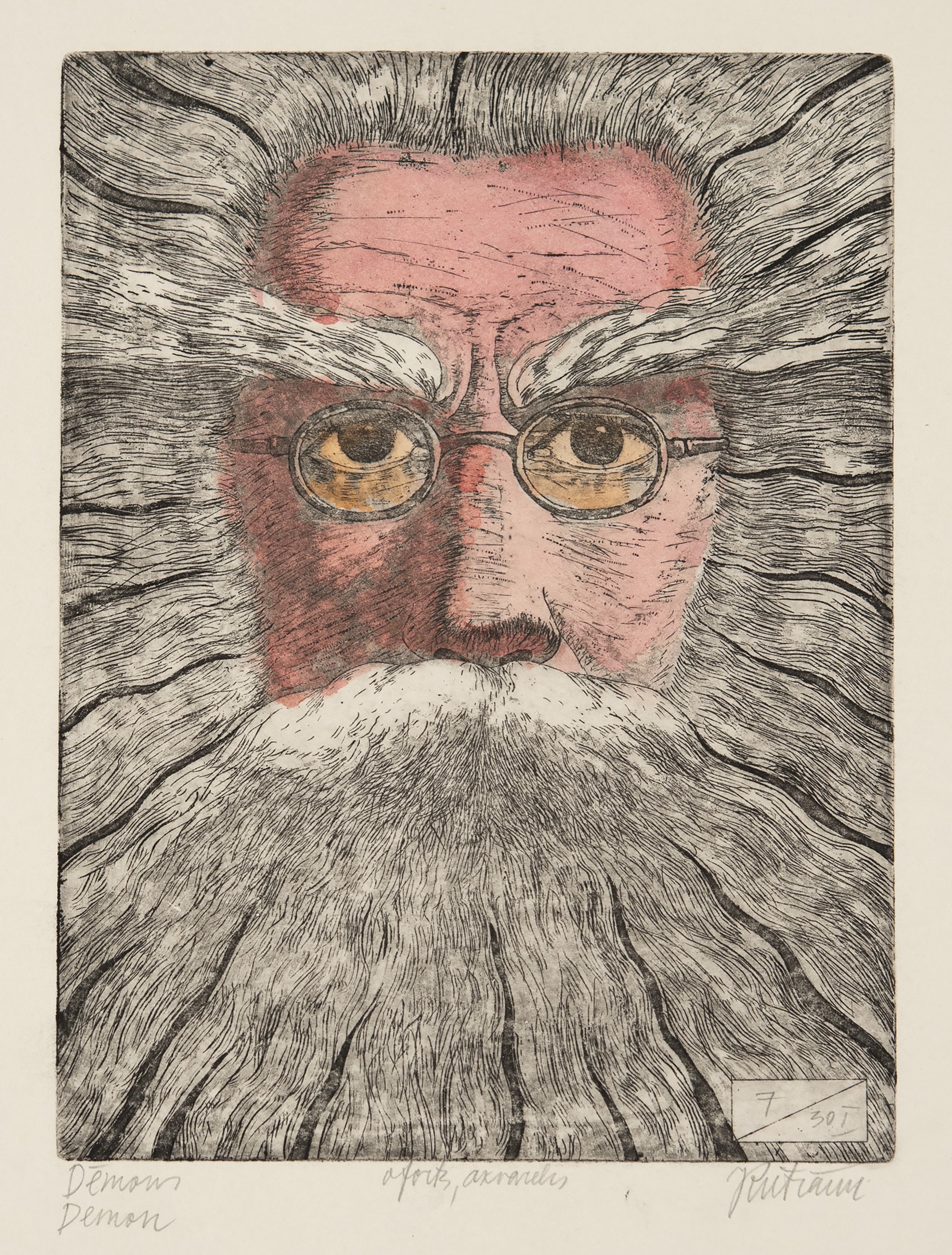
Demon, 1986. Etching on paper, 18 x 13 cm (7 1/16 x 5 1/8 in.). Norton and Nancy Dodge Collection of Nonconformist Art from the Soviet Union. D01330
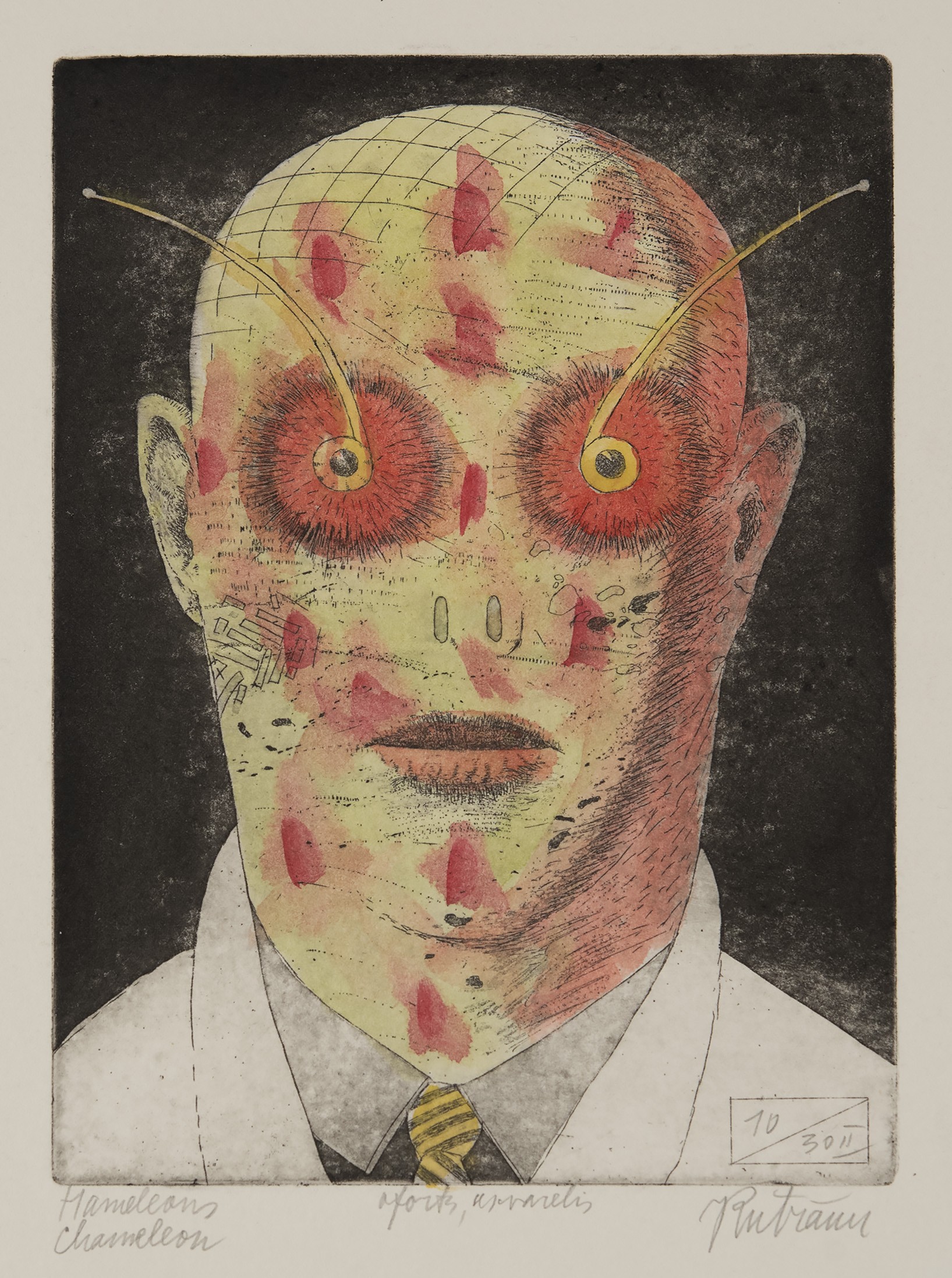
Chameleon, 1986. Etching on paper, 18 x 13 cm (7 1/16 x 5 1/8 in.). Norton and Nancy Dodge Collection of Nonconformist Art from the Soviet Union. D01331
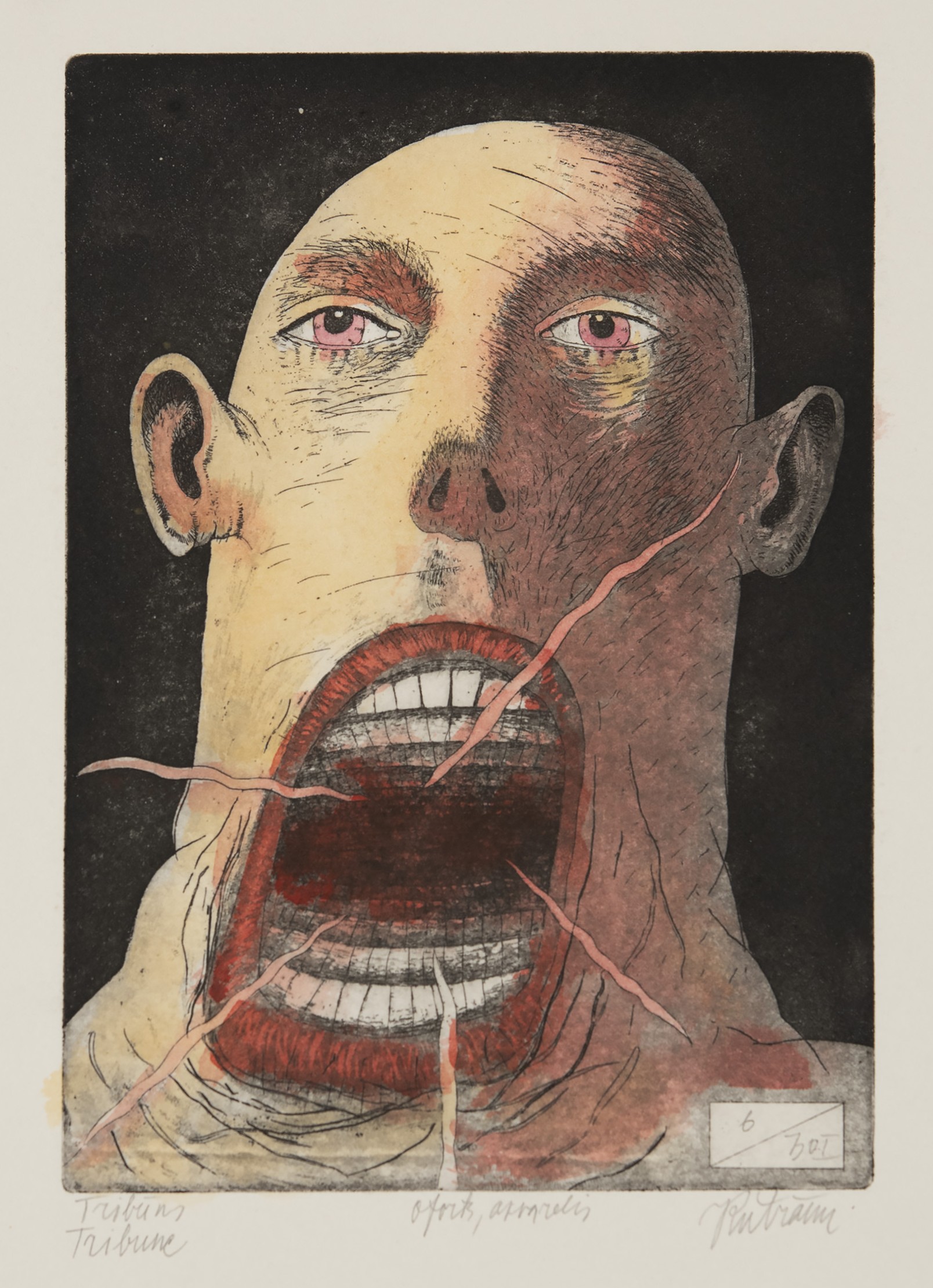
Tribune, 1986. Etching on paper, 18 x 13 cm (7 1/16 x 5 1/8 in.). Norton and Nancy Dodge Collection of Nonconformist Art from the Soviet Union. D01326
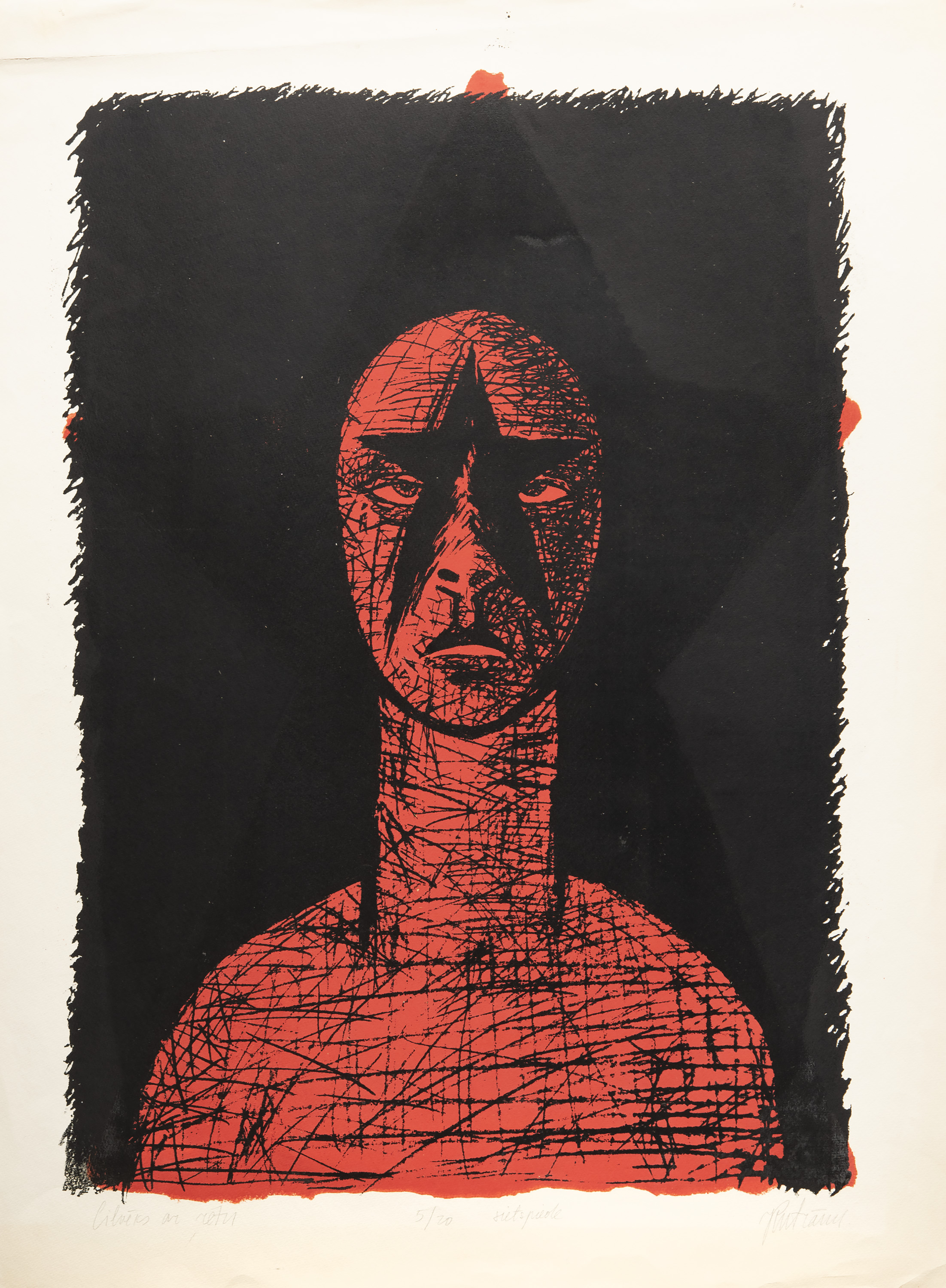
Man with a Scar, undated. Lithograph on paper, 60 × 88 cm (23 5/8 × 34 5/8 in.). Norton and Nancy Dodge Collection of Nonconformist Art from the Soviet Union. D09086