
Jüri Palm
1937 — Tallinn (Estonia) | 2002 — Tallinn (Estonia). Worked in Tallinn (Estonia)
Jüri Palm was born in Tallinn to the family of the violinist Rudolf Palm. From 1957 to 1963, he studied ceramics and printmaking at the State Art Institute of the Estonian Soviet Socialist Republic (now Estonian Academy of Arts), graduating as a poster artist. After graduation he worked mainly as a graphic artist, employing relief print methods typically used in poster art. His first graphic works were figural and adhered to the dark silhouettes and working-people subjects of the artistic severe style officially favored in the Soviet Union. About 1966 his art underwent a significant change: Abstract and surrealist elements started to appear in the realist compositions of his graphic work, and he took up what would thereafter become his main technique, oil painting.
The artist’s expressive personality and inclination toward darker subjects found an appropriate medium in easel painting, which enabled him to create large-scale works with intense color contrasts. Palm’s paintings from the 1960s are relatively small compared to the works of the following decade, but they already anticipate his later concerns. Even paintings that belong to a lyrical early period in Palm’s work such as Ansambel [The Band] (1971, Art Museum of Estonia) and Naised rõdul [Women on the Balcony] (1971, Art Museum of Estonia) have an eerie, surreal quality. In Women on the Balcony, two generations of women rest on a Mediterranean balcony against the background of an azure sky as a peculiar inner light radiates from their bodies. By 1969, when Palm painted Õhtune interjöör [Evening Interior] (Art Museum of Estonia), he was already more interested in dark themes of the evening or night than more serene daytime subjects. Evening Interior contains a number of objects chosen specifically to create an eerie effect: the moving curtain, the dark mirror, and the lemons precariously placed on the round table.
Palm’s painted compositions from the 1970s often deal with topics related to urban civilization. Born and raised in Tallinn, the artist observed how life in the city became faster and the city itself more modern, and he was not convinced that these changes had a positive effect on humankind. Meie elufragment [A Fragment of Our Life] (1973, Art Museum of Estonia) combines fragments of contemporary urban life, mixing symbols of consumption and overproduction, entertainment, and lack of social coherence into a dizzying kaleidoscopic composition. Although Palm mixed together two of the most urban artistic styles of the twentieth century—pop art and photorealism—the prevailing tone in his urban paintings is nevertheless one of emotional confusion, of feeling lost or alienated in the city environment. Palm was aiming to create a daunting nighttime mood similar to Alfred Hitchcock’s horror films. Pööriöö interjöör [Solstice Night Interior] (1976–77, Art Museum of Estonia) is a great example of this: a fragmented space lit by cold, almost cinematographic rays of moonlight, where shadows of strange beings and enormous bow-shaped forms, suggestively wetted with a toxic substance, become visible. The different yellow, blue, and green tones used in this painting appear almost toxic, including the bottle lying in the sink, thus linking this artwork to environmental concerns that increasingly appeared in Estonian art during the decade.
Several of Palm’s urban paintings from the 1970s focus on a nocturnal metropolis scenery and characters similar to western movies of the time—for example, a speeding motorcyclist. In Motoantropos [Moto-Anthropos] (1976, Art Museum of Estonia), there are actually two protagonists—the motorcyclist and the motorcycle itself. Together they create an apocalyptic symbol of modern urban life, a vision, desire, or fear of something that had not yet become a reality in 1970s Soviet Tallinn. Palm, a talented writer who occasionally composed poetry, invented the title’s neologism by combining moto (motorbike) and the Greek anthropos (human being). As in many of Palm’s paintings, the surface of the canvas is divided into several, here successive, frames that read like movie stills: the motorcyclist has let go of the handgrips, raising his hands high while driving through what appears to be a sea of crumpled paper. Moto-Anthropos impressed Palm’s contemporaries so much that it earned him the Kristjan RaudPrize, the highest artistic honor in Estonia, in 1977.
Another recurring figure in Palm´s paintings is a man in a bowler hat, a signature motif of the surrealist René Magritte’s (1898–1967). This lonely and melancholy urban flaneur and the artist’s existential alter ego observes the path that the industrializing and urbanizing human civilization has taken. Palm associated himself with the legacy of European surrealism and in 1989, together with Ilmar Malin, founded the group PARA ’89, which brought together artists who were interested in the style. Due to a developed sense of the absurd, surrealism remained relevant in Estonia—as well as in the rest of socialist Eastern Europe—until the collapse of the Soviet Union.
Even though some of his early works in graphic art border on abstraction and the artist often employed surrealist montage of different fragments, Palm always remained true to figural painting. He became a member of the Soviet Estonian Union of Artists in 1965. He has exhibited widely. The 2011 exhibition Alone in the City at Kumu Art Museum placed the urban paintings of Palm in dialogue with those of Ludmilla Siim, and the 2023 exhibition Art in the Age of the Anthropocene at the same museum brought attention to the eco-critical core of Palm´s paintings. The artist’s works can be found in the collections of the Art Museum of Estonia, Tartu Art Museum, Viinistu Art Museum, and Zimmerli Art Museum.
Liisa Kaljula
Photo portrait: Jüri Palm, 1973. Photographer unknown. Estonian National Archive. EFA.331.0.161597
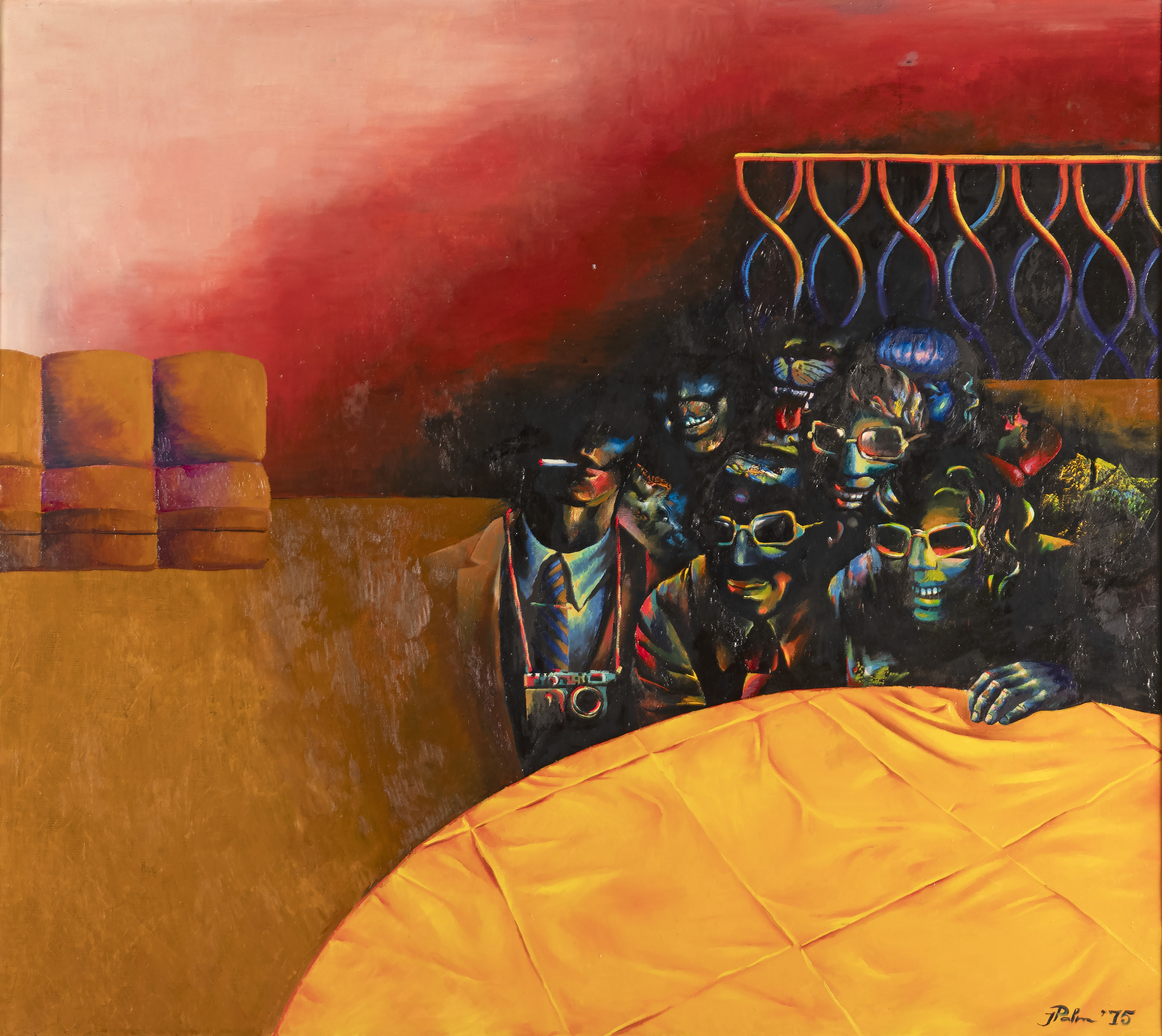
The Guests, 1975. Oil on canvas, 120.2 × 135.5 cm (47 5/16 × 53 3/8 in.). Norton and Nancy Dodge Collection of Nonconformist Art from the Soviet Union. D05226
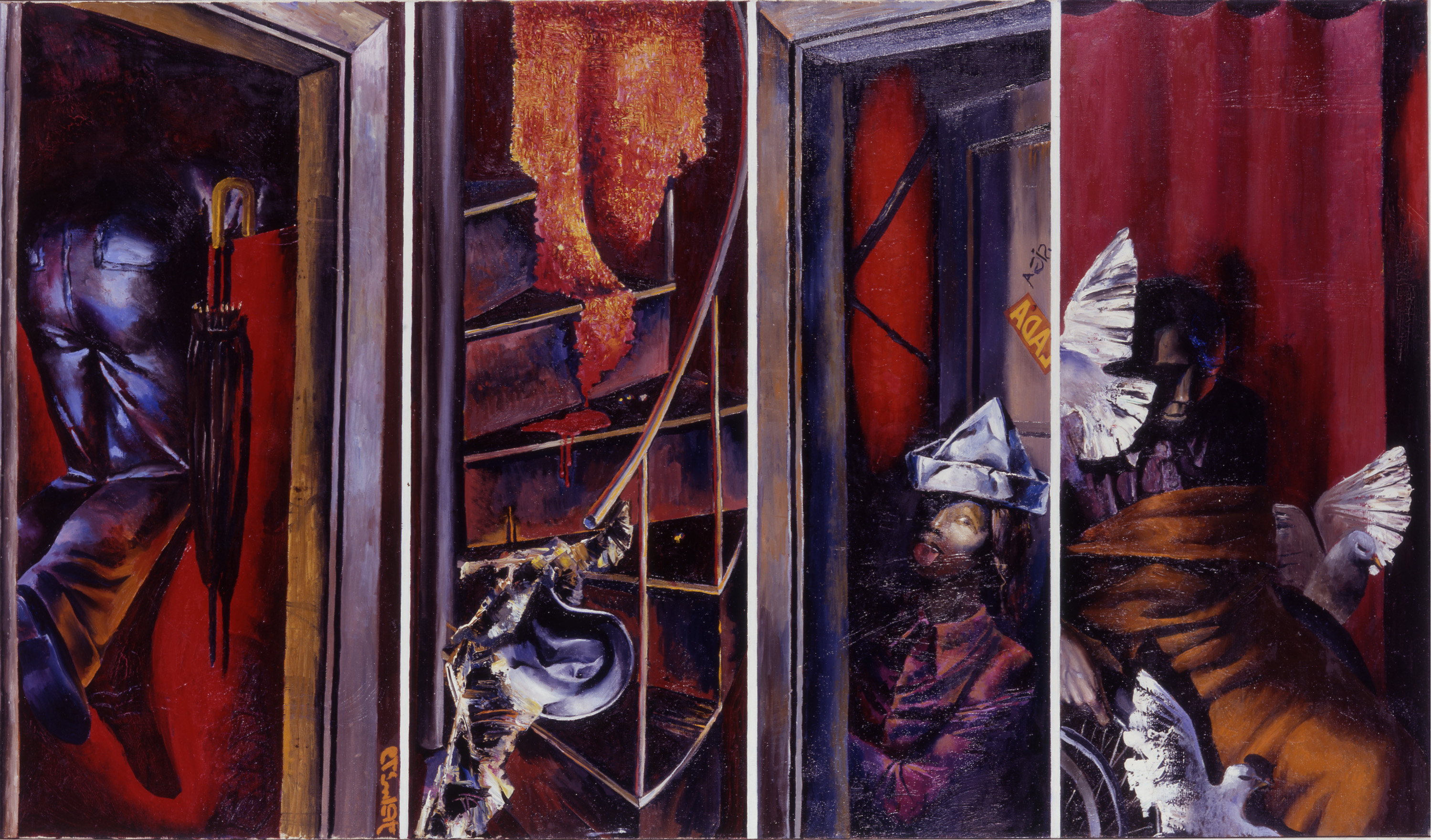
The Mystery of the House, 1979. Oil on canvas, 111 x 191 cm (43 11/16 x 75 3/16 in.). Norton and Nancy Dodge Collection of Nonconformist Art from the Soviet Union. D05228

The Fragrance of Apples, 1980. Oil on canvas, 85.5 × 100 cm (33 11/16 × 39 3/8 in.). Norton and Nancy Dodge Collection of Nonconformist Art from the Soviet Union. D06338
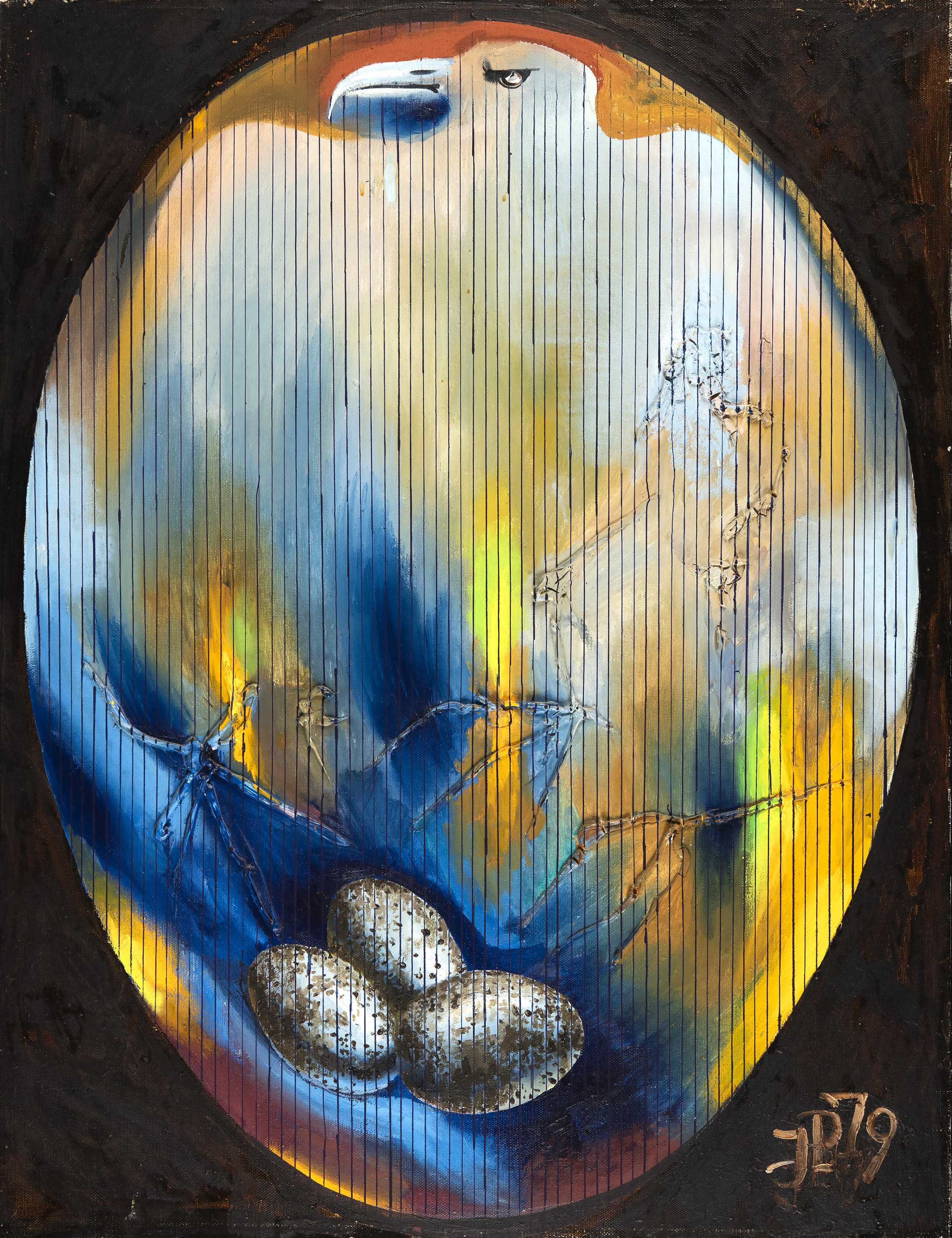
Egg of a White Eagle, 1979. Oil on canvas, 92.2 × 72.2 cm (36 5/16 × 28 7/16 in.). Norton and Nancy Dodge Collection of Nonconformist Art from the Soviet Union. D05005
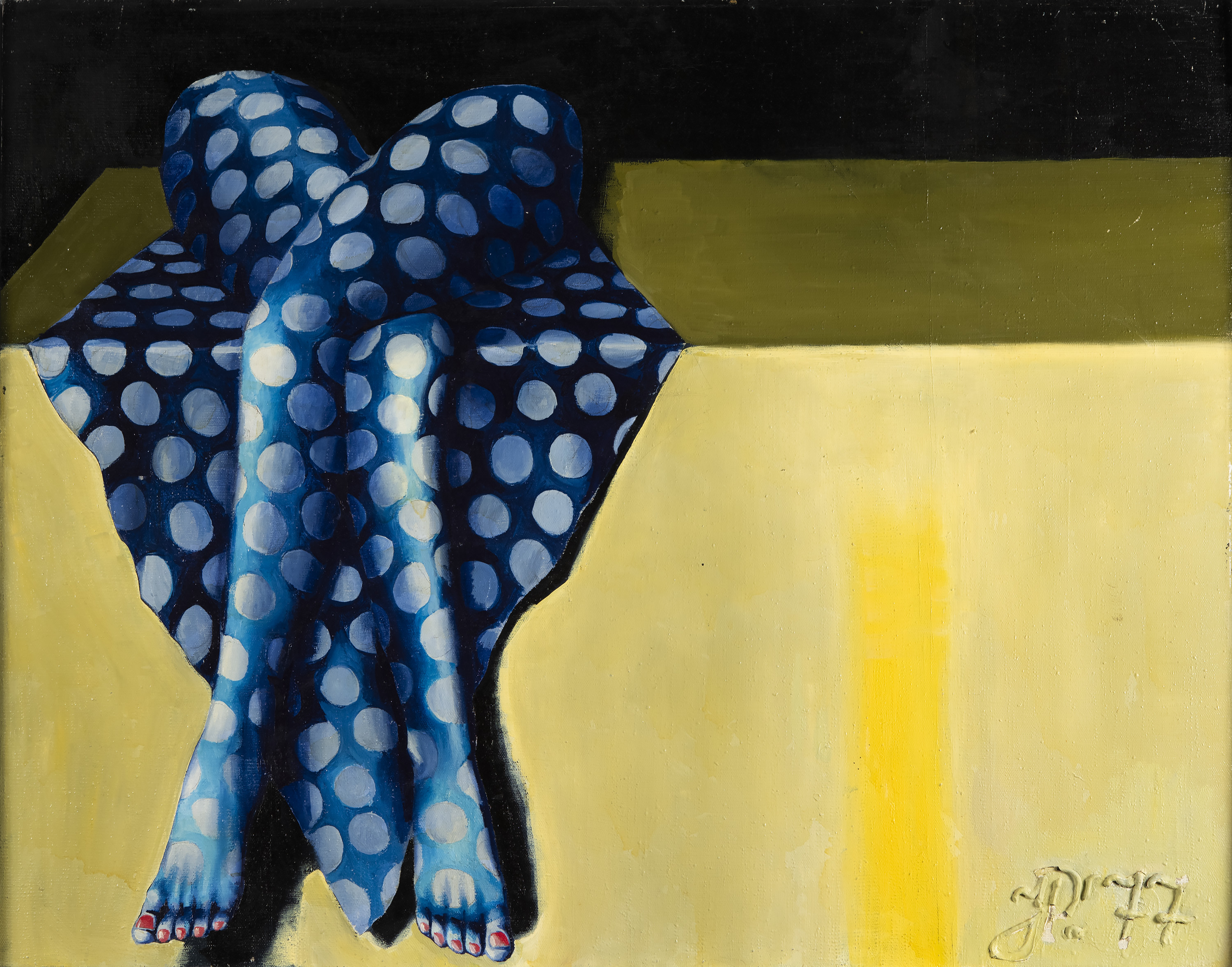
Her Legs, 1977. Oil on canvas, 75 × 100 cm (29 1/2 × 39 3/8 in.). Norton and Nancy Dodge Collection of Nonconformist Art from the Soviet Union. D06036