
Ivars Mailītis
1956 — Vestiena (Latvia). Works in Riga (Latvia)
Ivars Mailītis began his art studies in 1971 at the Riga Secondary School of Applied Arts in the Woodcarving Department. In 1975 he enrolled in the Teodors Zaļkalns Latvian SSR State Academy of Arts (now the Art Academy of Latvia), Industrial Art Department, with a specialization in graphic design, graduating in 1983.
Already during his studies, Mailītis was recognized for his skillful poster design, for which he won several awards. For Mailītis, along with other artists of his generation such as Andris Breže (b. 1958), Ojārs Pētersons (b. 1956), and Juris Putrāms (b. 1956), poster art was a platform enabling the expression of social critique, sarcasm, and irony. Some of these witty posters, for national anti-alcohol or anti-squandering campaigns, were done for financial benefit, while others implicitly critiqued the stagnating state system of the USSR. [1] Mailītis belongs to the so-called “trespassers” (robežpārkāpēji) generation in Latvian art, the group of artists who engaged in political, social, and cultural change in the 1980s and introduced art forms such as installation, performance, and video to Latvia, challenging the dominant conservative canon. [2] One of Mailītis’s most recognized early works was a triptych of graphic plates consisting of The Big Pillow, Giordano Bruno, and The End (1977–78). The first depicted a crowd of small figures trying to squeeze into a huge, amorphous pillow; the second thematized the execution of the truth-seeking cosmologist; and the third showed the deflated pillow of conformity. The works addressed the unwillingness of society to engage in a search for truth. The feeling of the time regarding the anticipation of the collapse of the existing order was also strongly articulated in Mailītis’s oil sketch for the poster Rats, or c’est la vie (1982), which shows a swarm of rats leaving a sinking ship packed with apathetic, unsuspecting humans.
The artist recalls as a formative experience a lecture at the Artists’ Union of the LSSR by the prominent Latvian painter Ojārs Ābols (1922–1983), during which Ābols recounted his impressions of the 1976 Venice Biennale, mentioning the installation in the British pavilion. [3] The 1980s were productive for Mailītis, who began to explore installation, performance, actions, film and video, large-scale graphic prints, and film-set and spatial design. Since 1983, the majority of his installations and performances were realized in collaboration with Inese Mailīte (b. 1959), a 1987 textile graduate of the Art Academy of Latvia and his life partner.
In spring 1983, the couple participated in the annual Art Days organized by the Latvian Artists’ Union in the Old Town of Riga with Orange Helicopter-Action, [4] a performance in which the artists were seated in a toy-like helicopter that was suspended on a cord and passed over the heads of the audience members, attacking a sculptural object in the form of a black airship representing “dark forces.” The action had personal significance for Mailītis, representing confrontation between the individual and the repressive state. A year later, the couple took part in an exhibition conceptualized by Ābols, Nature, Environment, Man. The exhibition, held at Saint Peter’s Church in Riga, for the first time in Latvia displayed large-scale installations by a generation of forward-thinking artists. Mailītis and Mailīte participated in the exhibition with the installation Transformable Installation—Environment for Children, which the artists described as a “positive space,” realized as a participatory environment crowned by a little helicopter. In following years, Mailītis expanded his activities, working as a production designer for the feature films Sprīdītis, named for a fairy-tale character (1985), and Būris [The Cage], 1993) as well as being a set and poster designer for the experimental theater group Studija Nr. 8 [Studio No. 8], established in 1986, which often rehearsed at the Mailītises’ home. He also created outdoor objects, including floating sculptures for the unconventional Film Days 86 events and, with Inese, and an entertaining live sculpture performance, Breakfast with Salvador Dalí, for the 1988 Film Forum Arsenāls in Riga.
In the late 1980s Ivars and Inese Mailītis created their most acclaimed series of works, People—Banners (1988) and Yarn Balls (1990), installations of sculptural objects that were often complemented by performance. In 1988, in their first solo show at the Jāņa Sēta Gallery, the couple presented large, star-shaped, anthropomorphic sculptures, People—Banners, made from shiny pitch-black rope. Some of the objects were suspended and raised above the ground on flagpoles, a metaphor for the sociopolitical and cultural changes of the perestroika (restructuring and reform) years. The display was complemented by prints and photographs in which the naked bodies of the artists were contrasted with the dark rope sculptures, creating an impression of vulnerability. [5] The exhibition also featured an improvised, video-recorded performance by the actors of Studio 8. In 1988–89 the works were included in the important exhibition of Latvian art Riga: Lettische Avantgarde that took place in West Berlin, Bremen, and Kiel. Soon after, the artists developed the sculpture series Yarn Balls, in which entanglements of black rope objects symbolized the course of a human life. The works became the signature pieces of the 14th International Biennial of Tapestry in Lausanne (1989) and, at the turn of the decade, they toured internationally. [6] The displays of these series often featured live performances or photo documentation with naked human figures entangled and suspended in a mesh of black ropes. in between, the performances were captured in four video and film productions (1988, 1992), of which Ivars Mailītis directed Yarn Balls (1990).
In 1988 Mailītis and architects Juris Poga (b. 1957) and Aigars Sparāns (1955–1996) proposed and designed a competition entry for the USSR pavilion at the Universal Exposition Seville 1992 (EXPO ’92). [7] The design featured a rectangular pavilion structure with seventy-five steps leading to a mirror-clad roof. Ironically, the pavilion, with its gravelike shape, was built a year after the collapse of the USSR, becoming the pavilion of Russia. In 1992, in an entry for EXPO ’92 with a different team, [8] Mailītis also attempted to realize the Latvian pavilion, to be situated in the shell of a disabled missile, a relic of Cold War tensions. The project Empire—Fatal Bomb, aiming to document the missile’s journey from Moscow to Seville, was canceled due to the newly signed US–Russian Agreement on the Safe and Secure Transportation of Weapons.
In the mid-1990s Ivars and Inese Mailītis created several installations featuring large plates of wax, on one occasion including beehives and bee colonies. [9] These works emphasized multisensory experience evoked by fragrant beeswax and alluded to the processes of coworking, accumulation, and social coexistence. In 1998 Mailītis created the mesmerizing, mirror-clad Glass House, a performance and exhibition space for the Film Forum Arsenāls, celebrating the 100th birthday of director Sergei Eisenstein (1898–1948).
Since 1992, Ivars turned largely to pavilion design. He has been the chief artist (with Aigars Sparāns) of the multinational Baltic pavilion for EXPO ’93 in Taejon, South Korea; coauthor (with his son, architect Austris Mailītis, b. 1984) of the design of the Latvian pavilion in EXPO 2010 in Shanghai; and chief artist (with the assistance of Inese Mailītis) of the Latvian Song and Dance Festival (1998, 2003, 2013) and a number of School Youth and Student Song and Dance Festivals. Together with Inese and their sons, Austris and Matīss Mailītis (1986–2016), he is coauthor of the reconstruction of the Mežaparks Open-Air Stage (completed in 2021), the central venue of the Latvian Song Festival.
Māra Traumane
Photo portrait: Award of Excellence in Culture ceremony, 2016. Photographer unknown
Notes
1. Ieva Astahovska, “Intervija ar Ivaru Mailīti” [Interview with Ivars Mailītis]. Materials of the project “Documentation and Preservation of Nonconformist Legacy of the Soviet Period for the Collection of the Museum of Contemporary Art,” June 6, 2010, Latvian Center of Contemporary Art Archives, Riga, Latvia. Digital repository: X:\IIE_INFORMACIJAS CENTRS\INFORMACIJAS CENTRS\Projekts UN CITI\PETIJUMS_SATURS\PETIJUMS_TEKSTI_FIN\1_MAKSLINIEKI, MAKSLINIEKU GRUPAS, file: Mailitis_Ivars_IA.
2. Helēna Demakova, “Robežpārkāpēji jeb daži teorētiski pārspriedumi un vēsturiski fakti par Latvijas netradicionālo mākslu” [Trespassers, or Some Theoretical Discussions and Historical Facts About Latvia’s Non-Traditional Art], in Zoom faktors [Zoom Factor], exh. cat. (Riga: Soros Center for Contemporary Arts, 1994), 16. According to Mailītis, the designation was promoted by the artists themselves, first informally applied in 1991 at the S.O.F.A. Nyborg Kunstfestival in Denmark and then at the exhibition Kryss–(Crossing Borders) in 1992 in Norrköping, Sweden, and Bergen, Norway.
3. Presumably, this was the installation by Richard Long, which invited the viewer to find his own path through the British pavilion.
4. Also called by the artists “Oranžais helikopteršlopstermotelis” (Orange Helikopteršlopstermotelis); see Gunta Prape, “Inese Mailīte & Ivars Mailītis,” Liesma 11 (1989):10.
5. The photographs were taken by recognized photographers and friends of the artists Valts Kleins (b. 1960) and Jānis Deinats (b. 1961).
6. It toured in group exhibitions in the Textile Museum, Tillburg, the Netherlands; Museum van Bommel van Dam, Venlo, the Netherlands (1989); S.O.F.A. Art Festival, Nyborg, Denmark (1991); Bergens Kunstforening, Norway (1992); and solo exhibition at the Norrköpings Konstmuseum and Eskilstuna Konstmuseum in Sweden (1991).
7. See Mark Allen Svede, “Curtains: Decor for the End of Empire,” in David Crowley and Susan E. Reid, eds., Socialist Spaces: Sites of Everyday Life in the Eastern Bloc (Oxford: Berg, 2002), 231–49.
8. The 1992 project team included Ivars Mailītis, Valts Kleins, Hardijs Lediņš (1955–2004), and Valdis Poikāns (b. 1957).
9. The artists performed a one-day solo exhibition action at the Riga Gallery (1994) and the group exhibition Ģeo, Ģeo (1996). See Mark Allen Svede, “From Broom Closet to Biennale: Latvian Contemporary Art Exposes Itself,” in Alla Rosenfeld and Norton T. Dodge, eds., Art of the Baltics: The Struggle for Freedom of Artistic Expression Under the Soviets, 1945–1991 (New Brunswick, NJ: Jane Voorhees Zimmerli Art Museum and Rutgers University Press, 2002), 279.
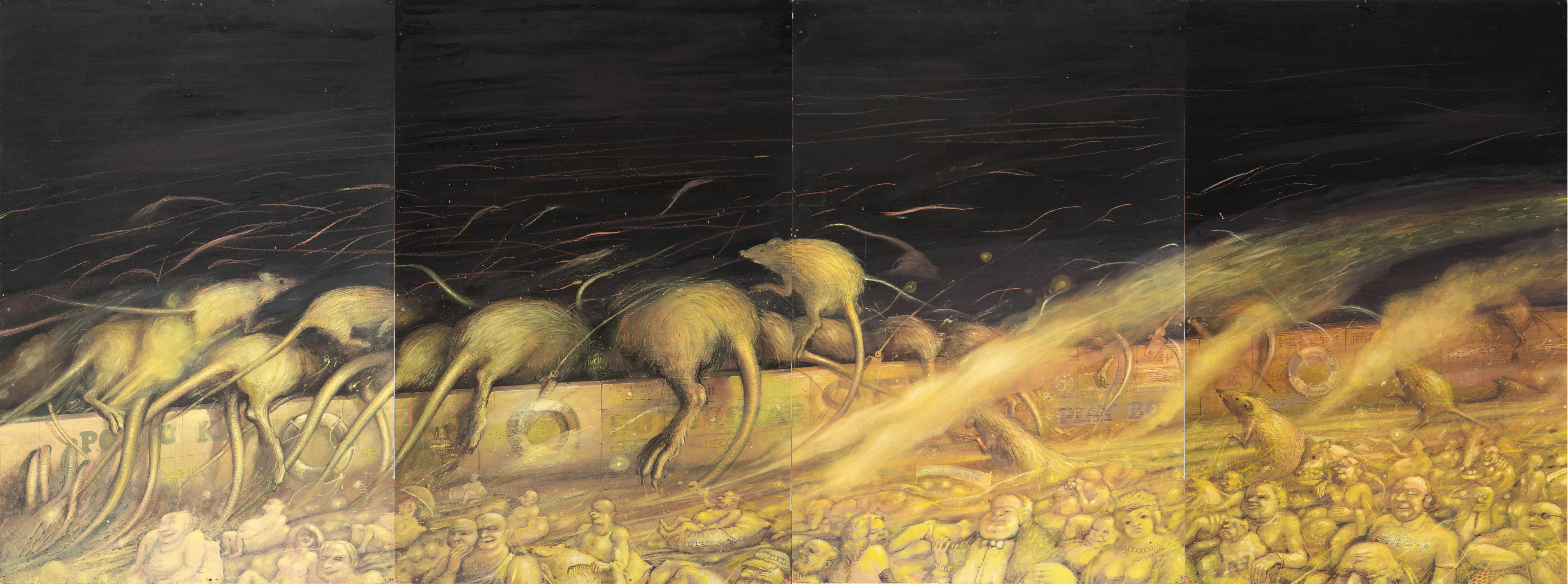
C'est la Vie, 1982. Oil on fiberboard, 4 panels, 90.5 × 240 cm (35 5/8 × 94 1/2 in.). Norton and Nancy Dodge Collection of Nonconformist Art from the Soviet Union. D01386.01-04
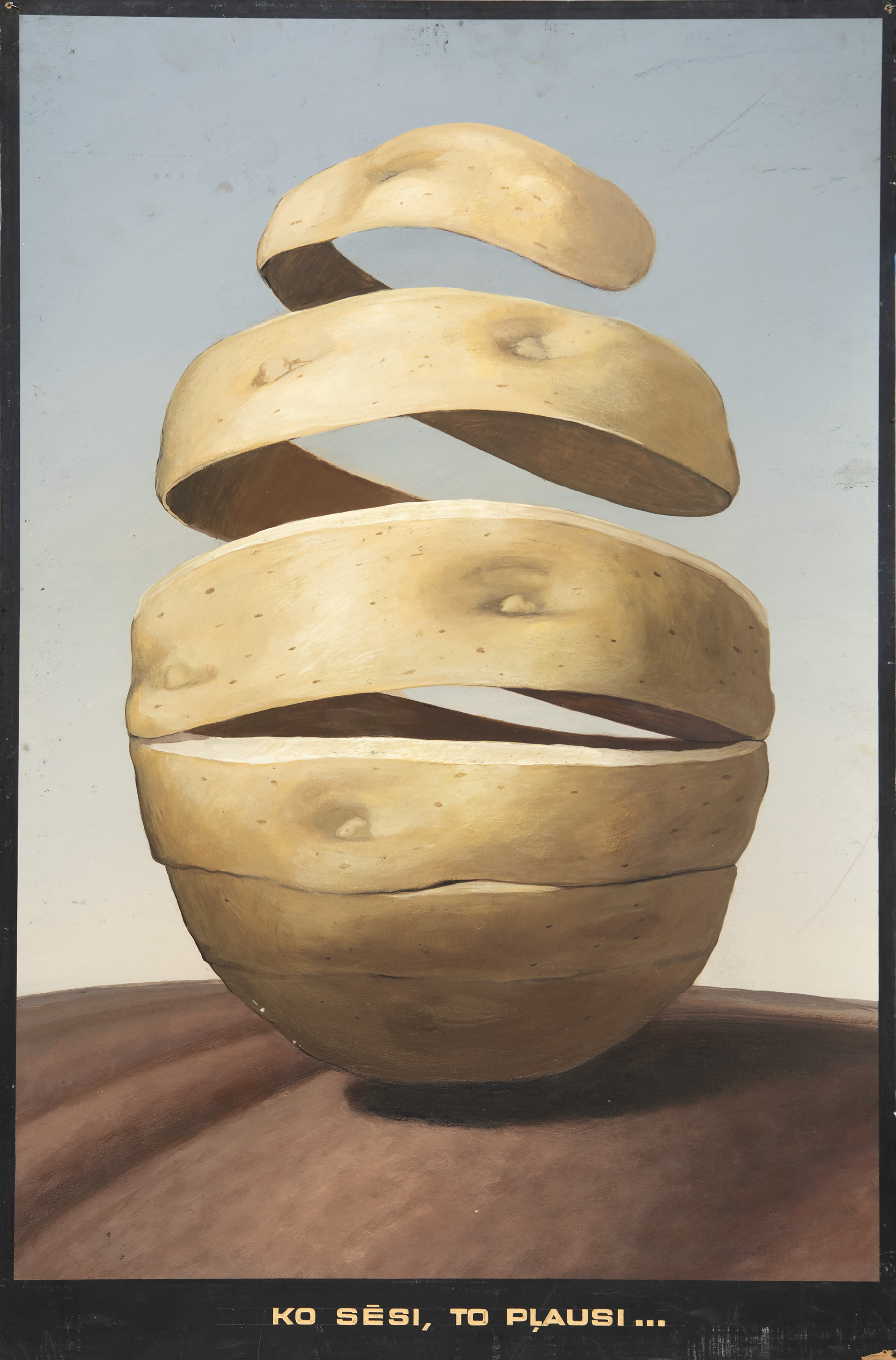
You Reap What You Sow, 1983. Gouache on fiberboard, 89.5 × 60 cm (35 1/4 × 23 5/8 in.). Norton and Nancy Dodge Collection of Nonconformist Art from the Soviet Union. D16986
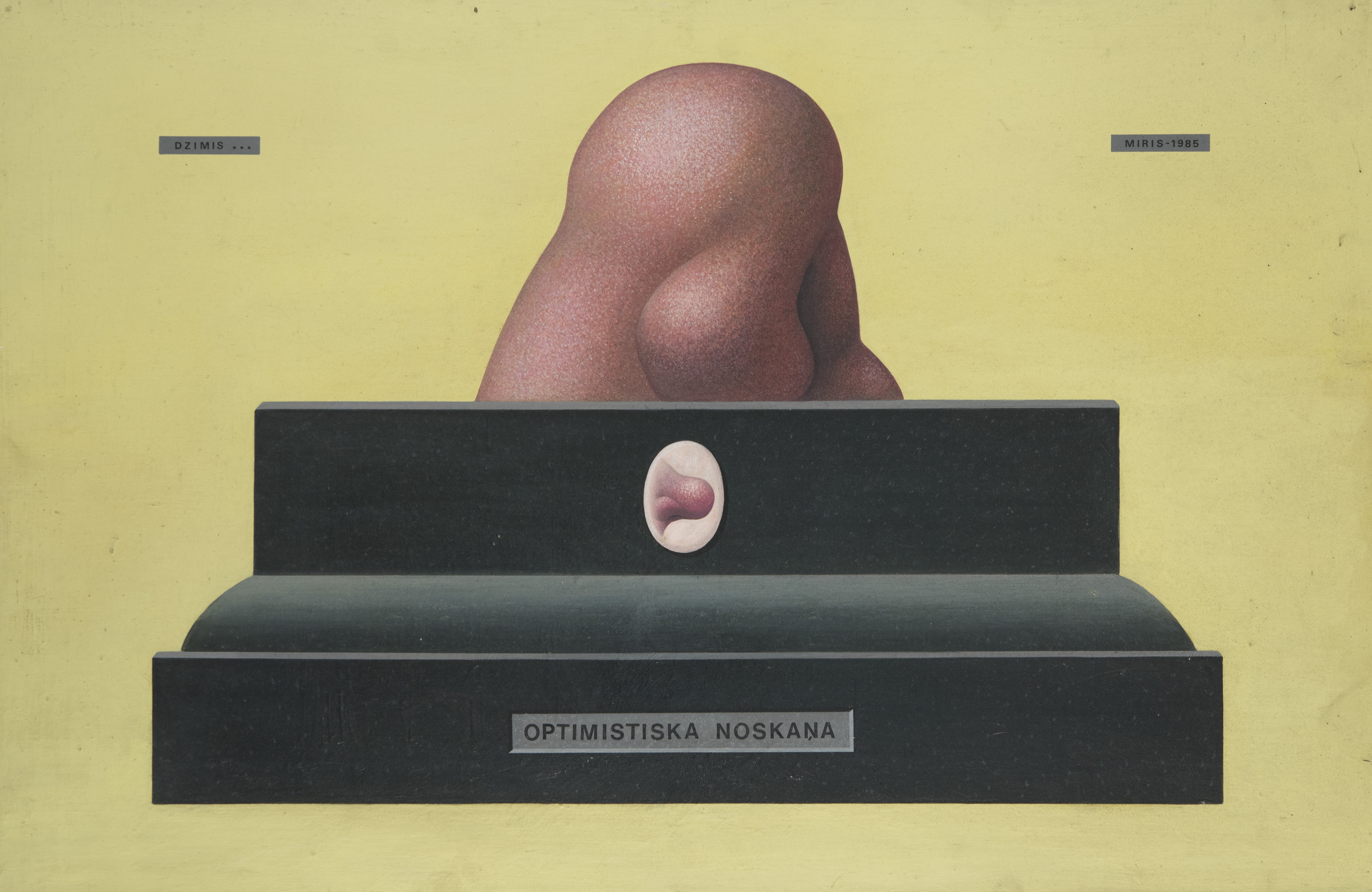
No. 3, 1986. Gouache on fiberboard, 60.3 × 90 cm (23 3/4 × 35 7/16 in.). Norton and Nancy Dodge Collection of Nonconformist Art from the Soviet Union. D16984
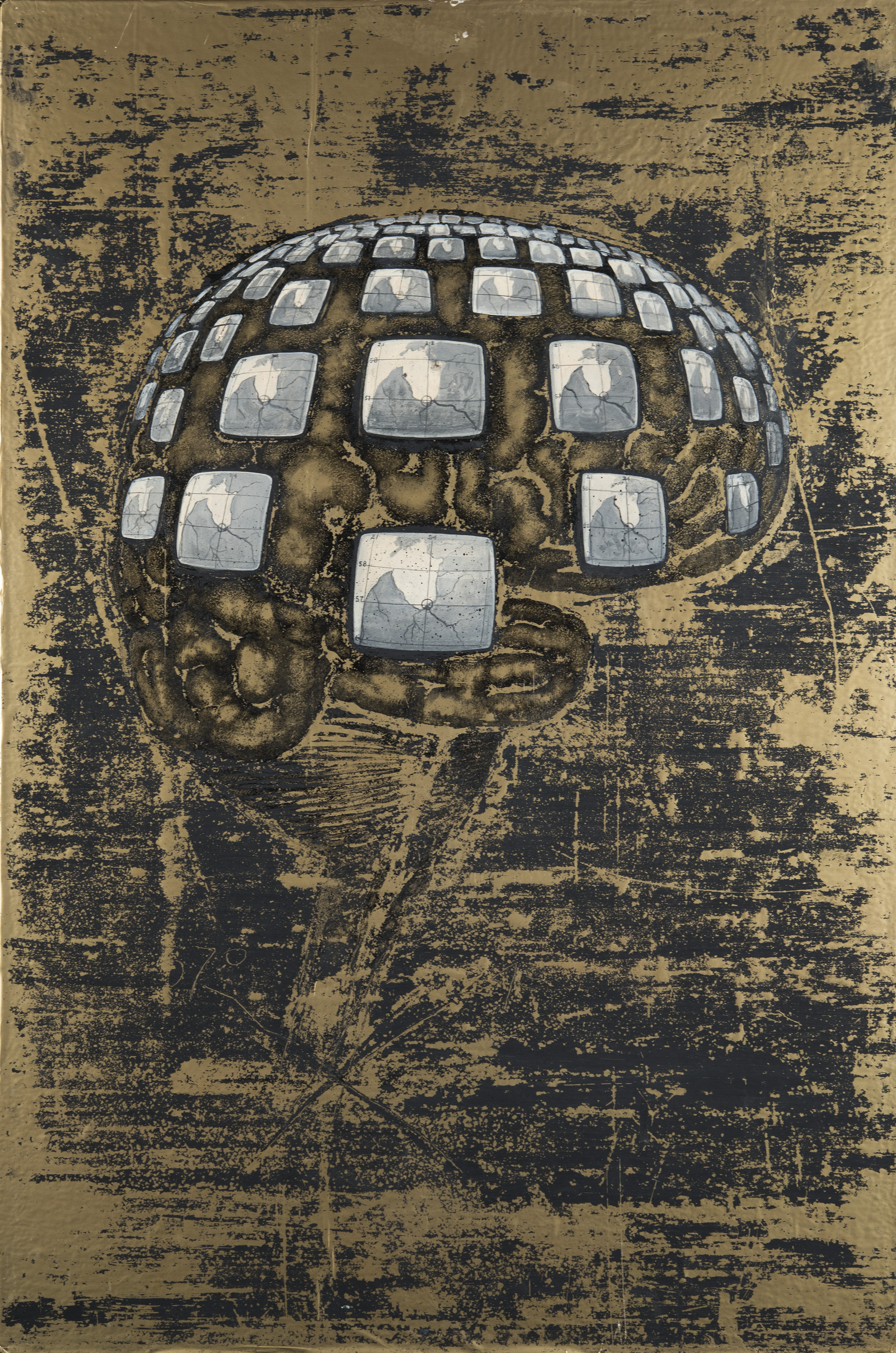
Action Brains in Latvia, 1986. Mylar with ink and gouache on top on fiberboard, 90.5 × 60.5 cm (35 5/8 × 23 13/16 in.). Norton and Nancy Dodge Collection of Nonconformist Art from the Soviet Union. D16982