
Ivan Marchuk
1936 — Moskalivka, Ternopil region (Ukraine). Worked in Kyiv (Ukraine), New York (USA), Moscow (Russia); currently works in Kyiv (Ukraine)
Born on May 12, 1936, in the village of Moskalivka, Ternopil region, Ukraine, Ivan Stepanovich Marchuk is a Ukrainian painter, muralist, and ceramicist, and a key figure of the Soviet nonconformist art scene from the 1960s to the 1980s. In the post-Soviet period, he was awarded various state prizes and honorary titles in Ukraine, holding the titles of Honored Artist of Ukraine (1996), Laureate of the Taras Shevchenko National Prize of Ukraine (1997), and People's Artist of Ukraine (2002).
Marchuk received his education at the Department of Decorative Painting of the School of Applied Arts named after Ivan Trush (now the Ivan Trush Lviv State College of Decorative and Applied Arts) (1956) and the Department of Ceramics at the Lviv State Institute of Applied and Decorative Arts (now Lviv National Academy of Arts) (1965). At the same time, from 1959 to 1965, he attended the "underground academy” of Karlo Zvirynsky, among the Sixtiers who sought to expand education beyond the rigidity of the workshop-based Soviet education system. [1]
After his studies, Marchuk worked in Kyiv as an artist at the V. Bakul Institute of Superhard Materials of the Academy of Sciences of the Ukrainian SSR (now National Academy of Sciences of Ukraine) (1965–1968) and at the monumentalist and decorative art combinat (kombinat, 1968–1984), and collaborated with the magazines Vsesvit (Universe), Vitchyzna (Homeland), and Dnipro.
He is the artist behind the mosaic Любіть книгу—джерело знань [Love the Book — It Is the Source of Knowledge] on the facade of the Taras Shevchenko Art High School in Kyiv (created in partnership with Olga Rapai and V. Melnikov, 1969), the ceramic panel Ярослав Мудрий [Yaroslav the Wise], the mosaics Фізики [Physicists] and Плахта [Plakhta] [2] at the N.N. Bogolyubov Institute for Theoretical Physics in Kyiv (1969–1971), the mural paintings Дари землі [Gifts of the Earth] which are located in the pavilion of the Exhibition of Achievements of the National Economy (now Expocenter of Ukraine) in Kyiv (1975), in the Hotel Ukraina in Moscow (1977), and the Sosny sanatorium in the village of Bykovo near Moscow (1981).
At the beginning of his creative career, he worked in ceramics, design, and illustration, mediums he used to interpret the traditions of Ukrainian folk and medieval art.
He has been painting continuously since the 1960s. His most significant series of paintings is Голос моєї душі [The Voice of My Soul] (1965–1971), and we can find the main features of his painting represented within them: folkloric worldview, allegorical interpretation of narrative motifs, sentimental tone, and the distinctive authorial technique of "pliontarism" (from the Ukrainian "пльонтати [pliontaty]," meaning to weave). The artist's paintings, usually painted with fine brushes, seem to be composed of thin, tightly intertwined colored threads or ribbons. The artist creates series of paintings that can be span across decades. His series include: Landscapes (from 1971 onwards), Цвітіння [Blossoming] (from 1973), Кольорові прелюдії [Colored Preludes] (from 1978), Portraits (from 1979), and the series Shevchenkiana (from 1982). During the 1990s and 2000s, he created the series Нові експресії [New Expressions], Still Life, Біла планета І [White Planet I], Біла планета ІІ [White Planet II], Виходять мрії з берегів [Dreams Spill Over from the Shores], and Погляд у Безмежність [A Look into Infinity]. In these, the artist interprets a wide range of various figurative and artistic styles—from primitivism to realism in the spirit of Ukrainian art of the 19th century, as well as surrealism, expressionism, and ornamental and decorative abstraction. Due to their nonconformity to socialist realism, the officially sanctioned style of Soviet art, the artist's paintings were not exhibited in Ukraine and the USSR for many years.
In 1968, Marchuk signed the 139 Letter of Protest, which was sent to the leaders of the USSR Leonid Brezhnev, Alexei Kosygin, and Nikolai Podgorny in response to the illegal trials of dissidents in Ukraine and the ideological pressure that existed across various cultural spheres in the country. After he signed the letter, the KGB began monitoring Marchuk.
Marchuk’s first exhibition was in 1979, under the title Contemporary Art from Ukraine. Exhibition of Painting, Drawing, Sculpture. Munich, London, New York, Paris (catalogue published in 1980). The project, organized by members of the Ukrainian diaspora, presented non-socialist realist art of Ukraine to the world for the first time. His first solo exhibition took place in Moscow the same year, in the Exhibition Hall on Malaia Gruzinskaia Street. Despite this, Marchuk was not yet admitted to the Union of Artists of Ukraine. From the late 1970s onward, exhibitions of his works were held at unofficial venues, such as research institutes and libraries. In 1988, during the perestroika period, he was finally admitted to the Union of Artists. In 1989, he moved to Australia, then in 1990, he moved to Canada, and from 1990 to 2000, he lived in the United States, periodically visiting Ukraine. After the events of September 11, 2001, in New York, he moved back to Ukraine.
Since then, he has held several hundred exhibitions in Ukraine and abroad. The artist's works are invariably popular with audiences in Ukraine. In the complicated context of sociocultural change amid a national journey towards self-determination that Ukraine experienced following the collapse of the USSR, Ivan Marchuk's work is generally perceived as the embodiment of a particularly Ukrainian worldview, with its national character and aesthetic traditions. His work can be characterized by its reliance on folk art, a retrospective perception of nature and the world, and his use of a pictorial language that has a mysterious symbolic ambiguity.
Halyna Skliarenko
Translated from Ukrainian by Nathan Jeffers
Notes:
1. Karlo Yosypovych Zvirynsky (1923–1997) was a Ukrainian painter and teacher. He was a representative of Soviet unofficial art from the late 1950s to the 1980s. Between 1959 and1966, he organized an "underground academy" in Lviv, which operated out of his apartment, giving lectures to students on world and Ukrainian art. (Viktor Korsak, foreword to Hermetychne kolo Karla Zvirynskoho: albom-monohrafiia [The Hermetic Circle of Karl Zvirynsky: album-monograph] by Mysiuga Bohdan. Lutsk-Lviv MSUMK, LNAM, Kolo, 2019: 280.)
2. A component of traditional Ukrainian dress, specifically, the unstitched waist section of a woman’s dress.

Composition, 1978. Watercolor on paper, 27.4 × 32.4 cm (10 13/16 × 12 3/4 in.). Norton and Nancy Dodge Collection of Nonconformist Art from the Soviet Union. D10164
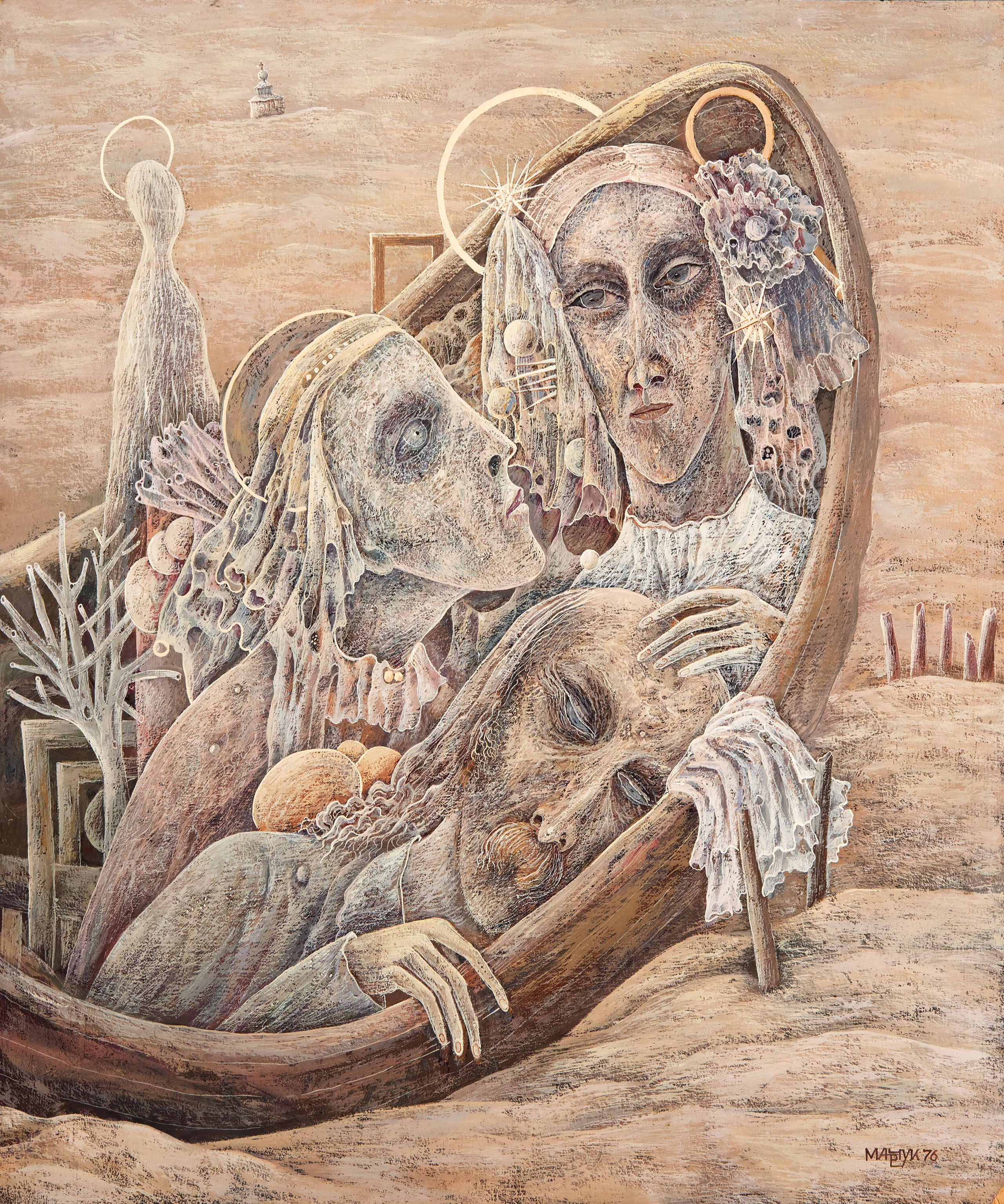
In the Boat, 1976. Tempera on cardboard, 48 × 42 cm (18 7/8 × 16 9/16 in.). Norton and Nancy Dodge Collection of Nonconformist Art from the Soviet Union. D10161
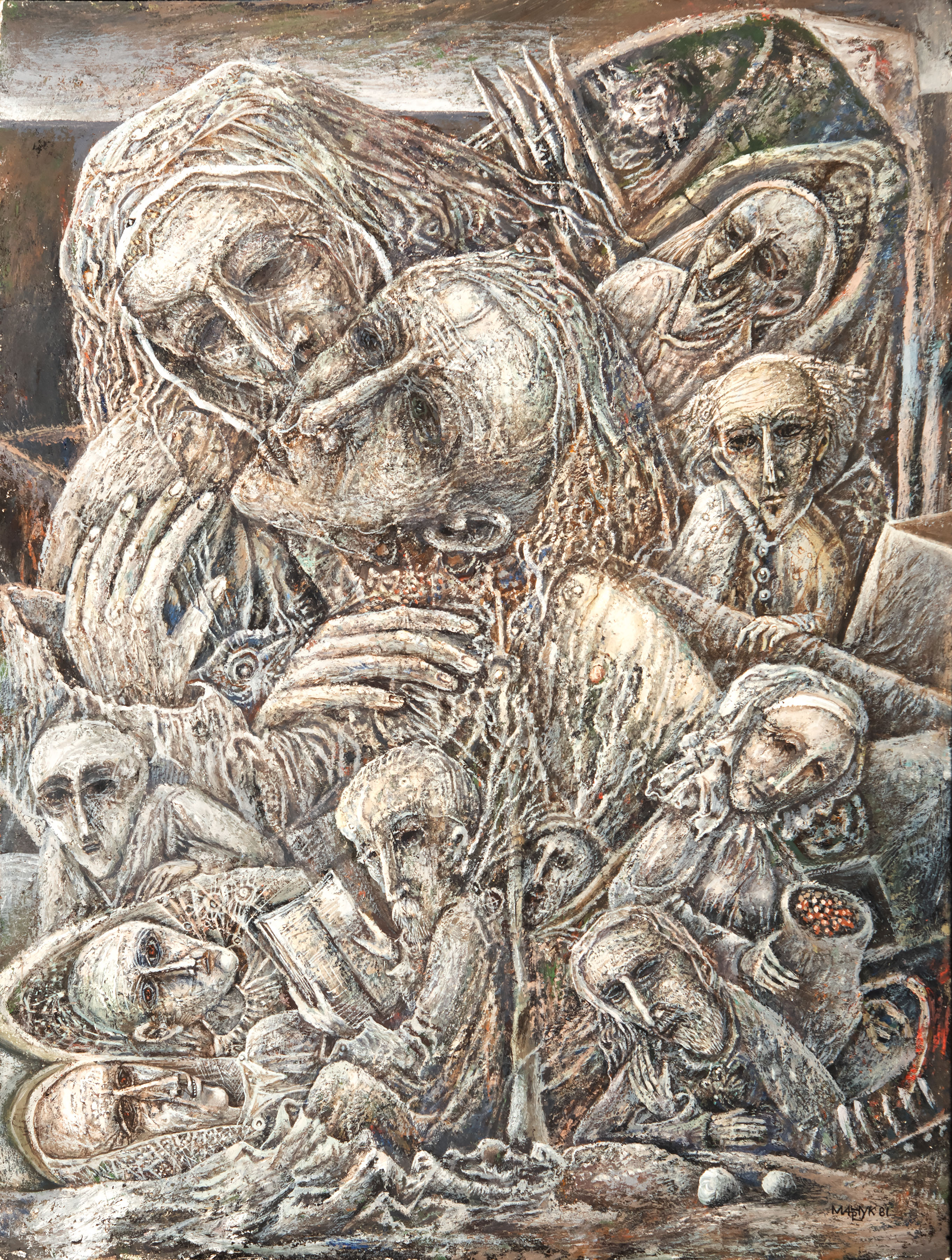
Voice of My Soul, 1981. Tempera on cardboard, 58.5 × 44.2 cm (23 1/16 × 17 3/8 in.). Norton and Nancy Dodge Collection of Nonconformist Art from the Soviet Union. D10162

Presentment from the series Remembrance of Chornobyl, 1986. Oil on cardboard, 35.5 × 47.5 cm (14 × 18 11/16 in.). Norton and Nancy Dodge Collection of Nonconformist Art from the Soviet Union. D10160