
Henry Khudyakov
a.k.a. Genrikh Fedorovich Khudyakov, a.k.a. Avtograf
1930 — Chelyabinsk (Russia) | 2019 — Jersey City, New Jersey (USA). Worked in Moscow (Russia), New York (USA), and Jersey City, New Jersey (USA)
Henry Khudyakov was a Russian conceptual poet who became a visual artist after immigrating to the United States in 1974.
Khudyakov was born in Chelyabinsk, Russia. His father worked for a government science enterprise and his mother taught literature. In 1948, after graduating high school in Moscow, he applied to Frunze Higher Naval School in Leningrad (later named the Saint Petersburg Naval Institute). Arriving for the admittance exams, he hesitated after seeing the other applicants. As it was raining, he sought shelter under the arch of another building, where he was asked if he was taking the entrance exam for the Leningrad University Faculty of Philology, his mother’s alma mater. He took the exam there and was admitted.
Khudyakov started writing poetry in 1955, first in traditional forms and later in free verse, after realizing that a more open form was better suited to the intensity of emotion that he was trying to convey in his poems. He would later invent a graphic system in which to write poetry.
In 1960, while working as an art historian for the Vsesoyuznaya Peredvizhnaya Vistavka Plakata [Nationwide Traveling Poster exhibition], he was able to travel to the Caucasus region, and he spent nearly two years in Central Asia. There, he became interested in yoga and breathing techniques that he would later incorporate into a new form of recitation for his poetry. Focusing on the diaphragm and throat, he was able to produce a rhythmic glottal stoppage, similar to that caused by a highly emotional state.
He began working at the Department of Information in Leningrad as a translator for technical documents in English and Czech. He had access to a typewriter in his new position, and so was able to type up his poems, creating self-published conceptual poetry books (samizdat). The first, Koshki-“Mishki” ili Treti k Lishnim, was published in 1963, followed by Katsaveiki in 1965 and Tvari po pare in 1966. He devised a radical technique, cutting up and rearranging lines in a poem and then reciting it in its new layout—a visual approach to poetry that later evolved into an artistic practice.
In the early 1960s, he recited and “showed” his poems at a performance gathering in Moscow. He stretched robes across the walls, from which he hung manuscript pages (approximately 30 x 40 cm, or 12 x 16 in., in size) from his book Katsaveiki. In addition to the text, these collages included scraps of fabric, broken pins, the author’s passport picture, and his fingerprint.
In 1968, an American journalist, who had met Khudyakov in Moscow, brought Katsaveiki to the United States to be included in the S.M.S. portfolios. S.M.S. (an abbreviation for “Shit Must Stop”) was a collaborative project between the surrealist artists William Copley (1919–1996) and Dmitri Petrov (1919–1986), protesting the commercialization of art by galleries. It offered a portfolio of artwork by subscription, published in editions through Letter Edged in Black Press. Six portfolios, containing eleven to thirteen objects, were ultimately produced. Khudyakov, under his pseudonym Avtograf, was included in S.M.S., No. 3 (1968) along with Marcel Duchamp, Man Ray, William Copley, John Cage, Dick Higgins, Yoko Ono, and others.
In 1974, Khudyakov, seeking a less restrictive environment in which to publish his poetry, immigrated to the United States, settling in New York City’s East Village. He immersed himself in the vibrant art scene for almost two years before beginning work as a visual artist. He attributed his disconnection from his own language to be one of the reasons for his turn from poetry to the visual arts.
His artwork frequently featured found objects, recurring patterns, and text elements. One of his signature motifs was the well-known “I Love New York” logo (1977), often with a heart symbol in place of the word “Love.”
His “soft sculptures” focused on clothing as a means of expression. The Shirt (1984–91, ZAM, 2021.017.001) was inspired by the sight of businessmen on Wall Street, who would undo their ties after leaving the office on hot summer days—a look he found sloppy. In reaction, he created dress shirts featuring beautifully painted and embroidered untied ties and decorated collars. He transformed donated jackets, which were cheaper than canvas, into resplendent mosaics of textiles, pins, buttons, and can labels, often taking the New York City night skyline as inspiration. He would begin a work, signing the time and date on the verso, and then leave it until he was ready to continue, which could be a day, a few months, or years. Most of his artworks were created over a period of two decades, the back of the work covered with documented additions. As art historian John Bowlt has noted, “The results are glamourous in their dissonance and jarring in their syncopation.” [1]
Khudyakov’s first solo exhibition, Visionary Nonwearables. E.S.P.ionage, was held in 1982, at the Contemporary Russian Art Center of America, under the direction of Norton Dodge and curated by Margarita Tupitsyn. When Dodge showed interest in one of the works, asking its price, Khudyakov responded, “A Malevich will go for a million dollars. I’m ten times as bad as Malevich. Now you do the math.” [2]
In 1984, Khudyakov’s mother, with whom he had been close, died in Moscow. Her death was devastating for him, made worse by his inability to return to Russia in the intervening years due to the Soviet government’s policies towards its émigré citizens. It was also a turning point for him as an artist. As he recounted, “I bought twenty pieces of canvas and said to myself: I will now challenge myself. If I’m a true artist, in three months I will fill the twenty pieces with paintings on twenty various themes. And if I’m not gifted, I don’t have much to lose. At least I will know my limits. And I did it! All the twenty pieces! My hand was jumping like crazy!” He continued work on those paintings for the next three decades.
In 1989, the Fine Arts Museum of Long Island, in Hempstead, New York, mounted his retrospective I Love NY, about which its curator, Eleanor Flomenhaft, wrote, “Hundreds of hours go into each compelling work by this remarkable artist, and many works have three lives, recreated in intervals of seven years in which they underwent a sequence of changes.” [3] In 1990, his solo exhibition Art or Bust was held at Eduard Nakhamkin Fine Arts Gallery in New York City.
In 1993, he moved from Brooklyn, New York, where he lived in an artist community, to Jersey City, New Jersey. His apartment was an artwork by itself. The outside door was covered in collage, and a sign announced Khudyakov to be the self-proclaimed “Knight of the Statue of Liberty,” the iconic monument visible from his window. The inside of his apartment was covered in various drawings, collages, pennies, and glitter. A human-height statue of Sir Galahad, knight of King Arthur’s Round Table, which Khudyakov chose as his double, was placed by his bed.
In 1996, a solo exhibition titled Top Floor Art was held at the Tabakman Museum of Contemporary Russian Art, in Hudson, New York, curated by the artist himself. In 2017, The Shirt and the book Katsaveiki were made a part of the permanent collection at the Centre Pompidou, Paris, France.
Khudyakov died on January 10, 2019, at the age of eighty-eight; in March of that year, a solo exhibition, Jumbo Love, curated by Vitaly Patsiukov, was held at the Moscow Museum of Modern Art, in Moscow—the first time Khudyakov’s work had been exhibited at an official venue in his home country.
Marina Dlugy
Photo portrait: Henry Khudyakov at the group exhibition at the C.A.S.E. museum in Jersey City, 1980. Photo by Nina Alovert.
Notes
1. Bowlt, John E. “To Wear or Not to Wear.” Henry Khudyakov. Moscow: Virtual Gallery Publishing, 2019: 62.
2.Bruskin, Grisha. Подробности письмом [Podrobnosti pismom, Details will follow in a letter]. Moscow: Novoe Literaturnoe Obozrenie, 2005.
3. Flomenhaft, Eleanor. Henry Khudyakov: I Love NY, exh. cat. Hempstead, NY: Fine Arts Museum of Long Island, 1989: 3.

The Shirt, 1984–91. Mixed media on fabric, 83.8 × 58.4 cm (33 × 23 in.). Gift of Marina Dlugy-Tabakman and Roman Tabakman. 2021.017.001
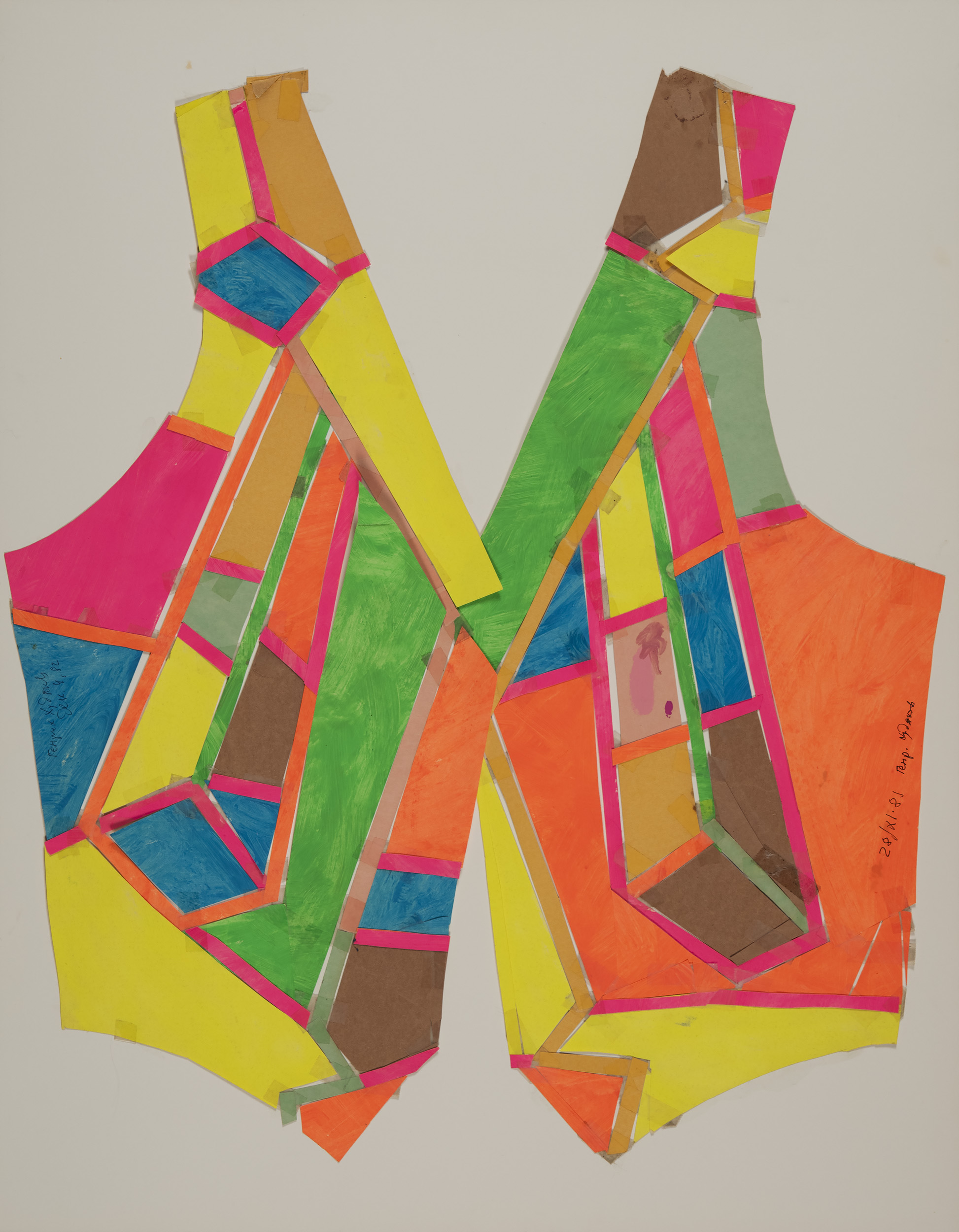
The Vest, 1981–82. Collage and tempera on paper, 70.4 × 56.1 cm (27 11/16 × 22 1/16 in.). Norton and Nancy Dodge Collection of Nonconformist Art from the Soviet Union. D08539

Sundial, 1985–95. Mixed media on canvas; painted foam, glitter, broken hangers, acrylic paint, plastic, 102.1 × 76.2 × 11 cm (40 3/16 × 30 × 4 5/16 in.). Gift of Marina Dlugy-Tabakman and Roman Tabakman. 2021.017.002

Yin and Yang, 1986–95. Mixed media on cardboard and burlap; acrylic, glitter, matchsticks, plastic, paper, 108.5 × 132.1 cm (42 11/16 × 52 in.). Gift of Marina Dlugy-Tabakman and Roman Tabakman. 2021.017.003

The Tie Shirt, 1991–96. Mixed media on foam core board; acrylic paint, glitter, shirt, 100.8 × 151.1 cm (39 11/16 × 59 1/2 in.). Gift of Marina Dlugy-Tabakman and Roman Tabakman. 2021.017.004