

Henry Elibekyan
1936 — Tbilisi (Georgia) | 2019 — Moscow (Russia). Worked in Yerevan (Armenia) and Moscow (Russia)
Henry Elibekyan was among the key figures in Armenia’s “national modernism,” or second-wave avant-garde, that emerged in the 1960s, following the political and cultural liberalization known as the Khrushchev Thaw. Within the cohort of Armenian modernists of the 1960s, he was the most radical and stood closest to the historical avant-garde; his artistic arsenal encompassed a breadth that ranged from cubism and biomorphic surrealism to abstraction, expressionism, absurdism, and pop art. Elibekyan worked in nearly all forms of visual art: painting, graphic art, sculpture, set design, collage, assemblage, installation, performance, and intervention. The artist’s creative journey spanned the Soviet and post-Soviet eras, but his rebellious spirit remained unchanged.
Elibekyan descended from a famous artistic family from Tbilisi that moved to Yerevan in the 1960s. His father, Vagharshak Elibekyan (1910–1994), was a well-known figure in the Tbilisi theater and a primitivist painter, and the Elibekyans’ family life was continuously connected with the theater, which left an imprint on the art of Henry and his brother, Robert.
From 1954 to 1967, Elibekyan restlessly explored various possible paths for his future: as an actor, director, and artist, studying by turns in the acting, painting, sculpture, and textile design departments of the Yerevan State Fine Art and Theater Institute (now the Yerevan State Academy of Fine Art) and in the acting and directing department of the Тheater Institute in Tbilisi. At the same time, he studied drawing at the Tbilisi Fine Art Academy with Vasily Shukhaev, who had been recently rehabilitated and released from internal exile, following years of Stalin-era imprisonment. He also studied at the Kyiv branch of the Lviv Printing Institute (now Ukrainian Academy of Printing). Elibekyan graduated from the painting department of the Yerevan State Fine Art and Theater Institute in 1967. The artist himself described 1956–66 as a period of study and self-exploration in the visual and performing arts that saw the growth of his iconoclastic approach to reality and the search for a corresponding means of artistic expression.
In Tbilisi in 1956, Elibekyan created the first pop art assemblage in Soviet art: Composition with Brushes and Perfume Tubes (Elibekyan family collection, Yerevan). In Yerevan in 1966, he realized his first protest photo-action: Dirty Boots. In 1967, Elibekyan began to display his work at Artists’ Union exhibitions in Armenia, Moscow, and abroad. Between the mid-1970s and the early 1980s, he participated in numerous exhibitions abroad: in Austria, Belgium, France (Marseilles and Paris), Hungary, Italy (Bologna), the Netherlands, Poland, Portugal (Lisbon), the United States (New York), and West Germany (Wiesbaden).
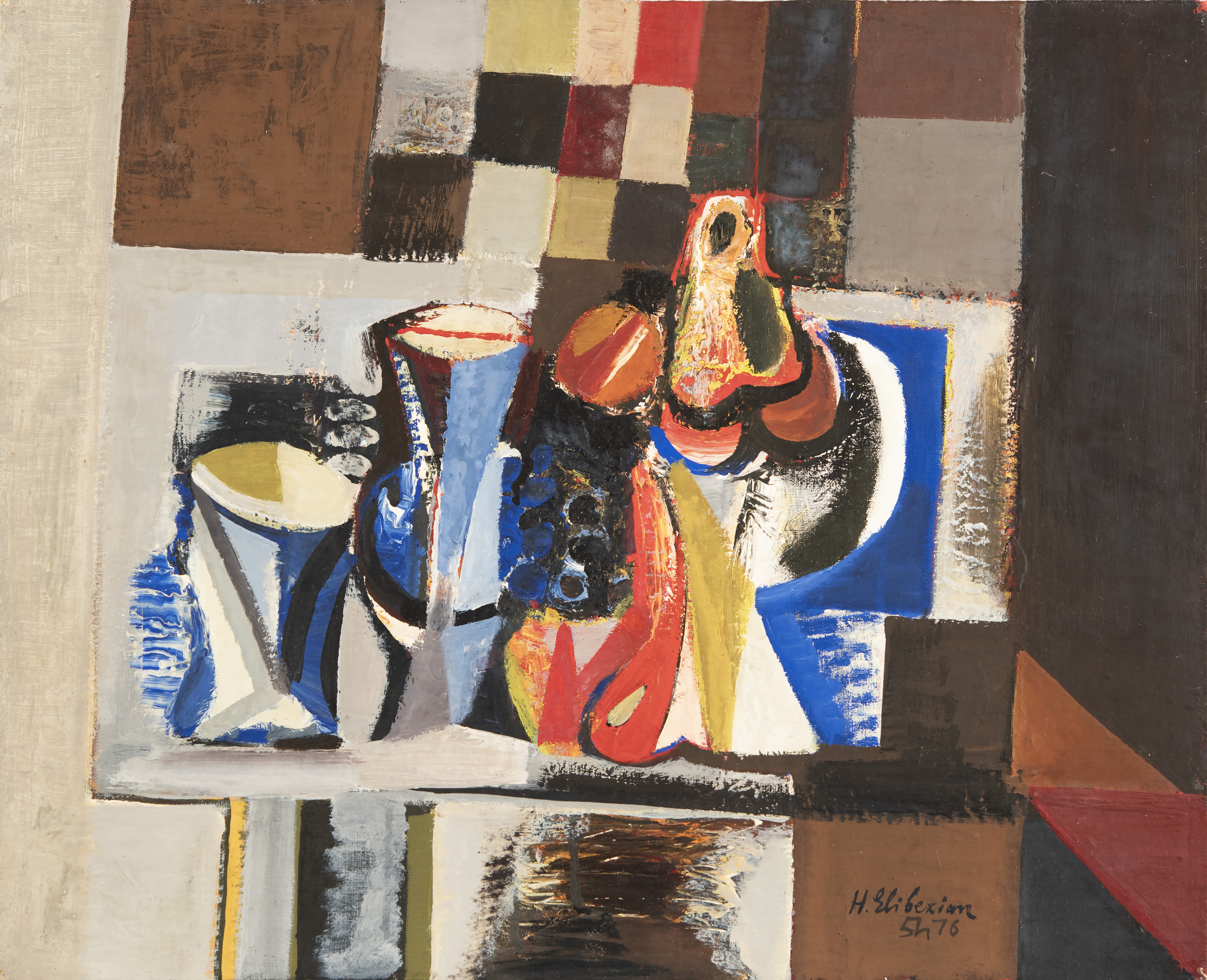
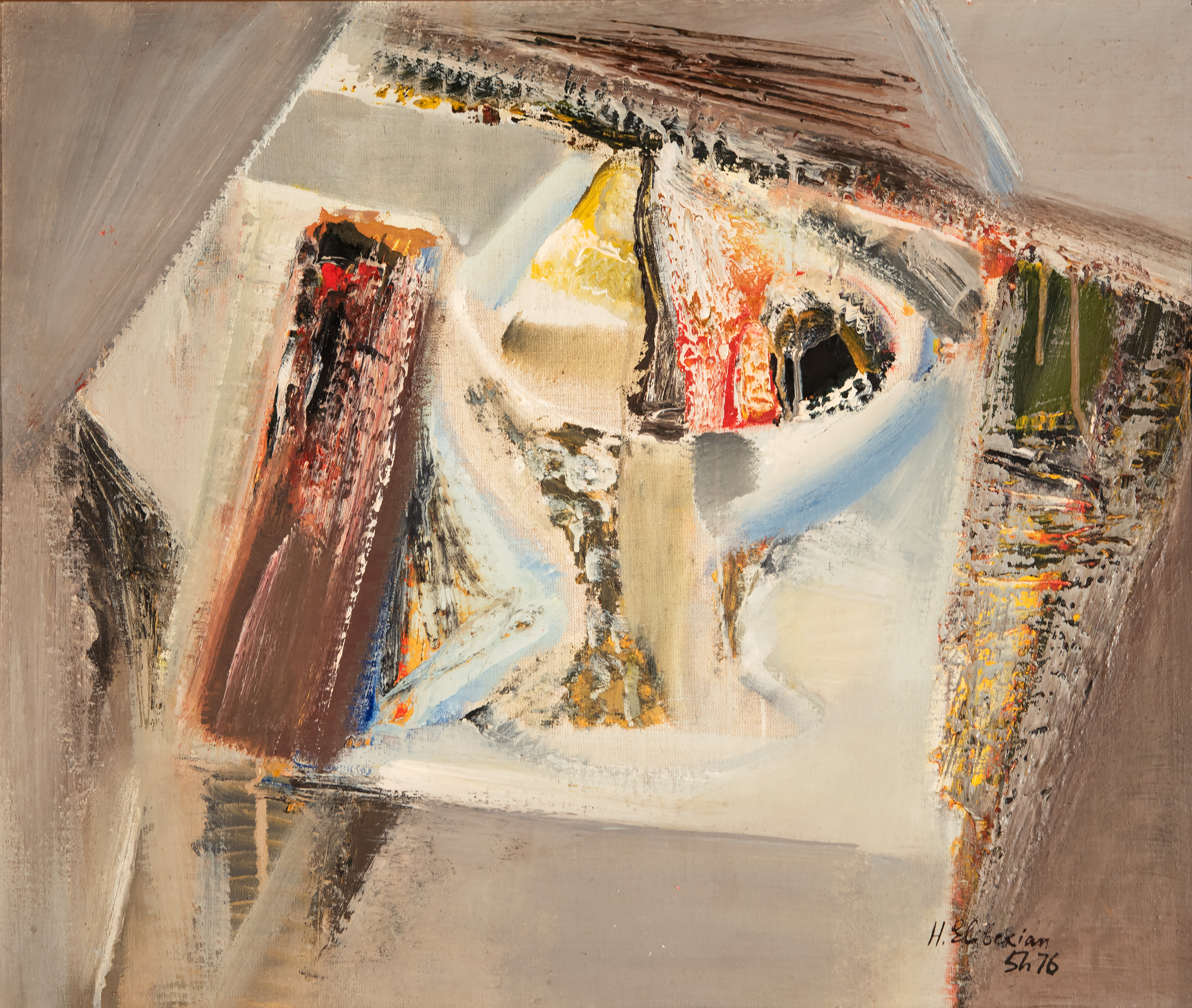
Elibekyan’s early paintings, like those of many painters of his generation, bear the imprint of Cézannism, cubism, fauvism, and expressionism. In his search for a free, authentic painterly language, the artist experimented with color as well as with form and the picture plane, which led him to abstraction. Elibekyan’s paintings in the Norton and Nancy Dodge Collection give an idea of his style in the 1970s–1980s: Still Life (1976, D06523); Still Life, Bowl with Fruit (1976, D05294); Still Life, Fruit on Table (1976, D06522); Untitled (1976–81, D05781); Mountains (1978, D06333); Untitled (1980, D05782); Suite (1981, D07191).
In 1968, Elibekyan moved to Moscow, and in 1970, he started developing his synthetic conception of “painting + sculpture in time and space,” featuring live models. These plastic-spatial experiments were aimed at expanding two-dimensional painting into three-dimensional space, toward a synthesis of all forms of visual art with music and theatrical performance—a goal that had likewise preoccupied the Russian artistic-theatrical avant-garde of the early twentieth century. Elibekyan also created painted objects and assemblages by using items not generally associated with art in the manner of Robert Rauschenberg (1925–2008), a key source for Soviet Armenian avant-garde artists.
In 1972, Elibekyan returned to Yerevan, remaining there until 1994. His work was presented in numerous solo and group exhibitions both inside and outside the USSR. These, combined with coverage of his work in the press and in catalogues during the 1970 and 1980s, brought the artist success and recognition. He came to be regarded as a significant figure in the second wave of the Armenian avant-garde, a reputation gained largely thanks to the efforts of Henrik Igityan, promoter of Armenian modernism and the founder of the Yerevan Modern Art Museum.
In 1994, due to the unfolding humanitarian crisis in Armenia, Elibekyan again moved to Moscow, while still realizing major projects annually in Yerevan, primarily a series of performances: Armenia—Yesterday, Today, Tomorrow (1993), Artists’ Union of Armenia; From Unbelief to Faith (1998), Theater Workers’ Union of Armenia; The Feast of Bacchus (1999), Sergei Parajanov House-Museum; Love the Human Being or the Iron (2001), artist’s studio; Minas (2002), artist’s studio; A Spit Is My Manifesto (2002), artist’s studio; Conversations About Tetra—an exhibition of portraits of major theater figures accompanied by a lecture (2002), Museum of Russian Art (Professor A. Abramyan Collection); and Hamlet Is Not Hamlet, or Revenge for the Father (2003), artist’s studio.
In the final years of the twentieth century, following the collapse of the Soviet Union, Armenia’s newly won independence, and the economic, political, and spiritual crisis that overtook the country, Elibekyan’s social-spiritual orientation became even more pronounced. During his late period, performance art was his primary means of expression. Humanism, spirituality, and protesting against the spiritual impoverishment brought about by the consumerism and political desolation of post-Soviet society became the central themes of his art. In 2000, he transformed his Yerevan studio into a public forum for heartbreaking performances addressing these topics.
Among the artist’s main themes is an understanding of all political power as a form of violence—and a conception of oppositional culture as a means of spiritual purification. This is the focus of a number of Elibekyan’s late works devoted to great cultural figures and spiritual and cultural traditions, such as composer Aram Khachaturyan, Henrik Igityan, painter Minas Avetisyan, artist and filmmaker Sergei Parajanov, and composer Komitas.
Elibekyan’s works are held in the Sakharov Center (Moscow, closed in 2023 by the Russian government); the Bakhrushin State Central Theater Museum, Moscow, Russia; the Zimmerli Art Museum, Norton and Nancy Dodge Collection, New Brunswick, NJ, United States; the Yerevan Modern Art Museum, Yerevan, Armenia; the National Gallery of Armenia, Yerevan, Armenia; the State Museum of Oriental Arts, Moscow, Russia; the State Tretyakov Gallery, Moscow, Russia; and many private collections in various countries.
Elibekyan was recognized as an Honored Artist of Armenia and Georgia in 1990 and received the Republic of Armenia Presidential Award in 2012.
Lilit Sargsyan
Translated by Ilya Bernstein
Still Life, Bowl with Fruit, 1976. Oil on fiberboard, 47.2 × 58 cm (18 9/16 × 22 13/16 in.). Norton and Nancy Dodge Collection of Nonconformist Art from the Soviet Union. D05294
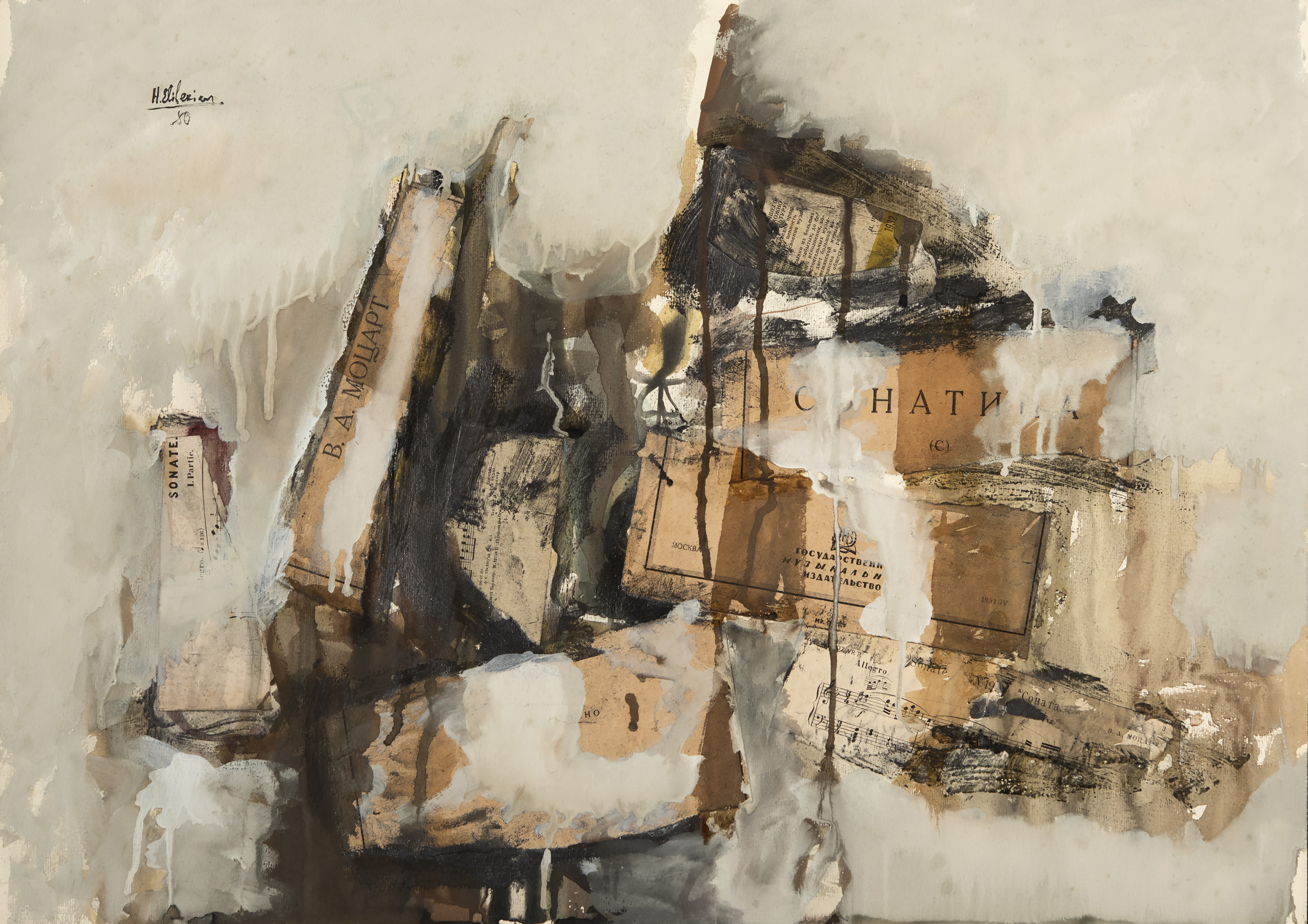
Untitled, 1980. Oil and collage on paper, 50.6 × 73.2 cm (19 15/16 × 28 13/16 in.). Norton and Nancy Dodge Collection of Nonconformist Art from the Soviet Union. D05782

Mountains, 1978. Oil on fiberboard, 76.7 × 97 cm (30 3/16 × 38 3/16 in.). Norton and Nancy Dodge Collection of Nonconformist Art from the Soviet Union. D06333
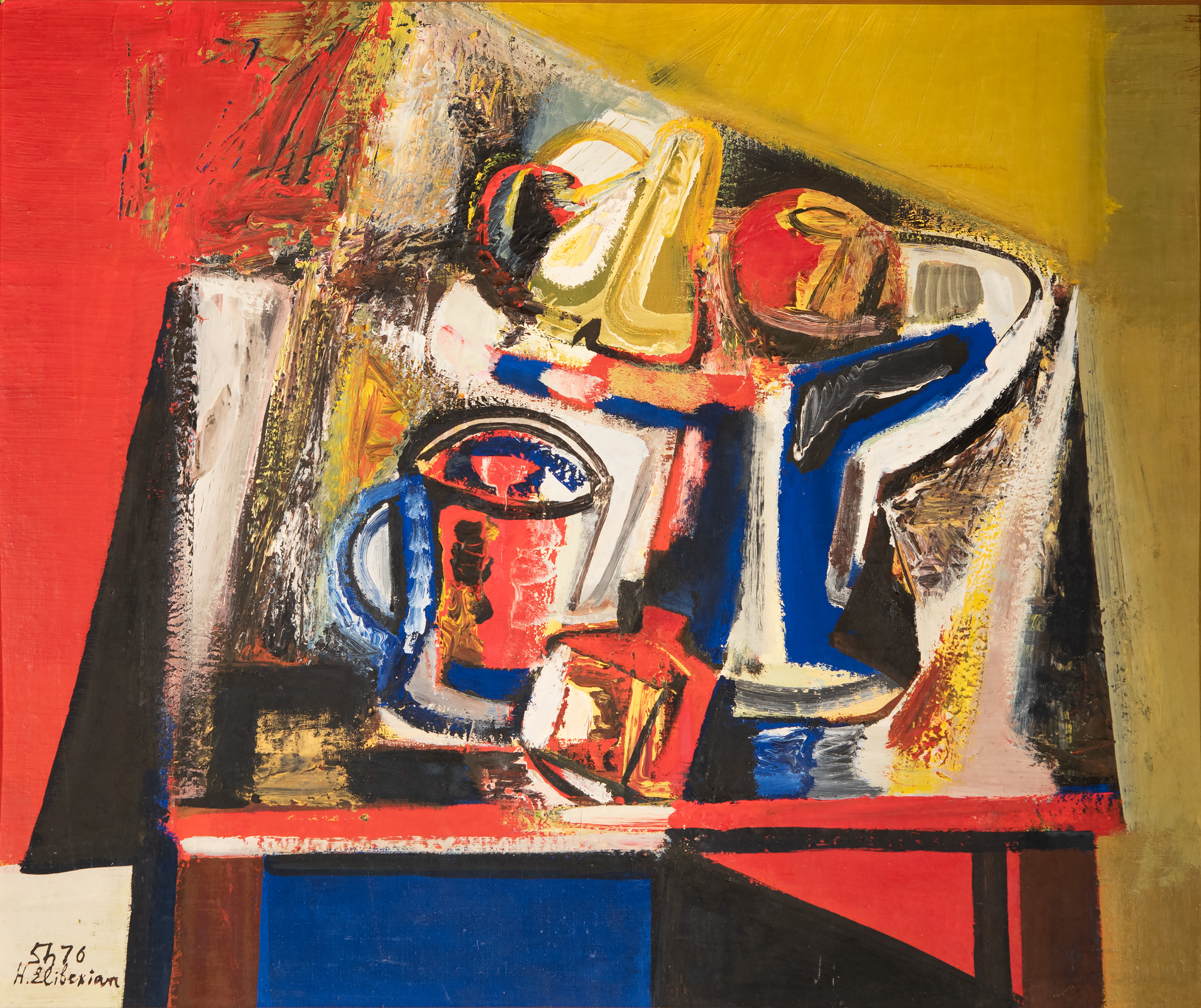
Still Life of Fruit on Table, 1976. Oil on canvas mounted on panel, 48 × 55.9 cm (18 7/8 × 22 in.). Norton and Nancy Dodge Collection of Nonconformist Art from the Soviet Union. D06522
Still Life, 1976. Oil on canvas mounted on panel, 48 × 58 cm (18 7/8 × 22 13/16 in.). Norton and Nancy Dodge Collection of Nonconformist Art from the Soviet Union. D06523
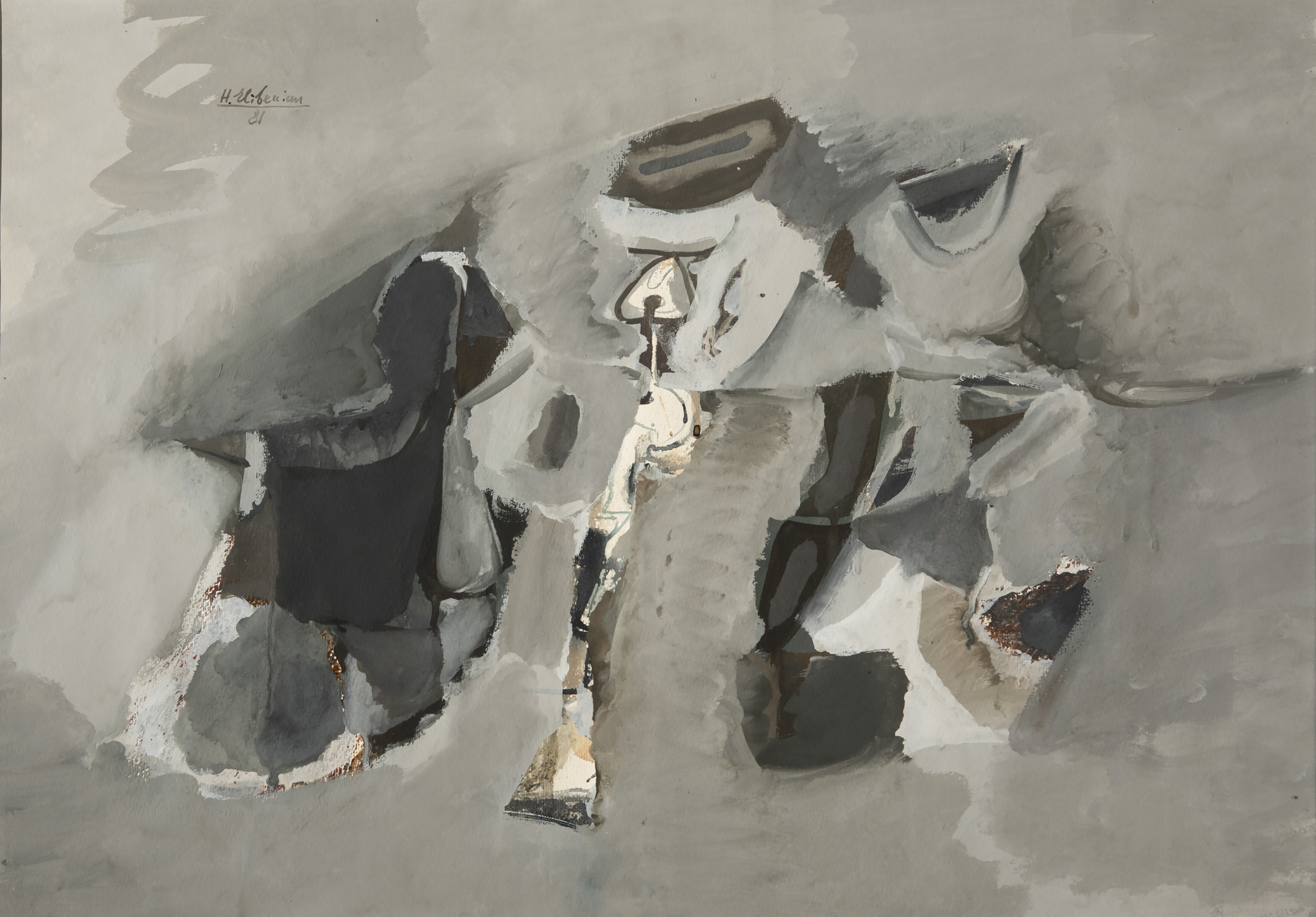
Suite, 1981. Gouache on paper, 49.6 × 70 cm (19 1/2 × 27 9/16 in.). Norton and Nancy Dodge Collection of Nonconformist Art from the Soviet Union. D07191
Selected Exhibitions
1968 Six Young Armenian Artists, Yunost’ editorial office, Moscow, Russia
1973 Small-Scale Sculpture Biennial, Budapest, Hungary
1981 Painting of the Elibekyan family, Wiesbaden, Germany
1981 Art Museum of Georgia, Tbilisi, Georgia (solo)
1986 Artists’ Union, Yerevan, Armenia (solo)
1987 Artists’ Union, Vilnius, Lithuania (solo)
1989 State Museum of Oriental Art, Moscow, Russia 1989 (solo)
2006 Self-Portrait: My Contemporary, Gevorgyan Gallery, Yerevan, Armenia
2012 Lifelong Dialogue (In memory of the founder of the Yerevan Modern Art Museum, Henrik Igityan), Modern Art Museum of Yerevan, Armenia
Selected Publications
Angaladyan, Ruben. Armenian Avant-Garde of the 1960s: The Seventeen Fates. Montreal, 2006.
Ayroumian, Zara, ed. Lifelong Dialogue: In Memory of the Founder of the Yerevan Modern Art Museum, Henrik Igityan. Yerevan: Ministry of Culture RA, Modern Art Museum of Yerevan, 2012.
Ayrumyan, Zara, ed. Le Musée d’art moderne d’Erevan. Catalogue. Yerevan: Modern Art Museum of Yerevan, 2022.
Elibekyan, Henry. Conceptualism. Action. Performance. Painting. Catalogue.Yerevan, 2004.
Henry Elibekyan. Portrait. Catalogue. With an introduction by R. Angaladyan. Yerevan: Tigran Mec, 2005.
Igityan, Henrik. Armenian Palette of the 20th Century. Yerevan: Tigran Mec, 2004.
Makhmuryan, Tatyana, ed. Henry Elibekyan. Yerevan: Artists’ Union of Armenia, 1984.
Manukyan, Seyranush. Henry Elibekyan. Yerevan: Artists’ Union of Armenia and Hamazgayin Educational-Cultural Union, 1993.
Manukyan, Seyranush, ed. Henry Elibekyan. Exhibition catalogue. Tbilisi: Art Museum of Georgia, 1981.
My Contemporaries. Introduction by Seyranush Manukyan. Catalogue. Yerevan: Ministry of Culture RA, Modern Art Museum of Yerevan, 2013.
Rosenfeld, Alla, and Norton Dodge, eds. From Gulag to Glasnost: Nonconformist Art from the Soviet Union. New York: Thames & Hudson, 1995.
Sargsyan, Lilit, comp., and Seyranush Manukyan, ed. Henry Elibekyan. Yerevan: Tigran Mec, 2006.
See also