
Hennadii Lesnychyi
1954 — Korenshchina, Podgorensky district, Voronezh region (USSR). Lived and worked in Kharkiv (Ukraine); lives and works in Berlin (Germany)
Hennadii Lesnychyi is a Ukrainian monumental and decorative painter, as well as a teacher. A member of the Kharkiv branch of the National Union of Artists of Ukraine since 1993, he combines numerous artistic strategies and techniques in his work, drawing from the traditions of classical art and realism along with abstract expressionism and postmodernism. Early on in his career, he gravitated toward the nonconformist movement and dissociated himself from the influence of socialist realism. In his pedagogical work, he developed his own methodology based on a strong academic grounding with a focus on the creative development of the individual. He was one of the brightest and most famous representatives of the Kharkiv school of monumental painting for more than thirty years, from the 1970s to the 2010s. In 2022, he left for Germany because of the war in Ukraine and the constant shelling of Kharkiv by Russian troops, which had damaged his home, studio, and archives.
Lesnychyi attended the Kharkiv State Art School (now Kharkiv Professional Higher Art College) from 1969 to 1974, studying first in the art and pedagogical department in the studio of Yurii (Ihor) Stakhanov (1925–2008), a prominent graphic artist and adherent of socialist realism. Later, Lesnychyi moved to the art and design department, where he studied with the famous monumentalists of those years, Anatoliy Bespalyi (1936–2002), an interior design specialist and fabric painting artist who laid the foundations of the Kharkiv monumentalist school, and Valery Paltsev (1935–2022). However, he was most influenced by Viacheslav Yurchenko (1946–2021), admiring his attitude toward art and democracy, as well as his teaching: how he introduced his students to books, expanded their worldview, and inculcated in them an interest in monumental art. Yurchenko also supervised Lesnychyi's diploma project “Creating a Unified Exhibition Installation on Kharkiv's Railway Station Square,” which demonstrated the young artist's skills and approaches to designing an exhibition.
While studying at the Kharkiv State Art School, Lesnychyi also visited the Studio of Drawing and Painting at the House of Architects in Kharkiv, headed by Vitalii Lienchyn (1940–2016). Although drawing on Soviet themes in his graphic and monumental works, Lienchyn maintained a flexible artistic language that was based on his own formula “Form is organized space.” According to this prescription, the structure of space and form combined verticals, horizontals, and diagonals, producing an extremely expressive and modernist result. Lesnychyi adopted the principles of Lienchyn's approach to form in his own work, thus opening up a wide set of possibilities for improvisation, from realistic depiction to free abstraction.
After his military service (1974–76), Lesnychyi joined the Department of Monumental and Decorative Painting within the Faculty of Interior and Equipment at the Kharkiv Art and Industrial Institute. He studied there from 1976 to 1981, taught by Borys Kosariev (1897–1994), a prominent Ukrainian modernist, theater artist, graphic artist, painter, photographer, and teacher. Lesnychyi was also taught by the prominent painter Oleksandr Khmelnytsky (1924–1998), a representative of state-sponsored art, who supervised his diploma project: the painting The Uprising of the Chernihiv Regiment. The Decembrists, which was intended for the Decembrists Museum (which was then under construction near Kyiv).
After graduating from the Art and Industrial Institute, Lesnychyi was sent to work at the Kharkiv Art Institute as a teacher of special disciplines from 1981 to 1984. After this, he went to work at Kharkiv Regional Art and Design Combine (kombinat) of the Art Fund where he worked as a monumental artist until the early 1990s, when the plant was closed following the collapse of the USSR. Lesnychyi then returned to work at the Kharkiv State University of Art, where he taught drawing, painting, and composition. He also went on to supervise diploma works in the Art and Pedagogical Department and direct the workshop and the commissioning of painting and compositional works (1990–2022). In 1993, he was accepted as a member of the Kharkiv branch of the National Union of Artists of Ukraine.
As a monumentalist, the artist worked with mosaics and, later, cold encaustic. In addition to working at the Kharkiv Art and Production Plant, he was actively engaged in other creative activities, such as painting and graphics, as well as participating in official and informal art exhibitions, apartment parties, performances, and street art projects.
In 1974, Lesnychyi created his first monumental mural, Geometry of Nature (tempera, 10 x 4.5 m) after winning the competition to decorate the drawing room of the Kharkiv State Art School. His formative creative approach to mural painting was already visible in this work, in which he orchestrated a harmonious unity between the mural and the space through a geometrized, rhythmic interplay of a stylized background, thematic elements, and associative forms and objects.
From the beginning of his studies through his time at the Art and Industrial Institute, and as he engaged in independent artistic work, Lesnychyi was influenced by the aforementioned cohort of artists, in particular Vitalii Lenchyn and Borys Kosarev. Their influence ranged from their deep and original approach to creativity in its modernist explorations to the way they taught art. This influence was reflected both in Lesnychyi's creative experiments with form and space and in his pedagogical work. As a teacher, he treated all students with equal respect and interest, developed their creative individuality, and in his teaching combined professional training in drawing, painting, and composition with various plastic artistic languages and imaginative systems. He paid special attention to students’ diploma work, during which, “as if in a fairy tale, just as a pupa turns into a butterfly, the student becomes an artist!” [1]
Lesnychyi’s students include well-known Ukrainian artists such as Roman Minin, Hamlet Zin’kivs’kyi, Oleksii Chornyi, Andrii Bilychenko, Tetiana Ivanova, Dmytro Danish, Oleksii Dehtiaruk, Olena Khall, and others.
From the beginning of his time working as a monumentalist at the Art and Production Combine, Lesnychyi again found himself in the circle of experienced artists Valery Paltsev and Anatolii Bespalyi. Under their influence, the young artist relearned his professional practice while working on his own commissions. At the same time, he faced censorship from the Combine’s Art Council (which had the power to forbid his work) and was rejected by official exhibitions. In line with the wider nonconformist movement of the time, Lesnychyi exhibited in apartment exhibitions and sought orders for artworks outside the purview of the Art Council.
Two paintings among Lesnychyi's works in the Dodge Collection particularly illustrate the artist's characteristic painterly style of the 1980s: the monochrome Self-Portrait X (1984, D00433.01) and the full-color Black Angel (1985, D00503). As in his wall-based murals, these pieces show how Lesnychyi’s work distinguished him from the official Soviet art of that period, displaying a generalization of forms and images; an avoidance of narrative in favor of allegory and symbolism; and a combination of figures with a stylized background. The artist inscribed his compositional and rhythmic figures into the general movement of tone and color, making the background an open cosmos suggesting themes of truth, freedom, repentance, and loneliness. In the self-portrait, the theme of captivity is reinforced by a bird in a cage, and in Black Angel by the figure of an angel sounding a trumpet that pierces the ears of a tormented figure below. The emotional power and painterly softness are combined with impastoed, seemingly stenciled circles, triangles, lines, and numbers that burst from the surface of the canvas, creating a multi-textured yet ordered expression.
Thanks to the tutelage of prominent and diverse artists at the Kharkiv Art and Industrial Institute, Lesnychyi mastered a wide range of artistic styles and approaches over his career. In his monumental works, he simultaneously adhered to a classical approach and improvised with the materials he was using. In his artistic interpretations of given themes, he tried to avoid obvious responses, instead aiming for timeless images that made the work contemporary for many years following its creation. He understood how to solve the problem of integrating an artwork with its architectural environment by changing its spatial architecture and color pathways, as exemplified by his murals Geometry of Nature (Kharkiv, 1974), The Alphabet of Ecology (Kupiansk, 1990), and Fairy Tales (Kharkiv, 2010), among others. He also often combined classical and realistic approaches with modernist techniques, as in his lyrical and geometric abstractions. In his easel paintings, Lesnychyi used various stylistic approaches, from mythopoetic realism (e.g., Walking with an Angel [2001] and Girl with a Harp [2003]) to abstract expressionism and tachisme [2] (e.g., Africa [1998] and the diptych Perseus and Andromeda [2010]), all while working with allegorical, figurative, and associative meanings in his work. His portraits made in sepia of various tones and colors give realistic images expressiveness as well as spiritual and psychological depth (e.g., Maestro. (Portrait of Vitalii Lienchyn) [2017]; Salamander (Portrait of Borys Kosariev) [2019]; and Portrait of a Girl [2017]). Often, after a customer or collector purchased a work, the artist would then remake it again.
From the late 2000s to the early 2010,s Lesnychyi engaged in street art, creating acrylic murals dedicated to the memory of Oleh Mitasov (Young Lady and a Hooligan [2009], 14 x 6 m) and Oleksander Lytvynov (Venya D'rkin [2010], 3 x 5 m). [3] He also participated in art events such as Street-Art Fest, a street art festival in Kharkiv, and GagarinFest, organized by the Kharkiv Municipal Gallery, as well as in the performances Black and White (2010) and Tales (2012).
By the time he left for Germany in 2022, he had completed about thirty designs for monumentalist murals, two of which were not implemented because of a lack of funding. He also completed around 200 paintings, some of which were destroyed in 2022 by Russian army shelling.
After moving to Germany, Lesnychyi continued his artistic practice and participated in a number of shows, such as the exhibition of artistic resistance War. Kharkiv. Berlin – Wedding (2023) and Graphics: Kharkiv Center. Berlin 2024 (2024).
Although Lesnychyi's work has not been widely analyzed or studied, his large body of work and wide artistic range exemplify the most powerful achievements of the Kharkiv art school and modernist nonconformist art.
Eugeny Kotlyar
Translated from Ukrainian by Nathan Jeffers
Notes:
1. Conversation with the artist in 2024.
2. A French style of abstract action painting that was popular in the 1940s and ’50s.
3. Oleh Mitasov was a Kharkiv-based economist and deputy director of a local store who became a cult figure in Ukrainian urban culture because of his prolific and enigmatic graffiti, which reflected his struggles with mental illness. His legacy as an outsider figure inspired Lesnychyi’s mural. Oleksander Lytvynov, known by his stage name Venya D’rkin, was a Ukrainian poet, musician, and songwriter whose lyrical work blended existential themes with folk-rock sensibilities. Lesnychyi’s mural honored his cultural impact and untimely death.
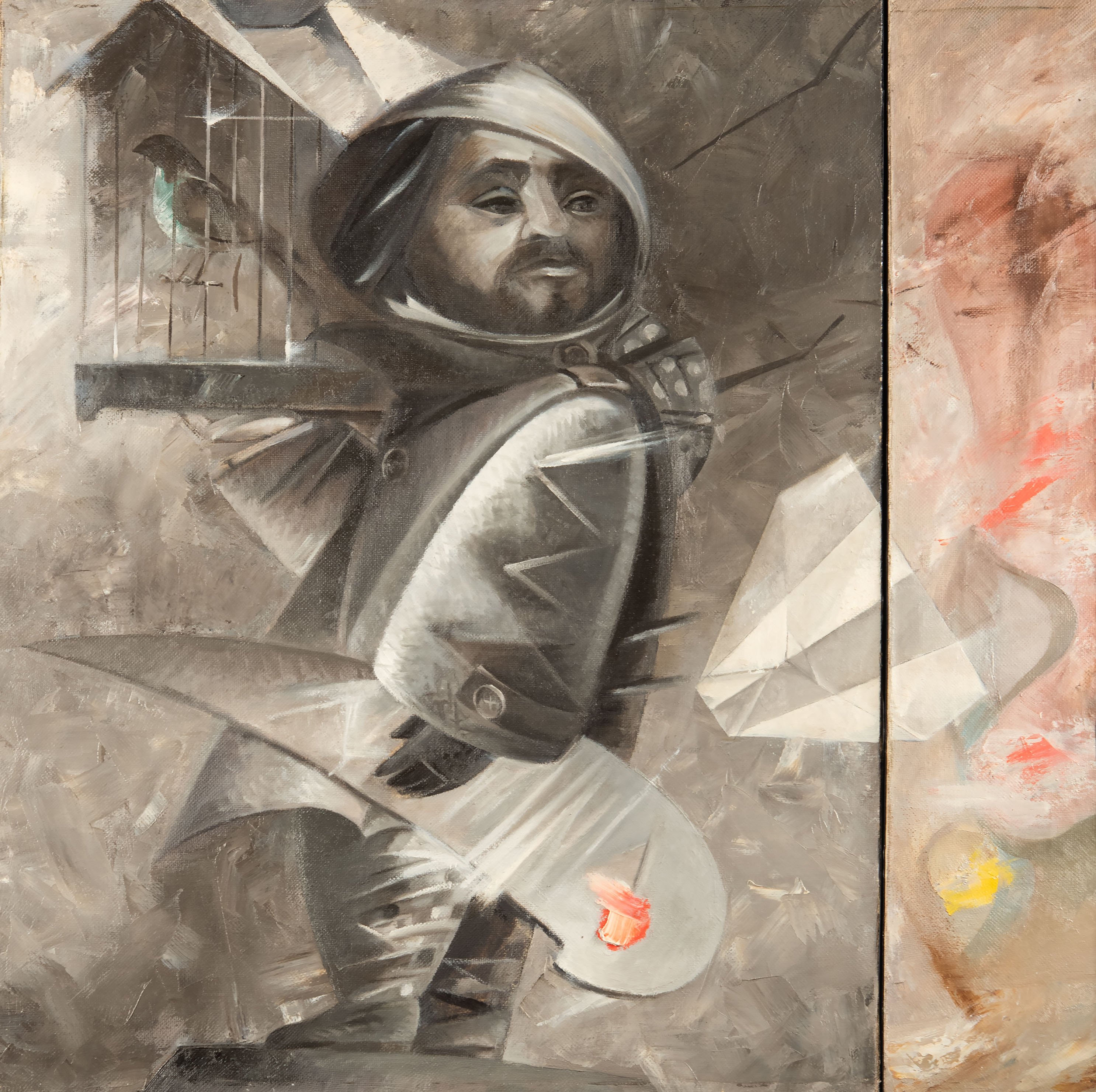
Self-Portrait X, 1984. Oil on canvas, 80.7 × 64.9 cm (31 3/4 × 25 9/16 in.). Norton and Nancy Dodge Collection of Nonconformist Art from the Soviet Union. D00433.01–02
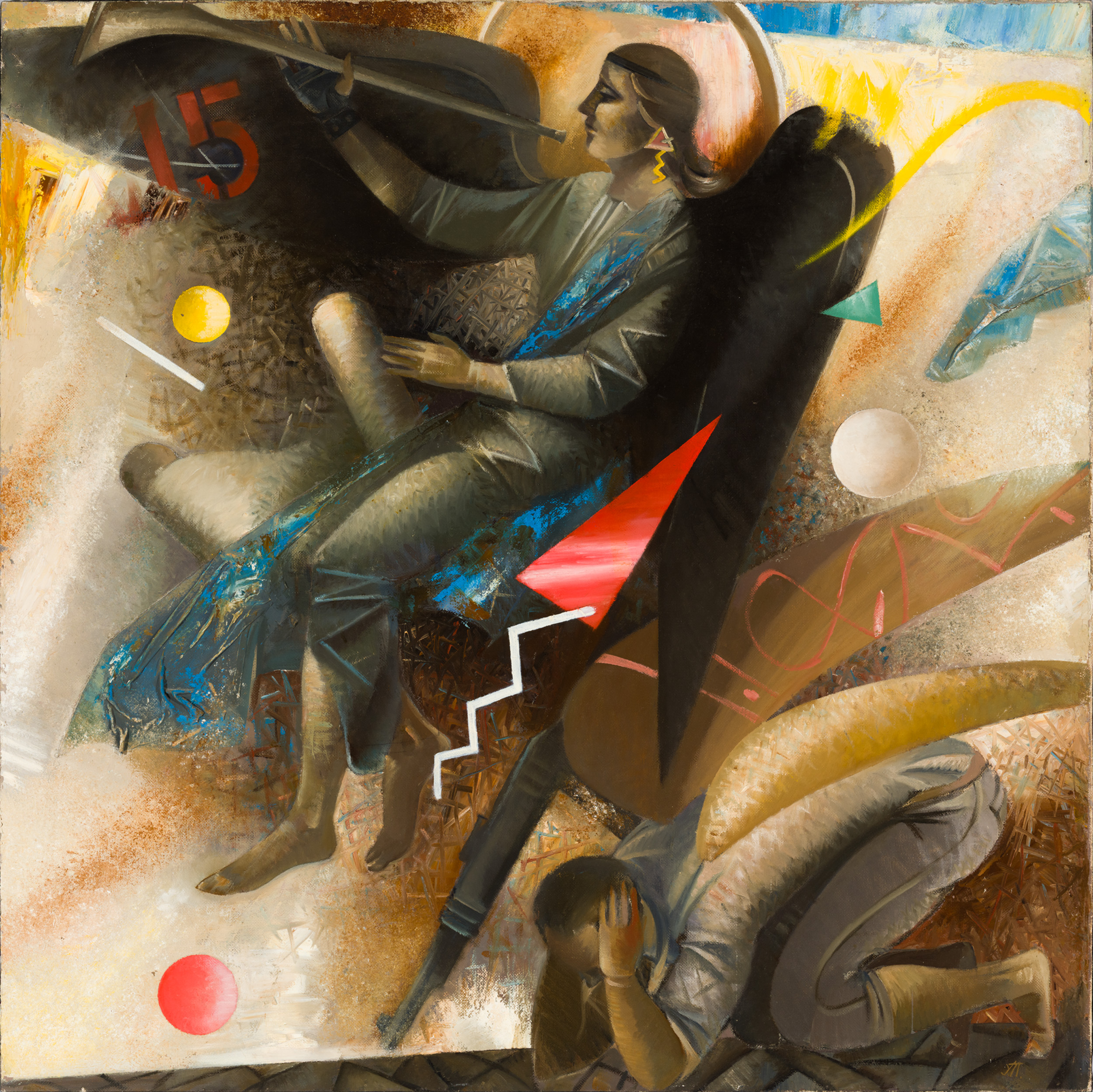
Black Angel, 1985. Oil and collage on canvas, 114 × 114 cm (44 7/8 × 44 7/8 in.). Norton and Nancy Dodge Collection of Nonconformist Art from the Soviet Union. D00503