
Henn Roode
1924 – Tallinn (Estonia) | 1974 – Tallinn (Estonia). Worked in Tartu and Tallinn (Estonia)
Henn Roode was born to an engineer father and a physician mother. In 1944 he began to study painting at Tartu State Art Institute (now Pallas University of Applied Sciences, where his principal teacher was the esteemed Estonian late impressionist painter Elmar Kits. Proficient in European languages such as French and German, Roode was destined to follow the Western European orientation that was prevalent in interwar Estonian art. However, after Estonia was retaken by the Soviet Union in 1944, Western influences were gradually forbidden, to the great distress and repulsion of Roode and most Estonian artists.
Roode’s studies coincided with the beginning of the Soviet reoccupation of Estonia, which was accompanied by Stalinist repressions. In November 1949 Roode was among a group of art students arrested on fabricated charges. In the subsequent trial, he and his fellow students Ülo Sooster, Lembit Saarts, Valdur Ohakas, and Heldur Viires were sentenced to ten years in a labor camp for allegedly organizing an armed plot against the Soviet Union. Another fellow student who was arrested and sentenced with Roode was his future wife, Esther Raudsepp (later Roode). The art students’ sentencing was probably initiated to frighten the Estonian intelligentsia, cast a bad light on the Tartu State Art Institute, and justify its closing a year later. From 1951 to 1956, Roode spent almost seven years in the Karaganda labor camp in present-day Kazakhstan.
After Stalin’s death and the discharge of political prisoners, in 1956 Roode was able to continue his studies at the State Art Institute of the Estonian Soviet Socialist Republic (now the Estonian Academy of Arts) in Tallinn, graduating in 1959. It has been said that Roode returned from the labor camp a broken man. He had lost his youthful rebelliousness and turned inward, completely devoting himself to his calling in painting. Roode never conformed to the official socialist realist style, instead intensively following his own line of modernist inquiries that were quite contrary to Soviet ideology. Owing to his past conviction, he was never allotted a studio, forcing him to paint either at home or in a joint space with colleagues.
Roode’s early works from the 1940s show influences of the painterly late impressionist style typical of the interwar Tartu Pallas school and his teachers Elmar Kits, Ado Vabbe, and Aleksander Vardi. After he returned from the labor camp, his approach became more analytical. Influenced by the cubism of Pablo Picasso and Georges Braque, Roode developed an individual style that was characterized by fragmented forms, thin layers of paint, and unfinished surfaces. As such, Roode’s work constitutes a brave attempt to interpret and develop modernism in the sharply antimodernist milieu of the Soviet Union in the post-Stalinist era.
Roode’s oeuvre includes townscapes (mainly of Tallinn), landscapes, seascapes, portraits, self-portraits, still lifes, and abstract paintings. He also produced figural compositions, privileged in Soviet art ideology, but like many painters with modernist leanings, he used officially favored subject matter mostly as a pretext to cover up his formal experiments.
In his large-scale figural compositions—such as the famous Market (Flower Market) (1961), Demonstration (1965), Art Students (1966), and Song Festival (1969) (all Art Museum of Estonia, Tallinn)—Roode undertook complicated experiments with figures, movement, and space. Characteristic of his personal style of painting are tight structure; bright, clean colors; and carefully applied surfaces. Despite his tragic experiences, Roode’s paintings invariably inspire the calm optimism of a clear and confident worldview. In later years his style became more sketchy, revealing more of the painting process.
The artist moved toward abstract art in 1963, presumably at the encouragement of his younger fellow painter Olav Maran. In these paintings, there is no clear line between figural and nonfigural works. From the mid-1960s onward, Roode painted numerous vastly different abstract works, as well as many portraits of varied approaches and degrees of finish. Among Roode’s abstract paintings are geometric, complexly balanced compositions as well as surprisingly colorful expressive paintings. In addition, hundreds of highly experimental self-portraits constitute a separate and unique facet of his work.
Roode was a close friend of the leading Estonian avant-garde painter Ülo Sooster, who resided in Moscow. From the mid-1960s Roode became religious, having been influenced by his friend Olav Maran. This did not sit well with Sooster, who was experimental and rebellious in both art and life. To the surprise of Roode’s friends, his spiritual searches led him to accept a number of portrait commissions from high-ranking Soviet military officers. “I paint them in order to forgive,” he reportedly said. [1]
Among his friends and colleagues, Roode was known as a serious man devoted to painting. He did not speak much, but when he said something, it often put the discussion to rest. The painter’s philosophical approach and search for truth can also be felt in his works. A small number of surviving cryptic written fragments (mostly written on the back of drawings) cast light on his thinking. Utterly rational and highly mystical in his endeavor, Roode sought to find a perfect system or universal language. “Within truth there is longing,” he wrote in one such fragment. “Only then it is alive. From truth to absolute Truth—that is the way of painting and the bow of cognition. Painting is the relationship between eternal and transient; spirit must master color through its spiritual aspect.” [2]
During his last couple of years, Roode gained recognition as one of the leading Estonian painters. His life was cut short by liver cancer. He was survived by his wife and two daughters. Today, he is hailed as an extraordinarily systematic modernist painter of great talent.
Tõnis Tatar
Photo portrait: Henn Roode, 1972. Photographer unknown. Art Museum of Estonia. EKM j 54723:2 FK 13:2
Notes
1. Kädi Talvoja, Henn Roode Modernist saatuse kiuste [Henn Rood: Modernist Despite Fate] (Tallinn: Art Museum of Estonia, 2007).
2. Henn Roode mõttekilde joonistustelt [Henn Roode’s Fragments of Thoughts from His Drawings], Kunst 73, no. 1 (1989): 27.
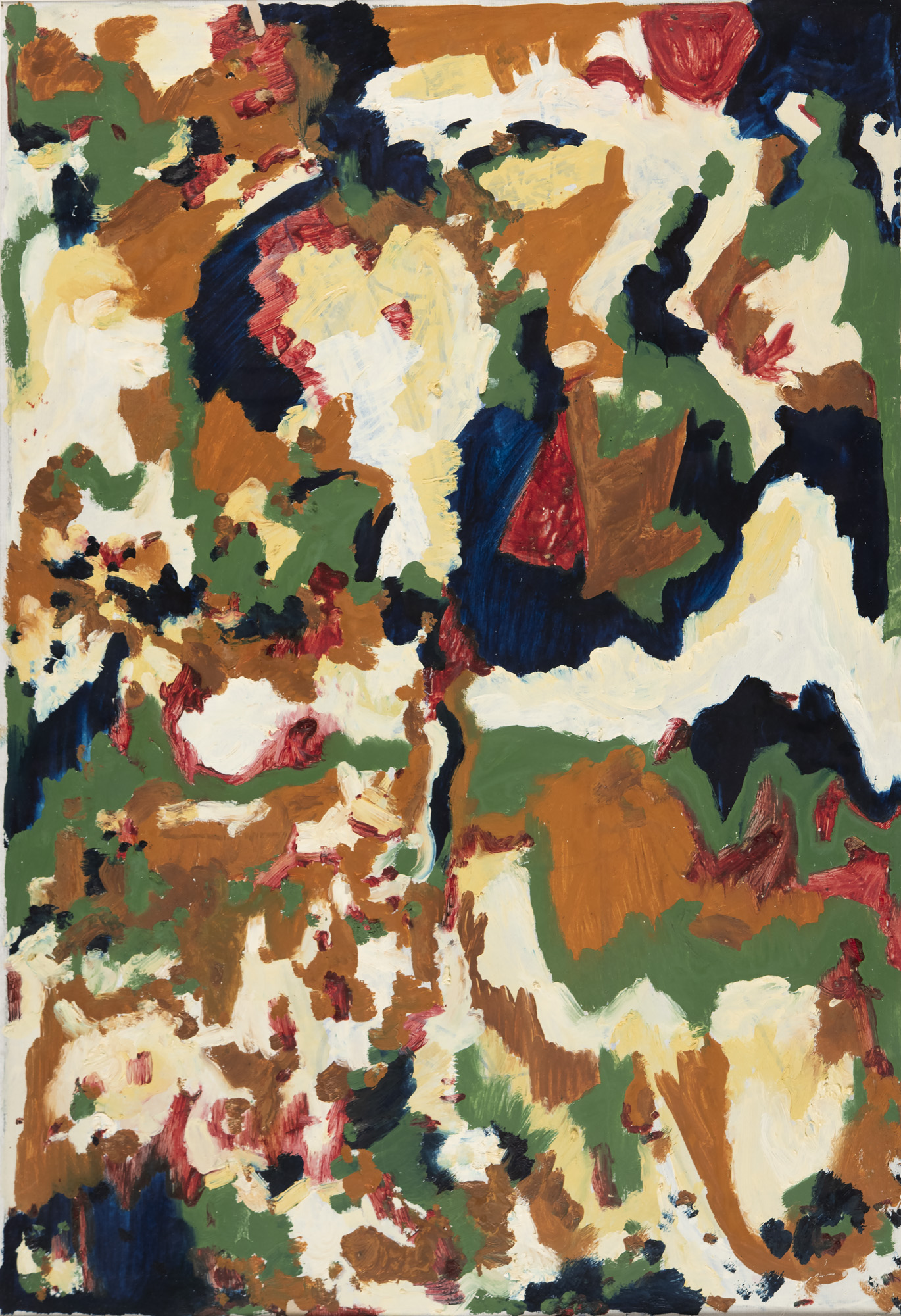
Temper, 1965. Oil on illustration board, 73.8 × 52 cm (29 1/16 × 20 1/2 in.). Norton and Nancy Dodge Collection of Nonconformist Art from the Soviet Union. D11449