
Georgy Kovenchuk (Gaga)
1933 — Leningrad (USSR) | 2015 — Saint Petersburg (Russia). Worked in Leningrad / Saint Petersburg (Russia)
Georgy (Gaga) Kovenchuk was a graphic artist, painter, sculptor, and writer. On his mother's side, he was the grandson of the Russian avant-garde figure Nikolai Kulbin (1868–1917). His mother, Nina Kovenchuk, a prop master and sculptor for the theater, worked at the Leningrad Comedy Theater under the direction of Nikolai Akimov.
During the Siege of Leningrad in World War II, Kovenchuk was evacuated. In 1944, upon returning from evacuation, he entered the Secondary Art School at the Academy of Arts, from which he graduated in 1953. Right after that, he enrolled to study at the graphics department of the Repin Institute (Academy of Arts) under the tutelage of Alexei Pakhomov. In 1959, he defended his diploma with distinction, submitting a series of satirical and propaganda posters made in the artists’ association Boevoy Karandash [Combat Pencil], where he had begun working in 1957. This Leningrad association performed a propagandistic function, producing large runs of posters with short, rhyming captions (“Not for their tight pants, but for their hoodlum pranks” [1957]; “Didn’t listen to the radio, didn’t read the paper / Made it up out of whole cloth … and now spreads it as a rumor” [1958]; “This virus grew out of sloth” [1959]) intended to mock and censure deviations from Soviet ideology and the “communist way of life.” It is worth noting that Kovenchuk, who belonged to artistic bohemian circles, first became widely known for work that rebuked followers of foreign fashions or hipsters.
Kovenchuk’s experience as a poster artist, promptly responding to any political demands, significantly influenced the subsequent development of his artistic style. He became a master of rapid draftsmanship and the creation of instantly recognizable images, continuing a tradition established by Honoré Daumier in his newspaper illustrations and caricatures (in the 2000s, Kovenchuk conceived a project to install a monument to the laundress from Daumier's painting The Burden on an embankment of the Seine).
In 1960, immediately after completing his studies, Kovenchuk was accepted into the graphic art section of the Leningrad Union of Artists. His work in Combat Pencil (the association lasted until 1990) provided protection for him and artists close to him and gave them an opportunity to pursue formal experiments and a variety of styles. In the poster genre, Kovenchuk drew on folk images, and his works moved closer to Russian popular pictures (lubok).
For many years, Kovenchuk worked as an illustrator and art editor at a number of children’s and literary magazines in Leningrad, but he distinguished himself most vividly as a book illustrator. In 1966, a collection of humorous aphorisms by the Soviet writer Ilya Ilf, Selections from Notebooks, for which Kovenchuk did the graphic design and illustrations, was published in a mass edition of 50,000 copies. In 1973, for the eightieth anniversary of the birth of Vladimir Mayakovsky, the artist designed a gift edition of the comedy The Bedbug, which was conceived as a unified work of graphic art. Kovenchuk called his work a “book-performance” and made use of techniques borrowed from Russian futurist publications of the early twentieth century. For example, collage was vigorously employed in the creation of the book’s layout (the first sketches were made in 1969), and the text was set in a variety of typefaces. Published in 1974 after overcoming censorship hurdles and awarded the Book of the Year prize in 1975, this edition—with a print run of 30,000 copies—can be considered a prime example of a livre d’artiste. In 2013, The Bedbug was reissued in a collector’s edition.
Kovenchuk traveled widely, and from the 1960s to the 1980s was regularly sent on creative work trips around the Soviet Union by the Union of Artists. These assignments guaranteed him a good salary and gave him relative freedom from bureaucratic and ideological pressures. The artistic strategy chosen by Kovenchuk was typical of many cultural figures during those years. In 2003, Kovenchuk was awarded the silver medal of the Russian Academy of Arts and the title of Honored Artist of the Russian Federation.
Throughout his life, the artist kept diaries. His notebooks from the 1990s and 2000s, records of trips to the United States and Europe, constitute a distinct creative genre in their own right. On their pages, Kovenchuk’s drawings and texts are combined into collages with objects that provide documentary evidence of his travels. Kovenchuk’s style, both in graphic art and painting, is distinguished by the spareness of his technique, the expressiveness of his silhouettes, and the quick and free manner in which he sketches from real life. His reference points are French artists, above all, the masters of the “school of Paris.”
Pavel Gerasimenko
Translated from Russian by Ilya Bernstein
Photo portrait: Gaga Kovenchuk, 2013. Photo by Mikhail Grigor'ev
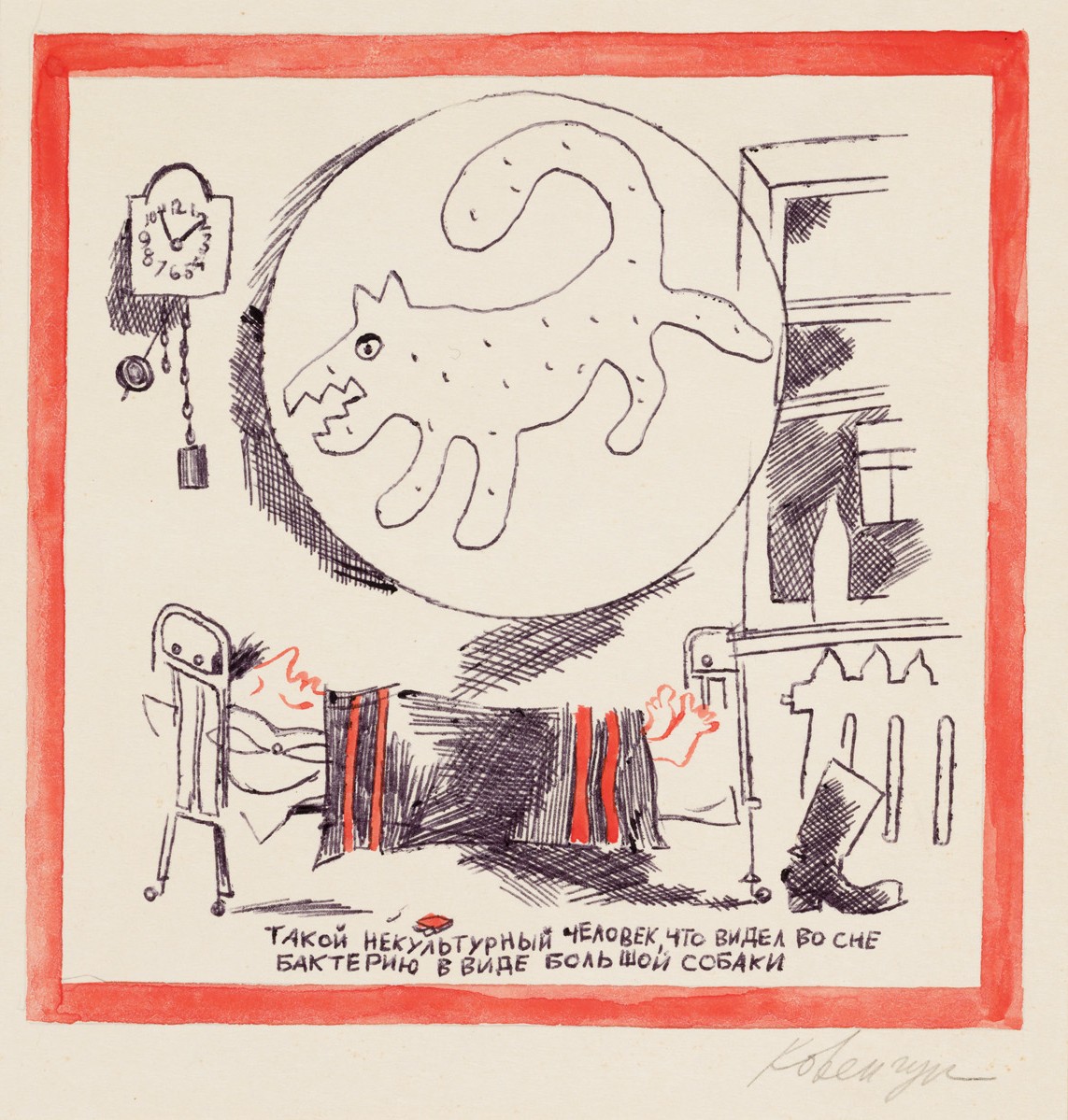
Untitled, undated. Ink and tempera on paper, 14.1 x 13.5 cm (5 9/16 x 5 5/16 in.). Norton and Nancy Dodge Collection of Nonconformist Art from the Soviet Union. D18555
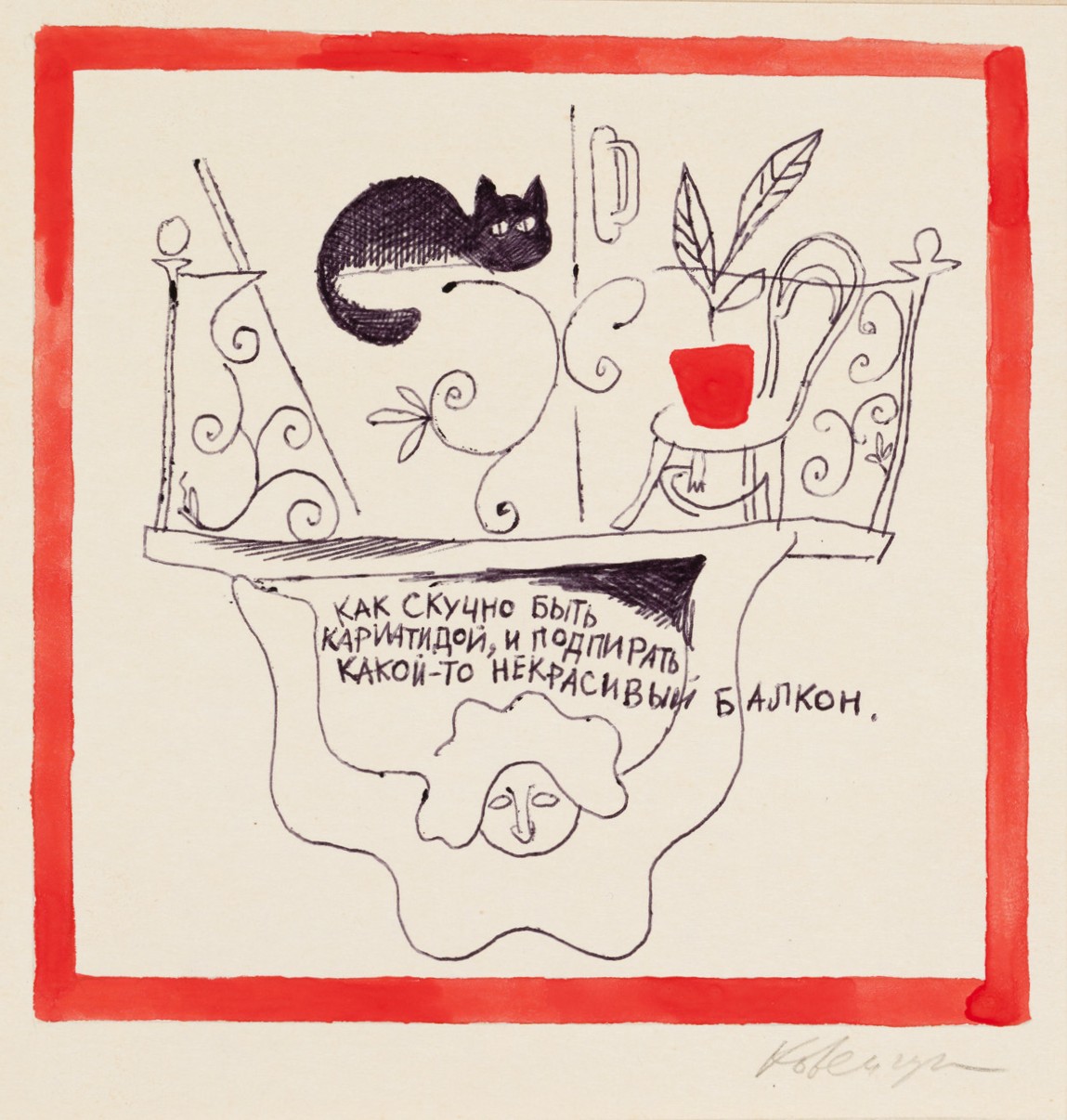
Untitled, undated. Ink and tempera on paper, 14.1 x 13.5 cm (5 9/16 x 5 5/16 in.). Norton and Nancy Dodge Collection of Nonconformist Art from the Soviet Union. D18556
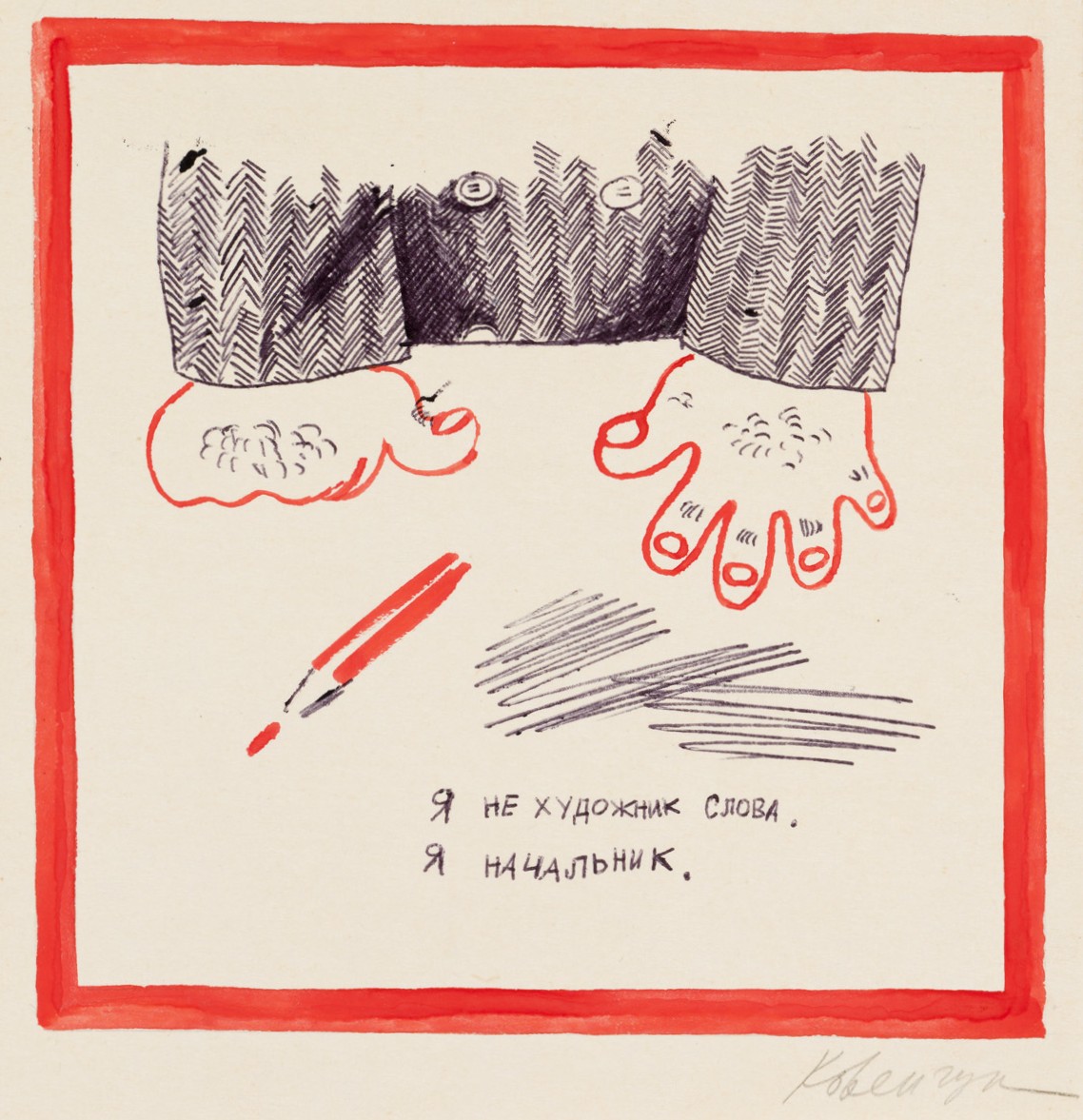
Untitled, undated. Ink and tempera on paper, 14.1 x 13.5 cm (5 9/16 x 5 5/16 in.). Norton and Nancy Dodge Collection of Nonconformist Art from the Soviet Union. D18557