
Georgy Guryanov (Gustav)
1961 — Leningrad (USSR) | 2013 — Saint Petersburg (Russia). Worked in Leningrad (USSR) / Saint Petersburg (Russia), Moscow (Russia), Berlin (Germany)
Georgy Guryanov is one of the most famous Russian artists of the 1980s–90s and one of the most sought-after by the art market. He went sequentially through the different artistic movements inspired by a charismatic guru of the Leningrad/Saint Petersburg art scene of this period, Timur Novikov: from the “wild” neo-expressionism of the New Artists, to the ideologically right-leaning “academicism” of the New Serious movement. However, despite his participation in collective practices, Guryanov always turned out to be on the border between the general and the personal, as evidenced by his substantial number of solo exhibitions in different countries and the active interest in his works on the part of curators of the most varied theme-based group projects.
The interest of the West in the rising Russian art scene of the 1980s–90s, triggered by perestroika, was followed in Guryanov’s case by a demand for the artist as a representative of Russia’s emerging gay and queer culture and an author working with the ambiguous codes of totalitarian art.
Few creative individuals can boast of being cult figures in two art forms at once. Guryanov could: his participation in the extremely popular Soviet rock band Kino (1981–90) placed him on the pedestal of a youth idol, and his fame in this regard has not faded to this day. At the same time, before, a little during, and after Kino, Guryanov was an actively working and exhibiting artist. This combination was, in fact, common for the generation of young people who entered the art scene in the early 1980s. In the informal artistic circles of that time, many simultaneously performed in the theater; made films; painted; and wrote poetry, prose, and music. In Leningrad, a mixing of art forms and precise characterizations reigned: everything was called “new” (New Artists, New Composers, New Theater, Parallel Cinema, the literary Club 81, and so on), and the notional “everyone” participated “in everything.”
At that time, which is referred to in the history of the USSR as the era of stagnation, party authorities became slightly more open to the existence of artistic groups outside the officially sanctioned ones. This was connected with the intention to “let off some steam” following the loud international scandal provoked by the Bulldozer Exhibition in Moscow in 1974 (an unofficial art exhibition in a park that was forcefully broken up with the use of water cannons and bulldozers). Tightly controlled by the KGB, unofficial art was given a minimal outlet to the public, which began actively consuming everything that was new, all of which seemed to be part of a single process. Musicians, theater people, and filmmakers, above all the leader of the band Kino, Viktor Tsoi, were happy to exhibit their work among the New Artists. Timur Novikov worked on stage design for Kino’s concerts. And the famous performances of the musical group Popular Mechanics (1984–96), led by Sergey Kuryokhin—a composer and performer who was able to release onstage a Noah’s ark of musicians, singers, dancers, artists, old Soviet pop stars, Vanessa Redgrave, domestic animals, and so forth—perfectly illustrated the universal celebration of disobedience associated with the new art.
Guryanov first met Timur Novikov around 1979. He participated in the first public showing of the works of Leningrad’s TEII, Fellowship for Experimental Fine Art (exhibition in the Palace of Culture, 1982); was one of the perpetrators of the art action Zero Object—an ironic provocation addressed to the “new authorities” represented by the ephemeral power of TEII’s leaders; and became one of the first participants in the New Artists movement (1982). Simultaneously, he became the drummer and backing vocalist of the band Kino, which remained his main activity until Viktor Tsoi’s death.
Guryanov’s participation in exhibitions and other projects of the New Artists was continuous, but his works from this time, by contrast with later periods, are few. What fundamentally distinguished him from most other participants in the group was the fact that Guryanov possessed good professional training, a rare phenomenon in the unofficial art world of the late USSR. He had graduated from the Municipal Art School no. 1 (now named after Georgy Antonov), one of the best in Leningrad. Later, he recalled: “I spent a great deal of time there. This was the best school in the city in which you could obtain an education. I was small, curious, from fourth to eighth grade, I studied for four years there in all.” In 1975, he entered Leningrad’s prestigious Vladimir Serov Art School (today the Nicholas Roerich Saint Petersburg Art School), although he stayed for only one year: “the Serov school was a vile Soviet establishment.” [1]
Guryanov supplanted outworn officialdom with fervent modernism. Among works left behind by the artist, his family has found abstract compositions from the second half of the 1970s, as well as figurative pieces in a clearly expressionist (or fauvist) vein. The neo-expressionism of the New Artists suited him well, as can be seen in their photographs colored with bright felt-tip pens, compositions of stick-figure pictograms, and Soviet heroes “translated” into the garish, reckless language of the “New Russian Wild Ones.” For example, Guryanov’s bald heads or skulls echoed Leningrad’s “necrorealists,” who grew out of the same scene as he did, while his fashionable, stylish, affectedly striking and broad-shouldered supermen, who looked like comic book heroes, turned out to be portraits of friends.
Portraits, including self-portraits, were plentiful in this circle in general, and their iconography varied. In 1986, Guryanov became one of the founders of the Friends of Vladimir Mayakovsky Club, a merry association with no obligations attached. In the most profound essay to date on Guryanov's work, Arkady Ippolitov notes the importance of this choice of hero for "worshiping" purposes. From the entire pantheon of heroes of the Russian avant-garde, the New Artists choose neither Mikhail Larionov nor Ilia Zdanevich, crucially important to them for their ideology of "everythingness," but Mayakovsky—towering, handsome, and stylish, a man who loved beautiful clothes and valued the symbolism of the artistic and private gesture. The desire that seized radical Russian artists and writers to throw Pushkin off the ship of modernity and to spit in the face of the bourgeoisie struck a chord with Leningrad’s artistic pranksters. But they went further: they did not propose to throw anyone off any ship; they simply resolved not to notice Soviet reality altogether. And differences with Soviet authorities were based exclusively on aesthetic lines: aestheticism was the main weapon of this new art.
In this process, Guryanov played a leading role. He was very handsome, which became part of his artistic essence. He often said that he himself was his work of art. In this regard, Guryanov's video works for Pirate Television (PTV, 1989–92) are very indicative. PTV was an art project that parodied the network of official television channels through a series of individual projects by the New Artists, above all Yuris Lesnik, Vladislav Mamyshev-Monroe, and Timur Novikov. Guryanov hosted the program Spartacus on PTV, in which "sports news" was presented to viewers by a handsome muscleman in a very revealing undershirt, his body glistening with oil. Openly gay aesthetics in the newly opened USSR were very radical.
The next turn of the wheel for Timur Novikov as a whole and for Guryanov in particular was connected with a programmatic return to the “academic” tradition. The former modernists returned to drawing, narrative, and linear perspective. This turn came in the late 1980s. In 1987, Novikov painted an exaggerated and expressive portrait of Guryanov as a young man with an oar (State Russian Museum collection); a year or two later, the second title of this painting—Severe Young Man—became the unofficial logo of the new style, called neo-academicism by Novikov. The direct reference to the firm and athletic "young women with an oar" that deluged all Parks of Culture and Leisure in the Soviet Union was replaced by an homage to the A Severe Young Man, an aesthetically elegant film by Abram Room from 1936. Ironic reflections of Soviet pop culture were replaced by the appropriation of totalitarian aesthetics, which depicted the Olympic existence of ideal human bodies. It is not surprising that from the new Soviet "reality" of the 1930s, it was only a step to making use of images from Leni Riefenstahl's Olympia (1938) as well, as Room’s Komsomol (Communist Youth Party) members were indeed the blood brothers of Riefenstahl's Aryan titans.
After the death of Viktor Tsoi in 1990, Guryanov devoted himself to visual art entirely. On the one hand, Novikov named him "honorary professor" of the New Academy of Fine Arts, and he clearly belongs to this trend. On the other hand, his style and imagery were so distinctly individualistic that he did not consider it necessary to follow the manifestos of the leader, who by the end of his life had come to embrace what at first glance appeared to be paradoxically right-wing ideas verging on Eurasianism and fascism. Guryanov chose his own image (a dandy); his own heroes (athletes, pilots, sailors); his own format of self-expression. His works became larger and larger, reaching two to three meters. His most famous work is the poster Rowers, made for the Gay Games held in August 1998 in Amsterdam. It is a composition with twelve rowers and one coxswain inscribed in a perfect triangle that refers simultaneously to all possible readings of the classic group of thirteen figures in the history of art, overlaid by a totalitarian-tinged queer aesthetic. This, as well as many of his other more successful compositions, were repeatedly duplicated by the artist, which after his death gave rise to many difficulties with attribution.
Making his life into art was the main principle of Guryanov's existence in the Saint Petersburg art scene, which he fully adhered to in all of his public guises. In the 1990s, he became the designer and king of raves; in the 2000s, he appeared in public as an exceptionally stylish figure, "dressed like a London dandy," in keeping with Pushkin’s definition. He was not so much a trendsetter as an unattainable ideal for several generations of the Russian art world. Collectors have shown special interest in his works both before and after his death. Today, Guryanov is the most sought-after Russian artist on the market, and the prices of his works are rising steadily: in 2013, Sotheby's sold the painting Rower Sergey (1999, with an estimate of £30,000–50,000), for £183,612 (approximately $305,000).
Kira Dolinina
Translated from Russian by Ilya Bernstein
Photo portrait source.
Notes:
1. Ippolitov, Arcady. Georgy Guryanov: Posledniy dendi Peterburga [Georgy Guryanov: The last dandy of Saint Petersburg]. Saint Petersburg: K-Gallery, 2022: 35.
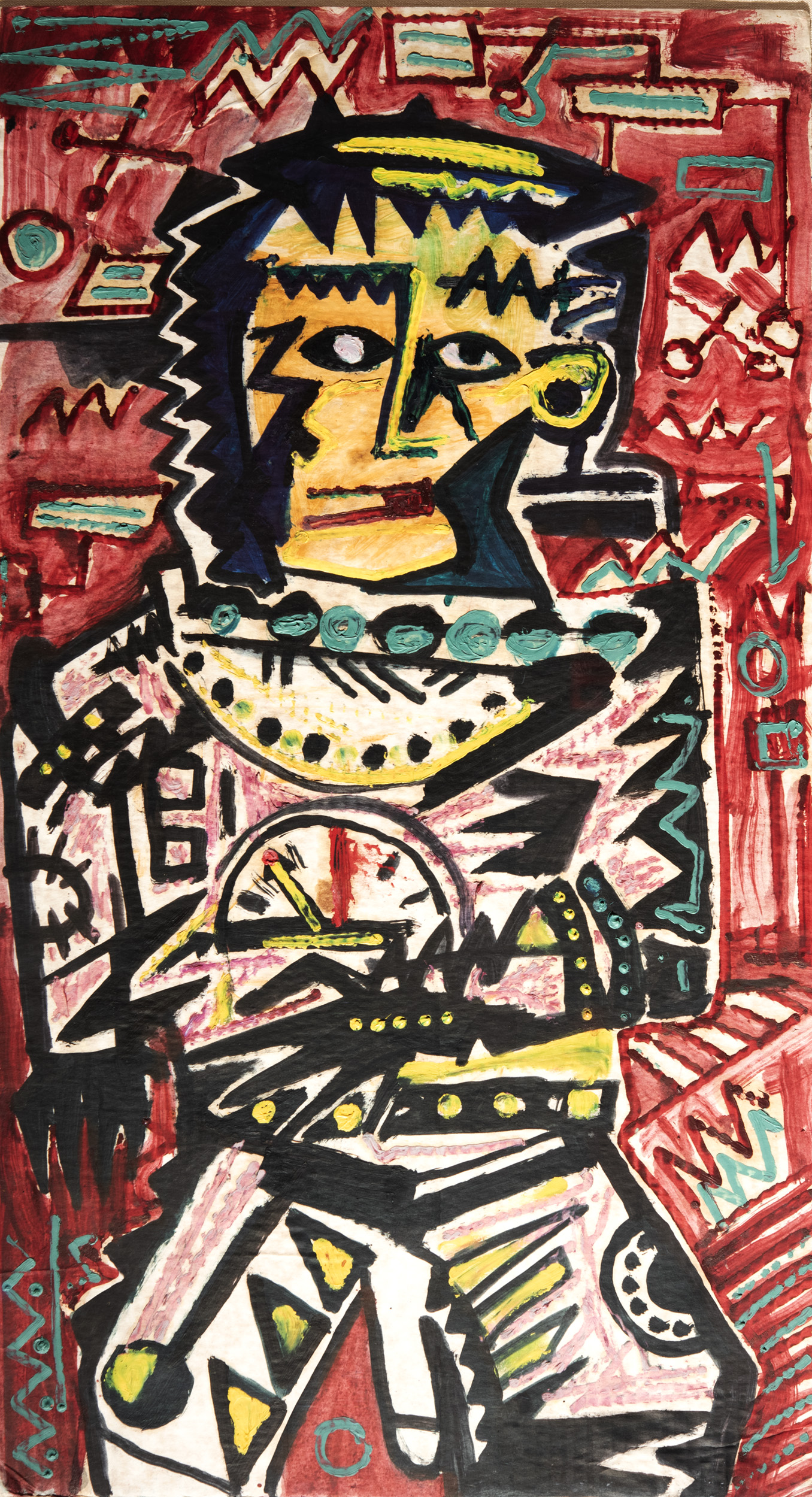
Untitled, 1984. Oil on corrugated cardboard, 77.1 × 42.8 cm (30 3/8 × 16 7/8 in.). Norton and Nancy Dodge Collection of Nonconformist Art from the Soviet Union. D10242