
Georgii Triakin-Bukharov
1943 — Nizhneudinsk, Irkutsk region (Russia). Works in Almaty (Kazakhstan)
Georgii Triakin-Bukharov, a representative of the Almaty underground of the turn of the twenty-first century, is an artist who works on social projects with incisive political overtones. His work combines the traditions of pop art, readymade art, and conceptualism; it includes elements of collage and assemblage using the detritus of human civilization, obsolete and trashed items that carry the energy of their former owners. In addition to creating sculptures, objects, installations, and environments, in the 1990s, he collaborated on a number of performances with Rustam Khalfin, one of the leading representatives of contemporary art in Kazakhstan.
Art critic Oksana Shatalova describes his work as follows: “Georgii Triakin-Bukharov’s method is artistic recycling, an aesthetic processing of decrepit anthropogenic objects . . . composed of irons, shovels, and toilets; this heavy-ringing fauna seems to have every right to claim honorary kinship with dadaist assemblages, the detritus improvisations of nouveau realisme, and the junk objects of Edward Kienholz. However, Triakin-Bukharov’s sculptures do not appear to have arisen from the history of art, but from a manmade Soviet dump. And it seems as if, with a clang and a roar, they stubbornly rise from their graves—from the cemeteries of dead tractors, from the former collective farm fields, from the frozen and mossy machine tractor stations . . . . The inhabitants of Triakin-Bukharov’s rusty bestiary are always behind, in the past, these are material phantoms of ‘former progress,’ wandering at the tail-end of the caravan.” [1]
In 1963, the artist moved to Almaty, where he tried to enter art school several times, always seeking specialized education. In 1967–68, he took drawing lessons at the Union of Architects of Kazakhstan.
He set up his own studio in an abandoned boiler house, in which he studied three-dimensional and painting methods. Victor Klepikov, Victor Razvaliaev, and Aleksander Zaitsev also worked in Triakin-Bukharov’s studio. He collaborated on several sculptural works with Klepikov.
In 1974–75, some of his sculptures were shown in exhibitions. His early works already demonstrate his associative approach, which is often dictated by the original form or texture of the material. When working with natural materials, the artist makes minimal intrusions into its original form, preserving the lifelike feeling of the surface. The material often prompts the artist as to what the stone or tree should become when the piece is completed.
Triakin-Bukharov does not limit himself to natural materials and also introduces finished objects into his compositions, turning readymade constructions into symbolic signs of the times. In the compositions Дом [Home] and Сердце [Heart], both from 1998, barbed wire appears as a symbol of nonfreedom and spiritual longing, like a snake creeping toward the human heart. In Совковая лопатка [Soviet/Square-Point Shovel] (2011), an ordinary object is equipped with a symbol of socialism (the pointed top of the flag), which deprives it of functionality but makes it “ideologically faithful.” The title of this work refers to the chronological and geographical position of the item, since the word совок (meaning both “shovel” and a Soviet citizen) is invariably associated with a specific historical and geographical setting.
In 1976, Triakin-Bukharov quit his job at KazTorgReklam in order to have more time for his creative endeavors, and he started working at Alma-Ata TransSignal Trust as a guard. In 1983, in Moscow, he attended the Higher Art and Industrial School (now the Stroganov Moscow State University of Arts and Industry) as an unenrolled auditor. At the same time, he also frequented four different workshops where he studied painting and drawing. Living in Moscow, he visited exhibitions and met with artists; some made a huge impression on him and influenced his work. This is also when he adopted the idea of turning old, disused objects into images. In the works of Vadim Sidur, another memorable artist, Triakin-Bukharov noticed the expressiveness of junk material, of garbage used in interesting constructive configurations.
Returning from his sojourn in Moscow, he enrolled as an auditor at the Department of Monumental Plastic Arts of the Almaty Theater and Art Institute, which he attended in 1983–87.
Working at the Alma-Ata TransSignal Trust, he made several sculptures on commission. For the enterprise, using collage techniques and recycled materials, he created a relief frieze in the form of a stylized emblem for a building. In the early to mid -1990s, his work in traditional sculpture gradually gave way to objects and installations with elements of collage and assemblage. For these, the artist used not only readymade industrial objects but old or discarded household items (such as old chairs and tables covered in paint, toothpaste tubes, dilapidated art reproductions, and photographs), since they carried information from the past in addition to their own sculptural characteristics. He often transformed an existing form into something new. Penetrating into the essence of the material, the artist was able to see the profile of the divine Nefertiti in the butt of a gun, or the face of the brilliant Pushkin in the soft, scuffed upholstery of an old chair.
Still, the bulk of his works have acute social and political overtones. Stalin’s repressions are examined in a triptych that shocked audiences, inspiring protest and rejection. A humanoid monster in an overcoat with rake arms and a vinyl record of a Stalin speech as its face (Геноцид [Genocide], 1989); a line of vertical bayonet shovels surrounded by barbed wire representing a detachment of prisoners (Панихида [Memorial Service], 1989, a project for a monument to victims of repression); and a meat grinder swallowing a human hand, with the addition of a soldier's boot, doll parts, and barbed wire, forms a kinetic object in the shape of a prison tower (Реквием ХХ века [Twentieth-Century Requiem], 1990). All of them together, and each one individually, serve as a portrait of an entire era, imbued with the pain of generations that survived revolutions, wars, repression, and persecution. In this collective image of the twentieth century, the artist expresses not aggression but sympathy, and the impossibility of having an indifferent or neutral attitude toward the horrors occurring in society and at the hands of the state. Visions of absolute deconstruction and irreversible destruction permeate a number of Triakin-Bukharov’s works, leaving the viewer uneasy: for example, the scattered fragments of plastic dolls or the crippled anthropomorphic figure in the work Ампутация [Amputation] (1992), an image that frightens viewers with its helplessness and tragedy and that is definitively associated with modern society and man’s place in it.
Of course, such artistic statements were not approved by official institutions, and he was one of many artists who remained in the underground. Art critic Valeria Ibraeva comments: “Shaii-Zia [Ziiakhan Shaigeldinov] and Triakin-Bukharov were not seen as artists by society since the idea of ‘high art,’ which was mostly produced by members of the Union of Artists, still had a strong grip on society. … The central social problem of the late 1980s was the desire for ordinary physical survival, and since these artists mainly worked outside of institutions and no one spent much money on them, there also was no public condemnation. Their actions and works were perceived as amateur performances by semi-literate self-taught people who did not ‘even’ belong to the Union of Artists.” [2]
Over time, his chamber objects expanded in size. Monumental kinetic images of a horse and a camel are close to life-size, looming over the viewer. Мустанг [Mustang] (2003) is assembled from furniture parts, traps, and an electric motor that drives the movement of a horse member. This zoomorphic theme was continued in the exhibition Ниф-Ниф и Нуф-Нуф [Nif-nif and Nuf-nuf] (2007). The main objects there were two pigs. The larger one (over two meters tall) was constructed out of an enameled bathtub, basins, sinks, and eye-globes, whereas the smaller pig had a snout-print with a price tag of two rubles and twenty kopecks, a reference to the cost of a kilogram of pork in Soviet times.
In 1997, he participated in an exhibition with Rustam Khalfin, which signaled the beginning of their productive collaboration. As part of the gallery Asia-Art, he took part in the preparation and proceedings of the seminar Art-Discourse-97. He participated in the projects and performances Шкура художника [The Skin of the Artist]; Последняя точка [The Last Point] (1997); Ленивый проект [Lazy Project]; Большое стекло [Large Glass], (1998); К осознанию границ [Toward Awareness of Borders]; В честь всадника [In Honor of the Horseman] (1997); Права человека. Второе дыхание [Human Rights. Second Breath] (1997); the art seminar IV International (1998); and the installation Летающий белый [Flying White] (1998).
Starting in 1998, in collaboration with Khalfin, he worked on the environment Глиняный проект [Clay Project] (1999) at the Almaty gallery Look; this included the performance Экстремальное дефиле [Extreme Runway Walk], in which the artists covered the naked bodies of women with clay—a symbol of the creation of the world and the first man. The central concept of the project was a giant anthropomorphic figure, eighteen meters tall, grandiose in its design and physicality, which pierced the space of the two-story building. In this work, the artists exposed the properties of clay as the material foundation of traditional Eastern cultures.
Georgii Triakin-Bukharov is an important figure in contemporary art, for whom engagement with historical memory plays a central role. His work is not only a form of aesthetic expression, but also a way of understanding the traumatic past. Using materials that bear the imprint of time, he creates powerful symbols of his era, engaging with themes of repression, nonfreedom, and social collapse. His artistic method allows him to approach these complex issues through his original and memorable visual language.
Ekaterina Reznikova
Translated from Russian by Maria Vassileva
Notes:
1. Shatalova, Oksana. “Triakin-Bukharov.” In Mezhdu proshlym i budushchim. Arkheologiia aktual'nosti. Sovremennoe iskusstvo Kazakhstana, 1990-e–2000-e. [Between past and future: Archaeology of relevance. Contemporary art of Kazakhstan, 1990s–2000s], exh. cat. Almaty: Goethe Institut, 2011: 120.
2. Ibraeva, Valeria. Iskusstvo Kazakhstana: Postsovetskii period [The art of Kazakhstan: Post-Soviet period]. Almaty: Tonkaia gran’, 2014.
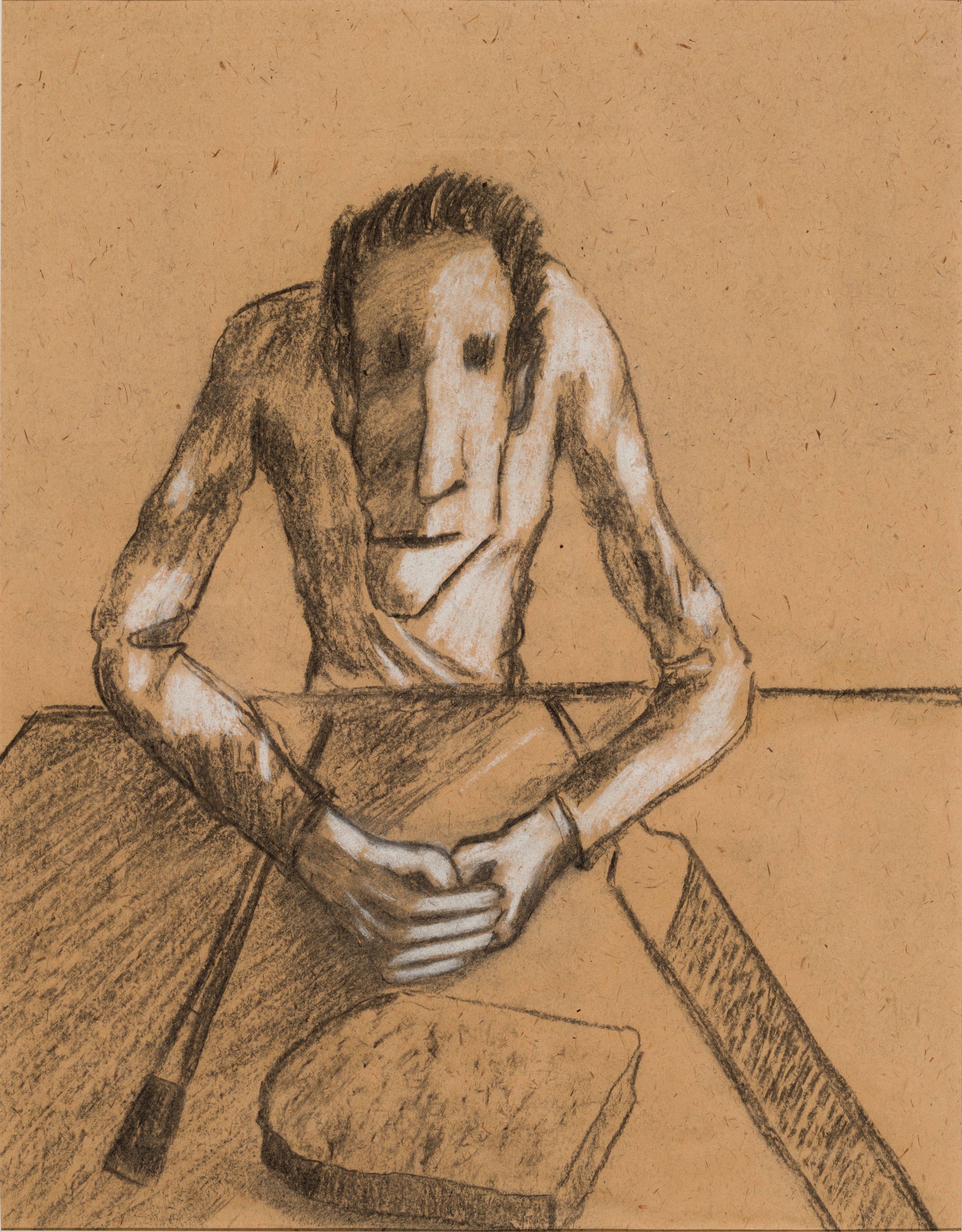
A Buridanov Donkey, 1970. Chalk and charcoal on paper, 52 × 41 cm (20 1/2 × 16 1/8 in.). Purchased with funds donated by Norton Dodge and Nancy Dodge. 2000.0034
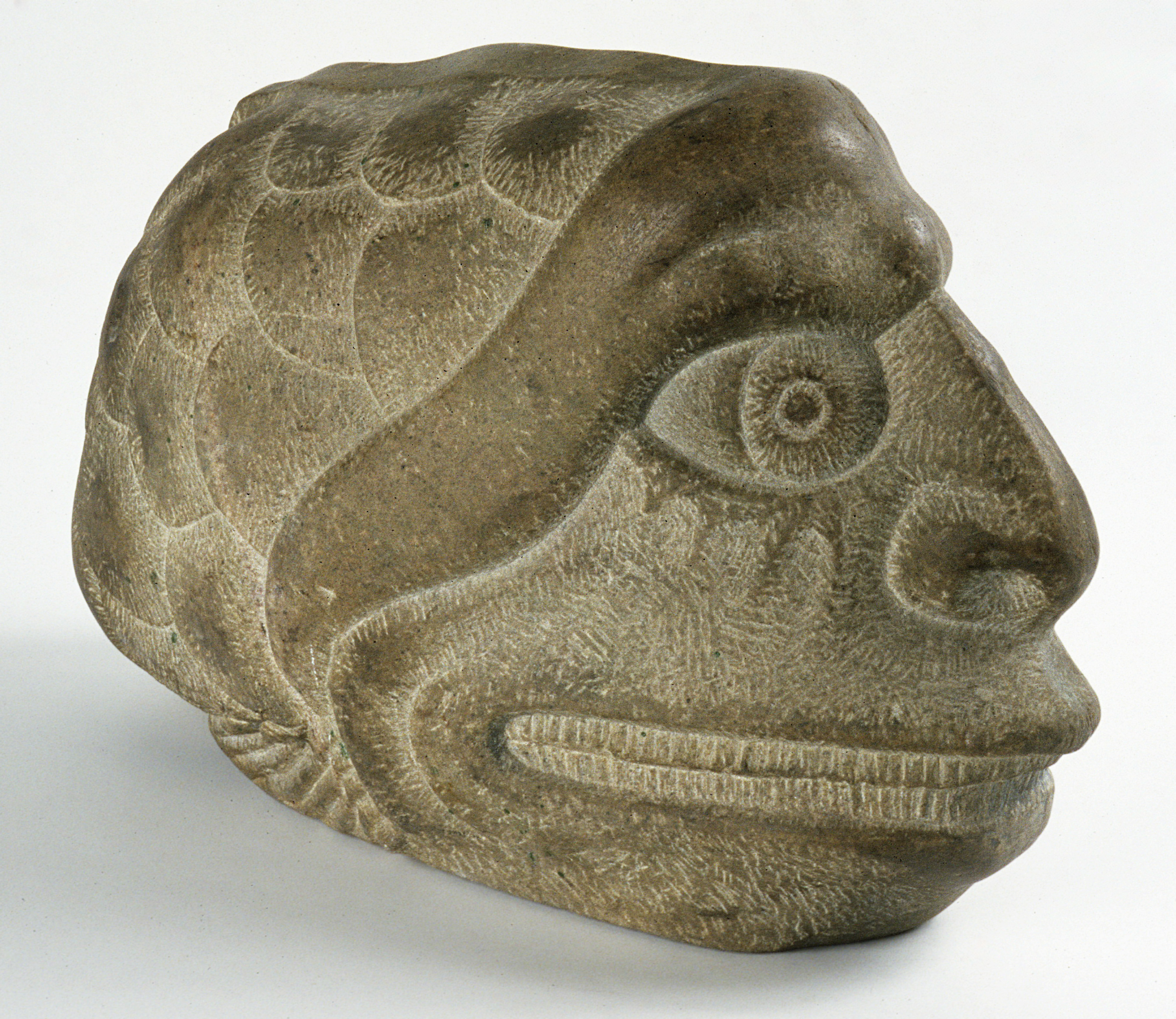
Man-Fish, 1982. Stone, 24 x 32 x 15 cm (9 7/16 x 12 5/8 x 5 7/8 in.). Purchased with funds donated by Norton Dodge and Nancy Dodge. 2000.0070