
Georgi Skrypnichenka
1940 — Nikolaev (now Mykolaiv), USSR (now Ukraine) | 2015 — Minsk (Belarus). Lived and worked in Minsk (Belarus)
Georgi Skrypnichenka was a painter, graphic artist, and book illustrator. After the Second World War he moved as a young boy with his family from the Ukrainian city of Mykolaiv to the small town of Slutsk, in the Minsk region of Belarus. There he attended a children’s art studio under the guidance of Vladimir Sadin (1924–2010). This studio in provincial Slutsk is a unique phenomenon in the history of Belarusian art, as Sadin nurtured a whole constellation of outstanding artists.
In 1961, Skrypnichenka entered the Minsk Art College (now the Aleksei Glebov Minsk Art College). He stood out among his peers with an unconventional style of dress and behavior, a special sense of humor, and nonconformism. He was one of those young people who felt uncomfortable in the monotonous Soviet reality. In art, Skrypnichenka also sought his own path, unwilling to accept the norms and standards of the socialist realism cultivated in the Soviet Union. However, even strict limitations and a cultural vacuum could not stop his intuitive search for new expressive means. The relatively safe genre, which faced fewer ideological requirements during Soviet times, was still life. In Skrypnichenka’s still lifes from the 1960s (two of which are in the Zimmerli Art Museum, Still Life, 1962, D15546, and Still Life with a Fish, 1965, D15547), the succinctness of artistic means seems to reproduce the austerity and severity of Soviet everyday life. The economy of the color palette’s individual bright accents, the generality and simplicity of forms, and play with perspective are some of the distinguishing features of Skrypnichenka’s still lifes from this period. Among other genres that the artist loved since his student days and never abandoned throughout his life were self-portrait and landscape, both realistic and fantastical.
He faced difficulties from his first major exhibition as a student. In 1965, at the All-Union Exhibition of Young Artists, he presented two paintings of that year: Still Life with Iron and Self-Portrait with Lemon. These works, executed in a cubist style using collage and flattened perspective, shocked many viewers and critics who were accustomed to realism and did not understand other trends. Later, he was almost expelled from the school and was accused of leaning toward “bourgeois formalism”—a very serious charge at that time. However, he was defended by his teachers, the famous Belarusian artists Leonid Shchemelev (1923–2021) and Algerd Malishevsky (1921–1989).
Skrypnichenka’s early works reveal not only aesthetic but also intellectual and spiritual dissonance with the Soviet artistic mainstream. For example, in the 1960s, when aggressive atheism prevailed in the country, he constantly turned to religious themes and images in his work. Nonetheless, he managed to graduate from the college in 1966. His reputation as a “formalist” prevented him from entering the Belarusian State Theater and Art Institute and obtaining higher professional education. From 1970 to 1974, he worked at the All-Union Scientific Research Institute of Technical Aesthetics, where he was involved in packaging design for the food industry. Since Skrypnichenka ’s creativity did not conform to the official canons of Soviet art, it was only on the third attempt, in 1972, that he became a member of the Belarusian Artists’ Union.
In the 1970s Skrypnichenka’s artistic language became more complex. His paintings and graphic works increasingly featured fantastical imagery, intricate symbolism, and distorted figures. More and more often, the artist opted for bold combinations of bright, unnatural, even otherworldly shades. In that same decade, the theme of space exploration became his salvation. Undoubtedly, this subject allowed the artist to give free rein to his imagination and break free from the rigid constraints of official art. The audience could appreciate his experiments in the lithograph series Cosmic Evolution (1977), the cycle of watercolors Cosmos—Earth (1977), and the series of works in mixed technique Cosmos (1978).
In the 1980s, the ideological foundations of Soviet society gradually weakened and collapsed, and socialist realism gradually began to lose its position. In this pivotal period, many Belarusian artists turned to the past: There was an interest in historicism and themes of national culture. In line with these trends, Skrypnichenka combined different temporal layers in his paintings and graphic works of the 1980s, using postmodern strategies of citation and reinterpretation of classical works of Belarusian and world culture. The combination of the real and the unreal, the complex metaphorical nature of artistic expression, is characteristic of his triptych Beloved Images of the Native Land (1981), along with the canvases Harmony of Centuries (1983), Allegory of the World (1984), and August (1986). Among his works of this period, the painting Today Is a Holiday (1985) should be noted; it presents the work of this author in the permanent exhibition of the National Art Museum of the Republic of Belarus. This painting is perhaps one of the strangest and most noncanonical interpretations of the theme of the Second World War, traditional for Belarusian art. Instead of the familiar images of victory celebrations or war heroes, the canvas represents the artist’s studio. In the center is an easel with a painting depicting the author’s memory of the end of the war, possibly his self-portrait as a child offering flowers to an old woman. Although various elements in the work suggest an association with Victory Day—such as the calendar with the date of May 9, [1] a dove perched on the studio’s open window, and tiny uniformed figures with red flags who can be seen through the window as part of the cityscape—the meaning of the work remains open to interpretation by each viewer. Art is immune to time; it makes use of symbols, connecting different events into a single image.
In the 1990s, after the collapse of the Soviet Union, opportunities emerged to come of the shadows and assert oneself with a full voice. Skrypnichenka was one of the most popular cultural figures, about whom much was said and written. Critics recognized him as one of the iconic revolutionary figures in Belarusian art of the second half of the twentieth century, an artist who had a significant influence on many contemporary artists. [2] In 1997 Skrypnichenka was elected as an academician of the public creative association of artists, the Belarusian Academy of Fine Arts.
Skrypnichenka was called “the first Belarusian surrealist” by critics. [3] Similar principles of organizing artistic space, the emphasis on the “constructed” nature of the artistic world, the paradoxical quality of illogical combinations, and the collision of the physical and metaphysical united him with the surrealists. In response to being dubbed by some critics as the “Belarusian Salvador Dalí,” [3] with characteristic humor, Skrypnichenka began to wear the same mustache as the famous Spanish artist. For Skrypnichenka, this was a way to ironically tease those critics and viewers who only noticed the superficial resemblance of his work to surrealism and were unable to look deeper.
Translated from Russian by Sergey Shabohin
Photo portrait by Yaugen Kolchau, 2014
Notes
1. The Soviet Union celebrated the victory over the Nazi Germany on May 9.
2. Mikhail Barazna, Vujaulenchaje mastactva Belarusi XX stahoddzia [Fine Art from Belarus in the Twentieth Century] (Minsk: Belarus, 2017).
3. Taras Schiryj, Nietipichnaja kartina piervogo belarusskogo siurrealista [An Atypical Painting by the First Belarusian Surrealist].
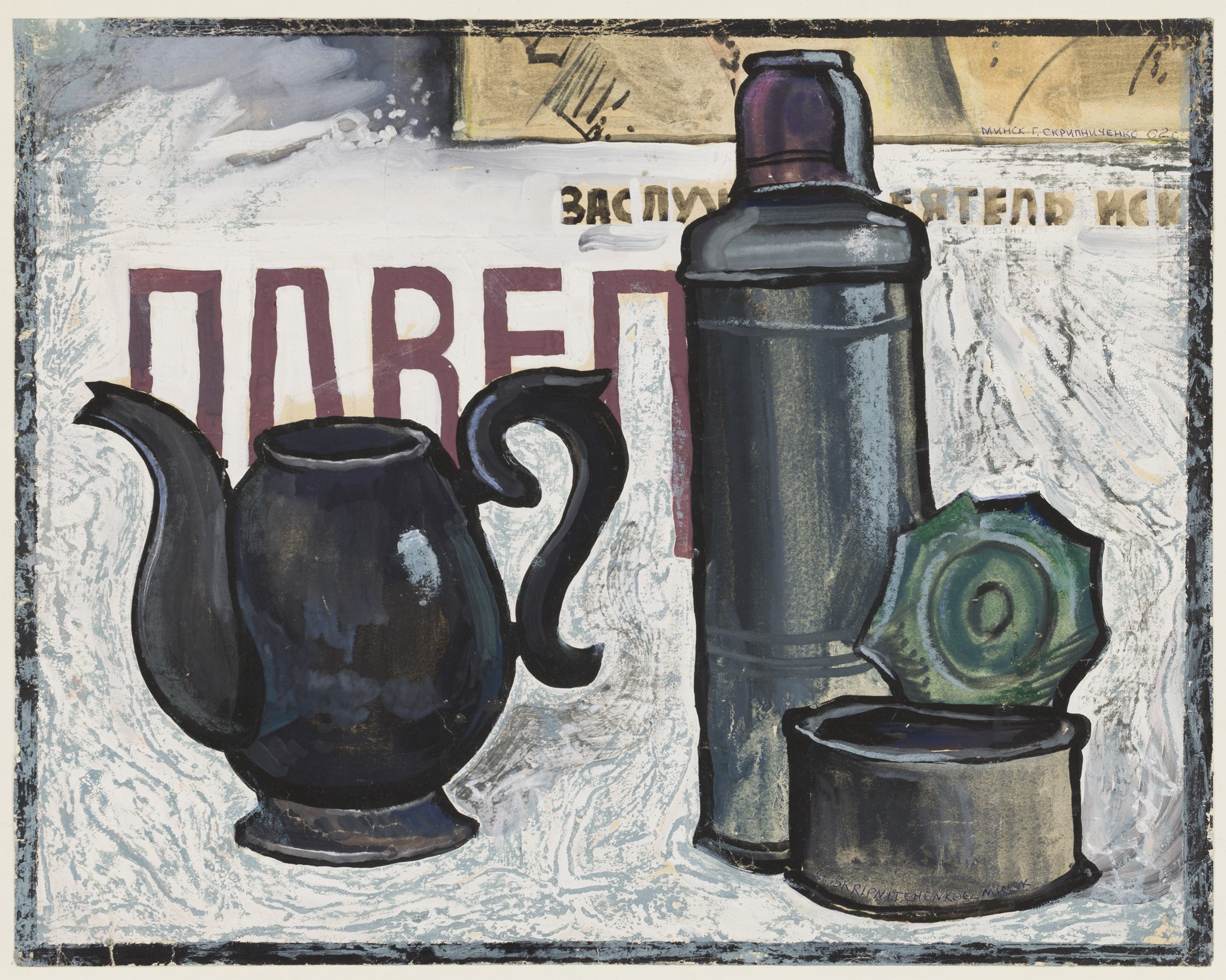
Still Life, 1962. Gouache on paper, 37 × 50.9 cm (14 9/16 × 20 1/16 in.). Norton and Nancy Dodge Collection of Nonconformist Art from the Soviet Union. D15546
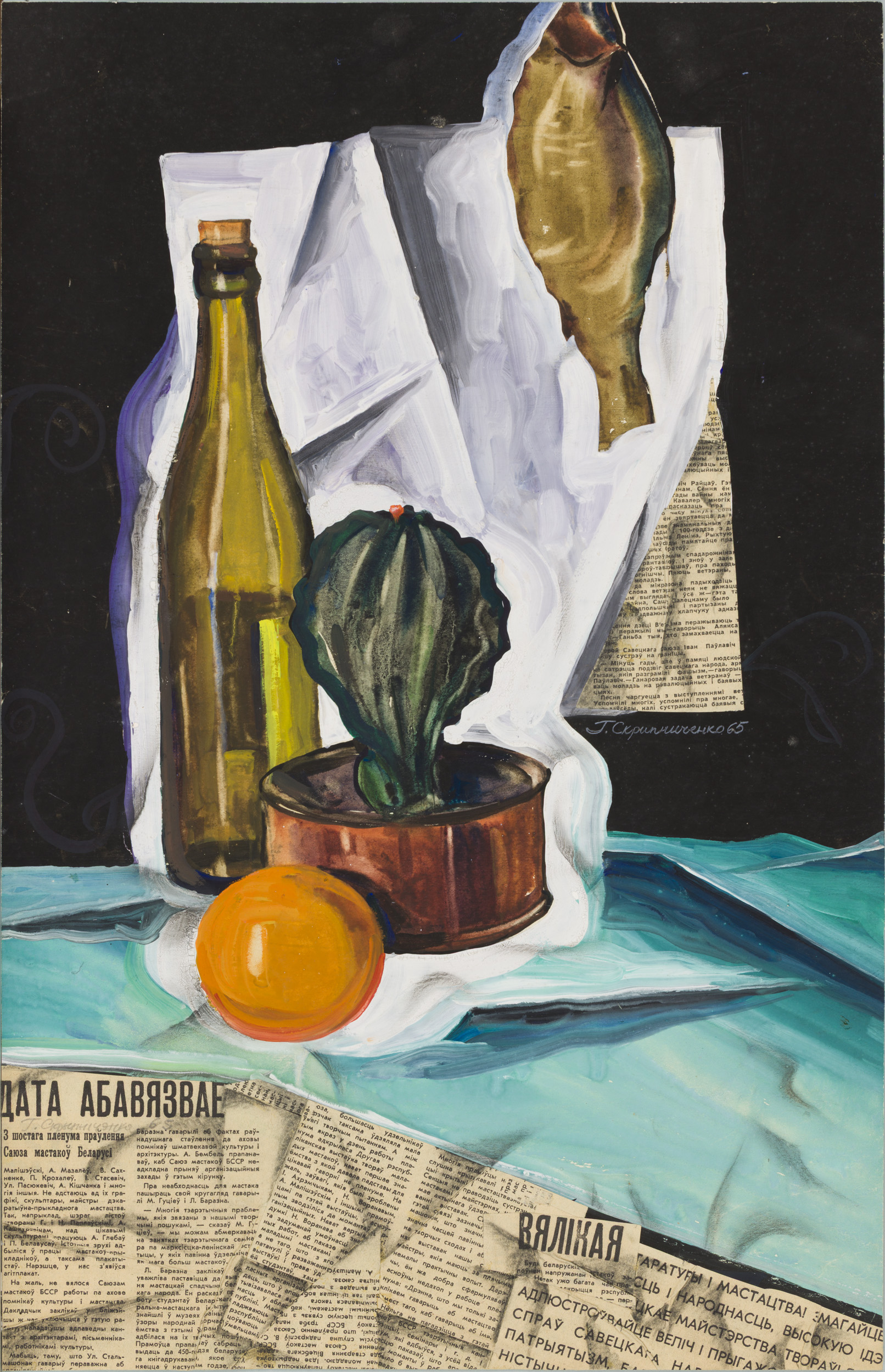
Still Life with a Fish, 1965. Gouache and collage on paper, 54.5 × 35.1 cm (21 7/16 × 13 13/16 in.). Norton and Nancy Dodge Collection of Nonconformist Art from the Soviet Union. D15547
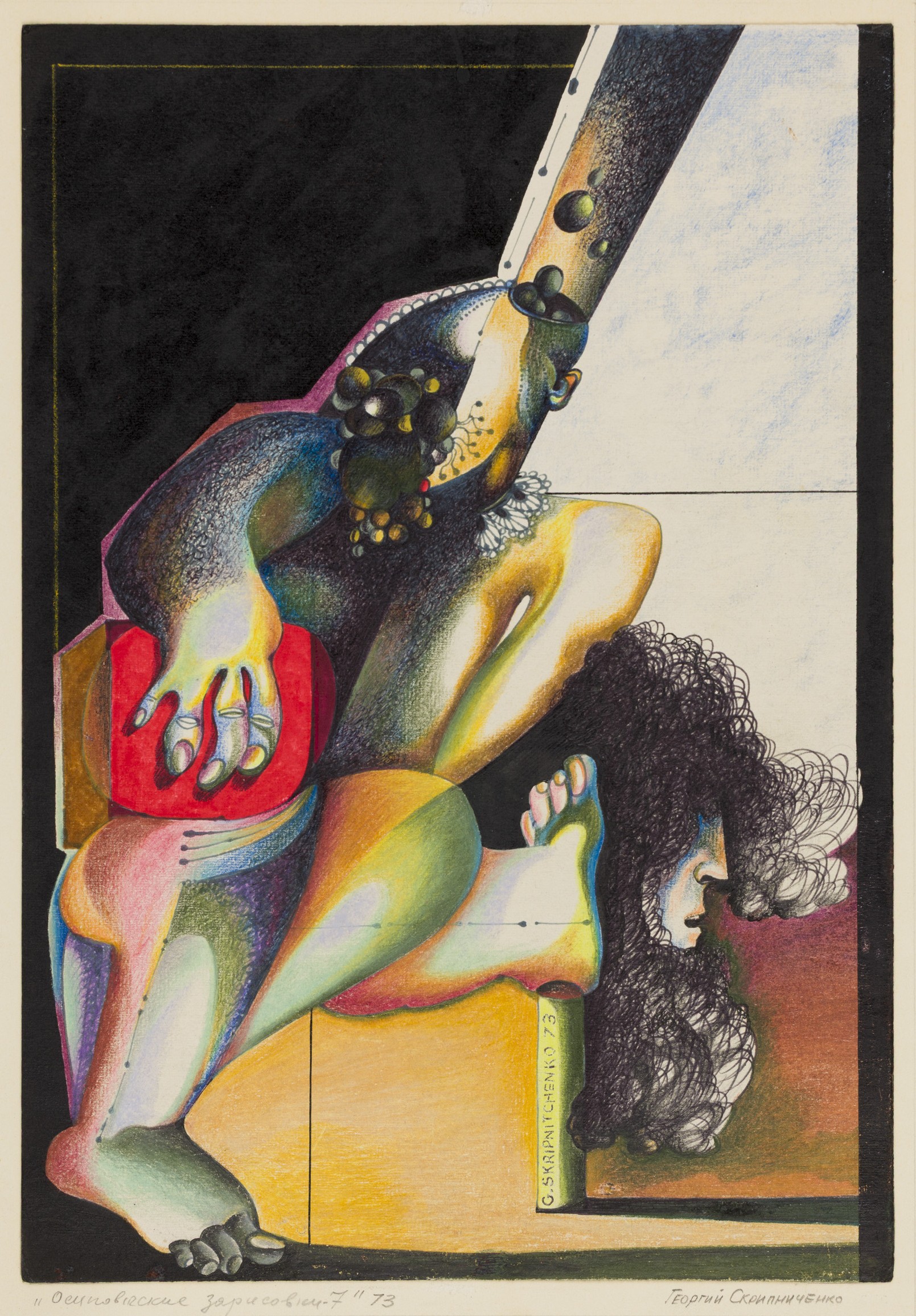
Prisioners, 1973. Colored pencil and ink on paper, 30.7 × 21.6 cm (12 1/16 × 8 1/2 in.). Norton and Nancy Dodge Collection of Nonconformist Art from the Soviet Union. D15564