
Georgi Alexi-Meskhishvili
1941 — Tbilisi (Georgia). Lives and works in Tbilisi (Georgia)
Georgi (Gogi) Alexi-Meskhishvili belongs to the small cohort of Georgian artists of his generation who have achieved international recognition despite the constraints of the Soviet system.
Born in Tbilisi, he is the son of the famous Georgian architect Vladimir (Lado) Alexi-Meskhishvili. In 1967, he graduated from the Tbilisi State Academy of Fine Art and shortly thereafter began making works that conveyed clear visual messages.
In 1971, he began his association with several great Tbilisi theaters when he assumed the role of set designer at the Rustaveli Drama Theater and the Tbilisi Opera and Ballet Theater; at the same time, he embarked on collaborations with the Kote Marjanishvili Drama Theater. In 1975, he was chosen as head designer of the Rustaveli Theater, where he designed the sets for nearly forty productions. He brought his distinctive scenographic vision—characterized by the influence of expressionist painting, as well as an original synthesis of symbolism and abstract motifs—to the staging of such plays as Bertolt Brecht’s Caucasian Chalk Circle and The Good Person of Szechwan, Carlo Gozzi’s Donna Serpente, William Shakespeare’s Twelfth Night, or What You Will and Midsummer Night’s Dream, Molière’s Don Juan (Tumanishvili Theater), and Mikheil Javakhishvili’s Jago's Dispossessed (in collaboration with director Temur Chkheidze).
Especially significant during this period were Alexi-Meskhishvili’s collaborations with director Robert Sturua and composer Giya Kancheli; the trio worked together on productions that figure largely in the history of Georgian theater, at times infused with dissident messages that evaded Soviet censorship.
Living under the Soviet system, Alexi-Meskhishvili was among a handful of cultural figures of the period who achieved global acclaim and engaged in international collaborations, creating costumes and set designs for leading theaters throughout the world, including: the Chekhov Moscow Art Theater, La Fenice (Venice), the Teatro Comunale (Bologna), the Bavarian State Opera (Munich), the Habima Theater (Tel Aviv), the Teatro General San Martin (Buenos Aires), the Helsinki National Theater, the Mariinsky and the Bolshoi Drama Theaters (Saint Petersburg), the Schauspielhaus (Düsseldorf), and the Metropolitan Opera (New York).
In 1999, he was featured in the Georgian Pavilion at the 49th Venice Biennale, and in 2009, he was the commissioner of the Georgian Pavilion at the 53rd Biennale.
In interviews, Alexi-Meskhishvili often points to the significance of Georgian film director Sergei Parajanov, characterizing him as a leading exemplar of Tbilisi culture and describing the inspiring nature of his collaborations and friendship with the great director. His work on Parajanov’s Ashik Kerib (1988) earned him the European Special Aspect Award (Felix Award). In 1990, Alexi-Meskhishvili painted one of the most iconic portraits of the director. The portrait was executed in an abstract expressionist mode; an uncanny rendering of its subject emerges from a whirlwind of brushstrokes, combining the look of the constantly acting performer with the monumental appearance of a “prophet.” As Parajanov was suppressed and marginalized by the Soviet regime, the portrait could be unveiled to the public only following Parajanov’s death that year, after Alexi-Meskhishvili had made some changes to the painting.
In addition to the Parajanov portrait, Alexi-Meskhishvili created other paintings, often in series, as well as conceptual multimedia works, sculptures, and installations. These works are not as well known as his theatrical designs, although in recent years these other aspects of his oeuvre have underpinned the artist’s rediscovery by the public. Most notable are the Body exhibition at the ATINATI Cultural Center in Tbilisi, which featured large, semi-abstract paintings, along with another project titled Like the Wind at Your Back, presented at the Tsinandali Estate in Kakheti, showcasing stylistically expressive, colorful mixed-media sculptural objects alongside photographic textile works by Georgi’s daughter, Ketuta Alexi-Meskhishvili. This pair of exhibitions revealed the artist’s pursuit of existential questions such as mortality, the limitations of the body, and the eternal and the transient, expressed in explorations of the relationship between abstraction and imagery, pure form and space, with references to psychological archetypes and body language.
Along with painting and drawing, collage is among the artist’s most important media. Collages such as Madonna with Glove (1993, ZAM, D16621) look to the Dadaist tradition, synthesizing painting, graphic techniques, fabric, paper, readymade objects, photos, and photo reproductions. Here, quotations from the history of painting and cinema appear as fragments of the stream of consciousness. Another major example of his work in collage is the ongoing series Rosebud. The series is based on the iconic scene of Orson Welles’s cinematic masterpiece Citizen Kane (1941), where the dying magnate drops a snow globe, after which it begins to snow outside, and he utters his final line: “Rosebud.” In these works, the readymades are small, glittering, fragile items such as Christmas tree ornaments that appear at the center of abstract-painterly backgrounds. The contrast between the light, almost weightless decorative motif and the gestural brushstroke conveys various impressions, including the sense of confronting chaos while experiencing a feeling of weightlessness. Other collages, among them Untitled (undated, ZAM, D19336), convey a sense of vanity and fragility, which is perceived from a distance. In a sense, this work continues the effect of the Rosebud series, in which the fragments convey a sense of vanity and fragility that can be felt even from afar, with a graceful object floating amid the infinity of a vast and mysterious world.
Alexi-Meskhishvili’s series of large, painted torsos comprises another important body of work. These canvases are a kind of palimpsest, sometimes left in the workspace for a long period and forgotten, which over time have been layered with paint, various printed fragments, and dust, either accidentally or experimentally applied. The images are figurative in nature, representing expressive silhouettes against an abstract background; some passages seem to depict the victim of a violent act and evoke images of the Crucifixion. The artist depicts the body in a somewhat brutal manner, while the abstract background creates the effect of the torsos falling in open space (Sleeping Body, 1984; Sleeping Body with Heads, 1985, ZAM, D00040).
Along with his global collaborations, Alexi-Meskhishvili’s international recognition is connected to his pedagogical activity. From 1995 to 2013, he taught at Dartmouth College in New Hampshire, United States, where he was awarded the title of best professor on campus. Upon his return to Georgia in 2014, he established the Gogi Alexi-Meskhishvili School of Contemporary Theatre and Design with the support of the Ministry of Culture and Monument Protection of Georgia. School projects were exhibited at the Prague Quadrennials of 2019 and 2023; in 2019, the school received the award for Best Student Exhibition Experience, and in 2023 for Visionary Teamwork.
Alexi-Meskhishvili has received various accolades and prizes including Public Artist of Georgia, the Soviet State Prize, and the European Felix Film Award, as well as the Rustaveli, Tumanishvili and Otskheli Prizes.
Khatuna Khabuliani
Translated from Georgian by Nino Gabunia
Photo portrait by Oleg Khaimov

Madonna with Glove, 1993. Collage on fabric, 39.7 × 35.9 cm (15 5/8 × 14 1/8 in.). Norton and Nancy Dodge Collection of Nonconformist Art from the Soviet Union. D16621
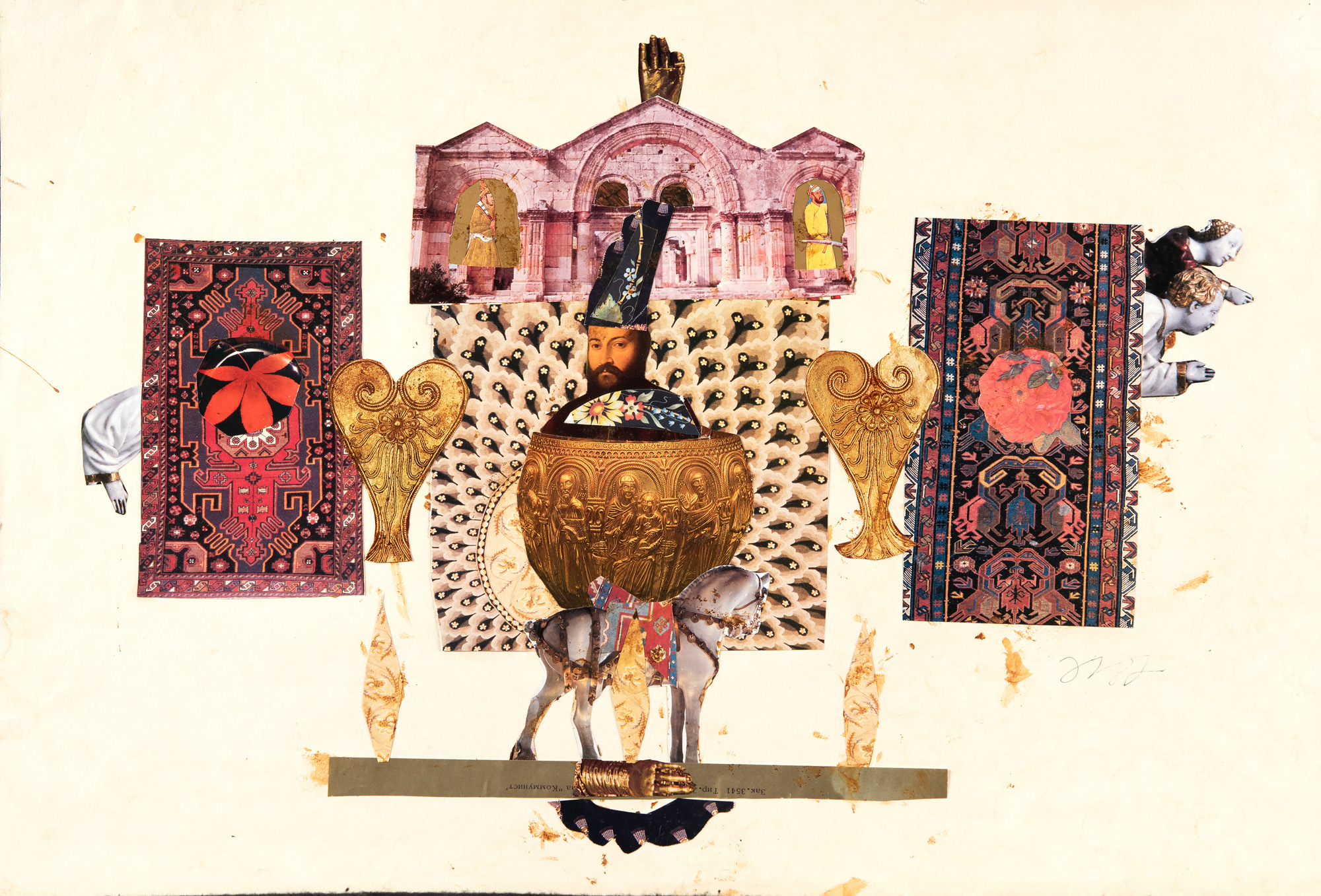
Untitled, undated. Collage on paper, 42.8 × 61.2 cm (16 7/8 × 24 1/8 in.). Norton and Nancy Dodge Collection of Nonconformist Art from the Soviet Union. D19336

Ashik Kerib set design, 1987. Paper collage on paper. Purchased with funds donated by Norton Dodge and Nancy Dodge. 2000.0417

Sleeping Body with Heads, 1985. Oil and mixed media on canvas, 195.5 × 195.5 cm (76 15/16 × 76 15/16 in.). Norton and Nancy Dodge Collection of Nonconformist Art from the Soviet Union. D00040