
George Pusenkoff
a.k.a. George Cohen
1953 — Krasnapollie (Belarus). Lives and works in Cologne (Germany) and Moscow (Russia)
George Puzenkov (who later adopted the spelling Pusenkoff) was born in 1953 in the village of Krasnapollie in the Mahilyow region of the BSSR (now Belarus). He received his first drawing lessons from his grandfather, an artist who graduated from the Art Academy in Odesa and studied with Marc Chagall (1887–1985) in Vitebsk. In 1968 Pusenkoff both graduated from the Kazan Art School and moved to Moscow with his family. From 1971 to 1976, he studied at the Moscow Institute of Electronic Technology, specializing in computer technology, while continuing his art studies. From 1977 to 1983, he studied at the Moscow Polygraphic Institute (now Moscow State University of Printing Arts).
From 1983 to 1988 he collaborated with various publishing houses and participated in major exhibitions of young artists during the years of perestroika: the 17th and 18th Youth Exhibitions and the ASSA Rock Art Parade (1988, S. M. Kirov Palace of Culture, Leningrad). The latter led to him being classified as a Soviet nonconformist artist. He was a member of the Hermitage, Labyrinth, and Moscow Group 88 associations and took part in their exhibitions. From 1987, he began to exhibit abroad. In 1990, at the invitation of the Hans Mayer Gallery in Düsseldorf, he began to work in Germany. Since then, he has been living and working in Cologne while maintaining a studio in Moscow.
Pusenkoff developed as an artist in the atmosphere of Moscow nonconformism of the 1970s and 1980s. Socially engaged art played a special role in the formation of his creativity; he was surrounded by such artists as Ilya Kabakov (1933–2023), Erik Bulatov (1933–2025), Vitaly Komar (b. 1943), and Alexander Melamid (b. 1945), who actively used methods of quotation and appropriation, incorporating cultural and aesthetic references to Soviet and world art as part of their commentary on the official culture and social life of the USSR. This domestic version of postmodernism had a strong influence on the generation of young artists in the 1980s. Pusenkoff, however, developed his own individual version of postmodernist aesthetics. As the eminent critic Boris Groys noted, “For Georgy Pusenkoff, the determining role is played not by the ideological, but purely aesthetic aspect of art, not by reference to specific social artistic codes, but to the great examples of past art.” [1]
In 1993 Pusenkoff created the striking installation The Wall at the State Tretyakov Gallery, which became the first installation to be shown in that museum. In 1995 his exhibitions at the Ursula Blickle Foundation in Kraichtal, Germany, and the State Russian Museum in Saint Petersburg, Russia, allowed him to further explore and develop his own method of the postmodern principle of quotation. His work became more abstract, with fewer traditional artistic strategies based on citation, appropriation, and cultural references. Pusenkoff increasingly created textured geometric works, experimenting with the character of the painted surface and the role of the black outline. In 1995 the renowned photographer Helmut Newton (1920–2004) sued Pusenkoff over his painting Power of Blue, accusing the artist of plagiarism. Pusenkoff won the case, which went down in copyright history as one of the first cases to address the issue of copyright and the postmodern artist’s right to artistic appropriation.
Since 1996 Pusenkoff has worked with Brigitte March Gallery in Stuttgart, Germany. In 1998, the Mannheim Kunstverein held an exhibition of Pusenkoff’s work entitled Simply Virtual, in which the artist showed for the first time a series of paintings depicting computer file frames that he had been working on since 1995. It was precisely through the juxtaposition of traditional painting techniques and the visual world of the computer that the artist developed his own recognizable aesthetic, which he described as the digital and the painted. Building on this theme, in 1997 Pusenkoff began a new series, Erased Paintings. In these works, the artist explores the logic of digital erasure—a gesture through which a computer user can erase and modify an image on the screen while working in graphic programs, creating a radically new visuality, which can be situated at the intersection of abstract expressionism, pop art, and digital aesthetics. In 2002, one of the paintings in the series Erased Malevich (2002) was exhibited at the Kulturgeschichtliches Museum in Osnabrück, Germany, in the same room as the original Black Square by Malevich from the collection of the State Tretyakov Gallery in Moscow.
In 1997 Pusenkoff embarked on a long-term project for which he photographed his own work, the 1996 painting Single Mona Lisa 1:1 (Yellow), in various contexts. The painting shows a fragment of the face of Leonardo da Vinci’s Mona Lisa, copied from the internet, depicted within a computer frame. He began by traveling around Russia and photographing this work as part of different everyday situations. On April 15, 2005 (Leonardo’s birthday), the painting was delivered to the International Space Station by Italian astronaut Roberto Vittori. Single Mona Lisa 1:1 returned to Earth on April 25, 2005, and the project was presented as part of the 51st Venice Biennale under the title Mona Lisa Goes Space. The multipart installation included light boxes displaying photographic documentation of the artwork’s journey on the ISS, as well as a cylindrical, roofless tower covered on the inside with rainbow-colored versions of the painting, allowing viewers to look up at the sky through the gradient frame of Mona Lisa’s faces.
Beginning with the 2007 retrospective Who Is Afraid, which was held at the Moscow Museum of Modern Art, the artist has turned to abstraction and the motif of the grid. For this exhibition, the artist focused on the theme of abstraction not only as a formal strategy but also as a subject. The retrospective showcased the artist’s journey toward nonfigurative art through his experiments in bringing together abstract painting and the computer interface, the virtual and the real, what the artist has called “digital abstractionism.” [2]
In 2013 the artist exhibited a series of paintings and interactive media installations as part of the exhibition Pusenkoff & Pusenkoff: After Reality at the Ludwig Museum in Koblenz and the Moscow Museum of Modern Art. The project arose from the artist’s reflections on the state of “relative reality” [3] that characterizes our contemporary experience, with the collapse of the visual after the triumph of digital images in mass media. This series is based on the artist’s “theory of shadow,” [4] which asserts that tones, halftones, light, and color are merely forms of shadow (which the artist depicts through the motif of the grid).
Since the 2000s, the artist has been actively collaborating with his son, Ilya Pusenkoff (b. 1982), which has resulted in a number of joint exhibitions and projects. In 2019 George Pusenkoff adopted the pseudonym George Cohen, and he continues to produce abstract geometric works that reflect on the history of abstraction and modernism, the transformation of monochromatic painting, geometric abstraction, and spontaneous gesture. In his studio in Cologne, Germany, the artist creates monumental paintings, which primarily feature grid structures that are texturally applied to the surface. This series of canvases includes both abstract images and photographs with a grid superimposed on the surface, in this case resembling a digital raster. He also creates video projections and installations that offer further variations on the grid motif. Cohen is actively engaged in art theory, and his art practice is closely intertwined with his theoretical explorations.
Sergey Shabohin
Photo portrait by Sasha Krasnov (2017)
1. Boris Groys, quoted in “Zhorzh Puzenkov. One of the Best-Known Contemporary Russian Artists in the West,” published November 4, 2014.
2. See the artist’s website.
3. “The After Reality project emerged from Cohen’s thoughts about the state of ‘relative reality’ of today’s existence, experiencing the collapse of imagery after the victory of digital image media.” George Cohen (Pusenkoff), exhibition text for After Reality, Ludwig Museum, Koblenz & Moscow Museum of Modern Art, 2013, as cited on artist’s PDF biography.
4. “His author’s concept, the ‘Semiotic Theory of Shadow,’ considers shadow as a structure of light that carries information.” George Pusenkoff profile, Pop/off/art gallery.
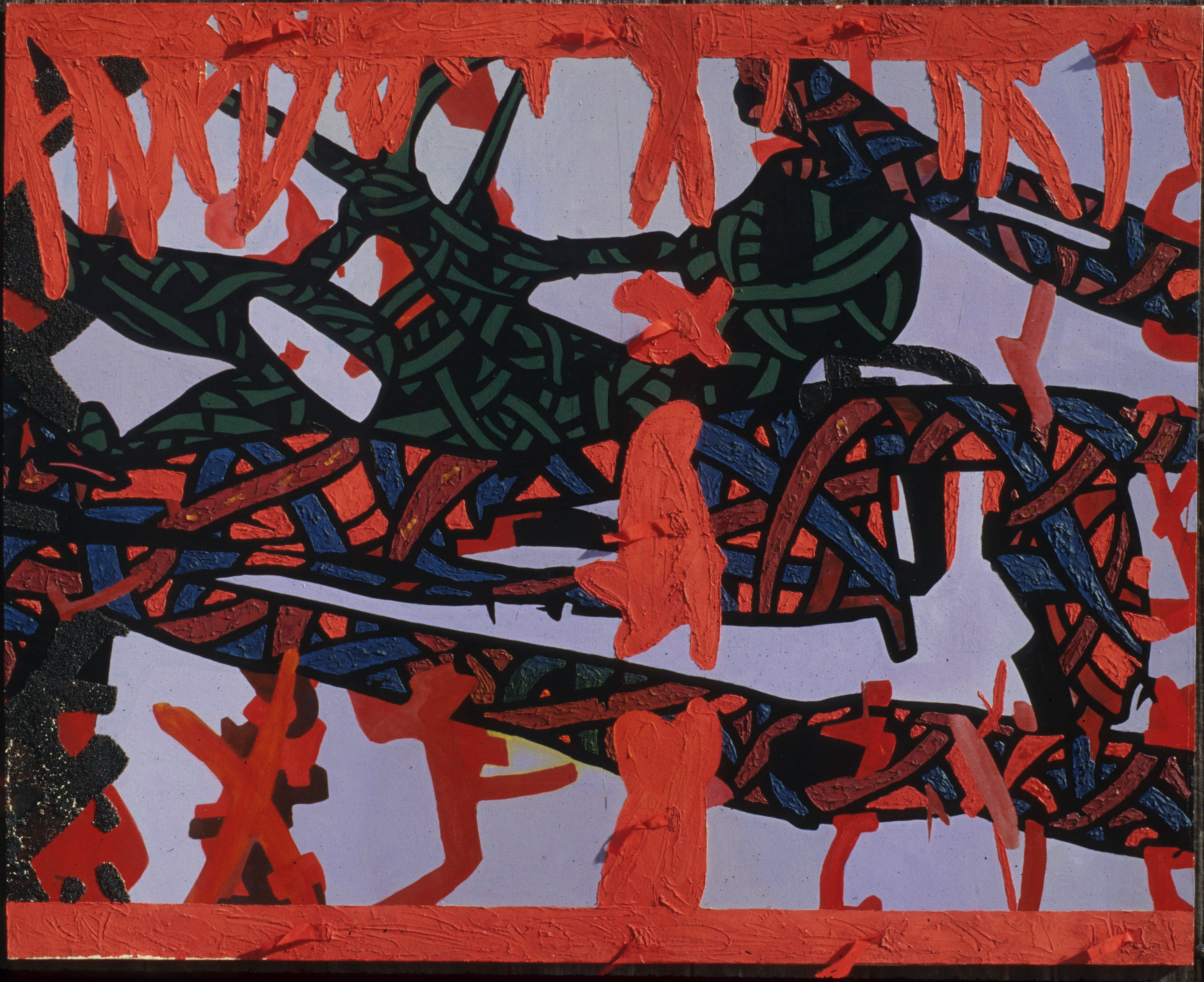
The Meeting, 1981. Oil, fabric, mixed media, and collage on canvas, 200 × 159 cm (78 3/4 × 62 5/8 in.). Gift of Robert E. Falcone. 1995.1017
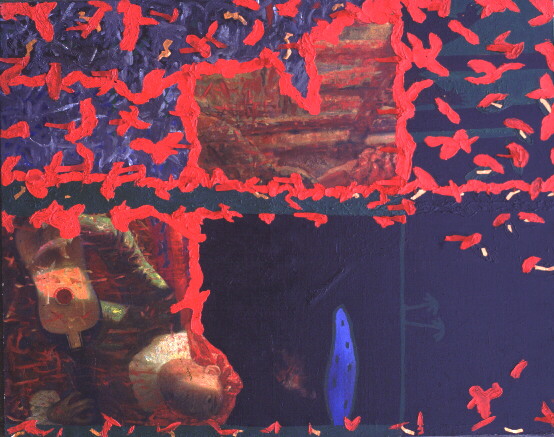
To and From, 1985–87. Oil and collage on canvas, 200 x 160.5 cm (78 3/4 x 63 3/16 in.). Norton and Nancy Dodge Collection of Nonconformist Art from the Soviet Union. D04754