
Gennady Ustyugov
1937 — Tokmok (Kyrgyzstan) | 2025 — Saint Petersburg (Russia). Worked in Leningrad (USSR) and Saint Petersburg (Russia)
Gennady Ustyugov was born into a family of Russian settlers in Kyrgyzstan. His father was a carpenter and his mother a seamstress. After World War II, his father, who had fought on the Leningrad Front, moved the family to Leningrad. They were refused residency there. Instead, the family was offered a chance to relocate to the Karelian Isthmus. They initially settled in the village of Khotoka (Hotokka in Finnish), which was renamed Strel’tsovo in 1948. In 1950, they moved to Novosaratovka, a village on the right bank of the Neva River in the Vsevolozhsky District. Once a German colony founded under Catherine the Great in the late eighteenth century, Novosaratovka saw the deportation of its entire German population in 1942. Ustyugov lived in this picturesque area for twenty-five years, until 1975. In the 1970s, the area was incorporated into the city limits of Leningrad.
Ustyugov had loved drawing since he was a child. According to the artist, his parents were not art professionals. However, his mother was skilled at drawing and embroidery, while his father created musical instruments from scratch at home. In 1953, Ustyugov enrolled in the famous Secondary Art School at the Ilya Repin Leningrad Institute of Painting, Sculpture and Architecture (now the Saint Petersburg Repin Institute for Painting, Sculpture and Architecture) after finishing the eighth grade at the rural school. The boy struggled with general education subjects, but he consistently received Bs for drawing and As for painting. The Soviet art education system inherited traditions from the nineteenth century, emphasizing structured drawing from plaster casts and life, sketching, oil painting grounded in realism, and composition. His teachers and classmates noted Ustyugov’s exceptional sense of color. He studied together with Oleg Grigoriev, the future poet who would remain his lifelong friend.
In 1956, during the Thaw, the State Hermitage Museum for the first time added to its permanent exhibition works by Paul Cézanne, Pablo Picasso, Henri Matisse, Vincent van Gogh, Paul Gauguin, and the French impressionists. These pieces came from the former collections of Sergei Shchukin and Ivan Morozov. The collectors themselves remained unrecognized until perestroika. Ustyugov was profoundly affected by the paintings he saw. Inspired by Matisse, he created a series of new works and exhibited them at the Secondary Art School. As a result, he was expelled from the final year for his fascination with impressionism. A few years earlier, in 1949, a number of his future peers in the unofficial art scene—Alexander Arefyev, Alexander Traugot, and Mikhail Voitsekhovsky—had also been expelled from the same school for formalism. In 1951, Vladimir Shagin and Valentin Gromov faced the same fate. Ustyugov would meet these nonconformist artists in the early 1970s.
After being expelled, Ustyugov completed evening school and tried to enter the Leningrad Theater Institute. He successfully passed the art exams but failed the other subjects. Beginning in the late 1950s, he worked at the V. I. Lenin factory, Trolleybus Depot No. 3, and the Bolshevik factory as a welder, painter, loader, general laborer, and decorative artist. At the same time, he studied at the art studio of the V. I. Lenin Palace of Culture at the Bolshevik factory under Felix Lembersky, who had begun his career in socialist realism, then transitioned to expressionist painting in the mid-1950s, a style that could not be officially exhibited in the USSR during the 1960s. In 1963, Ustyugov was hospitalized in a psychiatric clinic, where he was diagnosed with schizophrenia. One of the side effects of his treatment was hand tremors, which would stop as soon as he started to draw. After completing a course of treatment, Ustyugov started receiving a disability pension, which allowed him to devote himself solely to art. In 1975, he and his mother received an apartment in Leningrad, one room of which became his studio. Very few of Ustyugov’s early works from the late 1950s to the 1960s have survived, as he burned many of them during recurring episodes of his illness.
In the 1960s, the artist developed his main themes, images of people with musical instruments and Прекрасная Дама [Beautiful lady] subjects. This latter motif, named by Liubov Gurevich, refers to the image of the Russian Silver Age that emerged at the intersection of philosopher Vladimir Solovyov’s concept of “eternal feminine” and Alexander Blok’s Verses about the Beautiful Lady (1901–03). [1] Ustyugov was not familiar with late nineteenth-century Russian religious philosophy, as it was banned in the USSR and kept in restricted collections that required special access. However, he always enjoyed reading classical literature.
Ustyugov’s ladies are painted in a symbolist manner and resemble the heroines of Borisov-Musatov and the artists of the Голубая роза [Golubaia rosa, Blue rose] group from the early twentieth century. In the 1960s and 70s, symbolist art from the early 1900s was still not displayed in Soviet museums. Ustyugov’s Beautiful Ladies appear detached, as in the work in the Zimmerli Art Museum (Untitled, 1969, ZAM, D04277). Their eyes are closed or half-closed, their necks elongated and bowed, their silhouettes gently curved with arms raised or hanging down along their bodies.
Unlike his contemporaries, such as Mihail Chemiakin, Ustyugov was not drawn to the Mir Iskusstva [World of Art], another influential turn-of-the-century group. He avoided the nostalgic glorification of late nineteenth- to early twentieth-century art. Instead, he created a deliberately otherworldly, detached, and refined image. According to friends’ recollections, his palette was richer and more vivid before his medical treatment, and the paint application was denser. Ustyugov’s retreat into an ideal pictorial world did not mean that he was unaware of what was happening around him, as he expressed in one of his haiku-style poems from the collection Улитка на берегу [Snail on the shore]:
I take a pencil in my hand,
Draw palms and the Madonna’s face.
Yet all around is darkness, a witches’ sabbath,
And life is so short—it is just a single moment. [2]
In the 1970s, Ustyugov began exhibiting in unofficial art shows. Although he was not easily classified as a nonconformist, the Soviet art establishment effectively pushed him into the dissident art scene. Living a reclusive life, Ustyugov found admirers among underground artists and collectors. According to artist and collector Oleg Frontinsky, it was the poet Oleg Grigoriev who first introduced him to Ustyugov in the early 1970s. Frontinsky traveled to the village of Novosaratovka, where he was stunned by the artist’s talent. Ustyugov brought out his work into the light from a rural shed. Frontinsky later called this Ustyugov’s first “fence exhibition.” Soon after, Ustyugov was visited in Novosaratovka by Alexander Arefyev, the ideological leader of the Arefyev circle, also known as Орден непродающихся живописцев [Order of Mendicant Painters]. With this new meeting, Ustyugov realized that there were other unrecognized artists like him, and he took part in the first officially permitted nonconformist exhibition at the Ivan Gaz Palace of Culture in 1974. That show, along with a follow-up exhibition at the Nevsky Palace of Culture in 1975, came to define what was later called Gazanevshchina [Gaza-Nevsky culture]. [3]
In the 1970s, Ustyugov’s palette grew lighter, transitioning to soft pastel hues. He often worked with contour lines, sometimes painting directly onto the primed white canvas. Ustyugov earned the nickname “the Russian Matisse” within the unofficial art scene. His painting Solitude (1979, ZAM, D01927) evokes a dreamlike, symbolic space through translucent layers of paint. The influence of Matisse in this work lies not so much in the color scheme as in the distinction between figure and background: the figure seems to float above the vivid planes of color. During this period, Ustyugov expanded on his favorite themes by introducing landscapes featuring solitary travelers and desolate terrains. Angels also began to populate his paintings and drawings:
Blood flows from the wound of existence,
Not God, not angel—who am I here?
I weep along the road of passing days …
Always alone, yet my thoughts are with her.” [4]
Ustyugov was immediately recognized as a genius in the unofficial art scene. In addition to his rare gift as a painter, this recognition was also shaped by his image as an unsettled, otherworldly artist detached from earthly concerns. He became a member of the Society of Experimental Exhibitions from its founding in 1975, and later joined the Fellowship of Experimental Fine Art (TEII), which existed from 1981 to 1989. His works were exhibited at the annual shows, the main platform for Leningrad nonconformist artists until perestroika.
In the 1990s, the contours in Ustyugov’s works became more pronounced. During this period, he used paint as a graphic medium to draw directly onto the canvas. His paintings and drawings revealed an increasing restraint in expressive techniques. In 1990, Ustyugov had his first official exhibition at the Museum of Urban Sculpture. Saint Petersburg’s State Russian Museum and State Hermitage Museum acquired his works. His work began to feature planes of bright color, and he also started to use black in unexpected ways. The artist applied this color to outline figures or fill dense backgrounds, marking a shift from his earlier style. After the turn of the century, the colors of his works lightened again.
From 2001 to 2017, the famous Saint Petersburg photographer Yuri Molodkovets organized exhibitions of Ustyugov’s work and took care of him in his daily life. In 2020, the artist underwent eye surgery to restore his vision. Text began to appear on the surface of his paintings, linking Ustyugov’s easel works to graffiti, although he had no influence from graffiti art. Poetic text and painting just seemed to merge into a single visual space. Since 2021, Ustyugov lived in the psychoneurological dispensary No. 1 in the town of Zelenogorsk, where he painted with the support of the studio leader, Viktor Chuvashov. In 2022, the artist received an award for his inclusion in the “TOP50 Most Famous People of Saint Petersburg” from the magazine Sobaka. [5] Ustyugov died at the age of eighty-eight on December 12, 2025.
Olesya Turkina
Translated from Russian by Anna Matveeva
Photo portrait by Yuri Molodkovets.
Notes:
1. Gurevich, Liubov. Художники ленинградского андеграунда. Биографический словарь [Artists of the Leningrad underground: A biographical dictionary]. Saint Petersburg: Iskusstvo-SPB, 2007: 142.
2. Ustyugov, Gennady. Улитка на берегу [Snail on the shore]. Leningrad: Samizdat, 1991.
3. Basin, Anatoly, and Larisa Skobkina. Gazanevshchina Saint Petersburg: P. R.P., 2004.
4. Ustyugov, Улитка на берегу.
5. Full list of “TOP50. Most Famous People of Saint Petersburg” 2022 award, Sobaka.ru
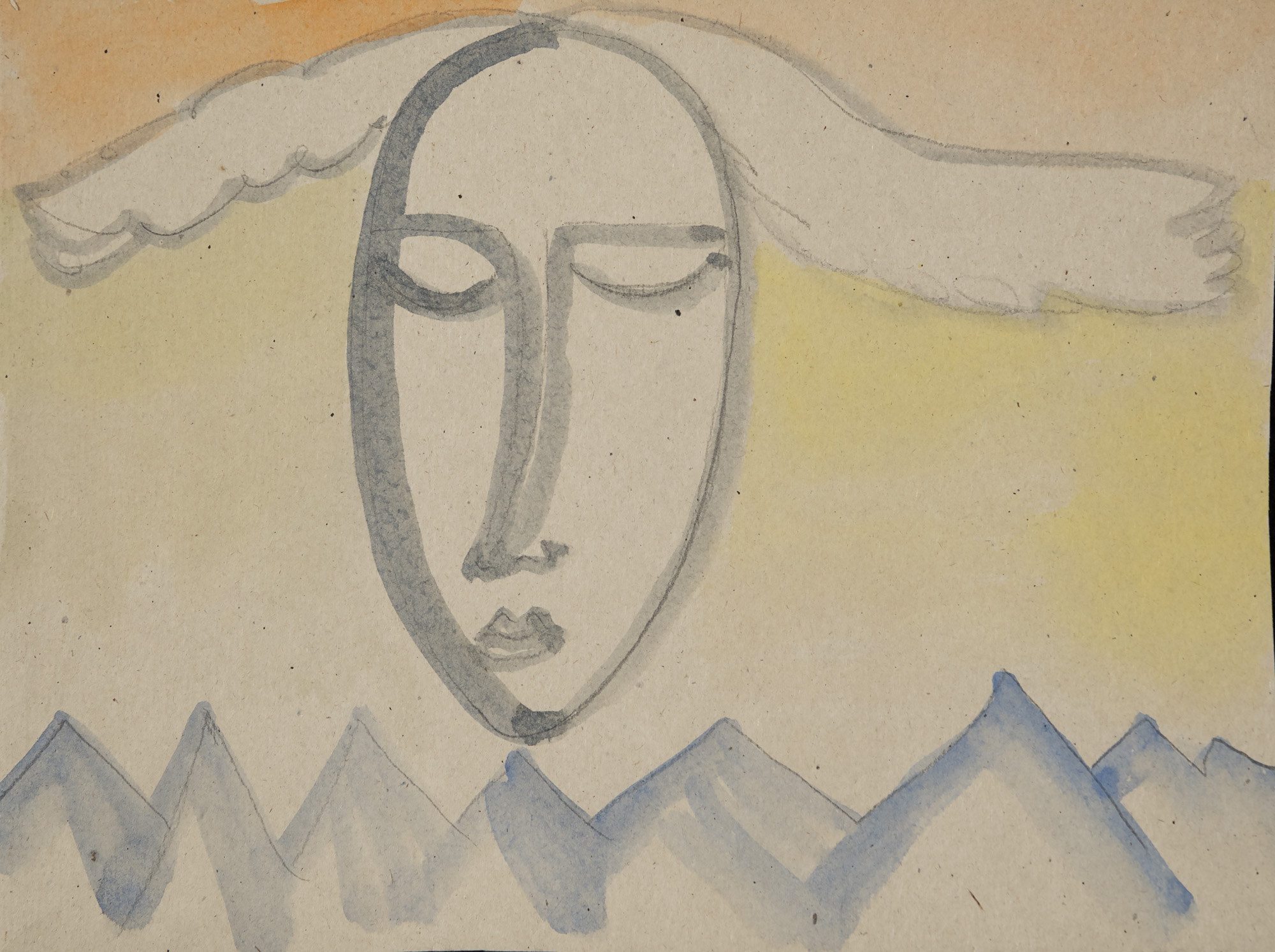
Moon, moon, 1987. Watercolor on paper, 23 × 30.8 cm (9 1/16 × 12 1/8 in.). Norton and Nancy Dodge Collection of Nonconformist Art from the Soviet Union. D04192

Solitude, 1979. Oil on canvas, 70.3 × 85 cm (27 11/16 × 33 7/16 in.). Norton and Nancy Dodge Collection of Nonconformist Art from the Soviet Union. D01927

Untitled, 1983. Watercolor and graphite on paper, 32 × 24 cm (12 5/8 × 9 7/16 in.). Norton and Nancy Dodge Collection of Nonconformist Art from the Soviet Union. D04197

Untitled, 1969. Oil on illustration board, 60.5 × 39 cm (23 13/16 × 15 3/8 in.). Norton and Nancy Dodge Collection of Nonconformist Art from the Soviet Union. D04277